What Amazon Nova's Demise Teaches About AI Study Tools
Accuracy Warning — Amazon Nova
Amazon Nova models are deprecated; no current accuracy testing. AI study tools risk hallucinations and should be verified against official materials.
- Accuracy:
- Limited
- Tested:
- Assessing study system resilience to AI tool discontinuation
- Last tested:
- 2026-07-28
Amazon introduced Nova in December 2024 as a new family of AI models. On July 28, 2026, Business Insider and Reuters reported that most flagship Nova models were being deprecated or moved out of active development, including Premier, Omni, Canvas, and Reel.[1][2] One date is especially clear: AWS lists Nova Canvas with an end-of-life date of September 30, 2026.[3]
That makes Canvas a roughly 22-month model lifecycle from launch to EOL. For Premier, Omni, and Reel, the public record is murkier: reporting describes them as being placed into a “keep the lights on” state, but it does not give each model the same documented shutdown date that Canvas has.[1] That distinction matters. Students do not need exaggerated panic; they need exact dates, known unknowns, and a study system that does not collapse when a vendor changes direction.
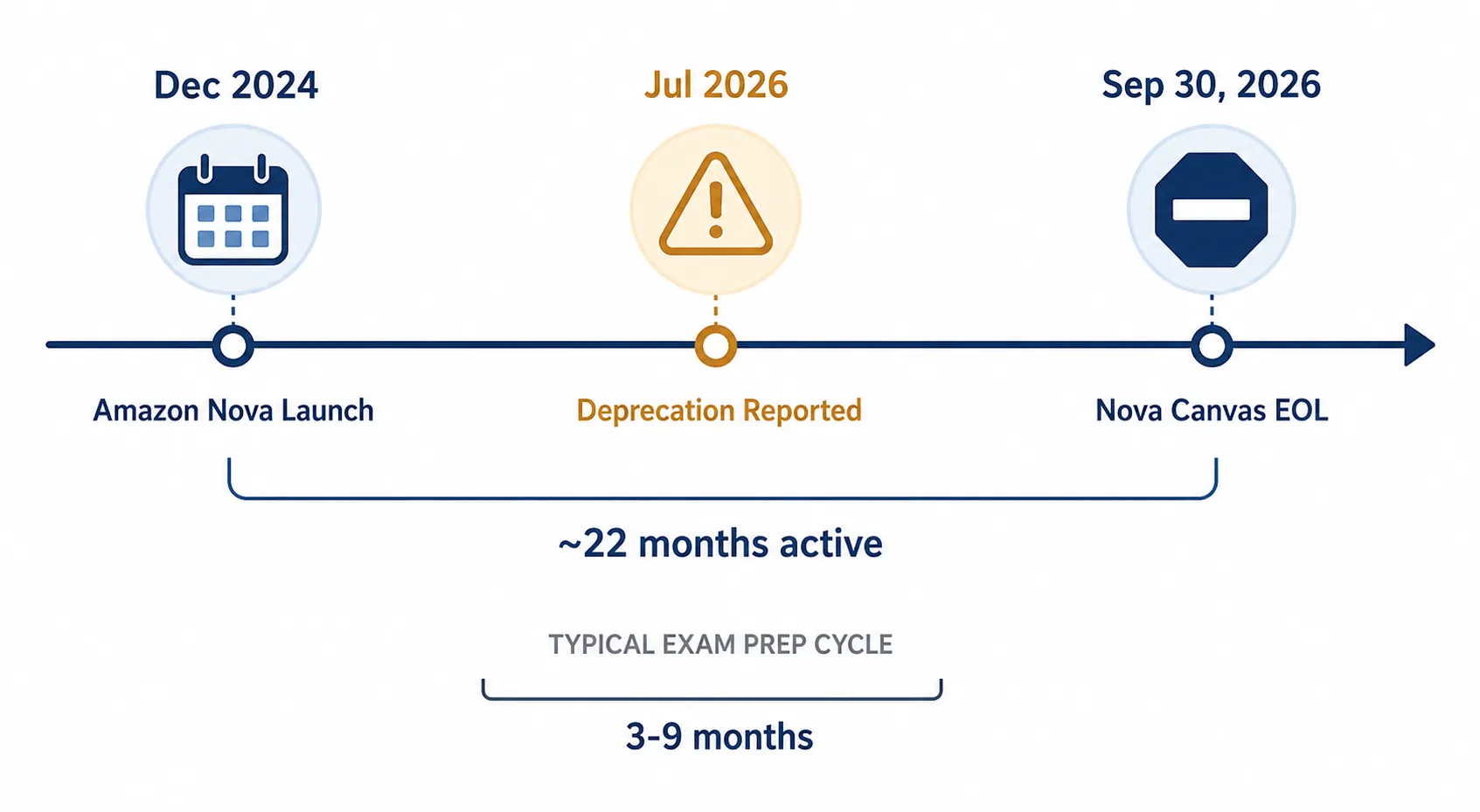
The useful lesson from Nova’s discontinuation is not that students should stop using AI. It is that an AI model family from one of the largest technology companies in the world can become a dead end inside the same planning horizon as a serious exam-prep cycle. If you are studying for the MCAT, GRE, SAT, ACT, ASVAB, or another high-stakes test, the question is not “Is this AI tool impressive today?” The better question is: “Which parts of my study system would still work if this tool disappeared tomorrow?”
Model Expiry Is A Feature Of The System, Not A Fluke
Nova is a clean example because Amazon is not a tiny vendor running out of runway. The company has been shifting resources toward Pieter Abbeel’s Frontier Model Research group, shutting its AGI Lab, and cutting staff while still operating in the context of very large capital spending.[1][4][5][6] That is exactly why the case should get a student’s attention. If a major platform can redirect its AI roadmap this quickly, a study app built on someone else’s model can change just as quickly.
AWS also publishes a model lifecycle policy for Bedrock that gives a minimum of 12 months from launch to end of life.[7] That is a reasonable vendor promise in a fast-moving infrastructure market. It is not a comforting foundation for a student who has already built six months of notes, explanations, and daily review habits around one interface.
This does not mean every tool using a deprecated model immediately dies. Some products switch backends, migrate users quietly, or keep old features running long enough for students to finish a term. The risk is narrower and more practical: when your study workflow depends on a proprietary AI layer, you may not control the export format, the model behavior, the pricing, the sync reliability, or the date when a feature stops being maintained.
That is already visible at larger scales. In a June 2026 IBM Institute for Business Value study of 1,000 senior executives, 71% said switching their primary AI vendor would be difficult, 91% said they lacked full visibility into their AI dependencies, surveyed organizations averaged six AI-related disruptions over two years, and 81% said a seven-day vendor outage would cause severe or critical operational disruption.[8] Those are enterprise numbers, not student numbers. A senior executive and an ACT test-taker are not the same population. But the dependency pattern is familiar: the more invisible the tool becomes, the harder it is to study without it.
What Should Never Depend On One AI Provider
Some parts of exam prep should be boring, portable, and easy to rebuild. Official practice tests should stay in your possession or in the official account where the exam maker provides them. Your test date, weekly plan, score targets, missed-question log, and review schedule should not live only inside an AI tutor’s chat history. Your core flashcards should be exportable, printable, or at least reviewable without a single model provider staying alive.
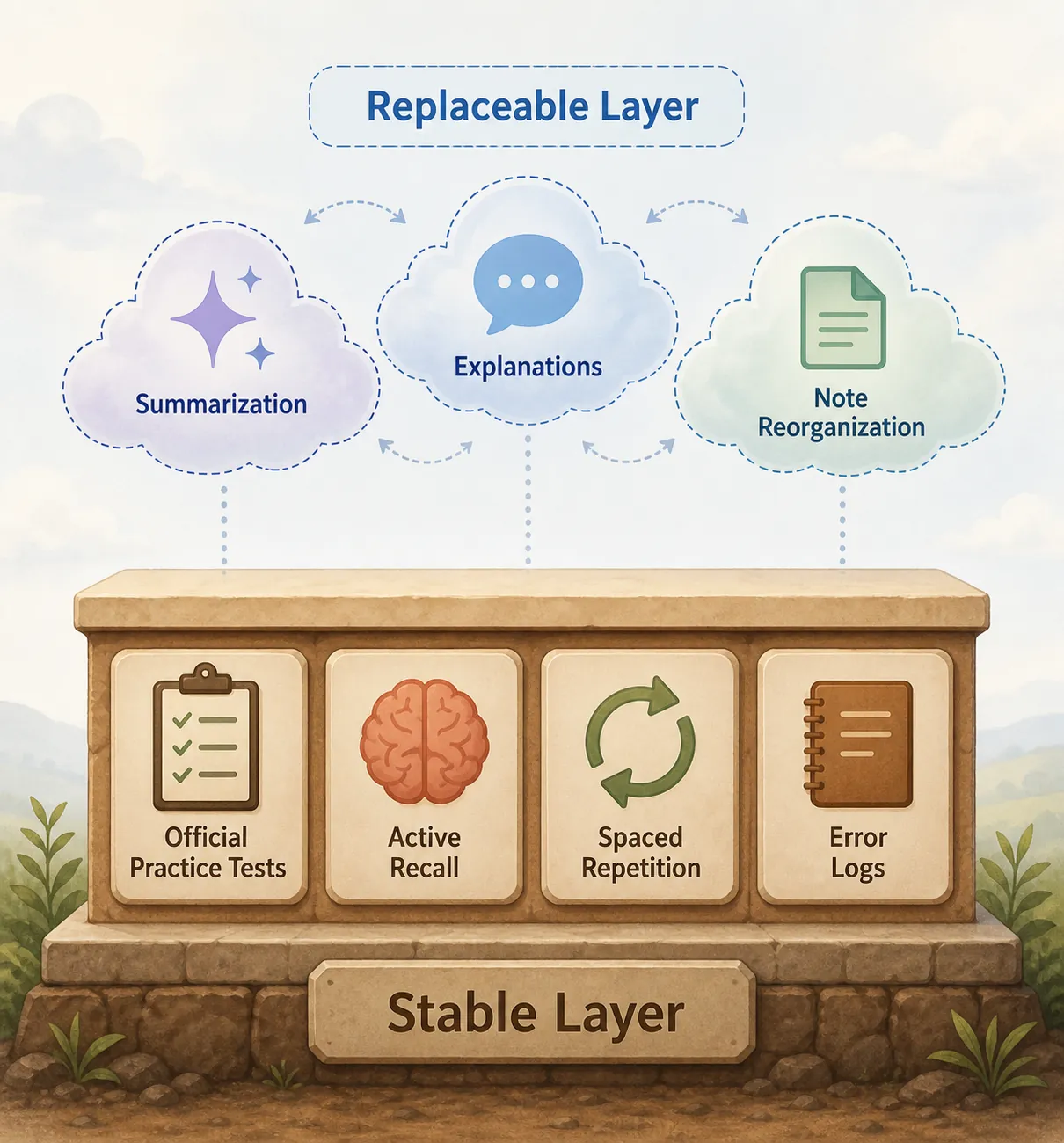
The stable layer of a study system is made of methods that still work with a notebook, a spreadsheet, a flashcard app, or a printed practice test. Active recall works when you cover the answer and retrieve it. Spaced repetition works when missed material comes back before it decays. Full-length practice exams work when they recreate timing, fatigue, and scoring pressure. Error logs work when they force you to name the mistake instead of just feeling disappointed by the score.
AI belongs in the replaceable layer. It can turn a dense biology passage into a first-pass explanation. It can help you brainstorm why a wrong SAT answer choice was tempting. It can convert rough notes into draft flashcards. It can generate practice prompts for a writing section. It can reorganize a messy transcript into a cleaner outline. Those are useful chores, but they should not become the only place where your understanding, schedule, and review history exist.
| Stable Layer | Replaceable AI Layer |
|---|---|
| Official practice tests and exam-maker materials | AI explanations of passages or answer choices |
| Spaced repetition schedule | Draft flashcard generation from notes |
| Active recall sessions | Brainstorming likely wrong-answer patterns |
| Error log with mistake categories | Rewriting notes into cleaner outlines |
| Weekly plan that still works offline | Practice prompts checked against official sources |
The dividing line is consequence. If an AI tool vanishes and you lose a convenience, that is acceptable. If it vanishes and you lose your next assignment, your weakest topics, your review queue, your official-source mapping, or the only explanation you ever kept for a recurring mistake, the tool has moved from supplement to infrastructure.
The Study Tasks Where AI Is Worth Keeping
A good AI study tool earns its place by shortening a narrow step and handing the student back to retrieval practice. If it saves 20 minutes on formatting flashcards but the cards are never reviewed, nothing meaningful has been saved. If it explains a missed GRE quant question and the student then solves three related questions without help, the tool has done its job.
- Use AI to make a first-pass explanation, then verify the concept against the official source or a trusted prep book.
- Use AI to draft flashcards, then edit the prompts so each card tests one fact, rule, or reasoning move.
- Use AI to classify missed questions, then decide the category yourself before adding it to the error log.
- Use AI to generate extra practice prompts, then treat them as unofficial drills rather than score predictors.
- Use AI when you are stuck, not as the default reader of every passage before you try it.
There is also a motivation argument that should not be dismissed. A polished AI tutor can get a reluctant student to sit down, ask one more question, or review after a bad practice score. Engagement matters. The problem starts when engagement is mistaken for transfer. A student can feel busy inside an AI chat and still be underprepared for a closed-book, timed test.
Availability Is Only One Risk; Learning Design Is The Other
The Nova case is about platform continuity. Education research adds a second condition: even when the tool stays available, the way it is used can strengthen or weaken learning.
Bastani et al. studied about 1,000 high school students and found that students using AI performed 48% to 127% better during practice, but their performance collapsed on closed-book tests.[9] That does not prove every AI tutor harms learning. It does show why practice performance inside a supported environment should not be treated as the same thing as independent mastery.
A Brazilian randomized controlled trial with 120 undergraduates found 11% lower retention 45 days later among students in the AI condition.[10] Again, that is one study in a specific context, not a universal law. It is enough to justify caution when a tool gives students fluent answers faster than they have to retrieve anything themselves.
The more encouraging version comes from a Wharton/University of Pennsylvania adaptive AI study of 770 students, which found six to nine months of additional learning gains with an AI system designed to force engagement rather than simply provide answers.[11] That is the design distinction students should care about. The better tool is not the one that sounds smartest. It is the one that makes you attempt, retrieve, revise, and test under conditions closer to the real exam.
For a deeper look at the learning-harm side of this research stream, StudyMethod’s article on AI addiction and study habits walks through why answer-giving tools can feel productive while reducing retrieval practice.
What To Change This Week
The practical response to Nova is not a dramatic AI detox. It is a continuity check. Set aside one study session this week to find the places where an AI product has quietly become load-bearing.
- Export your notes, flashcards, outlines, and AI-generated explanations into a format you can open outside the original app.
- Keep your exam calendar, weekly plan, and practice-test schedule in a document or spreadsheet that is not locked inside an AI tutor.
- Mark which materials are official, which are prep-company explanations, and which are AI-generated drafts.
- Review any subscription that sits between you and daily prep, especially if it stores your deck, logs your progress, or generates your assignments.
- Run one study block without AI and note what breaks: access to questions, explanations, timing, review order, or motivation.
If you use a tool built on Amazon Bedrock or another model platform, the next question is whether the vendor has said how it handles model migration. StudyMethod’s guide to Amazon’s frontier AI strategy and exam prep is the more tactical checklist for subscription renewals and Bedrock-dependent products.
A student using AI flashcards should ask a different question from a student using AI explanations. For flashcards, export and review portability matter most. For explanations, source verification matters most. For AI tutors, the key issue is whether the tool makes you answer before it explains. For AI search, the issue is whether you can trace claims back to official exam materials or reliable references.
Spaced repetition is a useful test case. You can use AI to draft cards, but the review schedule should not depend on the same AI staying available. If you are choosing among flashcard systems, the comparison of Anki, Quizlet, Knowt, and Brainscape is more relevant than another demo of a chatbot writing perfect-looking cards.
A Simple Rule For AI Study Tools
Before paying for an AI study product, ask what happens if it is unavailable for a week. That is not a dramatic scenario. IBM’s enterprise survey used a seven-day outage as a disruption threshold, and AWS’s own lifecycle materials make clear that models have expiry dates.[7][8] For students, a seven-day failure two weeks before test day is enough to matter.
If the answer is “I would lose a helpful explainer,” the tool is probably in the right layer. If the answer is “I would not know what to study, which questions I missed, what my weak areas are, or how to review my cards,” the tool has too much control.

Nova’s short life does not make AI useless for learning. It makes AI look like what it is: a fast-changing layer of assistance sitting above slower, sturdier study methods. Let it explain, reformat, quiz, brainstorm, and simplify. Keep official materials as the source of truth, let active recall and spaced repetition do the memory work, and make sure your exam plan still runs if one provider disappears tomorrow.
References
- Amazon overhauls its AI strategy, Business Insider, July 28, 2026
- Reuters report on Amazon Nova model deprecations, Reuters, July 28, 2026
- AWS Nova Canvas model card, AWS
- The Street report on Amazon AI strategy shift, The Street, July 28, 2026
- 247wallst report on Amazon AI strategy shift, 247wallst, July 28, 2026
- Futurism report on Amazon AI strategy shift, Futurism, July 28, 2026
- Your AI Models Have an Expiry Date, AWS Builder
- IBM Institute for Business Value study on AI vendor dependency, IBM newsroom, June 17, 2026
- Bastani et al. 2024 study on AI use and closed-book testing
- Brazilian randomized controlled trial on AI use and 45-day retention
- Wharton/University of Pennsylvania adaptive AI study
Authoritative source
For the authoritative version of this contentHow to Read the '1 in 4 NFL Players CTE' Study
Report an error in this tool's output
Found something this tool got wrong beyond what's documented above? Report it so the accuracy log stays current.
Comments
Join the discussion with an anonymous comment.