
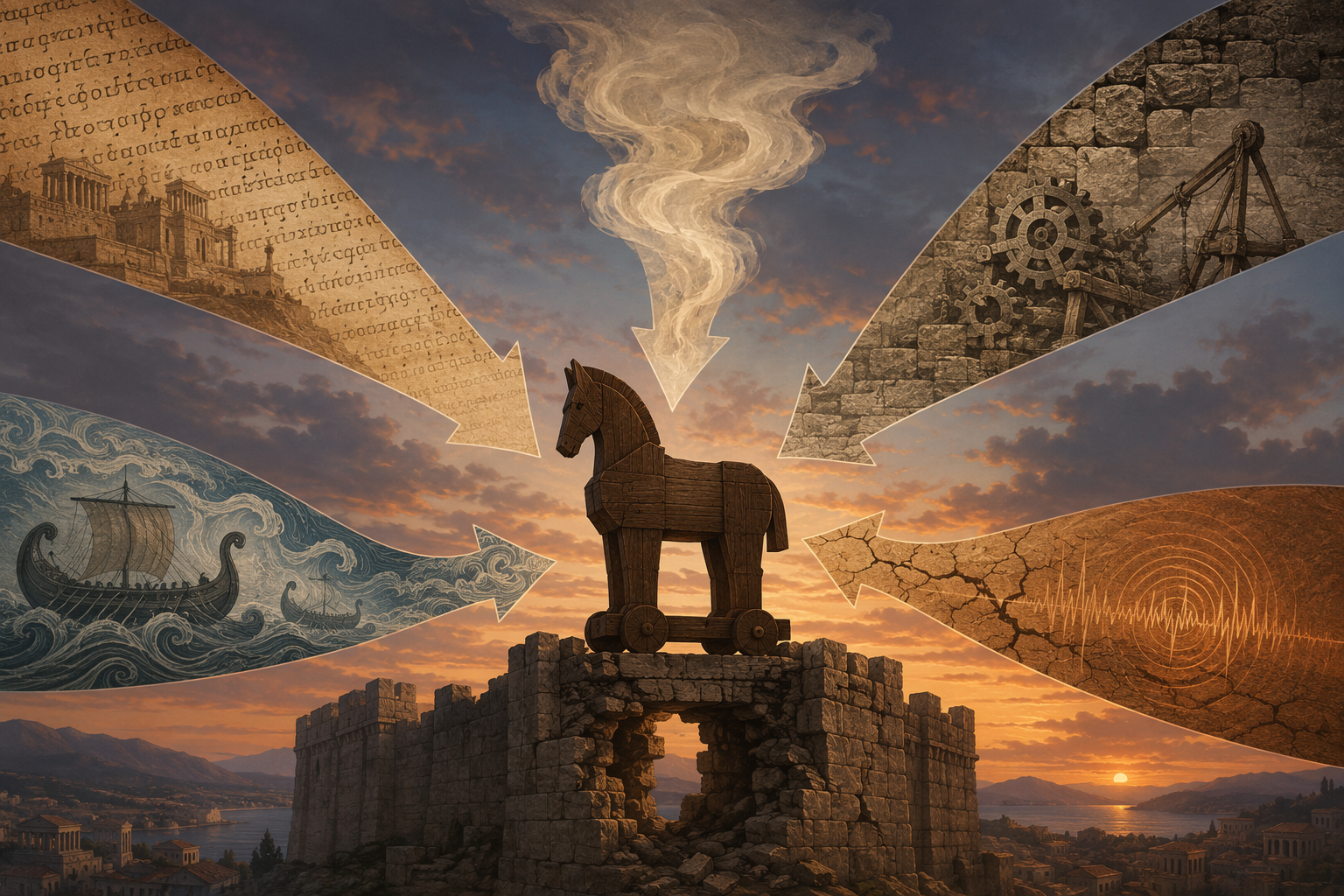
5 Theories in the Trojan Horse Historical Debate
Historians and archaeologists disagree about what the Trojan Horse actually was—a literal wooden statue, a siege engine, a ship, an earthquake metaphor, or pure fiction. This article breaks down the five main theories, the evidence behind each, and why no single explanation wins the debate.
Updated:
The Trojan Horse feels like the one part of the Trojan War everyone already knows: the Greeks build a wooden horse, hide soldiers inside it, trick the Trojans into dragging it through the gates, and win the war. Then the historical debate begins, and the neat story immediately starts shedding splinters.
The useful question is not simply “was the Trojan Horse real?” That question is usually too blunt for the evidence. A better version is: what kind of evidence would make the story more likely to preserve a real memory, and what kind would only show that ancient people were already telling, reshaping, or rationalizing it? The five major theories in the Trojan Horse historical debate rest on different kinds of evidence: inconsistent texts, ancient skepticism, military analogy, ship language, archaeology, iconography, and the habits of epic poetry.
The Five Theories at a Glance
| Theory | What It Claims | Main Evidence Type | Main Weakness |
|---|---|---|---|
| Literal wooden horse | A large wooden structure hid Greek warriors and was brought into Troy. | Ancient literary tradition; early visual art; warrior lists in later sources [1][2] | The ancient sources disagree on basic details, including how many warriors were inside. |
| Siege engine | The “horse” was a battering ram or military machine later misunderstood as a wooden animal. | Ancient rationalist interpretation; military analogy; animal names for machines [3][4] | No direct archaeological evidence from Troy proves such a machine was used there. |
| Ship | The “horse” was a ship, perhaps linked to Greek and Phoenician nautical language. | Linguistic and iconographic clues: ships as “horses,” hippos vessels, boarding language [4][5] | Suggestive language does not prove that this specific story began with a ship. |
| Earthquake metaphor | The horse represents Poseidon, both horse-god and earth-shaker, breaking Troy’s walls. | Mythological association plus seismic damage at Troy VI around 1250 BC [4][6] | Earthquake damage can explain a damaged city, not the full trick-with-a-horse plot. |
| Poetic invention | The horse is an epic device, not a disguised historical object. | Literary analysis of mythic convention and epic storytelling [4] | It may understate how oral tradition can preserve distorted memories of real events. |
That table is already more honest than a yes-or-no answer. It also keeps one common classroom trap out of the room: “plausible” does not mean “proved.” A theory can explain why the horse story exists and still fail to prove that the explanation is historically correct.
Why the Question Is Hard Before the Theories Even Start
The Trojan War tradition sits across an awkward time gap. Possible Bronze Age conflict around Troy belongs to one world; the written Homeric poems belong roughly 400 to 500 years later, after generations of oral transmission. That gap does not make the story worthless. It does make it dangerous to treat epic poetry as if it were a field report with better hexameter.
Even the famous horse episode is not actually told in full in the Iliad. The Iliad ends before Troy falls. Later ancient texts, summaries, visual art, and allusions preserve the episode. So when students ask whether “Homer’s Trojan Horse” was real, the first little correction is that the horse belongs to the wider Trojan cycle and later reception as much as to Homeric fame.
This is why the debate is unusually good for learning historical method. The evidence does not line up in a tidy procession. A vase can prove that a story was circulating early without proving the event happened. A damaged wall can prove destruction without proving deception. A clever linguistic argument can explain a metaphor without showing who first used it. Ancient texts can preserve old memories and still disagree spectacularly about the furniture.
1. The Literal Wooden Horse Theory
The literal theory is the version most people inherit first: the Greeks built an enormous wooden horse, hid warriors inside, left it outside Troy as a supposed offering, and waited while the Trojans pulled their own doom through the gates. It has the advantage of being the story ancient audiences clearly knew. That is not nothing. Ancient tradition is evidence for tradition.
But the tradition is already unstable on a very basic point: how many men were inside? The Bibliotheca gives 50 warriors; Tzetzes lists 23; Quintus Smyrnaeus names 30 while saying there were more; another version gives the wonderfully unhelpful figure of 3,000 [1][2]. If this were a quiz, one might be tempted to mark everyone wrong in red ink and go make tea. For historical reasoning, though, the disagreement is more useful than that. It shows that ancient authors were not preserving a single fixed technical memory of the object.
The mismatch does not disprove the horse. Oral traditions often vary. Later authors often expand, compress, or dramatize inherited material. Still, if a theory depends on the horse being a real engineered structure, the wildly different warrior counts matter. A structure holding 23 men is not the same practical problem as one holding 50, and 3,000 belongs to a different universe of exaggeration altogether.
This is where a student argument can become sharper. The literal wooden horse theory has strong evidence for cultural importance and early circulation, but weak evidence for engineering reality. The sources show that ancient people told the story, not that we can reconstruct the object in a stable way.

The Mykonos vase helps, but not in the way overexcited captions sometimes suggest. Found in 1961, the 7th-century BC clay pithos shows the oldest known visual depiction of the Trojan Horse, with seven Greek warriors visible through openings in the horse-like structure [7][8]. It proves that the horse story was being represented in Greek art by about 675 BC, and History Skills notes that this places the image at least 75 years before the Iliad was written down [7].
That is a valuable fingerprint. It pushes the story’s visible life earlier than some students expect. It does not, however, certify the horse as a historical object. Art can preserve memory, dramatize legend, or make a familiar story visible for an audience that already knows the punchline. The vase is a witness to the myth’s age, not a photograph of the siege.
2. The Siege-Engine Theory
The siege-engine theory is the respectable cousin of the literal horse theory. It keeps a real military event behind the story but removes the more theatrical part. On this reading, the “horse” was not a hollow statue but a machine: perhaps a battering ram or mobile siege device that helped the Greeks break into Troy. Later storytellers, being storytellers, turned machinery into miracle.
This is not a modern attempt to rescue the story from embarrassment. Pausanias, writing in the 2nd century AD, already gave a rationalizing interpretation. Julia Kindt notes his claim that “everybody who does not attribute utter silliness to the Phrygians” understood the horse as a siege engine [3]. Pausanias is delightful here partly because he sounds like someone who has just graded the Trojan defensive strategy and found it wanting.
Armand D’Angour’s version gives the theory a more specific military mechanism. As reported by History Today and HISTORY.com, he argues that ancient military machines were often named after animals and that such machines could be covered with damp horse hides to protect them from fire [3][4]. A wheeled battering ram covered in horse hide could, in theory, become remembered as “the horse” that entered or breached Troy.
The attraction is obvious. A siege engine answers the nagging practical objection: why would the Trojans drag a suspicious giant object inside their walls? Perhaps they did not. Perhaps the story preserves a memory of wall-breaking technology and later converts it into a trick involving sacred deception, divine signs, and very poor gatekeeping.
Still, this theory works best as a plausible reconstruction, not as a solved case. The animal-naming habit and horse-hide detail make the mechanism intelligible. They do not provide direct archaeological evidence that a particular horse-shaped or horse-named siege engine was used at Troy. The theory explains how a military event could become a horse story. It cannot yet show that this is what happened.
3. The Ship Theory
The ship theory is less familiar to many students, which is a shame, because it is one of the better examples of how a tiny linguistic clue can change the question being asked. Instead of asking, “Could a giant wooden animal hold soldiers?” it asks, “Could ‘horse’ have named something else made of wood that carried men?”
The argument gathers several hints. Homer uses horse imagery for ships, including the idea of ships as “horses of the deep.” The Phoenician hippos was a real merchant vessel with a horse-head prow. Some Greek language around entering the horse resembles embarkation language used for boarding a ship [4][5]. None of that proves the Trojan Horse was a boat, but it makes the semantic field rather more crowded than the children’s-book version allows.
The Archaeologist also points to a Late Minoan clay seal from Knossos, dated around 1200 BC, that shows a ship with a horse figure superimposed on it, possibly a pre-literary hint of the connection between horses and ships [5]. “Possibly” is doing real work there. The seal can support the idea that the image-combination existed; it cannot be made to confess that it is the Trojan Horse in disguise.
The ship theory is useful because it shows how myth can grow from a phrase, an object type, or a visual pun. A ship brings hidden men across water; a horse brings hidden men through walls. Both are vehicles. Both can be wooden. Both can be named, decorated, and ritualized. A later audience could literalize a metaphor, or a poet could turn nautical language into a land-based marvel.
Its weakness is the same quality that makes it interesting: the evidence is indirect. Linguistic parallels can show that “horse” and “ship” were not sealed compartments in ancient imagination. They cannot alone prove that the Trojan Horse episode began as a misunderstood ship story.
4. The Earthquake Theory
The earthquake theory begins with a god wearing two hats, which is always convenient and occasionally suspicious. Poseidon was associated with horses and also known as the earth-shaker. If Troy’s walls were damaged by an earthquake, a mythic tradition could remember the city’s fall as the work of a divine “horse” force that broke the fortifications.
Fritz Schachermeyr is associated with this interpretation. The archaeological hook is Troy VI, where evidence of seismic damage around 1250 BC has been used to support the possibility that an earthquake helped destroy or weaken the city [4][6]. This is the sort of evidence students quite reasonably like: walls are physical, cracks are visible, and “earth-shaker” is not exactly a subtle divine nickname.
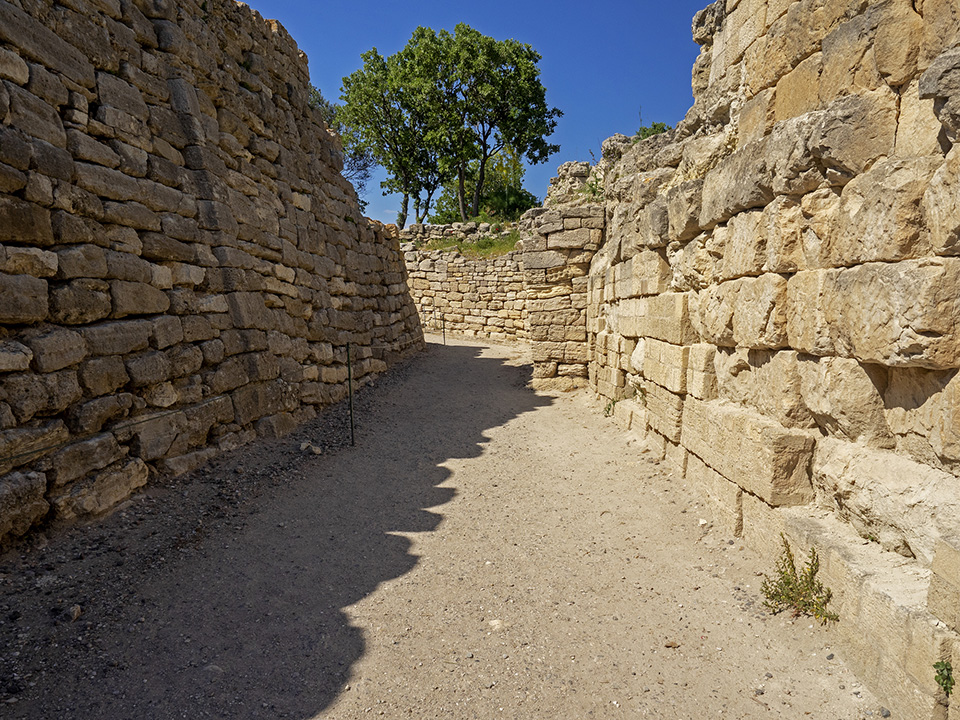
The theory’s best contribution is not that it explains every detail of the horse story. It does not. It explains why a tradition about Troy’s destruction might connect horses, Poseidon, and broken walls. It gives the myth a pressure point: a real catastrophe could be remembered through divine imagery and then absorbed into a larger war narrative.
The limitation is equally important. Seismic damage at Troy VI can support a claim that earthquake destruction belonged to the site’s history. It cannot by itself explain hidden soldiers, deceptive offerings, or the Trojans’ fatal decision to bring the object inside the city. An earthquake may be one ingredient in the mythic kitchen. It is not the whole stew, however vigorously one stirs Poseidon into it.
5. The Poetic-Invention Theory
After the engineered horse, the battering ram, the ship, and the earthquake, the poetic-invention theory arrives like the student in the back row who asks whether the assignment has misunderstood the genre. Perhaps the horse was not a disguised machine or a coded geological event. Perhaps it was a story device: memorable, strange, symbolically useful, and perfectly at home in epic.
Jonathan Burgess of the University of Toronto makes the point sharply. As quoted by HISTORY.com, “The wooden horse is not nearly as strange or fantastic as most of the story” [4]. That matters. If the wider Trojan tradition includes gods intervening, heroes of exceptional power, prophecies, omens, and divinely charged objects, then isolating the horse as the one part that must be converted into engineering may say more about modern discomfort than ancient storytelling.
This view does not require calling Homer or later poets liars. Poetry is not failed journalism. Epic can organize memory, honor, catastrophe, divine causation, and political imagination into a form that never intended to pass a modern evidence audit. The horse works beautifully as narrative compression: Greek cunning defeats Trojan strength; sacred trust becomes military vulnerability; a city falls because it misreads the object placed before it.
The risk, if this theory is used lazily, is that “fiction” becomes a broom sweeping away every historical question. Oral traditions can preserve names, places, conflicts, technologies, and disasters in distorted form. A poetic-invention argument should not mean that nothing historical lies behind the Trojan War tradition. It means that the wooden horse episode may be best explained as epic invention rather than as a recoverable object.
How to Use These Theories in a Class Argument
For an essay or debate, the strongest answer is usually not “the Trojan Horse was definitely real” or “the Trojan Horse was definitely fake.” Those are tidy positions, but tidy positions often have to pretend the evidence is tidier than it is. A better argument compares what each theory can prove.
- Use the literal wooden horse theory to show that ancient tradition strongly preserved the episode, while the conflicting warrior counts weaken confidence in a precise historical object.
- Use the siege-engine theory to show how ancient and modern rationalizers turn myth into military reconstruction, while admitting that no direct evidence proves such a machine at Troy.
- Use the ship theory to show how language and imagery can preserve an older association, while keeping the conclusion limited to possibility rather than proof.
- Use the earthquake theory to connect archaeology and mythology, while separating evidence for seismic damage from evidence for the horse episode itself.
- Use the poetic-invention theory to remind readers that epic stories do not have to be decoded into literal events to be historically meaningful.
The Mykonos vase is especially handy in a paper because it prevents two bad shortcuts at once. It stops anyone from saying the horse story was a late trivial invention with no early presence. It also stops short of proving that the horse was real. That is exactly the kind of evidence historians like: not because it answers everything, but because it narrows the question.
The same care applies to Troy VI. Archaeology can show destruction layers, fortifications, and seismic damage. It cannot identify Odysseus smirking behind a plank. When physical evidence and literary tradition seem to touch, the right move is not to glue them together immediately. It is to ask which part of the story the evidence actually supports.
Where the Debate Lands
No single theory wins the Trojan Horse historical debate. The literal wooden horse has tradition and imagery, but unstable details. The siege-engine theory has ancient skepticism and military plausibility, but no direct proof at Troy. The ship theory has intriguing language and iconography, but remains indirect. The earthquake theory has a real archaeological hook, but explains broken walls better than hidden warriors. The poetic-invention theory respects epic as epic, but can become too quick to dismiss distorted memory.
That uncertainty is not the failure of the topic. It is the topic. The Trojan Horse is valuable because it forces different kinds of evidence to sit at the same desk: texts that disagree, images that prove circulation but not fact, ruins that show damage but not motive, words that may preserve old meanings, and poems that were never obliged to behave like excavation reports.
A defensible student conclusion can be simple: the Trojan Horse cannot be verified as a literal object, but the competing theories show how myths may preserve, distort, rationalize, or invent memories of the past. The best answer is not the most dramatic one. It is the one that says exactly what the evidence can bear, and then has the discipline to stop there.
References
- Trojan Horse, Wikipedia, https://en.wikipedia.org/wiki/Trojan_Horse
- Trojan horse, Britannica, https://www.britannica.com/topic/Trojan-horse
- Was the Trojan Horse Real?, History Today, https://www.historytoday.com/archive/history-matters/was-trojan-horse-real
- Was the Trojan Horse Real?, HISTORY.com, https://www.history.com/articles/trojan-horse-gullibility
- Unraveling the Myth of the Trojan Horse: Historical Theories Behind the Legendary Tale, The Archaeologist, https://www.thearchaeologist.org/blog/unraveling-the-myth-of-the-trojan-horse-historical-theories-behind-the-legendary-tale
- Real Trojan Horse Preview, PBS Secrets of the Dead, https://www.pbs.org/wnet/secrets/real-trojan-horse-preview/2273/
- The Mykonos Vase, History Skills, https://www.historyskills.com/classroom/ancient-history/mykonos-vase/
- Mykonos vase, Wikipedia, https://en.wikipedia.org/wiki/Mykonos_vase
Comments
Join the discussion with an anonymous comment.