
How Dangerous Are Broadnose Sevengill Sharks to Divers?
Is the broadnose sevengill shark actually dangerous to divers? This article analyzes attack statistics and recent incidents to provide an evidence-based answer, helping divers understand the real risk.
Updated:
The Bruny Island bite is the kind of shark story that travels fast because it has everything a headline wants: a diver in the water, a fish on a spear, little room for error, and a witness describing “a good, dog-sized bite.” In July 2026, a spearfisher off Tasmania was bitten on the forearm while retrieving a fish. The injury was serious enough to matter and, just as importantly, reported as non-life-threatening.[1][2]
That scene is a real answer to one version of the question: can a broadnose sevengill shark bite a diver? Yes. A large coastal predator with jaws, teeth, and an interest in wounded fish does not need public-relations softening. But it is not the same question as whether the broadnose sevengill shark is broadly dangerous to divers in the way great whites, tiger sharks, and bull sharks dominate the historical attack record.
The evidence points to a narrower, more useful answer: broadnose sevengill sharks appear to be among the least dangerous large coastal shark species to divers by available attack metrics, while risk rises sharply when humans add food signals such as speared fish, blood, chum, or handled prey.
The Scale Problem in Sevengill Shark Risk
The International Shark Attack File gives the cleanest comparative baseline, even with caveats. Its species table lists the broadnose sevengill shark at 5 documented unprovoked attacks worldwide and 0 fatalities. On the same table, the great white shark is listed at 351 attacks and 59 fatalities, the tiger shark at 142 attacks and 39 fatalities, and the bull shark at 119 attacks and 26 fatalities.[3]
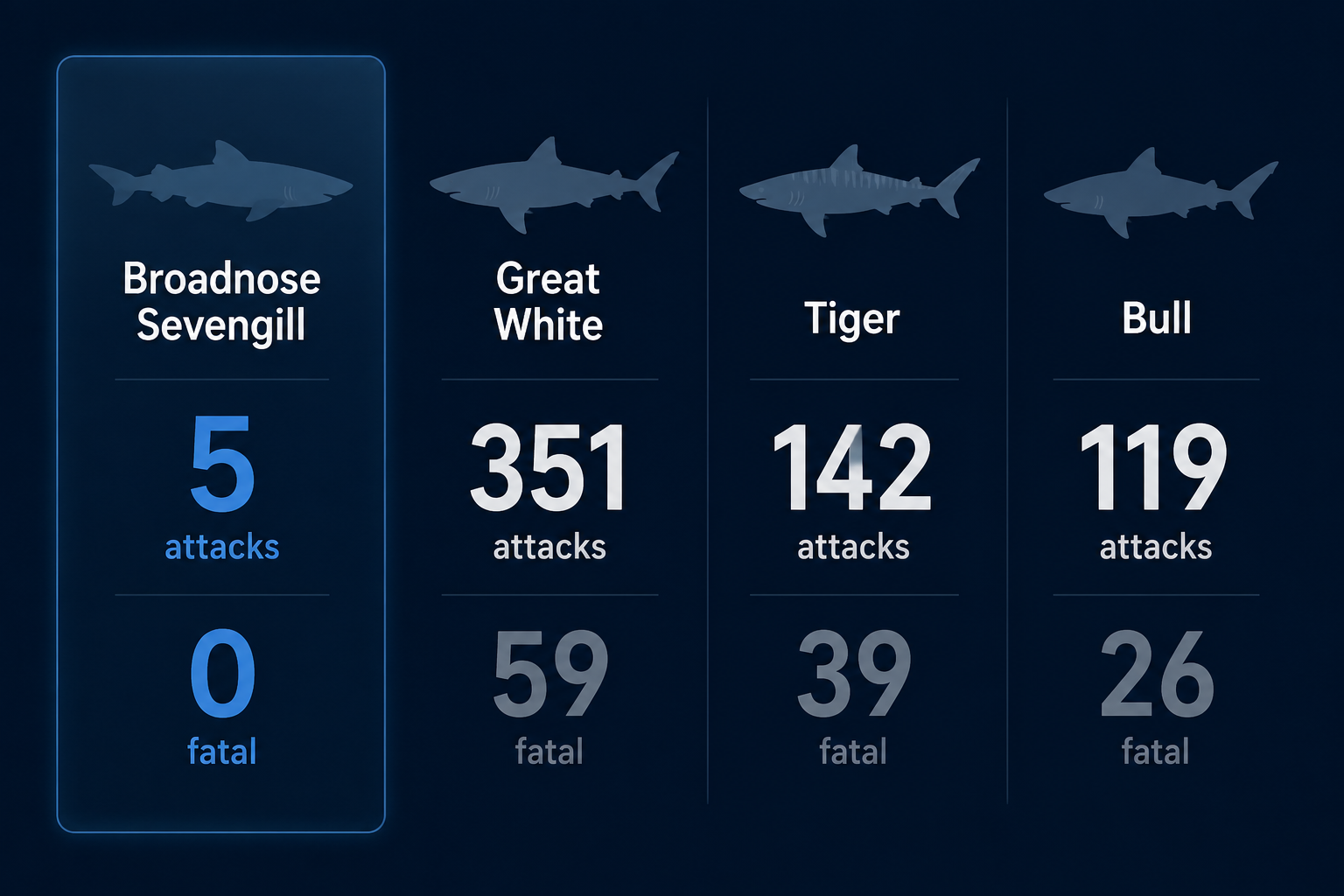
Those numbers do not make the sevengill harmless. They do make it a very poor candidate for the same mental shelf as the three species most often implicated in serious unprovoked shark attacks. A diver who hears “large shark” and immediately imports great white risk onto a broadnose sevengill is skipping the part where species identity matters.
| Species | Documented unprovoked attacks | Fatal attacks |
|---|---|---|
| Broadnose sevengill shark | 5 | 0 |
| Great white shark | 351 | 59 |
| Tiger shark | 142 | 39 |
| Bull shark | 119 | 26 |
There is still some discipline required in how that “5” should be read. It is not a perfect census of every bad sevengill encounter since people first entered coastal water. The ISAF species table itself carries a “use with caution” warning, and sevengill bites may be underreported or misidentified compared with bites by better-known species.[3] A frightened diver, a fast event, turbid water, and a shark that is not the celebrity villain of beach culture are not ideal conditions for confident species identification.
That caveat should make the conclusion humbler, not shapeless. Even if a small number of incidents are missing or differently classified, the gap between 5 nonfatal unprovoked attacks and the great white, tiger, and bull shark records is not a rounding error. The available record still places broadnose sevengills far down the list of shark species of concern for ordinary divers.
Why One Source Says Five, Another Six or Seven
The small disagreement across public sources is not a scandal; it is a classification problem. ISAF lists 5 unprovoked attacks. Other public summaries have given slightly different totals, including 6 or 7. The likely reason is that sources do not always separate the same categories with the same strictness: provoked versus unprovoked, captive versus wild, bite versus attack, and open-water encounter versus confirmed attack record.
That distinction matters more than it sounds. If a diver is holding a bleeding fish and a shark bites the diver’s arm while trying to get the fish, the risk lesson is not the same as a shark selecting an uninvolved swimmer in open water. Both can injure a person. Only one says much about the baseline danger of the species to divers who are not carrying food stimuli.
The Monterey Bay Aquarium’s species page says there is “no record of humans being attacked in open water” by broadnose sevengill sharks.[4] That line should be handled carefully. It cannot be used as a blanket denial that open-water bites have occurred, because the 2026 Tasmania case involved a diver off Bruny Island, and earlier open-water bite reports are part of the public discussion.[1] The more likely explanation is definitional: “attacked” may be used there in a narrower way than “bitten during a food-associated encounter.”
For divers, the practical reading is straightforward. Use ISAF as the main comparative baseline, keep the source variation visible, and do not let a loose word like “attack” erase the conditions around the event.
The Bruny Island Bite Was Not Random Background Noise
The Bruny Island sequence matters because it shows the hinge between curiosity and danger. The diver was reportedly retrieving a speared fish when the shark bit his forearm.[1] That is not a minor setting detail. To a shark, a struggling or bleeding fish is information. To a diver, it is a moment of task loading: one hand occupied, attention narrowed, visibility and distance harder to manage, exit decisions delayed.
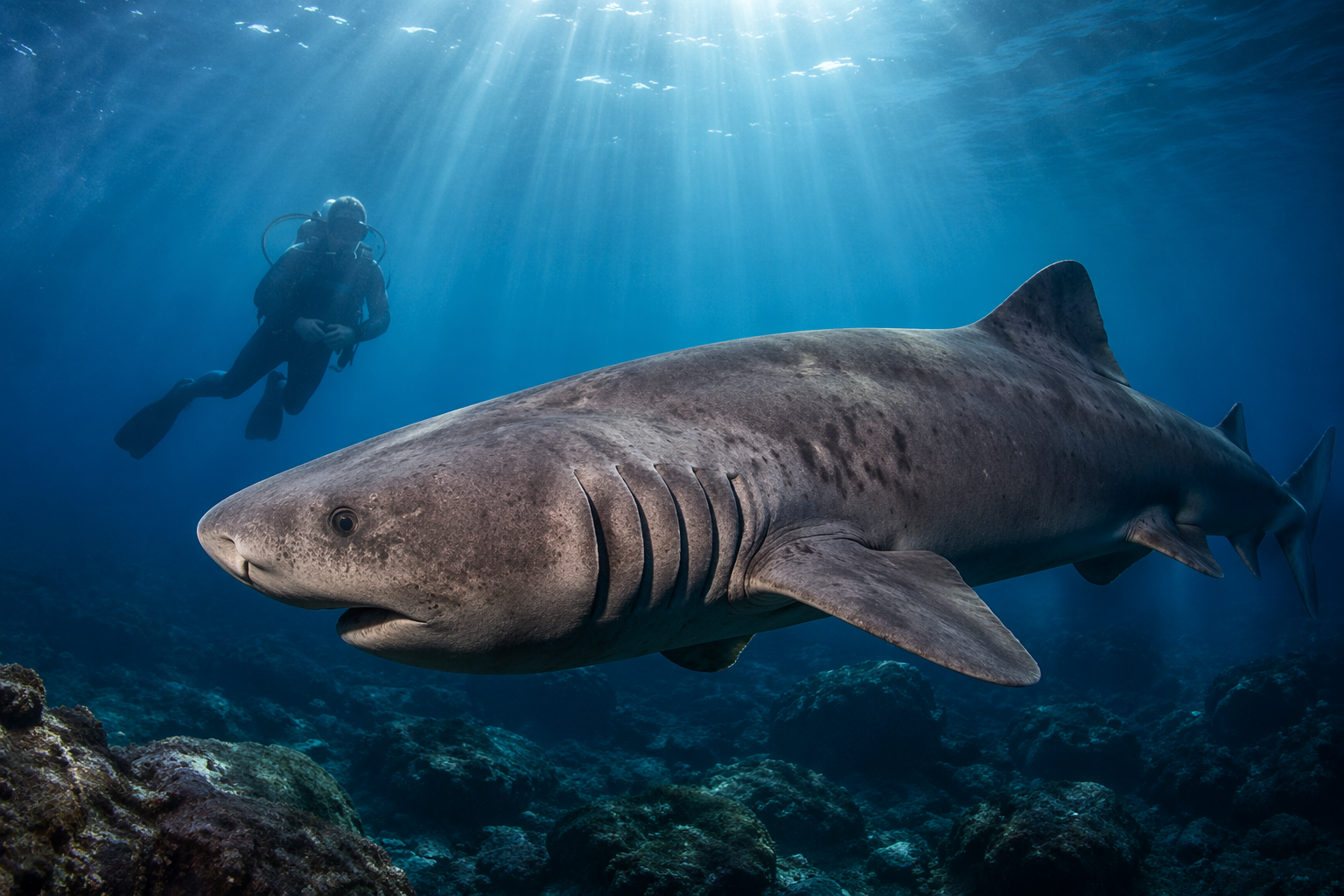
Chris Black, a shark researcher quoted by ABC News after the Tasmania incident, described broadnose sevengills as “often encountered by Tasmanian divers, usually without incident.” He also described them as curious animals that may investigate divers by slowly circling them, while warning that they “can become belligerent” when fish or blood are present.[1]
That is the part divers should not soften into comfort. Slow circling is not an attack, and many divers tolerate it calmly. But once fish, blood, or chum enter the water, the animal is no longer investigating an odd bubble-making mammal in the same way. It is investigating food.
Spearfishing changes the risk profile more than scuba gear does. A scuba diver with empty hands, neutral buoyancy, and no feeding behavior is mostly an object to assess. A spearfisher towing or grabbing wounded prey is attached to the most interesting thing in the water. If the shark closes distance, the diver may be the obstacle between predator and fish.
What Ordinary Sevengill Diving Looks Like When It Goes Well
South Africa’s Shark Alley is useful here because it shows what repeated broadnose sevengill diving looks like when operators treat the animals as powerful wildlife rather than props. Local dive protocol described by Learn to Dive Today emphasizes decades of sevengill diving without serious incidents, while prohibiting feeding, physical contact, and night diving.[5]
Those rules are not decorative. No feeding means no training sharks to associate divers with meals. No touching means no turning a close pass into a provoked response. No night diving reduces the chance of stacking poor visibility, altered predator behavior, and human confusion into the same dive.
A good protocol does not prove a species is incapable of harm. It proves that careful human behavior can keep encounters boring, which is exactly what most wildlife diving should aim for. The safest shark encounter is not the one that produces the most dramatic story afterward. It is the one where the animal keeps its distance, the divers keep their hands to themselves, and nobody introduces food.
A Formidable Animal Is Not Automatically a Frequent Human Threat
The broadnose sevengill shark is not small, timid, or ecologically trivial. It is the only living species in the genus Notorynchus, named for the seven gill slits visible on each side of the head, more than most sharks have.[6] It is also described as an apex coastal predator, with marine mammals making up about 30% of its diet in species-profile material.[7]
That biology deserves respect. A predator that can take marine mammals can certainly damage a human forearm. But diet and attack frequency are not the same measurement. The question for divers is not whether the shark has the equipment to injure a person. It plainly does. The question is whether the species commonly directs that equipment at divers under ordinary encounter conditions. The available record says no.
There is also a conservation cost to sloppy danger language. The broadnose sevengill is listed as Vulnerable, with a 30–49% decline over three generations reported in species-profile summaries.[6] A shark can be both capable of injuring a person and vulnerable to human pressure. Treating every bite as proof of monstrousness makes it harder to hold both facts at once.
How a Reasonable Diver Should Read the Risk
For ordinary scuba divers, the broadnose sevengill shark appears to be a very low-risk species compared with the large coastal sharks that dominate unprovoked attack statistics. The best evidence does not support treating a calm sevengill sighting as an emergency. It supports maintaining distance, staying composed, watching the animal’s path, and not rewarding curiosity with food or contact.
For spearfishers, the risk judgment is different. A fish on a spear is not just gear; it is a signal. A wounded fish in the hand, on a float line, or close to the body can pull a shark into the diver’s immediate space. If a broadnose sevengill appears while fish or blood are in the water, the useful response is not bravado. Secure distance from the fish if possible, avoid wrestling over prey, keep the shark in view, and end the dive without turning the exit into a chase.
- Do not feed broadnose sevengill sharks intentionally or indirectly.
- Do not touch, grab, block, or crowd a circling shark.
- Treat speared fish, blood, and chum as the main risk multipliers.
- Give a sevengill more space when visibility is poor or a fish is being handled.
- Do not use one food-associated bite to rewrite the species’ broader attack record.
So, is the broadnose sevengill shark dangerous to divers? Under ordinary scuba conditions, the evidence says the risk is low, especially compared with the large shark species most often implicated in serious unprovoked attacks. Under food-stimulus conditions, especially spearfishing, the risk becomes real enough to change behavior. That is not a contradiction. It is the difference between sharing water with a predator and carrying its dinner.
References
- Non-fatal shark attack diver Bruny Island Tasmania, ABC News, 2026-07-18.
- Diver survives after being bitten by nearly 7-foot shark in Australia: ‘Pretty good bite’, NY Post, 2026-07-18.
- Species Implicated in Attacks, Florida Museum.
- Broadnose Sevengill Shark, Monterey Bay Aquarium.
- Our protocol for scuba diving with cowsharks, Learn to Dive Today, 2014-07-15.
- Broadnose sevengill shark, Wikipedia.
- Broadnose Sevengill Shark, Notorynchus cepedianus, Shark Research Institute.
Comments
Join the discussion with an anonymous comment.