
The 4 Domains of SAT Math Questions and How to Master Them
Understand exactly what math questions appear on the digital SAT in 2026 — domain weighting, format split, and a study sequence that prioritizes Algebra and Advanced Math for the fastest score gains.
Updated:
If you are asking what kinds of sat math questions are actually on the digital SAT in 2026, the useful answer is much smaller than the giant topic lists make it look. The Math section has 44 questions across two 35-minute modules, a calculator is allowed for the whole section, and the Bluebook app includes a built-in Desmos graphing calculator.[1] The content is organized into four domains: Algebra, Advanced Math, Problem-Solving and Data Analysis, and Geometry and Trigonometry.[2]
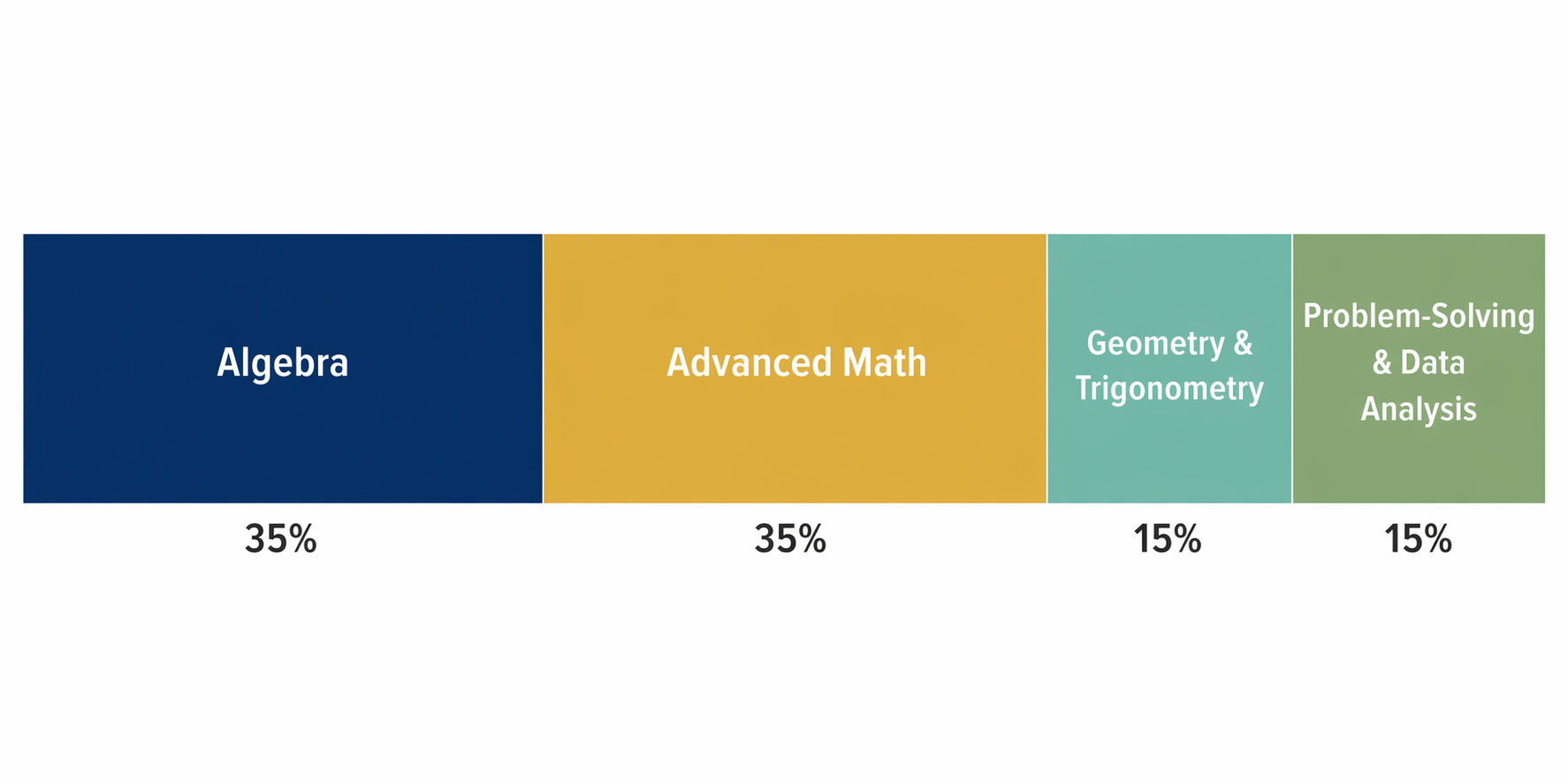
The part that should change your study plan immediately is the weight of the domains. Algebra and Advanced Math together make up about 70% of the section, or roughly 26 to 30 of the 44 Math questions. Geometry and Trigonometry matters. Data questions matter. But if your first instinct is to divide your study time evenly among all four domains, you are giving the smaller parts of the test too much authority.
| SAT Math domain | Approximate share | Typical question count | What that means for studying |
|---|---|---|---|
| Algebra | 35% | 13-15 questions | Start here if your score is unstable or below target. |
| Advanced Math | 35% | 13-15 questions | Build this early, especially once linear equations feel reliable. |
| Problem-Solving and Data Analysis | 15% | 5-7 questions | Add selectively after core algebra skills are moving. |
| Geometry and Trigonometry | 15% | 5-7 questions | Study the tested formulas and relationships, but do not let this become a geometry course. |
College Board gives question-count ranges rather than a neat percentage chart: Algebra and Advanced Math each appear in the 13-15 question range, while Problem-Solving and Data Analysis and Geometry and Trigonometry each appear in the 5-7 question range.[2] UWorld and IvyStrides present the same practical breakdown as 35%, 35%, 15%, and 15%.[3][4] That convergence is why the 70% core is worth treating as a planning fact, while still being precise about where it comes from.
The Test Rewards Algebra First
Algebra is the domain where many students can gain the most control fastest. These questions cover linear equations in one and two variables, systems of linear equations, linear functions, inequalities, and relationships that can be represented with expressions or equations.[2] In practice, that means you are solving, rearranging, interpreting slopes and intercepts, comparing equivalent forms, and translating a short situation into a linear model.
This is also where the digital SAT is kinder than old-school review packets. You do not need to become a contest-math person. You need to recognize the structure quickly enough that the first move is obvious: isolate the variable, substitute, compare coefficients, graph the lines, or use the answer choices to test a relationship. The built-in Desmos calculator can help with graphing and checking, but it does not replace knowing what the equation is saying.
For a student scoring below 500, Algebra is usually the first repair job. Not because other topics are fake, but because weak algebra leaks into the rest of the section. A data question may require setting up a proportion. A geometry question may hide a linear equation in the final step. An Advanced Math question often becomes impossible if factoring, substitution, or function notation is shaky.
Advanced Math Is the Other Half of the Core
Advanced Math is not optional enrichment. It carries the same approximate weight as Algebra: 13 to 15 questions, or about 35% of the section.[2][3][4] This domain includes nonlinear equations, nonlinear functions, equivalent expressions, polynomials, quadratic functions, exponential functions, and function notation.[2]
The most common mistake is treating Advanced Math as the thing to do after every linear topic is perfect. That delays too much of the test. Once a student can solve linear equations and interpret basic functions with some consistency, Advanced Math should enter the rotation. Quadratics, exponentials, and polynomial expressions need repeated exposure; they do not become reliable from one long weekend of review.
Desmos changes the work here in a useful way. A student can graph a quadratic, compare intersections, or check whether an answer choice creates the right shape. But higher-scoring students still need algebraic fluency: recognizing vertex form, reading transformations, factoring efficiently, and understanding what a parameter changes. A graph can confirm an idea. It is slower when it has to invent the idea for you.
Problem-Solving and Data Analysis Is Small but Easy to Misjudge
Problem-Solving and Data Analysis accounts for about 5 to 7 questions.[2] It covers ratios, rates, percentages, proportional relationships, units, one-variable and two-variable data, probability, statistics, and interpreting models.[2] The questions often look friendlier than they feel because the arithmetic may be simple while the setup is the actual test.
This domain deserves focused practice, especially for students who lose points on wording. College Board says about 30% of Math questions are set in context, so word-problem reading is not a side skill.[1] Still, it is usually not the first place to spend three weeks. Many data and percentage errors improve once algebraic setup improves: define the unknown, build the equation, track the units, then calculate.
Geometry and Trigonometry Should Be Contained, Not Ignored
Geometry and Trigonometry also accounts for about 5 to 7 questions.[2] The domain includes area and volume, lines, angles, triangles, right-triangle trigonometry, circles, and related formulas or relationships.[2] This is enough to affect a score, especially at higher levels, but not enough to justify turning SAT prep into a full geometry class.
The efficient version is narrower: know the circle facts that actually appear, review triangle relationships, practice right-triangle trig, and get comfortable using formulas without hunting for them in panic. Geometry questions can be quick points when the relevant relationship is visible. They become time sinks when a student tries to re-derive an entire unit from memory under test pressure.
Format Details That Matter, and a Few That Matter Less
The digital SAT Math section is split into two 35-minute modules.[1] The first module contains a mix of question difficulties; performance on that module affects the difficulty of the second module.[1] That adaptive structure matters most for students trying to reach the upper score bands: early accuracy is not just about avoiding lost points, but about earning the chance to see the harder second-module questions that support a higher score.
The calculator policy is simple: calculators are allowed throughout the Math section, and students can use the built-in Desmos graphing calculator in the testing app.[1] That makes practice with Desmos worth doing before test day. Students should know how to graph functions, find intersections, test answer choices, and check arithmetic. They should also know when typing into a calculator is slower than solving directly.
You will also see both multiple-choice and student-produced response questions. A commonly cited split across third-party prep sources is about 75% multiple-choice and 25% grid-in, though College Board does not publish that exact digital-SAT ratio as an official planning number.[3][4] It is useful context, not a reason to build your study plan around answer format. The domain weights do more strategic work.
A Better Study Order for Different Score Targets
A balanced calendar feels responsible. Monday algebra, Tuesday geometry, Wednesday data, Thursday advanced math. The problem is that equal time does not match the test. The study order should depend on the score you are starting from and the score you need.
If You Are Below 500
Stabilize Algebra first. That means linear equations, systems, inequalities, slope, intercepts, and translating words into equations. Do not spend your best study energy on obscure geometry or rare-looking formulas while basic equations are still costing you points. Add the most common data skills next: percentages, ratios, rates, and unit conversions. Geometry can enter in short, contained sessions once the algebra base is less fragile.
If You Are Around 600 or Trying to Break Past It
Build Algebra and Advanced Math together. At this level, the score usually moves when students stop treating quadratics, exponentials, and functions as occasional review topics. A strong weekly plan should include linear fluency, nonlinear functions, expression rewriting, and targeted word problems. Then add Problem-Solving and Data Analysis where diagnostics show leakage: ratios, percentages, scatterplots, probability, or interpreting a model.
If You Are Aiming for 700+
The job becomes less about coverage and more about precision. You still need all four domains, but the biggest returns often come from harder Advanced Math, clean Desmos decisions, and eliminating careless misses in questions you already know how to solve. The adaptive format also raises the stakes of Module 1 accuracy, because a strong first module positions you for the harder second module.[1]
At this range, Geometry and Trigonometry cannot be shrugged off just because they are smaller domains. Five to seven questions can separate a good score from the score a selective program expects.[2] The difference is that geometry practice should be diagnostic, not theatrical: circles if circles are weak, trig if trig is weak, volume if volume is weak. No dramatic tour of every shape ever drawn.
What to Do After You Know the Map
The map only helps if it changes your next practice session. Take a diagnostic or review a recent practice test, sort every missed Math question by domain, and look for the largest pattern. If Algebra and Advanced Math are both messy, do not dilute the week with four equal topic blocks. Put most of the time where most of the test lives, then reserve smaller blocks for data and geometry weaknesses.
- Use How to Make SAT Math Practice Questions Actually Work when you need a deliberate-practice routine instead of random drilling.
- Use How to Use SAT Practice Tests to Raise Your Score when you need to turn diagnostics into a weekly plan.
- Use Which SAT Prep Course Fits Your Learning Style, Score, and Schedule? if you need outside structure after seeing your baseline.
- Use A Complete Guide to SAT Study Tools in 2026 when you are choosing calculators, question banks, practice tests, and tracking tools.
SAT Math is not an endless syllabus. In 2026, it is a weighted, predictable section with four domains, 44 questions, calculator access throughout, and a 70% core made of Algebra and Advanced Math. Study it that way.
References
- The Math Section: Overview, College Board
- Types of Math Tested, College Board
- SAT Math Section: Syllabus & Format, UWorld College Prep
- SAT Math Topics, IvyStrides
Comments
Join the discussion with an anonymous comment.