
A Domain-by-Domain Guide to SAT Math Problems
Learn how the SAT Math section is organized into four content domains and discover which specific strategy works best for each type of problem.
Updated:
Mixed practice can make SAT math problems feel more random than they are. One question asks for a value of x. The next hides the actual question in a table. Then a diagram appears, and a student who was doing fine two minutes ago starts using the same algebraic grind on all three.
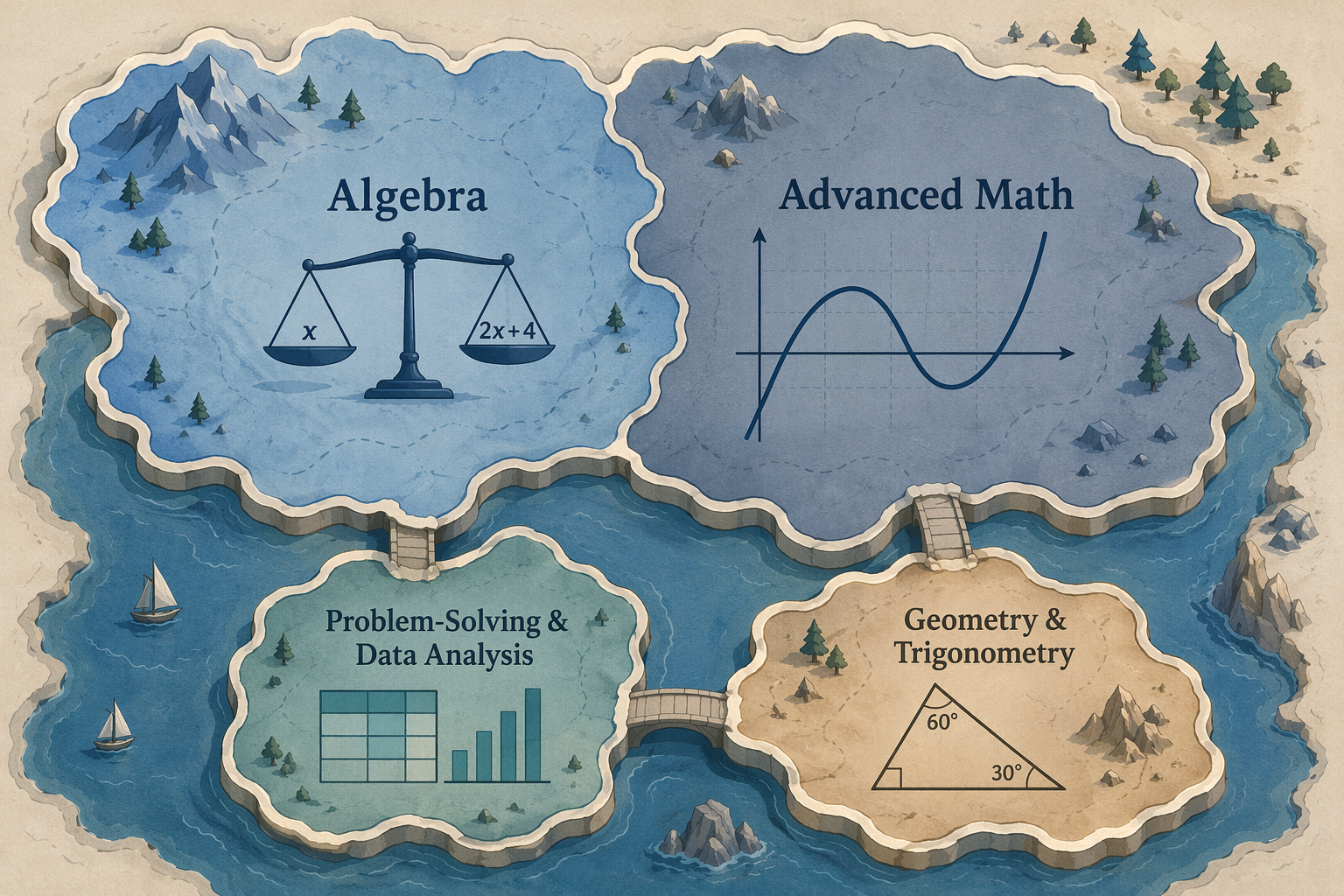
That is usually where wasted effort starts. The digital SAT Math section is not one giant bucket of math. College Board organizes it into four content domains: Algebra, Advanced Math, Problem-Solving and Data Analysis, and Geometry and Trigonometry. Algebra and Advanced Math each make up about 35% of the section, or roughly 13–15 questions apiece. Problem-Solving and Data Analysis is about 15%, or roughly 5–7 questions, and Geometry and Trigonometry is about 10%, also roughly 5–7 questions.[1][2]
Those percentages are not trivia. They tell you where your study time should go and why a student scoring in the 500–650 range can often improve faster by sorting misses instead of simply doing more mixed sets. If most of the test is Algebra and Advanced Math, then avoidable setup errors in those domains are expensive. The smaller domains still matter, but they usually call for a different kind of attention: reading units carefully, tracking percent direction, or matching corresponding sides before touching the calculator.
| SAT Math domain | Approximate share | Approximate question range | Best first move |
|---|---|---|---|
| Algebra | About 35% | 13–15 questions | Identify the unknown, write the equation or system, and keep the target variable visible |
| Advanced Math | About 35% | 13–15 questions | Look for structure: zeros, equivalent forms, functions, quadratics, and solution conditions |
| Problem-Solving and Data Analysis | About 15% | 5–7 questions | Read the quantities first: units, ratios, percent change, and what the statistic measures |
| Geometry and Trigonometry | About 10% | 5–7 questions | Mark the diagram, identify the relationship, and match corresponding parts before calculating |
Individual digital SAT forms can vary, so these ranges are better treated as a planning map than a promise for one test day. Still, the map is useful. It explains why “I missed math” is too broad to help, while “I keep solving for the wrong variable in Algebra” is something you can fix.
Algebra: keep the target from disappearing
Algebra questions test linear equations, linear inequalities, systems of equations, and relationships between quantities. On the SAT, the hard part is often not the algebra itself. It is setting up the right relationship and remembering what the question actually asked for.
The first move should be boring in the best possible way: circle or restate the target. If the question asks for y, do not spend two minutes finding x unless x is clearly a step toward y. If it asks for the value of 3x + 2, do not automatically solve for x just because x is present. Prep experts commonly flag “answering the wrong question” or solving for the wrong variable as a recurring SAT Math mistake, and Algebra is where that mistake has room to look like productive work.[3][4]
A clean Algebra routine looks like this:
- Name the target before solving: x, y, a constant, an expression, a slope, or an intercept.
- Translate words into one equation or a system before manipulating anything.
- If there are two equations, decide whether substitution, elimination, or graphing is fastest.
- Before choosing an answer, check whether the answer choice matches the target or only an intermediate value.
Desmos can help here, especially with systems. The digital SAT includes a built-in Desmos graphing calculator, and test-prep guidance often points to graphing systems of equations as one of its strongest uses: enter both equations, find the intersection, and connect that intersection back to the question.[4][5] That last step matters. Desmos can show that two lines intersect at a point; it cannot decide whether the test asked for the x-coordinate, the y-coordinate, the sum of the coordinates, or a constant in the original equation.
For example, in a hypothetical system where the intersection is visible, a student may correctly find the point and still choose the wrong coordinate. That miss does not mean the student “doesn’t know systems.” It means the first move was incomplete. The target variable disappeared.
When to use Desmos in Algebra
Use Desmos when the problem is naturally graphical: intersections, slopes, intercepts, and checking whether a linear equation matches a table. Be more cautious when the question is asking for a parameter or an expression rather than a point. In those cases, the calculator may still help, but only after you have written down what the answer must represent.
For a broader tool setup, including where calculator use fits into a full prep system, the SAT study tools guide is the better place to compare options. In this guide, the rule is narrower: use Desmos when it shortens the path without hiding the target.
Advanced Math: look for structure before expanding
Advanced Math is the other large domain, and it is where many capable students start doing too much. These questions involve nonlinear expressions, quadratic equations, functions, polynomial expressions, equivalent forms, and relationships that may be easier to read after factoring, graphing, or comparing forms.
The first move is not “expand everything.” It is to ask what form the problem is rewarding. A factored quadratic tells you zeros. Vertex form tells you a turning point. Standard form may make the y-intercept obvious. A function notation question may only require substituting the correct input, not rebuilding the whole function from scratch.
This is also the domain where solution conditions matter. Prep analyses often point to discriminant mistakes as a common issue: for a quadratic equation, the discriminant determines whether there are two real solutions, one real solution, or no real solutions.[3] A student can manipulate the equation correctly and still miss the problem if they forget that the question is asking about the number or type of real solutions.
A useful Advanced Math routine is shorter than a full lesson, but it prevents a lot of damage:
- If the expression is quadratic, check whether zeros, vertex, intercepts, or number of solutions is the real target.
- If answer choices are equivalent expressions, look for factoring, common factors, or substitution instead of expanding first.
- If the question asks about real solutions, pause for the discriminant or a graph-based check.
- If a function is involved, identify the input and output before doing algebraic manipulation.
Desmos is powerful in this domain, but it is not a substitute for recognizing structure. Test-prep discussions of the digital SAT often highlight graphing quadratics, checking intersections, and using sliders as useful Desmos strategies.[4][5] Those are real advantages. If a problem asks where a parabola and a line intersect, graphing can be faster than solving by hand. If a parameter changes the shape or location of a graph, a slider can help test the behavior.
But a calculator view can also be too much information. A graph may show two intersections, while the question asks for a coefficient. A table may show outputs, while the answer choices are equivalent expressions. In Advanced Math, Desmos is best used after you decide what feature of the expression matters.
Hard-question collections from PrepMaven and PrepScholar show why this domain can feel intimidating: the algebra is often layered, and the question may reward a small structural observation more than a long calculation.[6][7] That does not mean every student needs to chase the hardest examples first. For a 500–650 scorer, the better sequence is to master recognition: quadratic behavior, equivalent forms, solution conditions, and function inputs. Then the harder problems have somewhere to land.
Problem-Solving and Data Analysis: read the quantities before calculating
Problem-Solving and Data Analysis is smaller than Algebra or Advanced Math, but it has a different texture. These questions often involve ratios, rates, percentages, units, tables, graphs, sample interpretation, and summary statistics. The math may be lighter, but the reading burden is higher.
The first move is to identify what the number means. Is it a count, a rate, a percent, a percent increase, a probability, an average, or a median? Is the question asking for the original amount, the new amount, the difference, or the percent change? Prep experts commonly warn about mistakes with mean versus median and with percentage-change direction, and those mistakes fit this domain especially well.[3][4]
A student who knows percent change can still miss a question by reversing the base. A change from 40 to 50 is not the same percent change as a change from 50 to 40. The arithmetic is not the issue; the direction is. The same thing happens with summary statistics. The mean can move because one value is extreme. The median cares about the middle position. If you blur those two, the test can make a simple dataset feel slippery.
For this domain, write less algebra at first and annotate more:
- Underline the unit attached to each number.
- Label the starting amount and ending amount before computing percent change.
- For tables, read the row and column labels before reading the values.
- For mean and median, say what the statistic measures before comparing answer choices.
Desmos has a smaller role here. It can calculate, plot points, and help with regression-style tasks, but it cannot read the table heading for you. If the miss came from using the wrong denominator or comparing the wrong groups, more calculator work will not fix it. The repair is slower reading at the start, not faster arithmetic at the end.
Geometry and Trigonometry: trust relationships, not the picture
Geometry and Trigonometry is the smallest domain in College Board’s breakdown, but it can still decide several points.[1][2] These questions may involve area, volume, angles, circles, right triangles, trigonometric ratios, and similarity. The trap is that diagrams feel readable even when they are not drawn to scale or when the corresponding parts are easy to mismatch.
The first move is to mark the relationship. Parallel lines? Similar triangles? Right triangle? Circle radius? Arc or central angle? Do that before plugging numbers into a formula. Prep-strategy sources often identify mismatched corresponding sides in similar triangles as a common geometry error.[3][4] That mistake is especially frustrating because the student may know similarity perfectly and still build the wrong proportion.
With similar triangles, match angles first, then sides. Do not match the sides that look visually close. If the diagram has two triangles facing different directions, rewrite the correspondence in order. A quick line such as “small short side ↔ large short side” can save more time than a page of crossed-out proportions.
Desmos is limited here. It can graph equations and help with coordinate geometry, but it does not draw a geometric proof, identify corresponding sides, or decide which trig ratio applies. For right triangles, the useful first question is still human: opposite, adjacent, or hypotenuse relative to which angle?
The trap list is not official, but it is useful
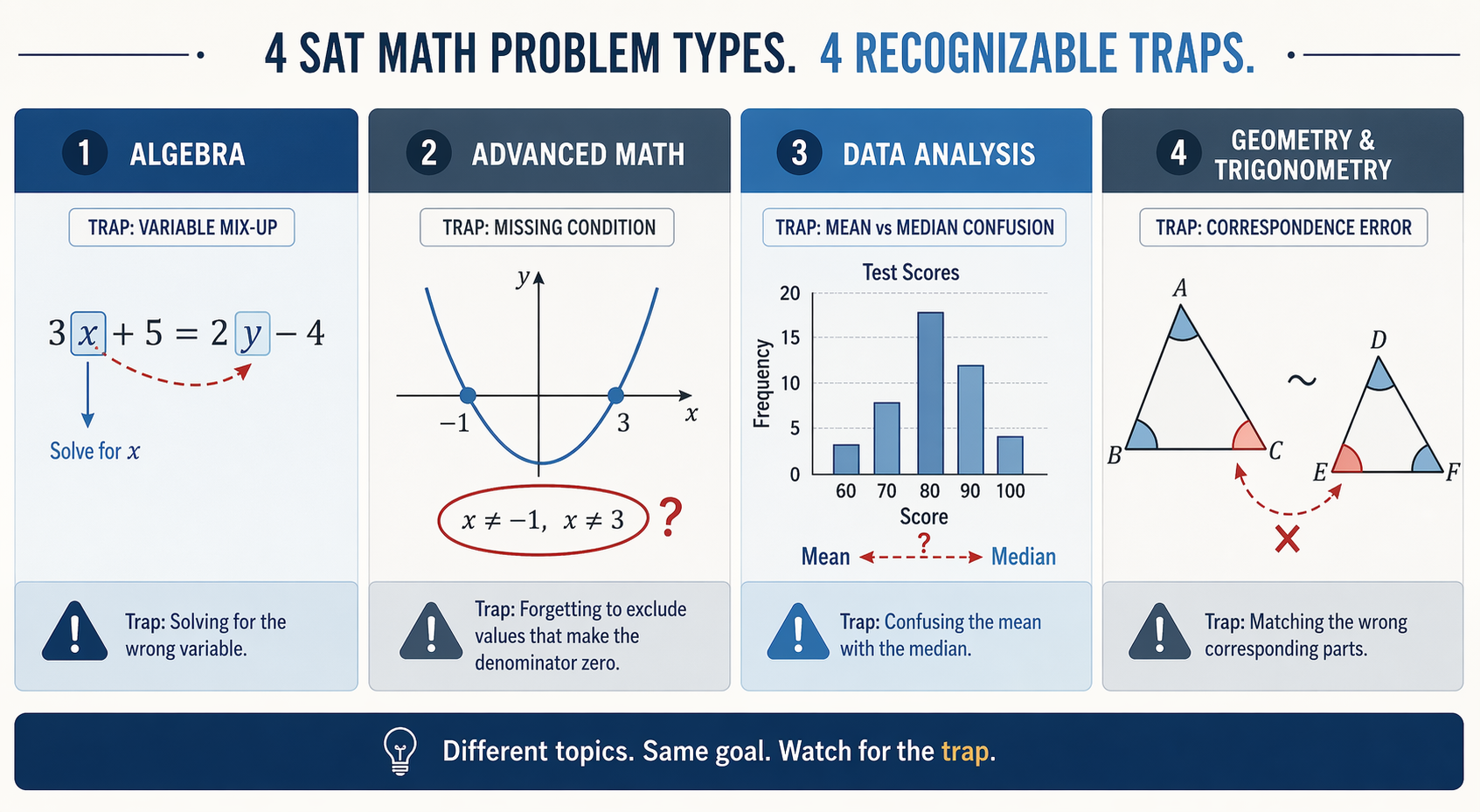
College Board’s domains are official. The “signature traps” are not. They are patterns drawn from test-prep analyses and from the kinds of errors that show up again and again when students review missed questions. That distinction matters. The SAT will not label a question “wrong variable trap” or “mean versus median trap.” You have to notice the pattern yourself.
| Domain | Common trap to watch | What to do before solving |
|---|---|---|
| Algebra | Solving for a variable the question did not ask for | Write the target next to the work area |
| Advanced Math | Forgetting real-solution conditions or using the wrong form of an expression | Identify whether the problem is about zeros, vertex, equivalence, or number of solutions |
| Problem-Solving and Data Analysis | Confusing mean and median, or reversing percent-change direction | Label units, groups, starting values, and ending values |
| Geometry and Trigonometry | Matching the wrong corresponding sides or using the wrong trig ratio | Mark angle relationships and side correspondence first |
This is why reviewing only the right answer is usually too thin. If you missed an Algebra question because you solved for x instead of y, doing ten more random Algebra questions may or may not fix it. Writing “target variable disappeared” next to the miss gives your next practice set a job.
How to review SAT math problems by domain
After a practice set, sort every missed or guessed question into one of the four domains. If you are not sure, use the main action of the problem. Linear equation or system? Algebra. Quadratic, nonlinear expression, function, or equivalent form? Advanced Math. Table, rate, percentage, unit, or statistic? Problem-Solving and Data Analysis. Diagram, angle, circle, triangle, area, volume, or trig ratio? Geometry and Trigonometry.
Then add one more label: the cause of the miss. Keep it plain. “Wrong variable.” “Forgot denominator.” “Expanded too early.” “Used mean instead of median.” “Matched wrong sides.” “Didn’t know formula” is allowed, but it should not become the default label for every miss. Many SAT math problems are missed because the first move was wrong, not because the student lacked all the content.
A review log can be simple:
| Question | Domain | Miss type | Better first move next time |
|---|---|---|---|
| Practice Set 2, Q8 | Algebra | Solved for x, question asked for y | Write the target before elimination |
| Practice Set 2, Q14 | Advanced Math | Ignored real-solution condition | Check discriminant or graph behavior |
| Practice Set 3, Q5 | Data Analysis | Used final amount as percent-change base | Label original and new values |
| Practice Set 3, Q18 | Geometry | Matched non-corresponding sides | Match angles before setting proportion |
For a deeper system, use a deliberate review cycle rather than just checking explanations. The guide to making SAT Math practice questions actually work fits naturally after this step because domain recognition only helps if it changes what you do on the next question.
Choosing practice without turning it into a blur
Mixed practice is useful, but not when every miss feels unrelated. A better pattern is to alternate between targeted and mixed work. If your log shows that most errors are Algebra setup errors, spend a short block on systems, linear relationships, and target-variable discipline. If Advanced Math is the issue, drill quadratic forms, function notation, and solution conditions. Then return to mixed sets to practice recognizing the domain without a label.
Free practice sources can help, as long as you use them deliberately. Mometrix offers SAT Math practice material, and Kaplan’s SAT Math tips emphasize practical habits such as using answer choices strategically and watching for what the question asks.[8][9] For a more complete list of sources, use the free SAT Math practice tests guide and choose sets based on the domain pattern you need to repair.
Student and tutor debriefs from 2026 test administrations can be useful for noticing what felt harder on a given date, but they are not the same as College Board’s official test structure. Strategic Test Prep’s May 2026 analysis, for example, discusses observed difficulty and Desmos-related preparation based on test-day reports, not an official redesign announcement.[5] Treat those reports as color, not as the foundation of your study plan.
The official domain map should stay at the center. It tells you that Algebra and Advanced Math deserve repeated attention, while Data Analysis and Geometry need sharper, more specialized habits. If you want the larger study structure around timing, tools, and section strategy, the SAT exam prep guide can hold that broader plan.
The useful shift is small but real: before solving, decide what kind of SAT math problem is in front of you. Algebra asks you to protect the target. Advanced Math asks you to see structure. Data Analysis asks you to read quantities precisely. Geometry and Trigonometry ask you to mark relationships before calculating. Better first moves do not make every question easy, but they do reduce the number of times you are simply guessing your way into the work.
References
- The Math Section: Overview, College Board
- Types of Math Tested, College Board
- The 7 Most Common SAT Math Mistakes and How to Avoid Them, PrepScholar
- How to Solve SAT Math Problems, UWorld
- May 2026 Digital SAT: What Was Harder, What Changed, and How to Prepare Next, Strategic Test Prep, May 2026
- The 25 Hardest SAT Math Questions Ever, PrepMaven
- The Hardest SAT Math Questions Ever, PrepScholar
- SAT Math Practice Test, Mometrix
- 5 Must-Know SAT Math Tips, Kaplan
Comments
Join the discussion with an anonymous comment.