
Sample SAT Math Questions by Difficulty Level
See what easy, medium, and hard Digital SAT Math questions actually look like and how the adaptive module system affects your practice strategy. This guide explains the characteristics of each tier and how to adjust your approach depending on your routing path.
Updated:
Two students can both say they are doing SAT Math practice and mean completely different things. One is learning how the Digital SAT sorts questions by difficulty and how that affects Module 2. The other is just collecting problems, hoping that enough exposure will somehow turn into readiness. That second student often feels blindsided when the test does not simply get “harder” in a neat, predictable way.
The useful question is not just whether you can solve a random problem. It is what kind of problem it is. Easy, medium, and hard SAT Math questions usually differ in how direct the setup is, how many ideas must be connected, how much algebra has to be managed, and whether the trap is a simple mistake or a hidden misunderstanding.
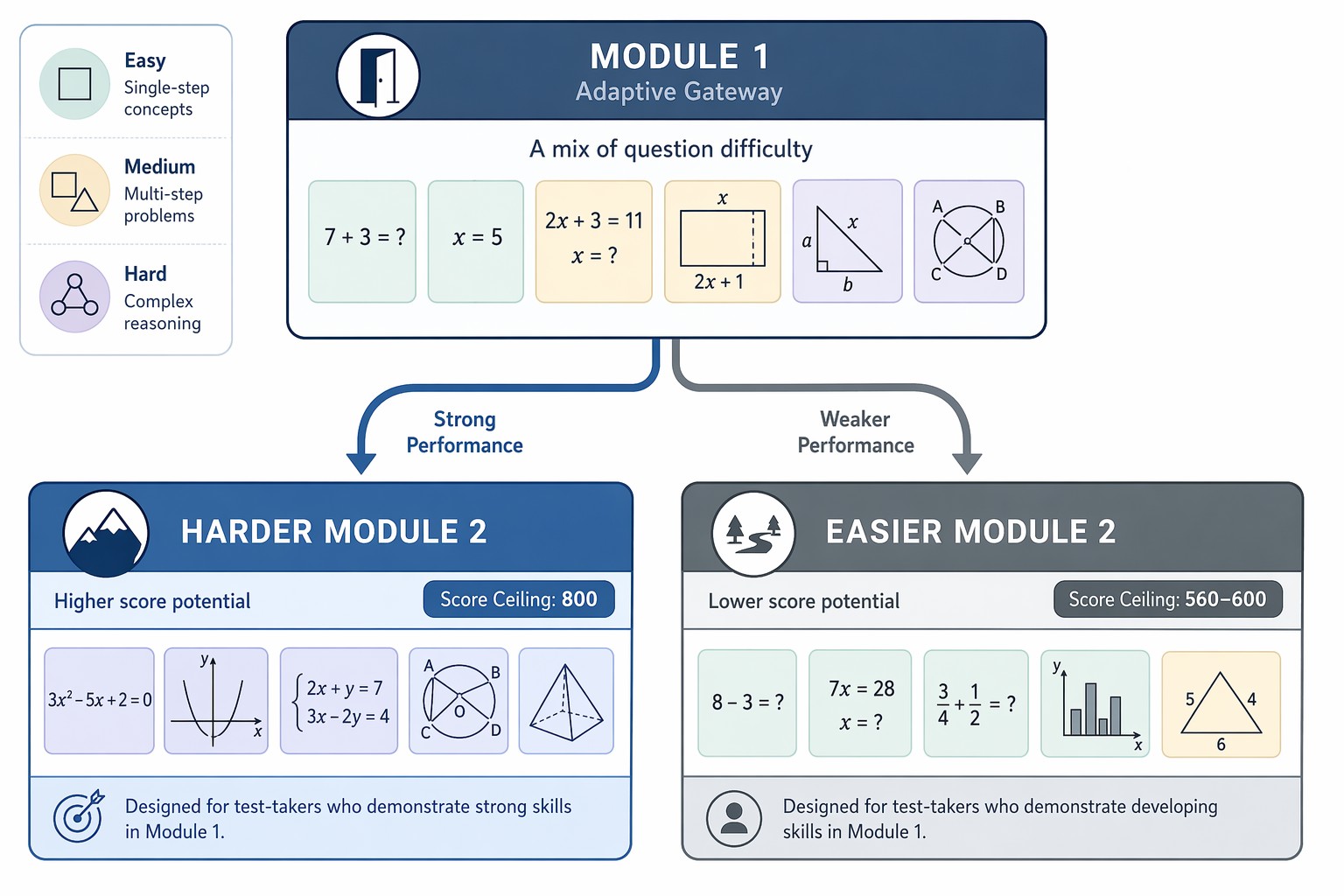
That matters more on the Digital SAT because the Math section is adaptive. The College Board describes the test as using a multistage adaptive design: Module 1 includes a mix of easy, medium, and hard questions, and performance on Module 1 helps determine whether the student receives an easier or harder Module 2.[1] Within each Math module, questions are generally arranged from easiest to hardest, and the Math section is mostly multiple-choice, with some student-produced response questions.[2]
So sample SAT math questions are not just warm-up material. Used well, they are calibration tools. They show whether a student is losing points because of arithmetic slips, weak algebra, poor translation from words to equations, or because the problem combines familiar skills in a form the student has not practiced.
What Difficulty Means on SAT Math
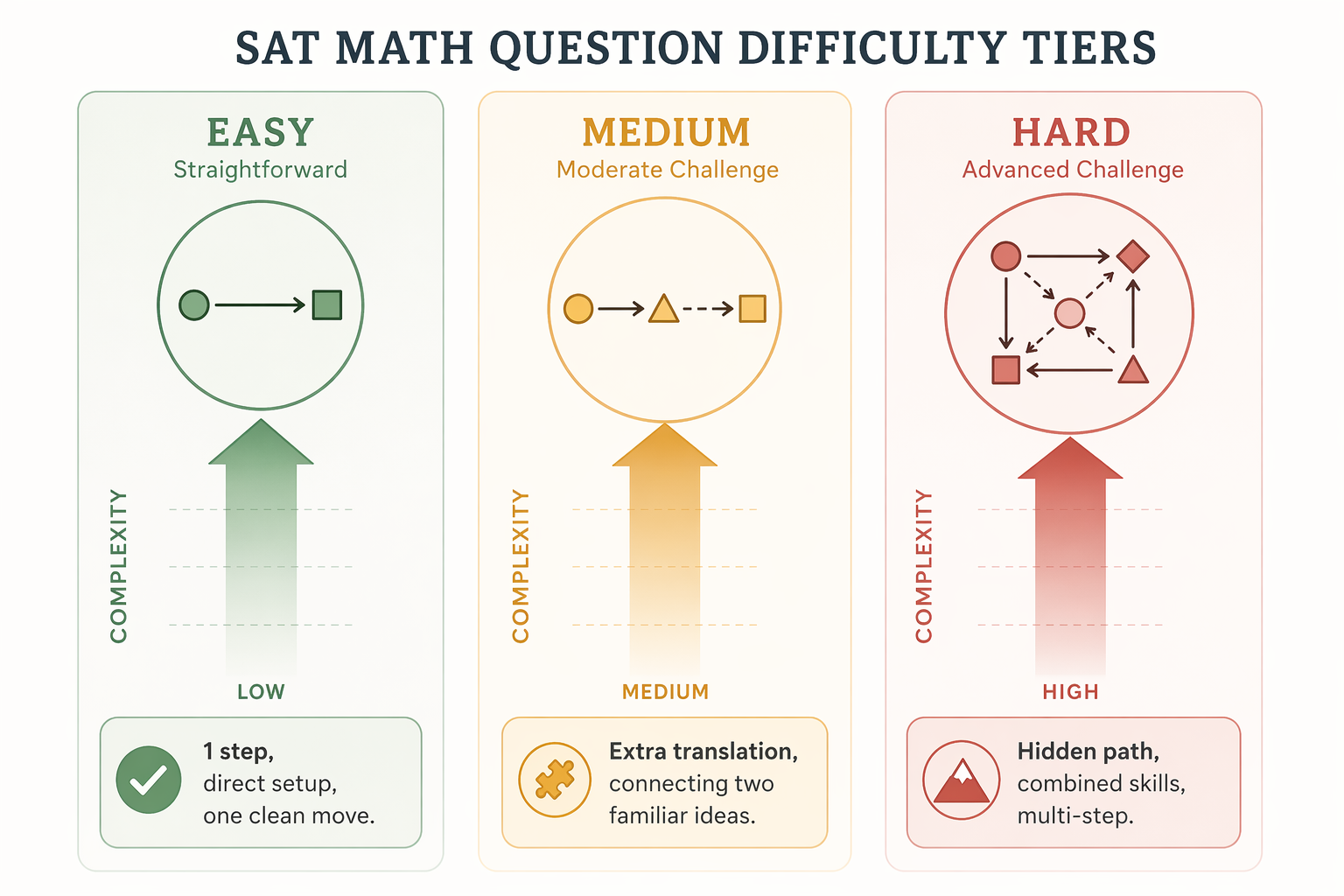
Difficulty is not a personality label. An easy question is not “for weak students,” and a hard question is not automatically better practice. Difficulty is a design feature. The test can make the same underlying skill easier or harder by changing how clearly the setup is presented, how many steps are required, and how much irrelevant-looking information must be ignored.
| Tier | What the question usually asks you to do | What often goes wrong |
|---|---|---|
| Easy | Apply one familiar rule or perform one clean calculation | Rushing, sign errors, calculator overuse, or skipping the exact question asked |
| Medium | Translate the setup, connect two skills, or choose the right representation | Knowing the topic but not recognizing it in a less obvious form |
| Hard | Find a hidden path, combine several ideas, or avoid a conceptual trap | Starting algebra too quickly without understanding the structure |
The College Board’s content weights are also worth keeping in view. Algebra and Advanced Math each account for 35% of SAT Math, or about 13 to 15 questions apiece, while Problem-Solving and Data Analysis and Geometry and Trigonometry each account for 15%, or about 5 to 7 questions apiece.[3] That does not mean geometry is unimportant. It does mean that if your easy and medium algebra work is shaky, jumping straight into exotic hard problems is usually a bad trade.
Easy Sample SAT Math Question: One Clean Move
The following sample questions are representative practice examples, not official College Board questions. Use them to notice the design of each tier, not just to check whether you got the answer.
Sample Question
If 3x + 7 = 22, what is the value of x?
- A. 3
- B. 5
- C. 7
- D. 15
Answer: B. Subtract 7 from both sides to get 3x = 15, then divide by 3 to get x = 5.
This is easy because the path is already visible. The equation is given. The operation order is standard. There is no need to decide which formula applies, translate a word relationship, compare answer choices, or manage several expressions at once.
That does not make the question disposable. Easy questions are where timing and accuracy are built. A student who misses this kind of question usually does not need “harder practice” first. They need to slow down just enough to stop bleeding points on direct skills: solving linear equations, reading graph values, evaluating expressions, working with percentages, and using basic geometry facts.
On scratch paper, an easy-question miss should be labeled very plainly. Was it a computation error? A sign error? A misread? A rule you did not know? Those are different problems. Treating all of them as “careless mistakes” makes the next practice set less useful.
Medium Sample SAT Math Question: The Skill Is Familiar, but the Setup Takes Work
Sample Question
A line passes through the points (2, 5) and (6, 13). Which equation represents the line?
- A. y = 2x + 1
- B. y = 2x - 1
- C. y = 4x - 3
- D. y = 8x - 11
Answer: A. The slope is (13 - 5) / (6 - 2) = 8 / 4 = 2. Substitute one point into y = 2x + b. Using (2, 5), 5 = 2(2) + b, so b = 1. The equation is y = 2x + 1.
This is medium because the math is still standard, but the question asks for a chain. Find slope. Use a point. Solve for the intercept. Match the answer choice. None of those pieces is advanced, but the student has to know what to do without being told, “First find the slope.”
This is the tier where a lot of practice starts to become honest. Students who can solve direct equations may still hesitate when the same algebra is embedded in coordinate geometry, data tables, function notation, or a short word problem. The score does not care that the underlying skill felt familiar after the explanation. It cares whether the student recognized the setup in time.
Medium questions are often the best training ground for students who are trying to move from “I know the lesson” to “I can use the lesson on the test.” When reviewing them, do not stop at the correct answer. Write down the first clue that should have told you what to do. In this problem, the two points are the clue: two points on a line usually invite slope, then an equation.
Hard Sample SAT Math Question: The Path Is Hidden
Sample Question
For the function f, f(x) = x^2 - 6x + k, where k is a constant. The graph of y = f(x) touches the x-axis at exactly one point. What is the value of k?
- A. 6
- B. 9
- C. 12
- D. 36
Answer: B. A parabola that touches the x-axis at exactly one point has exactly one real solution, so its discriminant is 0. For x^2 - 6x + k, a = 1, b = -6, and c = k. The discriminant is b^2 - 4ac = (-6)^2 - 4(1)(k) = 36 - 4k. Set 36 - 4k = 0, so k = 9.
This is hard for a different reason than the arithmetic. The equation is short, and the calculations are not long. The difficulty is recognizing what “touches the x-axis at exactly one point” means. The student has to connect a graph description to a quadratic condition.
There is a second possible route: complete the square. x^2 - 6x + k = (x - 3)^2 + k - 9. For the graph to touch the x-axis once, the vertex must sit on the x-axis, so k - 9 = 0 and k = 9. That route is elegant if the student sees it. It is not obvious if the student only practices quadratics as plug-and-chug factoring.
Hard SAT Math questions often feel unfair when students expect the topic name to announce the method. This problem never says “discriminant,” “double root,” or “complete the square.” It gives a graph behavior and expects the student to translate. That is why hard-question practice should not be measured only by whether you can follow the explanation afterward. The better review question is: What clue did I miss before I started calculating?
A Hard Question Is Not Always the Best Next Question
A student missing easy linear equations does not need a week of the hardest quadratic modeling problems. A student who gets every direct algebra question right but freezes when the wording changes probably does need medium mixed-skill practice. A student already strong in medium questions needs hard problems to learn hidden setups and less obvious shortcuts.
That is the reason difficulty-matched practice beats random volume. If you want a broader system for choosing problems by current score level, use The Best SAT Practice Problems for Your Score Level. If the bigger issue is that your practice sets are too random, Choose SAT Practice Questions by Difficulty, Not Volume goes deeper into that selection problem.
| If your misses look like this | Practice should focus on |
|---|---|
| You miss direct equations, basic percentages, or one-step geometry facts | Easy questions for clean execution and fast recognition |
| You know the lesson but miss questions with tables, graphs, or worded setups | Medium questions that force translation and skill transfer |
| You solve medium questions consistently but miss hidden relationships | Hard questions with careful review of the first clue and setup choice |
| You get the answer later but not under time pressure | Mixed sets by tier, with timing added only after the method is stable |
How Tier Awareness Changes Module 1
Module 1 deserves more respect than students sometimes give it. Because it helps determine the second module, it is not just a warm-up. It is the gate. The College Board does not publish exact routing thresholds, so students should be careful with anyone who presents a fixed number of misses as a rule.
Third-party analyses can still be useful if treated as estimates. PrepMaven, based on a 31-test experiment, reported that students could miss approximately 8 Math questions in Module 1 before being routed to the easier Module 2, while noting that the exact outcome depends on which questions are missed and how they are weighted.[4] Test Ninjas and PrepMaven also describe the easier second module as having a likely section score ceiling around 560 to 600, while the harder second module can reach 800; this is not an official College Board ceiling chart.[4][5]
The practical takeaway is narrower and safer: Module 1 accuracy matters, especially on easy and medium questions. If a student spends too long wrestling with one hard problem and gives away two medium questions later, that is not ambition. It is poor routing management.
- On easy questions, aim for clean first-pass answers. These should not become time sinks.
- On medium questions, slow down enough to identify the setup before calculating.
- On hard questions, decide whether you see a path. If not, mark it, protect the rest of the module, and return if time allows.
- After the module, review misses by tier, not just by topic.
If You Are Routed to an Easier Module 2
If Module 2 feels noticeably more direct than expected, the response should not be panic. The job becomes maximizing the questions in front of you. Easier Module 2 questions still count, and giving up because the route was not ideal only compounds the damage.
In that path, easy and medium execution matters most. Expect more questions where the setup is visible: solve the equation, read the graph, compare rates, evaluate a function, or apply a known geometry relationship. The main danger is emotional: rushing because the questions look familiar, or mentally replaying Module 1 instead of solving Module 2.
Practice for this route should emphasize recovering points from fundamentals. If your practice review shows repeated easy misses, the next week should not be built around proving you can attempt hard problems. It should be built around making direct Algebra and Advanced Math questions automatic, because those domains carry the largest share of the Math section.[3]
If You Are Routed to a Harder Module 2
A harder Module 2 is a good sign, but it changes the kind of discipline required. The questions may ask for more translation, combine topics more aggressively, or reward recognizing structure before doing algebra. This is where hard practice earns its place, provided the student already has reliable easy and medium accuracy.
The strongest students are not the ones who blindly attack every difficult-looking expression. They are the ones who can pause for a few seconds and classify the problem: Is this asking for a value, an expression, a relationship, a graph feature, or a constraint? Is there a shortcut through structure? Is the calculator helpful, or is it about to hide the pattern?
For a more specific split between the two second-module paths, read Adaptive Digital SAT Module 2: How to Adjust Your Strategy for the Hard vs. Easy Path. The key here is that hard Module 2 practice should include full explanations of why the setup was hard, not just answer keys.
How to Review These Sample Questions So They Actually Change Your Score
A missed question should produce more than a corrected answer. The review note should tell you what to do differently the next time that design appears. A useful note is specific enough that it changes behavior.
| Weak review note | Better review note |
|---|---|
| I forgot slope. | When a question gives two points on a line, first find slope, then use one point to get the equation. |
| Quadratics are hard. | When a parabola touches the x-axis once, think one real solution: discriminant equals 0 or vertex on x-axis. |
| Careless mistake. | I solved for x but the question asked for 2x, so I need to circle the requested value before calculating. |
| Need more practice. | I missed a medium translation question, so I need mixed practice where linear equations appear in graphs, tables, and word problems. |
This is also where tier labels help. If you miss an easy question, the review should usually be about fluency or accuracy. If you miss a medium question, ask what translation step you failed to notice. If you miss a hard question, ask whether the setup was hidden, whether you chose the wrong method, or whether the problem required a concept connection you had not practiced.
For a fuller review process, use How to Make SAT Math Practice Questions Actually Work. Once your tier review is stable, full-length practice becomes more useful; at that point, Best Free SAT Math Practice Tests in 2026 can help you move from isolated calibration to adaptive test simulation.
The Practical Judgment
Effective SAT Math practice is tier-aware and route-aware. Easy questions build the accuracy that protects Module 1. Medium questions show whether skills transfer when the test changes the wrapping. Hard questions prepare students for hidden setups and top-score separation, but only after the earlier tiers are stable enough to support that work.
A sample question is useful when it tells you where your confidence actually breaks: at the calculation, the translation, the concept link, or the time decision. Once you know that, “practice more” becomes too vague. You can practice the tier that is actually costing you points.
References
- What Is Digital SAT Adaptive Testing?, College Board Blog
- SAT Math Overview, College Board
- Types of Math Tested, College Board
- Digital SAT Adaptive Testing Explained, PrepMaven
- Digital SAT Adaptive Testing, Test Ninjas
Comments
Join the discussion with an anonymous comment.