
Which SAT Questions Are the Hardest? A Guide to Scoring 700+
Learn which specific SAT question types separate 600-level scorers from 700-plus students. This guide breaks down the predictable archetypes in Reading & Writing and Math that reward conceptual reasoning, and explains why mastering these patterns is the fastest path to a top score.
Updated:
When a student says, “I need more sat test questions,” I usually hear a different problem underneath it: “I keep doing well until the questions that decide whether my score stays around 680 or climbs into the 750s.” At that level, volume alone is a blunt instrument. The student already knows the format. They already get most medium questions right. They can often explain a missed problem after seeing the answer. What they have not done yet is classify the last, stubborn questions by the reasoning habit they punish.
The hardest SAT questions are not random monsters. They are usually predictable archetypes. In Reading and Writing, the real ceiling-setters are Inference and Command of Evidence questions because they ask what must follow or what a piece of evidence actually proves, not whether the student generally understood the passage. PrepMaven’s analysis of difficult digital SAT Reading questions identifies those two types as the core difficulty drivers, precisely because they test logical reasoning beyond literal comprehension.[1]
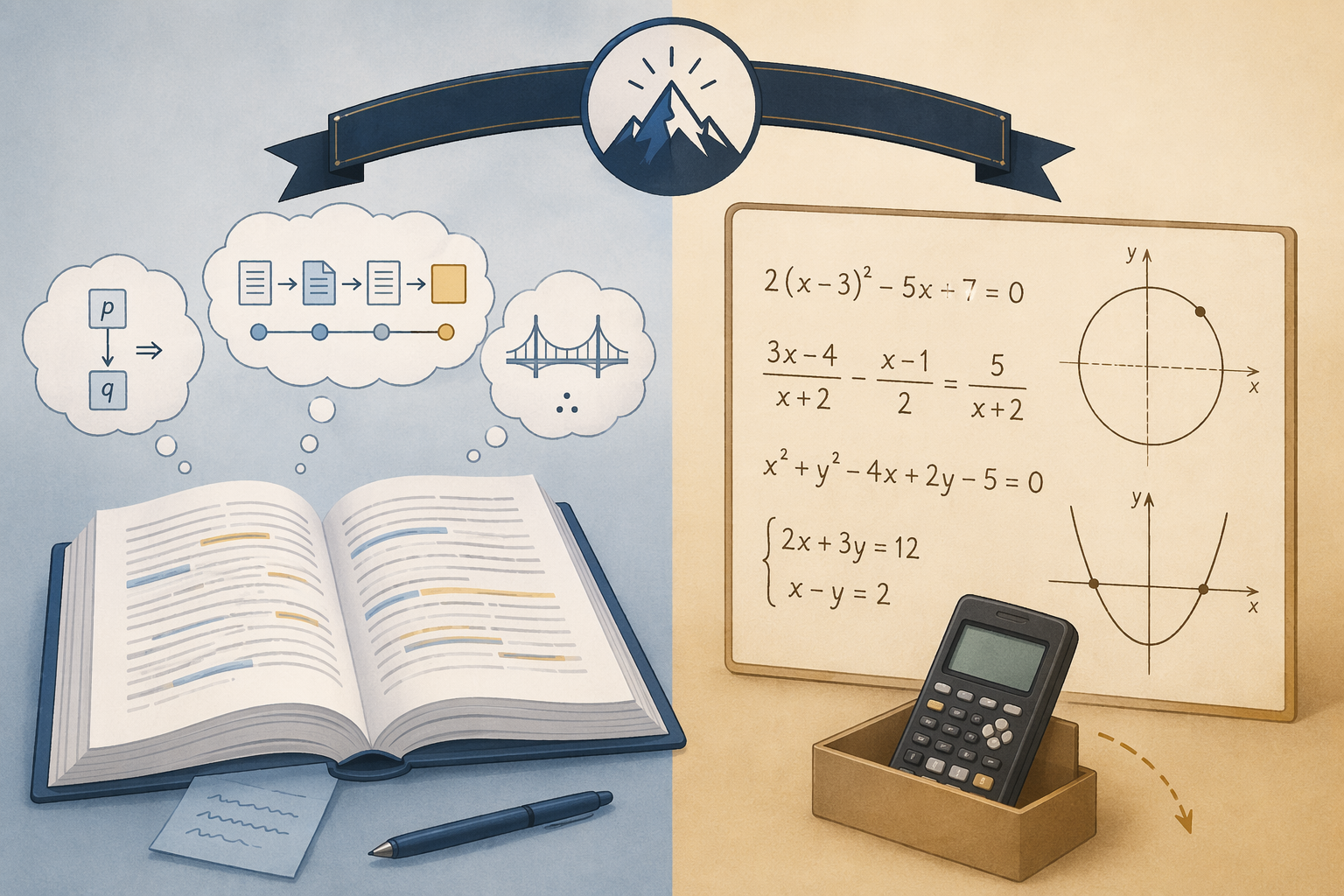
In Math, the hardest questions tend to be multi-step conceptual algebra problems: percentages with several moving quantities, systems with no or infinitely many solutions, circle equations on the coordinate plane, completing the square, and polynomial remainder problems. PrepMaven’s curated collection of hard 2026–27 SAT Math problems is useful here as a pattern map, not as a promise that each type will appear with a fixed frequency on test day.[2]
The Hardest Reading Questions Are Usually Logic Questions in Disguise
Strong readers often resent this part of the SAT because the missed question does not feel like a reading miss. They understood the paragraph. They knew the topic. They could summarize the argument. Then they chose an answer that sounded reasonable, and the correct answer turned out to be colder, narrower, and more defensible.
That is exactly why Inference questions matter. A good Inference answer is not the most interesting extension of the passage. It is the answer that must be true, or at least is most strongly supported, based on the given text. The trap answer often says something compatible with the passage but not required by it. At 680, students are good at rejecting answers that contradict the text. At 750+, they also reject answers that merely feel plausible.
A useful review question after an Inference miss is not “Did I understand the passage?” It is “Where did I add a bridge the passage did not build?” That bridge may be a background assumption, a stronger version of the author’s claim, or a cause-and-effect relationship that the text never actually states. The student who can name that extra bridge is trainable. The student who only writes “read more carefully” is going to repeat the miss.
Command of Evidence questions create a similar kind of frustration. The student can identify the general topic, but the question is asking a stricter thing: which quotation, data point, or textual detail best supports a specific claim? PrepMaven treats Command of Evidence as one of the hardest Reading categories because it requires students to evaluate the relationship between claim and proof, not just locate familiar words.[1]
The most common high-score error is evidence matching by topic. If the claim is about a scientist’s conclusion, the student chooses an answer mentioning the same scientist. If the claim is about a trend in a table, the student chooses the option that includes one relevant number. But evidence is not decoration. It has a job. It must prove the exact claim, at the exact strength, with no missing link.
| Hard Reading Archetype | What It Punishes | What to Review After a Miss |
|---|---|---|
| Inference | Choosing what could be true instead of what must follow | Identify the assumption you added that was not in the text |
| Command of Evidence | Matching topic words instead of proving the claim | State the claim in your own words, then test whether the evidence fully supports it |
| Data-based evidence | Reading a chart for a relevant number but not the relationship the question asks about | Name the comparison, increase, decrease, or exception the evidence has to establish |
This is why broad Reading practice often stalls. A student may complete dozens of passages and still never isolate the actual fault line. If the misses are mostly Inference and Command of Evidence, then the review should train proof standards: what the passage states, what it implies, what it does not justify, and which answer changes the strength of the claim.
Words in Context still matters, and so do the other Reading and Writing types. But for a student already scoring in the 600s or low 700s, vocabulary-in-context work is rarely the whole ceiling. If you need the full inventory before narrowing your work, use Know Every SAT Prep Question Type on the Digital SAT as the broader map. Then come back to the question types that keep demanding proof rather than recognition.
The Hardest Math Questions Usually Start Before the Calculator
The digital SAT gives students Desmos, and Desmos is excellent. It can graph, solve, compare, and expose patterns quickly. But the hardest Math questions often begin one step earlier than the calculator. They ask whether the student can set up the right relationship before using the tool.
Strategic Test Prep makes this point directly in its analysis of a hard 2026 SAT Math problem: some questions are designed to look Desmos-friendly while still requiring conceptual algebra, such as completing the square, before the calculator becomes useful.[3] That distinction matters. A student who opens every hard problem by graphing may still be stuck if the problem’s real demand is structure.
PrepMaven’s hard Math collection points to several recurring archetypes worth drilling. Again, this is not a frequency forecast. A curated “hardest questions” set tells us which patterns are capable of producing high-difficulty problems; it does not tell us exactly how often each will appear. Used correctly, though, it gives a strong student a useful diagnostic list.[2]
Percent Problems With More Than One Moving Part
Easy percent questions ask for a single increase, decrease, or part-whole relationship. Hard percent questions make two or more quantities move at once. A price changes while a quantity changes. A population is split into groups, then one group changes at a different rate. A variable represents the original amount, and the answer choices describe the final amount in terms of that original.
The error pattern is predictable: students calculate one percent correctly, then attach it to the wrong base. On review, the question should be labeled by base, not by topic. “Percent question” is too vague. “Changed quantity used as the new base” is useful. “Two groups with different rates of change” is useful. The point is to make the next version recognizable under pressure.
Systems With No Solution or Infinitely Many Solutions
These questions look procedural until they are not. A student who only knows how to solve a system may miss the question that asks when a system has no solution or infinitely many solutions. The concept is about line relationships: same slope with different intercepts for no solution, and equivalent equations for infinitely many solutions.
Desmos can help confirm the relationship, but the efficient path is usually algebraic. Put the equations into comparable form. Match coefficients deliberately. Track the parameter that controls whether the lines are parallel, identical, or intersecting. Students who try to “just solve” often burn time because the problem was never asking for a normal intersection point.
Circle Equations on the Coordinate Plane
Circle questions punish students who half-remember the formula but cannot read its structure. The standard form tells you the center and radius. Expanded form hides them. A hard question may ask for a radius, a coordinate, a tangent relationship, or a constant that makes the equation represent a particular circle.
Here, completing the square is not a decorative skill. It is how the equation reveals the geometry. If a student’s first move is to graph an unorganized equation, the calculator may show a circle, but the problem may still require the exact center, radius, or relationship between constants. The algebra turns the picture into usable information.
Completing the Square When the Form Matters
Completing the square appears in more than one costume. It can show up inside a circle equation, a quadratic vertex question, or a problem that asks for a minimum or maximum value. The student who memorized the steps but does not know why the form matters will be slow and fragile.
The review routine should ask: what did the completed-square form reveal that the original form hid? A vertex? A radius? A minimum value? A constant relationship? That question matters more than whether the student can perform the manipulation in isolation.
Polynomial Remainder Problems
Polynomial remainder questions are difficult because they compress several ideas into a small space. The Remainder Theorem, factors, zeros, and function notation can all appear in one problem. A student may know each ingredient separately and still miss the question because they do not recognize which input value matters.
A clean review label might be “remainder from evaluating at the opposite sign,” or “factor condition used to solve for a coefficient.” Those labels are not pretty, but they transfer. “Polynomial hard problem” does not.
| Hard Math Archetype | Common 680-Level Mistake | Better First Move |
|---|---|---|
| Multi-variable percentages | Using the wrong base after a change | Name the original quantity, changed quantity, and comparison quantity before calculating |
| No/infinite solution systems | Solving mechanically instead of comparing line relationships | Rewrite equations so slopes and constants can be compared |
| Circle equations | Graphing before extracting center and radius | Convert to standard form when the structure is hidden |
| Completing the square | Treating it as a procedure without asking what the new form reveals | Identify whether the target is a vertex, radius, minimum, or constant relationship |
| Polynomial remainders | Forgetting which input value determines the remainder | Connect divisor, zero, and function value before expanding |
If the foundations underneath these topics are shaky, do not start with a hardest-question set. Use The 4 Domains of SAT Math Questions and How to Master Them or A Domain-by-Domain Guide to SAT Math Problems first. Hard problems expose weak concepts; they do not kindly teach them from scratch.
Why Two or Three Math Misses Can Matter So Much
The pressure around hard Math questions is not imaginary. At MIT and CalTech, about 75% of enrolled students scored between 780 and 800 on SAT Math, which leaves room for only a very small number of mistakes across the 44 Math questions.[4][5] That benchmark should not turn every practice session into a panic drill. It should clarify the standard for students aiming at the most math-intensive admissions pools: the late-module questions cannot be treated as bonus questions.
This is also where digital SAT adaptivity changes the way practice should be prioritized. On the digital SAT, students who perform well in Module 1 move into a harder Module 2, and that harder second module gives access to the higher score ceiling. Prep companies and tutors commonly report that harder questions carry more scoring value in this adaptive structure, though College Board has not published a clean point-per-question formula. College Board describes digital SAT scores as accounting for question difficulty and student performance, but not as a public table where each item has a disclosed point value.[6]
So the practical rule is careful but firm: behave as if harder Module 2 questions matter disproportionately, without pretending anyone outside College Board can assign a guaranteed point value to a specific question. For a student in the 600–700 range, this makes targeted hard-question practice efficient once the common types are stable. It is not because hard questions are glamorous. It is because those are the questions most likely to decide whether the adaptive test lets the score keep climbing.

How to Practice Hard SAT Questions Without Wasting Them
Hard questions are limited, and burning through them casually is one of the more expensive mistakes a strong student can make. The goal is not to collect a trophy list of impossible problems. The goal is to make each missed question produce a transferable label.
- Sort the miss by reasoning failure, not by surface topic: wrong base, unsupported inference, evidence that matches topic but not claim, hidden circle structure, parameter controlling solution count.
- Write the first move you should have made: compare slopes, state the claim, convert to standard form, identify the original quantity, evaluate the polynomial at the needed input.
- Redo the question after a delay without looking at the explanation, because recognition immediately after review is not the same as transfer.
- Find two or three similar questions before moving on, so the label becomes a pattern rather than a one-time correction.
If you are not sure whether you are ready for this difficulty band, start with The Best SAT Practice Problems for Your Score Level or Choose SAT Practice Questions by Difficulty, Not Volume. A student still missing many medium algebra or grammar questions does not need a heroic hard-question plan yet. They need the score floor raised first.
If you are already stable on the common types, then the next work is narrower. For Math practice structure, use How to Make SAT Math Practice Questions Actually Work. For the review routine after misses, use How to Use SAT Practice Questions to Actually Raise Your Score. If the issue is that you need someone else to impose sequence, feedback, and accountability, a structured prep option may be more efficient than another folder of unreviewed questions.
The student stuck at 680 or 710 usually does not need to be told to work harder. They need the work to stop being so general. Once the basic SAT test questions are reliable, the fastest route upward is deliberate exposure to the archetypes that punish loose reasoning: Inference and Command of Evidence in Reading and Writing, and conceptual algebra setups in Math that have to be understood before they can be calculated.
References
- The Hardest Digital SAT Reading Questions, PrepMaven.
- 25 of the Hardest SAT Math Problems in 2026-27, PrepMaven.
- Hardest SAT Math Problem of 2026, Strategic Test Prep.
- MIT Common Data Set, Massachusetts Institute of Technology.
- Caltech Common Data Set, California Institute of Technology.
- Digital SAT Suite of Assessments: Scores, College Board.
Comments
Join the discussion with an anonymous comment.