
A Step-by-Step GRE Study Plan with Free Tools
This article provides a chronological plan for using free GRE study tools, from your initial diagnostic test through to the final practice simulation, so you can prepare effectively without spending money.
Updated:
The easiest way to waste free GRE study tools is to open the best ones too early. A full-length official practice test feels productive on day one, but if you use both ETS POWERPREP tests before you know what to do with the results, you lose the cleanest test-day rehearsal you have. The better plan is chronological: get an early diagnostic, rebuild the foundations exposed by that diagnostic, drill deliberately, then save your most realistic simulation for the end.
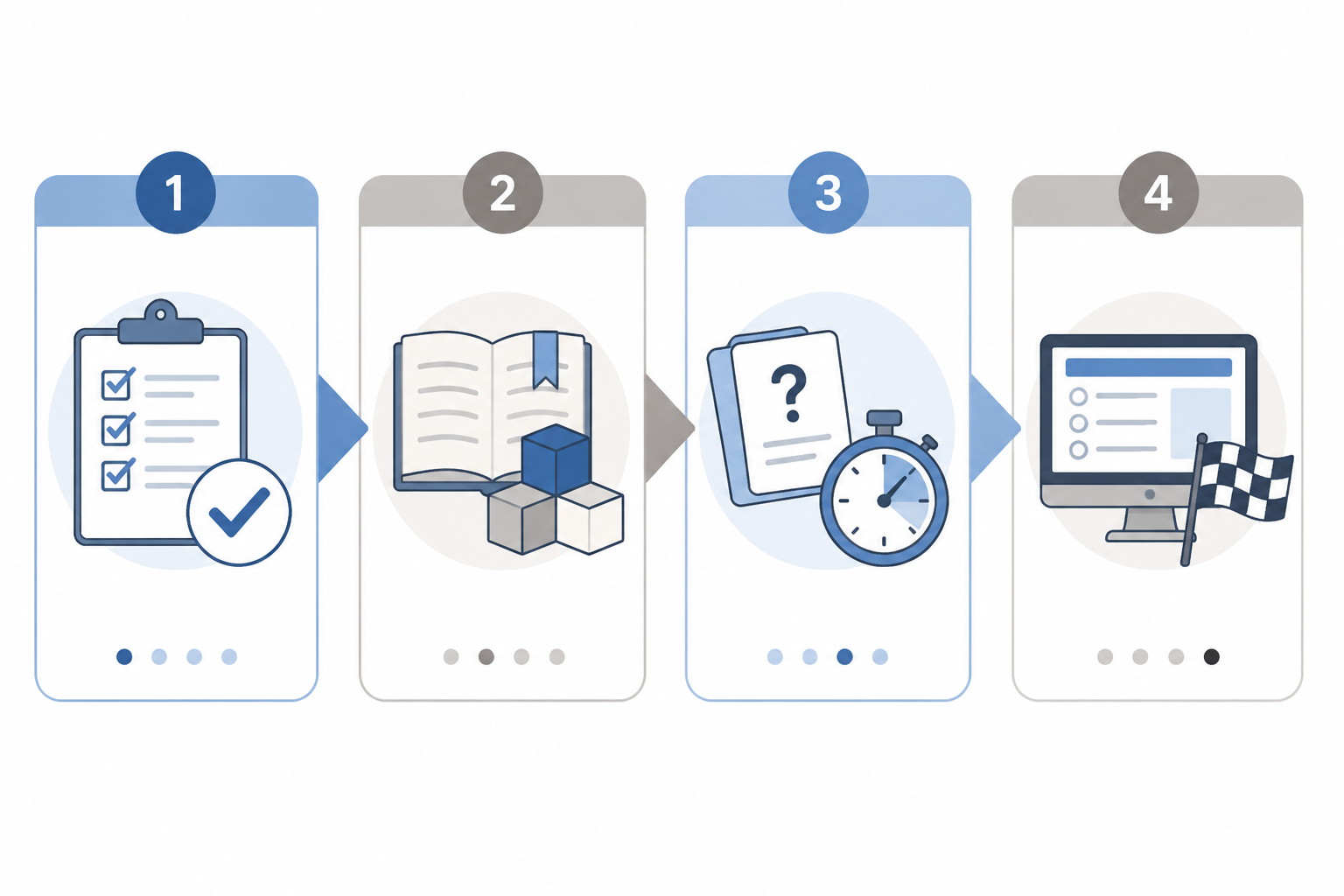
Here is the route before the details:
| Phase | Main job | Free tools to use |
|---|---|---|
| Diagnostic | Find your starting score range and error patterns without spending your best official test too soon. | Magoosh free practice test; ETS POWERPREP 1 |
| Foundation | Rebuild quant and verbal basics from the diagnostic instead of studying everything equally. | ETS Math Review PDF; Khan Academy topics mapped by ETS; official GRE prep materials |
| Drill | Turn weak skills into repeated retrieval and timed accuracy. | Magoosh Vocab Flashcards; free FSRS-capable flashcard apps; ETS Issue Essay Topic Pool; error log |
| Final simulation | Practice under current GRE timing and make final adjustments. | ETS POWERPREP 2, saved for the final two weeks |
If you want the larger test-prep landing page while you work through this plan, keep the GRE Prep Hub nearby. This article is the route through the free tools, not a replacement for every GRE topic guide.
Start With Two Diagnostics, Not Every Practice Test You Can Find
For a no-cost plan, you have three useful full-length data points: Magoosh’s free practice test and the two ETS POWERPREP practice tests listed among free GRE prep materials.[1][2] That does not mean you should take all three in the first week. Use the Magoosh test and POWERPREP 1 early. Save POWERPREP 2 until the final stretch, when it can still tell you something close to the truth.
Magoosh’s free test is useful because it gives you a starting point before you touch an official scored simulation. It is also a commercial tool from a prep company, so treat it as evidence, not gospel. If it says quant is weak, check whether POWERPREP 1 agrees. If it says pacing is fine but POWERPREP 1 punishes you, believe the official test first. PrepScholar and independent GRE educators also emphasize official ETS materials as the closest match to the real exam, which is why the free third-party diagnostic should support your plan rather than define it alone.[3][4]
Take the first diagnostic cold enough to expose reality, but not carelessly. Use a quiet block, follow the current section timing shown by the test platform, and do not pause to look up formulas or vocabulary. The goal is not to perform well. The goal is to create a repair list.
- Record your Quantitative Reasoning, Verbal Reasoning, and Analytical Writing results separately when available.
- Mark every missed quant question by topic, such as arithmetic, algebra, geometry, data analysis, or word-problem translation.
- Mark every verbal miss by task, such as vocabulary gap, sentence logic, passage mapping, trap answer, or rushed elimination.
- Separate knowledge errors from execution errors. A forgotten exponent rule and a misread negative sign need different fixes.
- Write down where time disappeared. A correct answer after four minutes is still a pacing warning.
Then take POWERPREP 1 after a short review of the test format, not after weeks of studying. POWERPREP 1 gives you an official baseline from ETS, the test maker, and it helps you check whether your first diagnostic was an outlier.[2] If both tests point to the same weaknesses, you have your foundation phase. If they disagree, look at the question-level evidence before you rewrite the whole plan.
Turn the Diagnostic Into Foundation Work
This is where many self-study plans become a pile of tabs. A diagnostic score does not automatically tell you what to study tomorrow. You have to translate it into skills.
For quant, start with the ETS Math Review PDF. Magoosh describes the ETS Math Review as a 100+ page official PDF, and ETS also directs test takers to official preparation materials for the General Test.[1][2] Its value is not that it is glamorous. Its value is that it uses the test maker’s boundaries: the formulas, terms, and concept areas the GRE expects you to know.
Do not read the whole PDF like a textbook unless your diagnostic shows broad quant damage. Use your error log as the index. If the diagnostic exposed ratio questions, percent change, coordinate geometry, or standard deviation, go directly to those areas first. Then use Khan Academy through ETS’s topic mapping when you need more explanation or practice on a concept the PDF names but does not fully teach.[1][2]
| Diagnostic evidence | Foundation response |
|---|---|
| You miss questions because you do not recognize the underlying concept. | Read the relevant ETS Math Review section, then watch or practice the mapped Khan Academy topic. |
| You know the rule but choose a slow method. | Redo the question untimed, then find a shorter setup before adding timed practice. |
| You make arithmetic or sign errors on familiar material. | Create a careless-error category in your log and review the exact trigger before the next timed set. |
| You run out of time with many blanks. | Practice smaller timed sets before returning to full sections. |
Verbal foundation work is less tidy because there is no equivalent official vocabulary syllabus. Still, the diagnostic tells you where to start. If Text Completion and Sentence Equivalence collapse because you do not know enough high-frequency words, build vocabulary. If Reading Comprehension is the main issue, spend more time on passage structure, answer prediction, and wrong-answer analysis than on adding another word list.
For Analytical Writing, the free official Issue Essay Topic Pool is helpful because it shows the kinds of prompts you may face, but it does not solve your scoring problem by itself.[2] You can practice outlining and writing from real prompt types. You cannot assume that a free automated score, a friend’s quick read, or your own confidence is the same as expert feedback. Budget plans can still include essay practice; they just need more humility about grading.
Drill So the Same Mistake Has Somewhere to Go
Drilling is not doing random questions until you feel tired. It is the part of the plan where every recurring mistake gets assigned a next action: review the concept, redo the setup, add a vocabulary card, write a better passage map, or practice a timed set.
A simple error log is enough. Use a spreadsheet, notebook, or document with columns for source, question type, topic, why you missed it, correct method, and next review date. The next review date matters because most students do not lose points only from never learning something. They also lose points from learning it once and letting it decay.
Vocabulary: Use Cards for Retrieval, Not Recognition
Magoosh Vocab Flashcards are a reasonable free starting point for GRE vocabulary, especially if you need a ready-made deck instead of building every card from scratch.[1] But the app or deck is not the whole method. If you flip a card, nod because the word looks familiar, and move on, you are rehearsing recognition. GRE sentence tasks often require usable meaning under pressure.
When vocabulary practice begins, pair a deck with a retrieval routine. Say the meaning before revealing the answer. Add a short phrase or contrast when a word is slippery. Separate words you truly missed from words you merely hesitated on. For deck choices, use GRE vocabulary flashcard deck comparisons when you need to choose a source list, and use How to Use GRE Vocabulary Flashcards the Right Way when the problem is technique rather than card supply.
Spaced repetition helps only if you actually follow the schedule. Free flashcard apps that support FSRS-style scheduling are appealing because FSRS project data reports 20–30% fewer reviews than fixed-interval systems for the same retention target, but that figure should be read carefully: the benchmark comes from FSRS project data rather than broad independent replication.[5] The practical takeaway is modest and useful. If an app can schedule reviews intelligently and you keep showing up, you may reduce wasted review time compared with rigid intervals.
If you are comparing tools, look at spaced repetition apps for GRE vocabulary with one question in mind: will this app make tomorrow’s review list clear enough that you will do it after work? The best algorithm does not help if the workflow is so fussy that you abandon it.
Quant and Verbal Drills: Keep Them Tied to the Log
After the foundation pass, drill in short, targeted sets before you return to full sections. If your log says coordinate geometry is weak, do not spend the evening proving to yourself that you are good at arithmetic. If your Reading Comprehension misses come from trap answers, do not hide inside vocabulary cards because they feel more measurable.
A useful drill cycle is small and repeatable: choose one weakness, review the underlying rule or strategy, do a short set, review every answer, then write one sentence about the mistake pattern. That final sentence is where the learning often happens. “Need more practice” is too vague. “I choose answers that mention a passage detail but ignore the author’s purpose” is something you can fix.
For essay work, use the Issue pool to practice fast outlining before full writing.[2] Pick a prompt, give yourself a few minutes to identify your position and examples, then compare your outline to the actual task wording. Full essays are still necessary, but outline practice is a cheap way to reduce panic and improve structure before you spend an entire timed session.
Before the Final Simulation, Update Your Timing Assumptions
The current GRE is not the old marathon version. ETS shortened the GRE General Test in September 2023, and current descriptions put the exam at about 1 hour and 58 minutes.[2] If a free guide, video, or study calendar is still built around a 3 hour 45 minute GRE, treat its timing advice as outdated even if some of its content review is still useful.
This matters most near the end. Your final simulation should train the stamina, pacing, and transitions of the test you will actually take. A longer old-format practice session may build endurance, but it can also teach the wrong rhythm. Use current official timing when you rehearse.
Save POWERPREP 2 for When It Can Still Tell the Truth
POWERPREP 2 should be protected. Community advice, commercial prep discussions, and independent GRE educators commonly treat the second official free test as the one to save for late-stage simulation because the official free tests draw from a fixed question pool.[1][3][4] Once you have seen the questions, the score is less clean. You may remember an answer, recognize a passage, or move faster because the problem no longer feels new.
A practical rule: take POWERPREP 2 in the final two weeks. That is late enough for the score to reflect most of your preparation and early enough to respond if it exposes a serious issue. Do not take it the night before the exam. A disappointing result then gives you anxiety but little time to repair anything.
- Use the same device setup and calculator rules you expect on test day.
- Follow the current GRE timing without pausing.
- Review the test after a break, not while you are still emotionally reacting to the score.
- Choose at most a few final fixes. The last two weeks are for high-impact repairs, not rebuilding the whole plan.
After POWERPREP 2, look for patterns, not drama. One bad geometry problem does not require a geometry emergency. Three misses caused by rushing through diagrams do. One unfamiliar word does not mean your vocabulary plan failed. Repeated mistakes on sentence logic may mean you are memorizing definitions without practicing how words function in context.
Where Free Tools Become Thin
A zero-cost GRE system can be complete enough for disciplined self-study, but it is not magic. The first thin spot is essay feedback. Official prompts are free, and writing practice is free, but nuanced scoring is harder to get without a knowledgeable reader or paid service. If your target programs care strongly about writing, you may need outside judgment.
The second thin spot is personalized diagnosis. Free tools can show that you missed a question. They usually cannot tell you, with much subtlety, whether the real problem was concept knowledge, translation, pacing, anxiety, or a bad elimination habit. Your error log has to do some of that work.
The third thin spot is judgment about when to move on. Free resources make it easy to keep collecting explanations. At some point, another video on averages is less useful than ten carefully reviewed problems. The plan works when each tool has a job and you stop using it once that job is done.
That is the honest bargain. You can build a serious GRE plan without buying a course if you protect the official tests, use the Magoosh diagnostic as one data point rather than a verdict, rebuild quant through ETS and Khan Academy mapping, schedule vocabulary for repeated retrieval, and manually interpret your mistakes. Free does not mean behind. It means you have to be the person who keeps the system in order.
References
- Free GRE Study Materials, Magoosh
- Prepare for the GRE General Test, ETS
- Best Free GRE Prep, PrepScholar GRE
- Free GRE Prep Resources, Vince Kotchian
- Best Flashcard App for GRE Vocabulary, Flica
Comments
Join the discussion with an anonymous comment.