

Study Resources: Florida Property Tax Amendment Impact on Libraries
A curated collection of primary sources, data, and analysis for researching how Florida's 2026 property tax amendment (Amendment 3) would affect public library funding, including key reports, revenue projections, and expert commentary.
Updated:
The quickest way to write a weak paper on the Florida property tax amendment impact on libraries is to pick one impressive-looking source and let it do every job. Amendment 3, also described in some materials as SJR 2-F, creates a source-matching problem: the library brief explains why public libraries are exposed, the state revenue estimates measure broader local-government losses, county maps show uneven geography, tax-policy groups explain the homeowner-burden argument, and local reporting shows how claims land in actual budget conversations.
For a research paper, those are not interchangeable sources. A library-specific issue brief can support a claim about funding dependence, but it cannot by itself prove the final county-by-county cut. A state estimating conference projection can show the scale of local-government revenue at risk, but it does not tell you which library branches would shorten hours. A pro-amendment tax argument matters, but it does not answer the replacement-funding question. The better study packet is built by giving each source a narrower assignment.
Start With the Library Funding Baseline
The EveryLibrary Institute issue brief is the load-bearing library source because it asks the library question directly. Its central figures are the ones a student should extract first: Florida public libraries received about $900 million in local property tax revenue in 2024, while total state aid to libraries was $17.7 million; the brief also identifies 541 public libraries and gives an average Florida library spending figure of $33 per resident per year.[1]
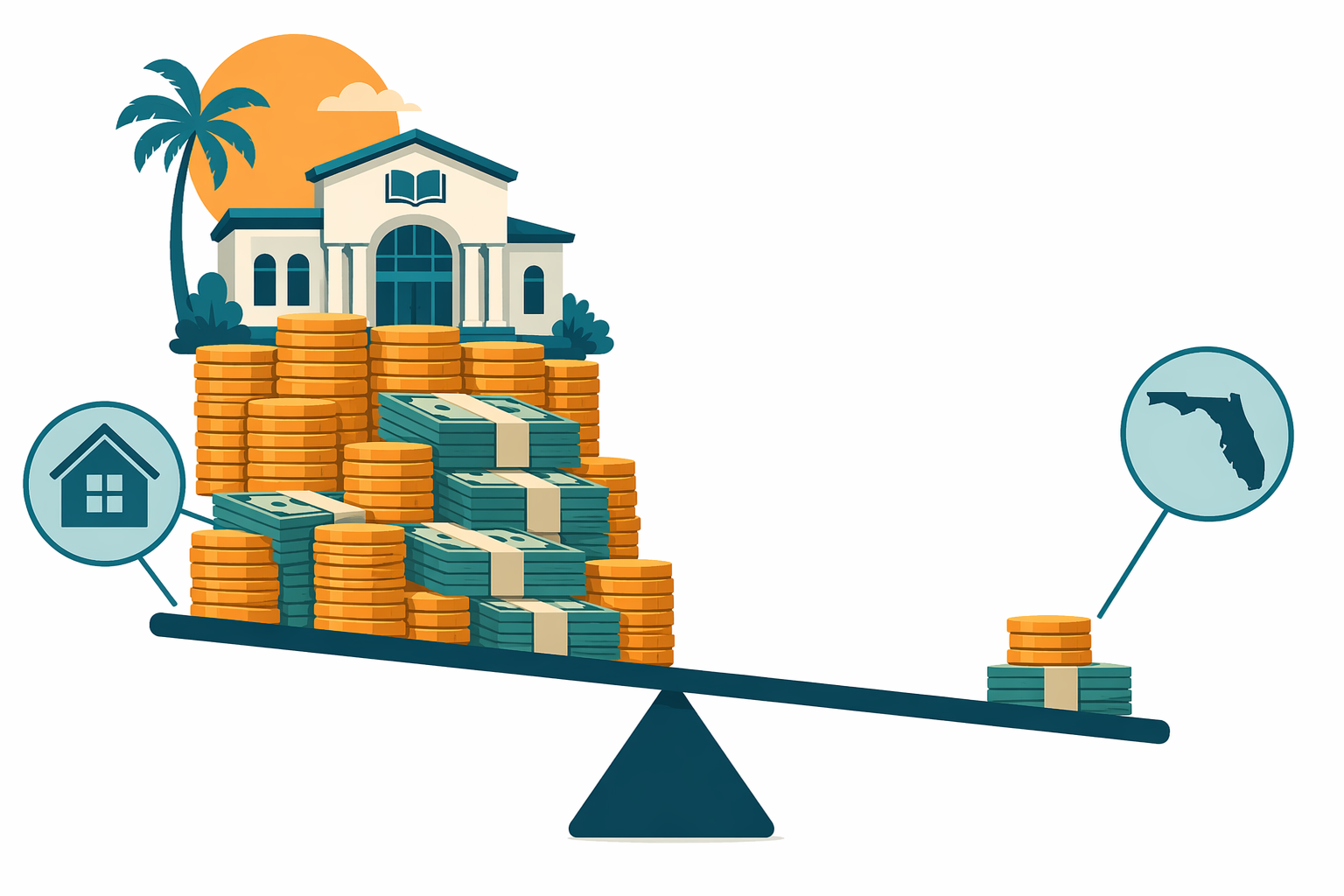
That $900 million beside $17.7 million is more useful than a general statement that “libraries rely on local funding.” It gives the paper a funding structure. If local property tax revenue is reduced and no replacement mechanism appears at comparable scale, libraries are not merely adjacent to the amendment; they sit inside the affected revenue system. The EveryLibrary brief is also the right place to look for its conclusion that there is no replacement mechanism at scale, but that claim should be paired with state and county fiscal materials rather than quoted alone.[1]
Use the EveryLibrary brief for three tasks: establishing the library funding baseline, identifying which library systems may be exposed to property tax reductions, and framing the replacement-funding problem. Do not use it as the only estimate of Amendment 3’s total fiscal impact. It is library-specific, which is its strength, but statewide revenue projections and county estimates still have to come from sources built for those questions.
One source-integrity note belongs near the top of any student’s notes: obtain the EveryLibrary PDF directly before quoting its figures. The available summary identifies the key numbers, but a defensible paper should verify the original brief, including any tables, definitions, footnotes, and county-level assumptions.[1]
| Research job | Best starting source | Use it for | Do not overclaim |
|---|---|---|---|
| Library funding baseline | EveryLibrary Institute | $900M local property tax revenue, $17.7M state aid, 541 libraries, $33 per resident | Exact branch-level service cuts |
| Statewide fiscal exposure | Revenue Estimating Conference via CBS Miami | Projected local-government revenue losses over time | Library-specific allocation of losses |
| County variation | Florida Policy Institute | County revenue-loss estimates and ballot-language context | Uniform effects across all counties |
| Tax-burden context | Florida TaxWatch | Historical property tax levy growth and policy alternatives | Evidence that library cuts are avoided |
| Local stakes and claims | WLRN | Miami-Dade reporting, renters issue, fact-checking of core-services claims | Statewide frequency from one county example |
| Pro-amendment framing | Americans for Tax Reform | Homeowner-relief argument and levy-growth claim | Independent fiscal replacement analysis |
Then Separate Total Revenue Loss From Library Revenue Loss
The statewide fiscal projection belongs in a different paragraph from the library baseline. CBS Miami’s report on the Revenue Estimating Conference gives the broader local-government scale: the amendment was projected to reduce local government revenue by about $5 billion in the first year and about $12 billion annually by year five; the same reporting says property taxes could rise to $83 billion by 2032 if unchecked.[2]
Those numbers are important because libraries compete within local budgets, not because the full $5 billion or $12 billion can be labeled a library cut. In a paper, the safer chain is: Amendment 3 is projected to reduce local-government revenue; Florida libraries are heavily dependent on local property tax revenue; therefore, libraries are plausibly exposed unless local governments replace or shield that funding. The last step is an inference from connected sources, not a single-source finding.
This distinction prevents a common citation mistake. A student should not cite the Revenue Estimating Conference projection as if it proves library closures. It proves estimated pressure on local-government revenue under a specified amendment design. To discuss libraries, bring EveryLibrary back into the paragraph and explain why that pressure matters for a property-tax-dependent service.
Use County Materials to Keep the Paper From Becoming Too Statewide
Florida Policy Institute’s ballot summary and county map are the right bridge between the big statewide estimate and local consequences. Its annual county revenue-loss estimate for the $250,000 exemption is about $4.6 billion to $4.8 billion, and its materials are designed to show how losses vary by county rather than treating Florida as one uniform budget.[3]
That county geography matters for library analysis. A county with a larger property tax base, different service structure, or different reserve position may respond differently from a county already making difficult budget choices. If the paper moves from “Florida libraries” to “what might happen in Miami-Dade, Broward, Hillsborough, or a rural county,” the citation burden changes. At that point, use county-level estimates as county-level evidence and label property-appraiser estimates as illustrative when they are not part of a uniform statewide study.
The Florida Policy Institute source is also useful for ballot-language context. Students often quote ballot summaries as if legal meaning, implementation, and fiscal outcome are already settled. They are not. If the source is explaining what voters will see, use it for that purpose; if it is estimating county revenue loss, identify the estimate and the exemption design being modeled.[3]
Tax-Burden Sources Belong in the Evidence Packet Too
A study resource on library impacts should still include the homeowner-relief case. Florida TaxWatch reports that total Florida property tax levies reached $59.2 billion and more than doubled over a decade, which gives students a grounded way to explain why property tax reform gained political traction.[4]
Florida TaxWatch is most useful for historical levy trends and policy alternatives. It should not be treated as evidence that library funding losses will or will not occur under Amendment 3. The source helps explain the pressure that produced the amendment debate; it does not replace the EveryLibrary funding baseline, the Revenue Estimating Conference projection, or county-level revenue modeling.
Americans for Tax Reform should be read as a pro-amendment argument source, not as a neutral fiscal note. Its framing emphasizes homeowner relief and cites a 40 percent increase in property tax levies over three years.[5] That is useful for a debate brief or counterargument section. The caution is equally important: advocacy framing can identify the political case for reform, but it does not by itself answer how counties would replace revenue or how library systems would be protected.
Local Reporting Shows What the Estimates Mean in Practice
WLRN’s reporting is where the budget discussion stops looking like a spreadsheet exercise. Its June 26, 2026 story reports that Miami-Dade’s library system projected a first-year cut of about $20 million and that library officials characterized the threat as existential.[6] That figure gives scale to the local stakes, but it should stay attached to Miami-Dade. It is not a statewide average and should not be converted into a template for every county.
The same reporting is also useful because it brings renters into the analysis. Property tax relief is often discussed through the homeowner’s bill, but local revenue changes can also raise questions about renters, businesses, landlords, and cost-shifting. The available material supports treating that as a live policy issue, not as a settled prediction about who ultimately pays more in every county.[6]
WLRN’s fact-checking is a separate source job. Its June 5, 2026 fact-check examined claims about “defunding” essential services and focused on the vagueness of the “core services” definition.[7] For a student paper, that source is useful when the argument turns on whether libraries, emergency services, or other local functions are clearly protected. It does not eliminate fiscal uncertainty; it helps define where the uncertainty sits.
Use National Context Briefly, Then Return to Florida
Bloomberg Tax can help situate Florida inside a broader homeowner-relief versus local-revenue debate.[8] That kind of national context is useful in an introduction or literature review, especially if the paper compares state tax limitation measures. It should not crowd out the Florida-specific evidence chain.
The same caution applies to the nationally cited $10.18-to-$1 library return-on-investment figure. It can explain why library advocates discuss libraries as economic assets, but it is not a Florida Amendment 3 revenue projection. If used at all, it belongs in a short background sentence, not in the core fiscal argument.
A Defensible Source Chain
A strong paragraph on Amendment 3 and libraries can be built in a simple sequence. Start with EveryLibrary for the library funding structure. Add the Revenue Estimating Conference projection for total local-government exposure. Use Florida Policy Institute to show that losses are geographically uneven. Bring in WLRN when discussing Miami-Dade, renters, local officials, or claims about protected services. Use Florida TaxWatch and Americans for Tax Reform to explain why supporters frame the amendment as tax relief.
- Claim: Florida libraries are highly dependent on local property taxes. Best support: EveryLibrary’s $900M local property tax revenue and $17.7M state aid figures.
- Claim: Amendment 3 creates major local-government revenue exposure. Best support: Revenue Estimating Conference projections reported by CBS Miami.
- Claim: Local impacts will vary by county. Best support: Florida Policy Institute’s county map and annual county revenue-loss estimate.
- Claim: Miami-Dade library officials see a large immediate threat. Best support: WLRN’s $20M first-year Miami-Dade reporting.
- Claim: Supporters are responding to real property tax burden concerns. Best support: Florida TaxWatch levy trend data and Americans for Tax Reform’s pro-amendment framing.
The weakest version of the argument would collapse these into one claim: Amendment 3 cuts taxes, therefore libraries close; or Amendment 3 helps homeowners, therefore libraries will be fine. The available materials support something more precise. Florida public libraries are overwhelmingly dependent on local property tax revenue; Amendment 3 is projected to reduce local-government revenue substantially; no replacement mechanism currently appears at comparable scale in the cited library materials; and exact local outcomes remain contingent on county budgets, legal developments, implementation decisions, and revised estimates.
Questions to Keep Open While Drafting
Several questions should remain marked as unresolved rather than smoothed over. Amendment 3 faces potential legal challenges, and fiscal projections may be revised. The Legislature removed a proposed trust fund for rural counties, leaving a replacement-funding gap that deserves explicit attention rather than a passing mention. County-level case studies from local property appraisers can be valuable, but they should not be mistaken for one standardized statewide study.
For the final draft, the safest research conclusion is not a sweeping prediction about every branch in Florida. It is that the strongest available materials support the claim that Florida public libraries depend heavily on local property taxes and that the current evidence base does not show a replacement mechanism at scale. After that, the paper should move carefully: county by county, source by source, and with the original EveryLibrary PDF verified before any key figure is quoted.
References
- Issue Brief: SJR2-F & the Future of Florida Libraries, EveryLibrary Institute, June 2026, link
- Florida property tax cut amendment could mean $5B in local government revenue losses, CBS Miami, link
- Florida Property Tax Amendment Ballot Language Summary, Florida Policy Institute, link
- Options to Eliminate or Reduce the Property Tax Burden on Florida Homeowners, Florida TaxWatch, link
- Americans for Tax Reform property tax amendment argument, Americans for Tax Reform
- Florida property tax reform could threaten libraries and raise questions for renters, WLRN, June 26, 2026, link
- WLRN fact-check on Florida property tax amendment and essential services, WLRN, June 5, 2026
- Bloomberg Tax coverage of homeowner relief and local revenue debate, Bloomberg Tax
Comments
Join the discussion with an anonymous comment.