

Choose SAT Practice Questions by Difficulty, Not Volume
Learn why doing more easy SAT practice questions won't raise your score above 650 and how to tier your practice by difficulty to access the harder module that unlocks higher scores.
Updated:
If you are doing SAT test practice questions every week and your score still sits in the 500–650 range, the problem may not be effort. It may be the difficulty band you keep practicing inside.
The digital SAT is adaptive by section. In each section, you answer Module 1 first; your performance there helps determine whether Module 2 is easier or harder.[1] That routing matters because the two second modules do not offer the same scoring ceiling. EdisonOS, analyzing Bluebook-style digital SAT behavior, reports that a student routed to the easier Math Module 2 can be capped around 650 even with a perfect second module, while a student routed to the harder module can still reach 800.[2]
That is the part many score reports do not make emotionally obvious. A student can be responsible, complete neat sets of questions, and even feel more fluent than last month, yet still be training below the line that opens the harder Module 2. More easy questions can make the spreadsheet look better while leaving the adaptive gate untouched.
The first target is Module 1, not your total question count
EdisonOS estimates that the harder Math Module 2 usually requires about 60% accuracy on Math Module 1, roughly 13 of 22 questions correct. For Reading and Writing, it estimates the harder Module 2 cutoff around 70% accuracy, roughly 19 of 27 questions correct.[2] Those are not College Board-published rules. They are third-party estimates based on practice-test behavior, so they should be treated as planning targets, not as magic numbers.
Still, they change the way practice should be chosen. A student at 520 Math does not need 100 more questions that confirm basic linear-equation comfort. That student needs enough Module 1 accuracy, across the right domains and difficulty bands, to stop being routed into the lower-scoring branch.
| If this is happening | The likely practice problem | What to change |
|---|---|---|
| You finish many sets but miss hard Module 1 questions | The work is too concentrated in Fundamental or comfortable Medium questions | Keep accuracy work, but move deliberately into Medium and then Advanced items |
| Your practice-test score jumps on one test and drops on another | The tests may not be equally difficult or equally predictive | Use Bluebook tests in a more careful sequence instead of treating all scores as identical |
| You review every miss equally | Low-weight and high-weight domains are competing for the same study time | Prioritize the domains that occupy more of the test |
Use the Student Question Bank as a difficulty filter, not just a question warehouse
The College Board Student Question Bank is the cleanest place to build this kind of practice because it lets students filter official questions by assessment, test, domain, skill, and difficulty level: Fundamental, Medium, or Advanced.[3] The useful move is not simply opening the bank and doing whatever appears first. The useful move is choosing the smallest set that tests the next threshold.
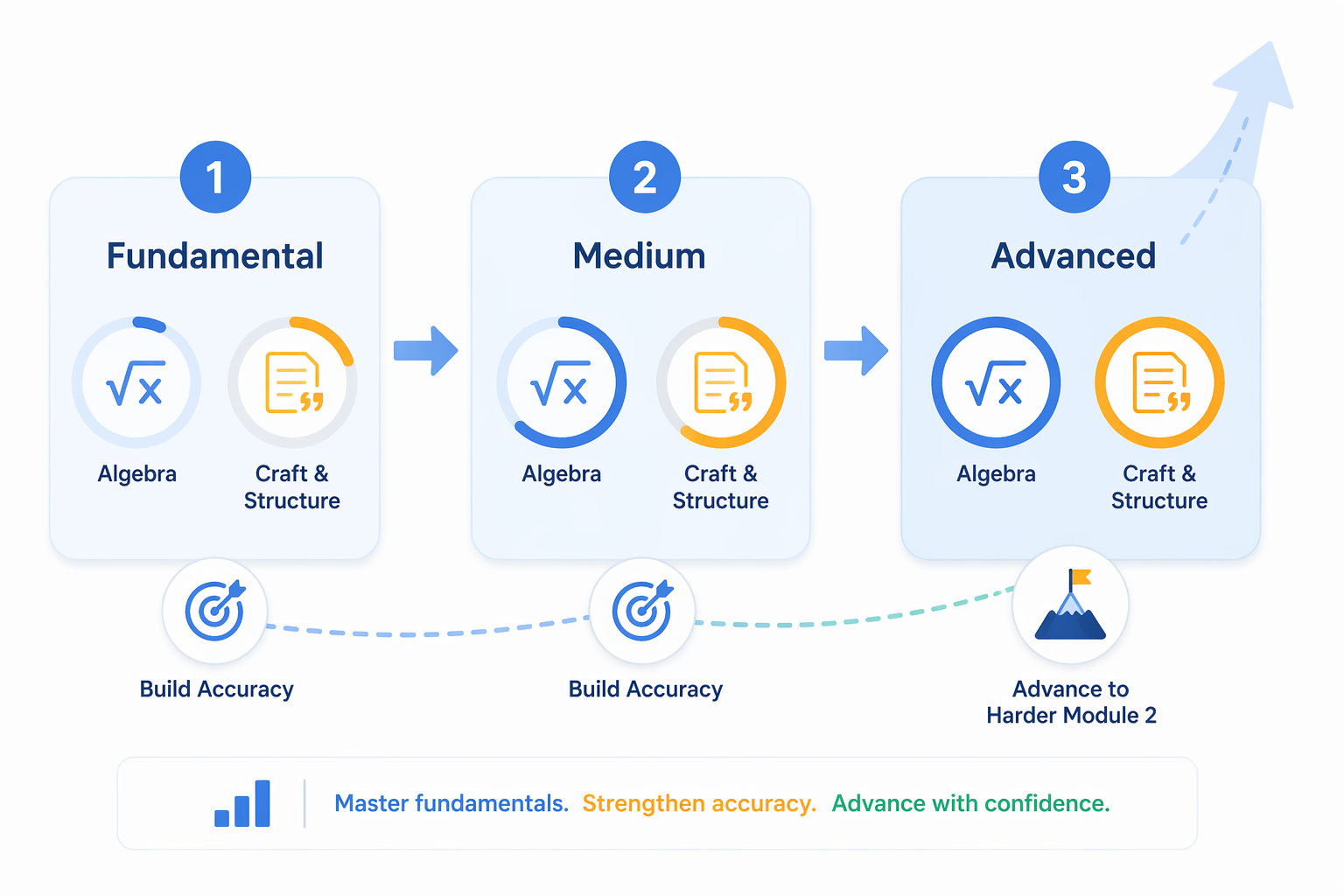
Start by filtering for the section you are trying to raise, then filter by domain. Within that domain, use difficulty as the steering wheel. Fundamental questions are for repairing missing basics. Medium questions are where many 500–650 scorers should spend serious time, because this is where accuracy has to become stable rather than occasional. Advanced questions should enter before the student feels completely ready, because the harder Module 2 will not wait until every weakness is gone.
A practical tiering routine
- Choose one high-value domain, not the whole test. For Math, that often means Algebra or Advanced Math. For Reading and Writing, that often means Craft & Structure or Information & Ideas.
- Do a short Fundamental set only if the skill is shaky. If you are missing these because of content, pause and repair the skill before adding difficulty.
- Move to Medium and stay there until accuracy is steady across mixed versions of the skill, not just after seeing one familiar format.
- Add Advanced questions in small batches. Review why the trap answer worked, what made the setup harder, and whether the mistake was content, reading, timing, or strategy.
- Return to mixed Module 1-style practice. The goal is not to master a worksheet category in isolation; it is to keep enough accuracy when the test changes topics.
For a student hovering near the adaptive cutoff, this approach is more honest than counting finished questions. Twenty Medium and Advanced questions in a high-weight domain may reveal more than 80 easy questions that never threaten the routing line.
Not every missed question deserves the same study time
Domain weights are not exact personal score formulas, but they are good triage. EdisonOS summarizes College Board-aligned Math weighting at about 35% Algebra, 35% Advanced Math, 15% Problem-Solving and Data Analysis, and 15% Geometry and Trigonometry.[2] That means a Math student who treats all misses equally can accidentally over-study smaller slices while under-training the two domains that carry most of the section.
| Section | Higher-priority domains | Approximate weight |
|---|---|---|
| Math | Algebra | 35% |
| Math | Advanced Math | 35% |
| Math | Problem-Solving and Data Analysis | 15% |
| Math | Geometry and Trigonometry | 15% |
| Reading and Writing | Craft & Structure | 28% |
| Reading and Writing | Information & Ideas | 26% |
| Reading and Writing | Standard English Conventions | 26% |
| Reading and Writing | Expression of Ideas | 20% |
In Reading and Writing, the same logic applies. Craft & Structure is about 28%, Information & Ideas about 26%, Standard English Conventions about 26%, and Expression of Ideas about 20%.[2] A student who wants the harder R&W Module 2 should not hide entirely in grammar drills if inference, vocabulary-in-context, or evidence questions are the misses that keep pulling down Module 1.
This is where difficulty filtering becomes useful instead of decorative. If Algebra is weak, do not only sort for Algebra. Sort for Algebra at Fundamental, then Medium, then Advanced. If Craft & Structure is weak, do not only read more passages. Sort for that domain and watch whether the miss rate changes when the question moves from ordinary wording to denser answer choices.
What Advanced questions feel like
Advanced does not always mean longer. In Math, it often means the setup is less direct, the algebra has to be chosen rather than obvious, or two concepts are layered. PrepMaven’s 2026–27 collection of hard SAT Math problems shows this well: the difficulty often comes from recognizing the structure before doing the computation, not from performing exotic math.[4]
In Reading and Writing, Advanced can feel like a passage that refuses to hand you a formula. Test Ninjas describes SAT reading comprehension as especially difficult because there is “no formula or shortcut,” requiring active reading and inference across varied passage types.[5] That does not mean practice is vague. It means the practice set has to include inference-heavy and evidence-sensitive questions early enough that the student learns what the hard module is asking for.
When to stay in Medium and when to push Advanced
The common mistake is jumping from easy accuracy to hard frustration. A cleaner path is to use Medium as the proving ground. If Medium accuracy is unstable, Advanced questions will mostly produce messy review notes: “read better,” “don’t rush,” “be careful.” Those notes feel responsible and usually change very little.
Stay in Medium when the miss is still about the tested skill itself. For example, if a Math student cannot reliably solve a linear equation in context, an Advanced systems question is not yet the best use of time. Push into Advanced when the basic skill is present but the student loses points because the question is less direct, combines skills, hides the relevant relationship, or uses tempting answer choices.
- Use Fundamental questions to diagnose and repair missing content.
- Use Medium questions to stabilize Module 1 accuracy.
- Use Advanced questions to prepare for the harder Module 2 and expose trap patterns.
- Use mixed sets to check whether the skill survives topic switching.
A 500–650 scorer does not need to abandon easier questions. Easier questions are useful when they explain a miss. They become a problem when they are used to avoid the difficulty band that controls the next score range.
Practice tests can mislead you if the sequence is wrong
Full-length tests are still necessary, but not all practice-test scores should be trusted in the same way. Strategic Test Prep’s 2026 Bluebook ranking calls Test 11 the “gold standard,” noting that it contains at least five passages the author observed in real SAT administrations.[6] The same ranking warns that Tests 8, 9, and 10 combine old questions from retired Tests 1–3 and may feel noticeably easier, advising students to mentally adjust those scores downward.[6]
That is expert sequencing guidance, not a controlled study. Still, it is useful if your scores seem to jump without a matching change in skill. An easier Bluebook test can create the same false comfort as an easy question set: it rewards work, but it may not reveal whether you can clear the harder adaptive path.
Use easier or less representative tests earlier for stamina, interface comfort, and broad diagnosis. Save the strongest simulations for moments when the result will change your plan. If you need a broader comparison of official and free materials, a guide such as Which Free SAT Practice Tests Actually Boost Your Score in 2026 can help separate practice quantity from practice quality. For the mechanics of combining official tests with review, How to Take SAT Practice Tests with Bluebook and Khan Academy is the better companion.
A better weekly pattern for a 500–650 scorer
A useful week does not need to be complicated. It needs to make the student face the right evidence. One high-weight domain, one difficulty ladder, one review pass, and one mixed check will usually teach more than a large undifferentiated pile of SAT test practice questions.
| Practice block | What to do | What it tells you |
|---|---|---|
| Domain selection | Choose Algebra, Advanced Math, Craft & Structure, or Information & Ideas first if those are weak | Whether study time is aimed at a large enough part of the test |
| Fundamental check | Do a small set only when the skill foundation is uncertain | Whether the problem is content knowledge |
| Medium set | Work until the skill holds across several versions | Whether Module 1 accuracy is becoming reliable |
| Advanced set | Add harder questions in small batches and review traps closely | Whether practice is beginning to resemble the harder Module 2 |
| Mixed review | Combine domains and difficulty levels after targeted work | Whether the gain survives the real test’s topic switching |
Math students who want a deeper section-specific version of this approach can use How to Make SAT Math Practice Questions Actually Work after setting the difficulty framework. Students building a full prep system can place this routine inside a broader plan with SAT Exam Prep Guide: Best Tools, Study Plans, and Section Strategies for the Digital SAT or A Complete Guide to SAT Study Tools in 2026.
The point is not to make practice harsher for its own sake. The point is to stop rewarding work that does not touch the adaptive gate. For a student in the 500–650 range, the goal is not to finish the most SAT test practice questions. It is to build enough accuracy in the right domains and difficulty bands to earn the harder Module 2.
References
- SAT Structure — College Board
- Digital SAT Format & Structure Breakdown (2026) — EdisonOS
- Student Question Bank — College Board
- 25 Hardest SAT Math Problems (2026–27) — PrepMaven
- SAT Reading Practice — Test Ninjas
- Best Bluebook SAT Practice Tests Ranked (2026 Update) — Strategic Test Prep
Comments
Join the discussion with an anonymous comment.