

How to Decide Between the SAT and ACT in 2026
Choosing between the SAT and ACT in 2026 depends less on which test is 'easier' and more on how your personal pacing and stamina match each format. This guide provides a 5-step diagnostic framework and college policy updates to help you decide.
Updated:
The SAT/ACT decision usually becomes stressful at the worst possible moment: a sophomore or junior is ready to start prep, a parent is trying not to waste a semester, and every search result seems to promise that one test is secretly easier. In 2026, that is the wrong question. The better question is much more specific: does this student score better with the Digital SAT’s more generous pacing and shorter adaptive format, or with the ACT’s faster, more linear rhythm and optional science section?
This matters more now because testing policies are no longer safely parked in the test-optional era. Compass Prep tracks SAT and ACT policies and score ranges for more than 400 colleges, and CollegeVine reports that six of the eight Ivy League schools require the SAT or ACT for the 2026-27 cycle.[1][2] That does not mean every student needs to chase a score at every college. It does mean students should not delay the test decision until spring and hope policy confusion will make the question disappear.
The Difference Students Actually Feel
On paper, both exams test reading, grammar, math, and college-readiness skills. In the chair, they feel different because the clock behaves differently. The Digital SAT is about two hours and 14 minutes long, uses adaptive modules, allows a calculator throughout math, has no separate science section, and gives roughly 71 seconds per Reading and Writing question.[3] The Enhanced ACT is linear, moves faster, and is about two hours and 55 minutes with Science, or about two hours and 10 minutes without Science; its English section gives roughly 42 seconds per question.[3][4]
That 71-versus-42-second contrast is not trivia. It is the student experience. One student rereads a sentence twice and still recovers on the SAT. The same student may spend the ACT English section feeling hunted. Another student gets bored by the SAT’s slower rhythm, overthinks, and performs better when the ACT forces quick decisions. Neither reaction is a moral quality. It is a pacing match.
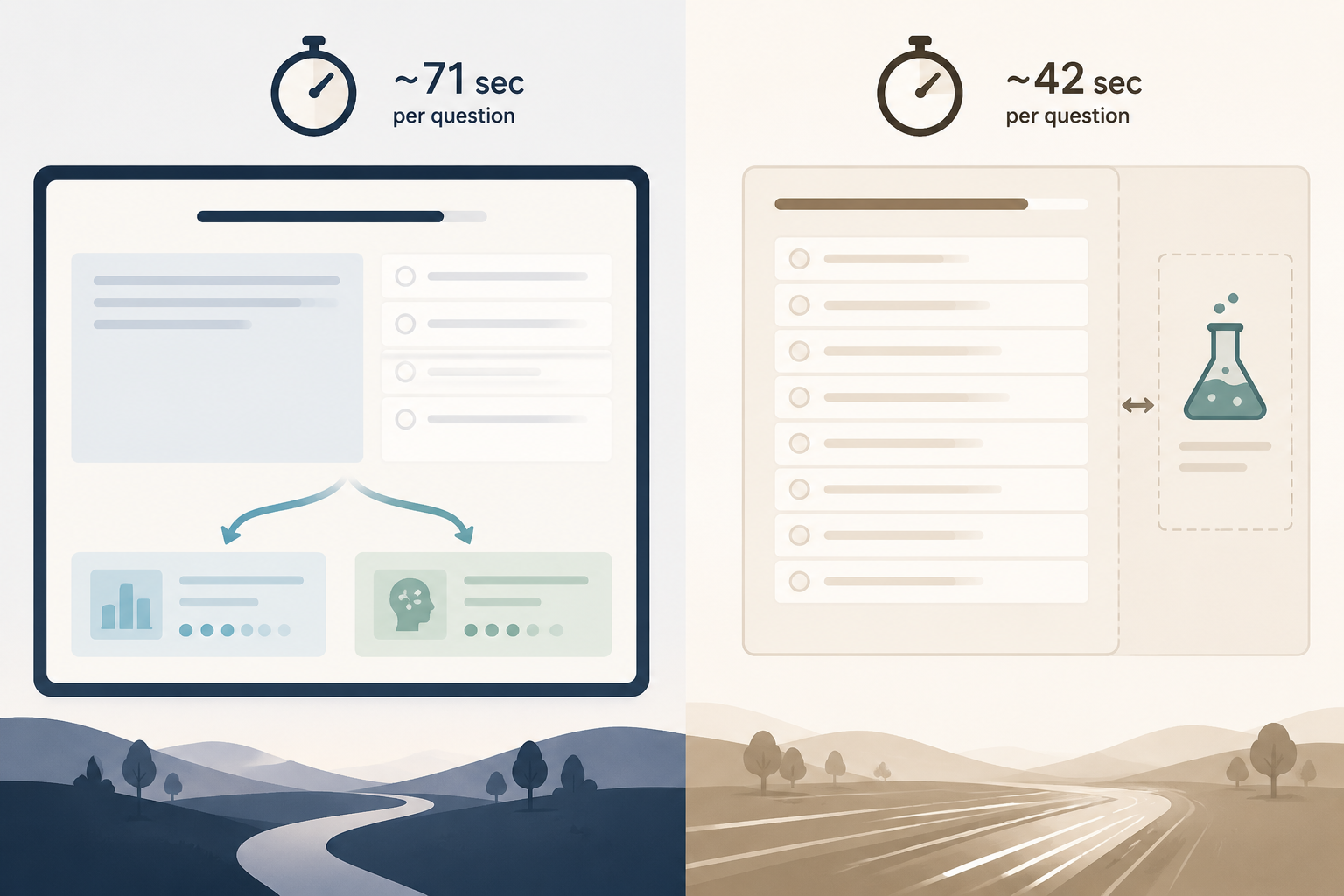
The adaptive SAT also changes the emotional texture of the test. A student completes one module, then receives a second module shaped by performance. The ACT does not adapt mid-test; students move through the same linear sections under tighter time pressure. Some students like the clean march of a linear test. Others do better when the total sitting is shorter and the test is broken into digital modules.
Science deserves special attention in 2026 because it is no longer simply the fourth equal piece of the ACT for every student in every context. National Saturday paper testing switched to the Enhanced ACT in September 2025, and school-day testing switches in spring 2026; under some formats, Science is optional and the composite may average English, Math, and Reading, with each carrying about one-third weight instead of one-fourth.[5] Students still need to check the registration format, school-day rules, and college expectations before assuming Science can be ignored.
| Question to Ask | Digital SAT Signal | Enhanced ACT Signal |
|---|---|---|
| Does the student need more time to read and decide? | Often a better fit because pacing is more generous. | Can be punishing if slow rereading is common. |
| Does the student stay sharp during a longer sitting? | Shorter total duration may reduce fatigue. | Longer version with Science can expose stamina issues. |
| Does the student like fast, linear work? | May feel too slow or invite overthinking. | Often rewards quick readers and decisive test-takers. |
| Does data interpretation help the student? | No standalone science section. | Science may help, hurt, or be strategically optional depending on format. |
A Five-Step Diagnostic That Beats Guessing
The cleanest SAT/ACT test prep decision comes from two serious diagnostics, not from a student’s first emotional reaction after one section. The steps below are practical, not a laboratory instrument. Their purpose is to stop a family from spending months preparing for the test that merely sounded more comfortable.
Step 1: Take One Official Digital SAT Under Real Conditions
Start with a full official Digital SAT practice test in Bluebook if possible, with normal timing, normal breaks, and no pausing to look up formulas or argue with the answer choices. Khan Academy’s Official Digital SAT Prep is the free resource partnered with College Board, and it is useful after the diagnostic because it can turn weak areas into targeted practice.[6]
The conditions matter. A student who takes one module after dinner, another the next morning, and the math section with a parent explaining missed questions has not produced a diagnostic. That student has produced a mood board. For a more detailed setup, use a full-length testing routine like taking SAT practice tests with Bluebook and Khan Academy before interpreting the result.
Step 2: Take One ACT-Style Diagnostic With the Right 2026 Format
Next, take an ACT diagnostic that matches the version the student is likely to face. This is where 2026 gets messy. Because the Enhanced ACT rollout is phased, some students may still see format differences depending on test date, location, and whether the exam is national Saturday testing or school-day testing.[5] Before comparing scores, confirm whether Science is included, optional, or required for the student’s actual plan.
Do not let the ACT diagnostic become four casual section drills scattered across a week. The ACT’s faster cadence and longer version are part of the test. A student’s hands tell the truth here: rushing bubbles, skipping line references, guessing in clumps, or losing patience with charts in Science are not side notes. They are the diagnostic.
Step 3: Compare Percentiles, Not Raw Feelings
After both diagnostics, compare percentile performance. Do not compare how much the student liked the interface, how familiar the math felt, or whether a friend said the ACT was easier. A higher percentile means the student performed better relative to other test-takers on that exam. That is the first serious clue.
If one test is clearly stronger by percentile, the decision is usually done. Families often resist this because the weaker test has a story attached to it: “She just had a bad morning,” “He has not taken biology yet,” “The SAT felt weird.” Maybe. But if the gap is meaningful and the testing conditions were fair, start where the student is already performing better.
If the percentiles are close, then the next question is not “which score can we fantasize into a 99th percentile?” It is which prep path the student can live inside for the next several months. A close diagnostic can justify dual awareness for a short time. It does not automatically justify full dual-prep.
Step 4: Audit Timing Misses and Reading Fatigue
This is the part many score reports do not explain clearly enough. Two students can miss the same number of questions for completely different reasons. One misses because the content is weak. Another misses because the section ended while three answer choices were still unread. Those are different prep problems.
- Mark questions missed after rushing, not just questions missed from lack of knowledge.
- Count questions left blank or guessed in the final minute of each section.
- Notice whether accuracy drops late in the test, especially on ACT Reading or Science.
- Separate math errors caused by concepts from math errors caused by speed.
- Ask whether the student recovered after hard questions or carried frustration into the next passage.
The SAT’s shorter total duration and more generous per-question time can help students who need a moment to settle into a question. The ACT can favor students who read quickly, make decisions without circling back repeatedly, and do not become rattled when every section feels brisk. This is why a student who earns strong grades in school can still choose the wrong test if the family only looks at subject strengths.
Step 5: Decide What Science Does to the ACT Plan
ACT Science is often misunderstood. It is not mainly a test of memorized lab facts. For many students, it is a data-reading and pacing section. That distinction matters. A student who likes graphs, tables, experimental setups, and quick pattern recognition may find Science useful. A student who gets irritated by dense visuals after already completing English, Math, and Reading may watch the section drain the score report and the afternoon.
Because some Enhanced ACT scoring models separate Science from the composite, the Science decision is no longer identical for every student.[5] Still, optional does not mean irrelevant. A college, scholarship program, school-day requirement, or personal score strategy may make Science worth taking. The diagnostic should answer a narrow question: does Science improve the student’s ACT case, or does it add fatigue without enough payoff?
What College Policies Should and Should Not Change
College policy should affect urgency, not replace the diagnostic. If a student is applying to colleges that require testing, waiting until senior fall to discover a pacing mismatch is a bad plan. If a student is applying mostly to test-optional schools, a strong score may still help, but the score has to be worth the time taken from grades, essays, activities, and sleep.
Score ranges also need careful handling. Compass Prep’s college profiles include score ranges, but those ranges represent the middle 50% of enrolled students, not hard cutoffs or guarantees.[1] A score below a range does not automatically end an application, and a score inside a range does not carry the rest of the file. Use ranges to set a target, not to create a fantasy of certainty.
Policies can also shift. Lists for one admission cycle may not perfectly predict the next. Before a student locks in a final testing calendar, check the colleges on the actual application list and confirm whether they require, recommend, consider, or ignore SAT and ACT scores.
After the Diagnostic, Stop Shopping and Start Prepping
Once the diagnostic points to a test, the next mistake is to keep researching as a form of procrastination. SAT/ACT test prep only starts working when the student is doing timed practice, reviewing errors, and repeating the skills that actually lost points.
For the SAT, official Bluebook practice and Khan Academy’s free Official Digital SAT Prep should be part of the plan.[6] Students comparing free and paid support can use a resource like Khan Academy vs AI SAT tutors to think about whether they need structure, feedback, or simply more disciplined practice.
For the ACT, use a diagnostic and practice materials that reflect the Enhanced ACT format the student will actually take. PrepMaven’s review compares 32 prep courses, which can be useful for families choosing between structured programs after they already know the target test.[7] The order matters: choose the test first, then choose the course.
Dual-prep is sometimes reasonable, but it is expensive in attention. Princeton Review discusses strategies for preparing for both exams, and that approach can make sense when diagnostics are close and the student has enough calendar space.[8] It is much harder to justify when one percentile is clearly stronger or when the student is already overloaded.
Prep format is a separate decision from test choice. Some students need a local schedule and an adult in the room; others do well with online practice and feedback. If location is becoming the main question, it is worth asking whether SAT prep near me really matters for the Digital SAT. But do not confuse a convenient prep option with evidence that the test itself is the better fit.
The Decision Rules
Choose the SAT if the student’s SAT percentile is stronger, or if the diagnostics show a clear benefit from more time per question, shorter total duration, calculator access throughout math, and no standalone science section. This is especially true for students whose ACT misses come from rushed reading, late-section fatigue, or irritation with the science-style data work.
Choose the ACT if the student’s ACT percentile is stronger, or if the student handles fast linear work well, reads decisively, maintains stamina, and is helped rather than harmed by the Science option. A student who thrives under a brisk clock should not be talked out of the ACT just because the SAT gives more time.
Consider both only if the diagnostic percentiles are close, the student has enough months before testing deadlines, and dual-prep will not crowd out schoolwork. Otherwise, pick the better-fitting test and begin. The student does not need the theoretically easier exam. The student needs the exam on which their actual score, timing, and stamina hold up.
References
- SAT and ACT Policies and Score Ranges, Compass Prep
- Complete List of Colleges Requiring SAT/ACT 2025-2026, CollegeVine
- SAT vs. ACT in 2026: Which Test Should You Take?, Spark Admissions
- ACT® vs Digital SAT®: Which Test Is Better for College Admissions in 2026, UWorld
- ACT Changes 2025-2026: New Format & What to Expect, Test Ninjas
- Maximize your score with free Official Digital SAT® Prep, Khan Academy
- 12 Best SAT Prep Courses for 2026 (32 Courses Reviewed), PrepMaven
- How to Prep for BOTH the SAT and ACT, Princeton Review
Comments
Join the discussion with an anonymous comment.