
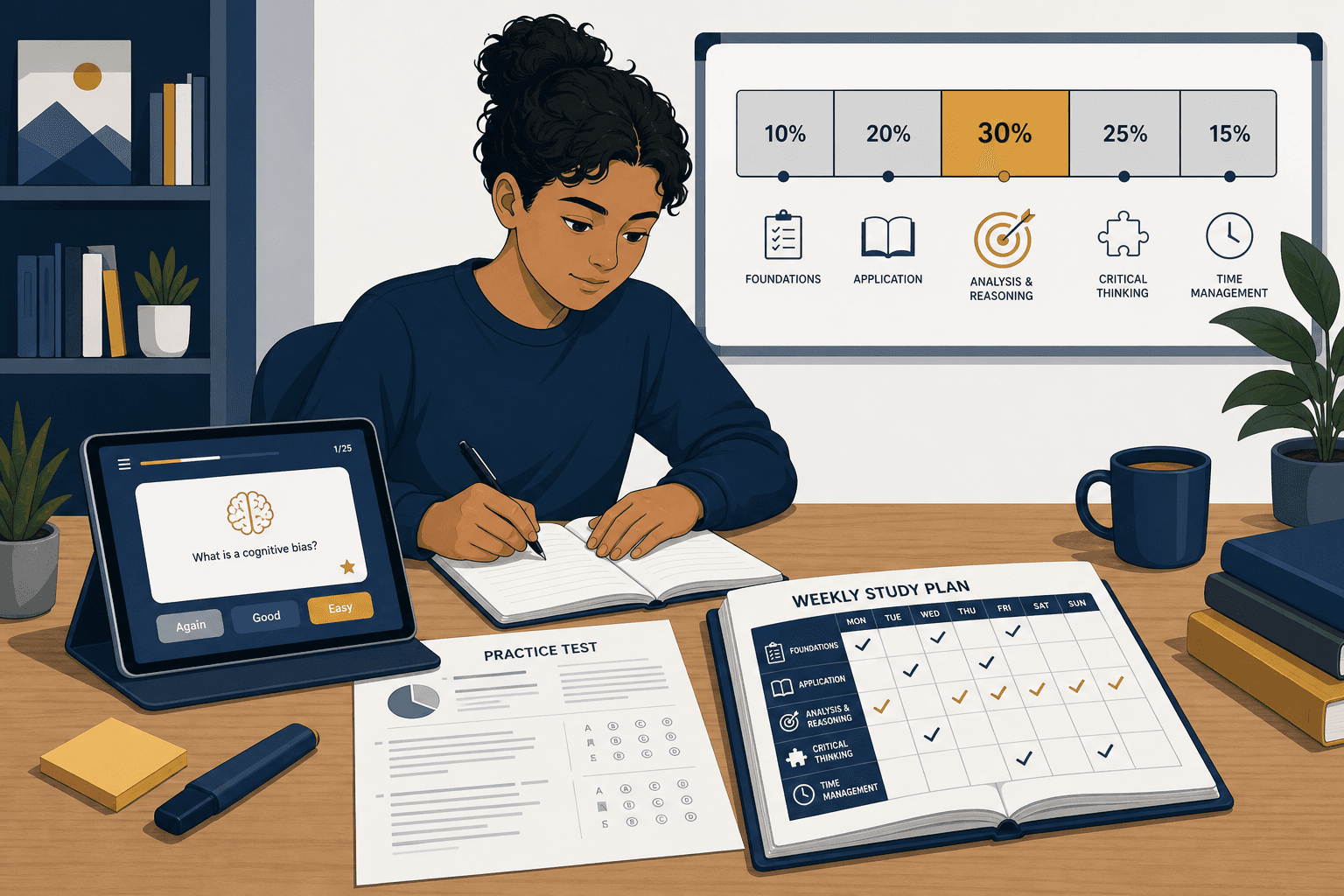
ASVAB Exam Prep Guide: How to Study Smarter by Subtest Priority
Most ASVAB guides treat all 10 subtests equally — but the AFQT formula double-weights Verbal Expression, meaning Word Knowledge and Paragraph Comprehension deliver twice the score return per hour studied. This hub walks prospective military recruits through the AFQT scoring formula, a subtest priority strategy, a week-by-week study plan, and the right study tools matched to each section type.
Updated:
What Is the ASVAB?
The Armed Services Vocational Aptitude Battery (ASVAB) is a standardized test administered by the U.S. Department of Defense. It serves two functions: determining whether you qualify to enlist in a branch of the military, and identifying which military occupational specialties (MOS), rates, or Air Force specialty codes (AFSC) you are eligible for.
Anyone applying to enlist in the Army, Navy, Marine Corps, Air Force, Space Force, or Coast Guard is required to take the ASVAB. Most recruits take it between their junior and senior year of high school, or shortly after graduation. Retakes are permitted, but waiting periods apply — one calendar month after your first test, one calendar month after your first retest, and then a six-month wait between each subsequent attempt.
CAT-ASVAB vs. Paper-and-Pencil ASVAB
The test comes in two formats, and the behavioral differences between them matter for how you prepare.
| Feature | CAT-ASVAB | Paper-and-Pencil (P&P) |
|---|---|---|
| Where administered | Military Entrance Processing Stations (MEPS) | Military Entrance Test (MET) sites |
| Format | Adaptive — question difficulty adjusts based on your answers | Non-adaptive — all test takers receive the same questions |
| Can you change answers? | No — once submitted, an answer is final | Yes — within the time limit for each subtest |
| Guessing strategy | Guess only if you've exhausted your thinking time | Always guess on unknowns — unanswered questions count as incorrect |
| Approximate questions | 135 questions | 225 questions |
| Approximate time | ~3 hours 17 minutes | ~2 hours 29 minutes |
| Score availability | Unofficial scores available same day | Scores take longer to process |
How Your AFQT Score Is Calculated
Your AFQT (Armed Forces Qualification Test) score is the number that determines whether you can enlist at all. It is not the same as your overall ASVAB score — it is calculated from just four of the ten subtests.
The formula is:
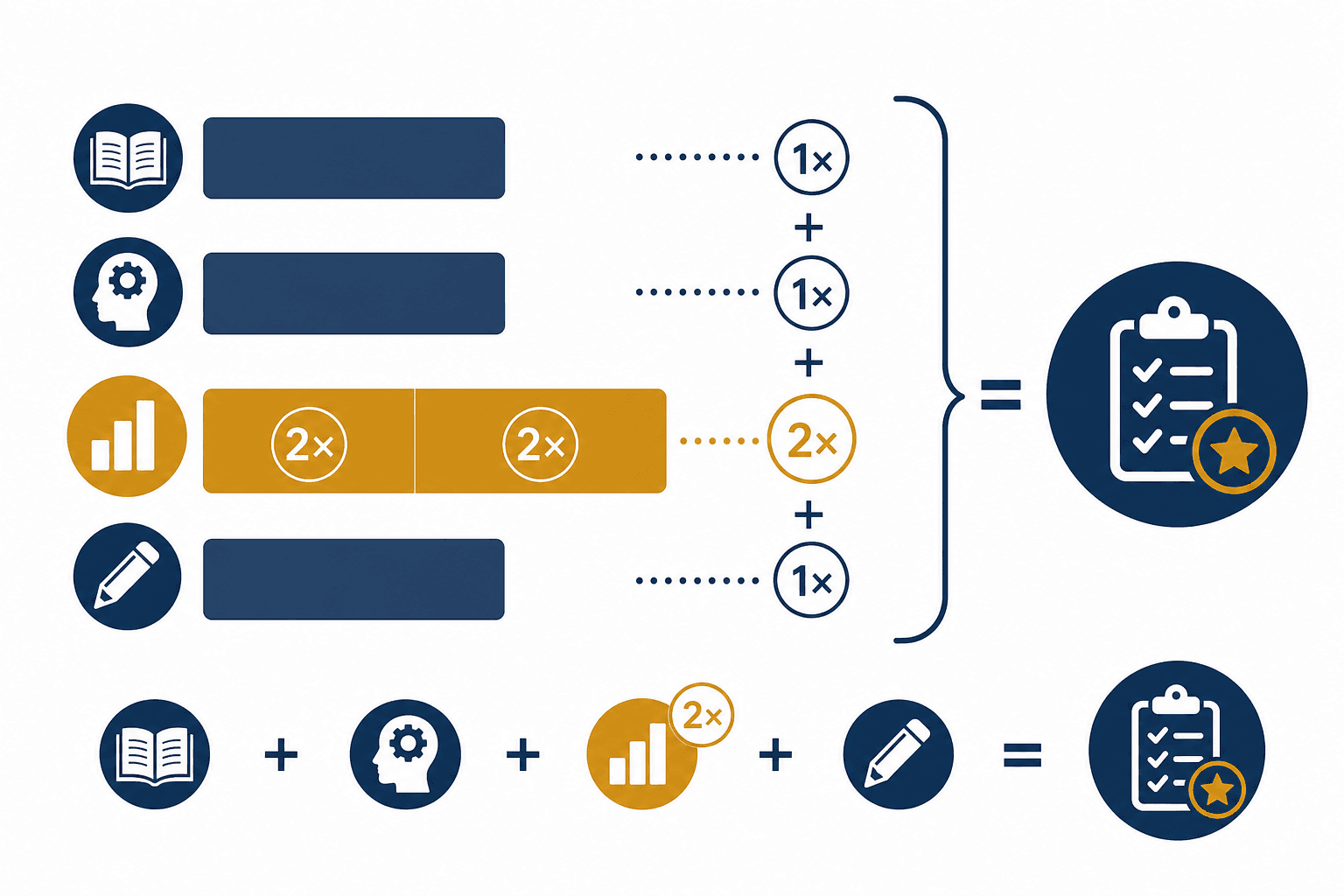
The Verbal Expression (VE) score is calculated by adding your Word Knowledge and Paragraph Comprehension raw scores together — and then that combined score is multiplied by two before being added to AR and MK. This double-weighting is the single most important structural fact about the ASVAB for study planning purposes.
A Worked Example: Why VE Dominates Your AFQT
Consider a recruit with these raw subtest scores: AR = 12, MK = 13, WK = 11, PC = 12. Their VE score is WK + PC = 23. Plugging into the formula: AFQT raw = 12 + 13 + (2 × 23) = 12 + 13 + 46 = 71. The VE contribution alone is 46 out of 71 raw points — roughly 65% of the total.
That means a single additional point on VE (earned by improving WK or PC) adds 2 points to your AFQT raw score. A single additional point on AR or MK adds only 1 point. Word Knowledge and Paragraph Comprehension are, by structure, the highest-leverage subtests on the entire test.
Your raw AFQT score is then converted to a percentile ranging from 1 to 99, based on a 1997 national reference sample. A score of 50 means you performed better than 50% of that reference group — it does not mean you answered 50% of questions correctly.
Branch Minimum AFQT Scores
| Branch | HS Graduate Minimum | GED Holder Minimum |
|---|---|---|
| Army | 31 | 50 |
| Marine Corps | 31 | 50 |
| Navy | 31 | 50 |
| Air Force | 31 | 50 |
| Space Force | 31 | 50 |
| Coast Guard | 36 | 47 |
All 10 ASVAB Subtests at a Glance
The ASVAB measures ten distinct content areas organized into four domains. The table below gives you a complete map of the test — what each subtest covers, its approximate CAT question count and time limit, and whether it feeds your AFQT score or only your line scores for job eligibility.
| Subtest | Abbreviation | Domain | What It Tests | CAT Questions (approx.) | CAT Time (approx.) | AFQT or Line Score? |
|---|---|---|---|---|---|---|
| Word Knowledge | WK | Verbal | Vocabulary, synonyms, word meanings in context | 16 | 8 min | AFQT (via VE) |
| Paragraph Comprehension | PC | Verbal | Reading comprehension, inference, main idea | 11 | 22 min | AFQT (via VE) |
| Arithmetic Reasoning | AR | Math | Word problems involving basic arithmetic and reasoning | 16 | 39 min | AFQT |
| Mathematics Knowledge | MK | Math | High school math: algebra, geometry, number properties | 16 | 20 min | AFQT |
| General Science | GS | Science/Technical | Biology, chemistry, physics, earth science fundamentals | 16 | 8 min | Line score only |
| Electronics Information | EI | Science/Technical | Electrical circuits, current, voltage, components | 16 | 8 min | Line score only |
| Auto Information | AI | Science/Technical | Automobile systems, engines, maintenance | 11 | 7 min | Line score only |
| Shop Information | SI | Science/Technical | Tools, materials, construction, shop practices | 11 | 6 min | Line score only |
| Mechanical Comprehension | MC | Science/Technical | Mechanical principles: gears, levers, pulleys, force | 16 | 20 min | Line score only |
| Assembling Objects | AO | Spatial | Spatial reasoning: how parts fit together | 16 | 16 min | Line score only |
Which Subtests to Prioritize — and Why
The AFQT formula creates a clear priority hierarchy. Not all subtests are created equal, and treating them that way is the single biggest mistake most recruits make when studying.
The Three-Tier Priority Framework
- Tier 1 — WK and PC (highest leverage): Every point you gain on Word Knowledge or Paragraph Comprehension adds 2 points to your AFQT raw score because VE is doubled in the formula. These two subtests should receive the most study time of any in your plan.
- Tier 2 — AR and MK (AFQT core): Arithmetic Reasoning and Mathematics Knowledge each contribute one point per raw point to your AFQT. They are essential — but each point gained here is worth half what a VE point is worth. Study these after WK and PC are showing improvement.
- Tier 3 — GS, EI, AI, SI, MC, AO (line scores only): These six subtests have zero effect on your AFQT. They only affect your line scores, which determine eligibility for specific military jobs. Study these only after your AFQT core is secured, and only if you have a target MOS or rate that requires a strong line score in these areas.
Line Scores and Job Eligibility: A Quick Reference
If you are targeting a specific military job that requires strong line scores, you will need to layer in Tier 3 subtest preparation after your AFQT target is secured. Each branch uses different line score composites. Here is a condensed reference:
| Branch | Key Line Score Composite | Subtests Included | Example Jobs That Use It |
|---|---|---|---|
| Army | GT (General Technical) | AR + VE | Intelligence Analyst, many technical MOS |
| Army | EL (Electronics) | GS + AR + MK + EI | Electronics and signal MOS |
| Air Force | M (Mechanical) | AR + AS + MC + VE | Maintenance and mechanical AFSC |
| Air Force | G (General) | AR + VE | Admin, intel, many officer-adjacent AFSC |
| Air Force | E (Electronics) | AR + EI + GS + MK | Avionics, cyber, electronics AFSC |
| Navy | Nuclear Field | AR + MK + EI + GS ≥ 252 | Nuclear Electronics Technician, Nuclear Machinist |
How Long to Study — and Why a Diagnostic Comes First
Test prep experts recommend a preparation window of four to eight weeks for most recruits. A four-week plan is workable if your goal is minimum enlistment eligibility and your diagnostic scores are already in the ballpark. A six-to-eight week plan is more appropriate if you are targeting competitive MOS or rate scores, have significant gaps in math or reading, or are starting from a low baseline.
Before you build any study schedule, take a full-length diagnostic practice test. This is not optional — it is the most efficient first step you can take.
Why the Diagnostic Is the Real Starting Point
A diagnostic reveals your actual baseline on each subtest, not your assumed baseline. Most recruits overestimate their math and underestimate their vocabulary gaps. Without a diagnostic, you risk spending three weeks on Arithmetic Reasoning when your real score drag is in Word Knowledge — the highest-leverage subtest in the entire formula.
- Take a full-length timed practice test before you open any study materials.
- Score each subtest separately — do not look only at your total or AFQT estimate.
- Identify your two or three lowest-scoring subtests within the AFQT core four (WK, PC, AR, MK).
- Allocate your first two weeks of study to those weak areas, not to subtests where you are already scoring adequately.
Week-by-Week Study Plan Template
The following templates are starting frameworks, not rigid prescriptions. Adjust the daily session length and subtest rotation based on your diagnostic results and the time you have available each day. Aim for one to two study sessions per day, each 30 to 45 minutes long — shorter focused sessions with active recall are more effective than long passive reading blocks.
4-Week Track (Minimum Eligibility Focus)
| Week | Primary Focus | Daily Session Structure | End-of-Week Goal |
|---|---|---|---|
| Week 1 | WK + PC (Verbal Expression) | Mon: WK flashcards | Tue: PC reading practice | Wed: WK review | Thu: PC timed passages | Fri: WK + PC mixed | Sat: Partial practice test (verbal sections) | Sun: Mistake review | Identify your 20 highest-frequency vocabulary gaps; complete 2 timed PC passage sets |
| Week 2 | AR + MK (Math core) | Mon: AR word problems | Tue: MK algebra/geometry | Wed: AR timed set | Thu: MK review | Fri: AR + MK mixed | Sat: Partial practice test (math sections) | Sun: Mistake review | Complete 3 timed AR sets and 3 MK sets; convert missed questions to flashcards |
| Week 3 | AFQT Core Review + Full Test Simulation | Mon–Thu: Rotate weak subtest from Weeks 1–2 | Fri: Light review only | Sat: Full-length timed practice test | Sun: Score analysis and mistake review | Complete first full-length timed practice test; identify remaining weak areas |
| Week 4 | Targeted Weak Area Repair + Final Simulation | Mon–Thu: Focus on lowest-scoring AFQT subtest from Week 3 test | Fri: Light review and rest | Sat: Second full-length practice test | Sun: Final mistake review and rest | Complete second full-length practice test; score should be at or above target |
6-Week Track (Competitive MOS Score Focus)
| Week | Primary Focus | Notes |
|---|---|---|
| Week 1 | WK + PC (Verbal Expression) | Same as 4-week Week 1. Build vocabulary flashcard decks and complete daily PC reading practice. |
| Week 2 | AR + MK (Math core) | Same as 4-week Week 2. Focus on timed problem-solving, not passive review. |
| Week 3 | AFQT Core Review + First Full Simulation | First full-length timed practice test on Saturday. Identify your AFQT score estimate and remaining weak areas. |
| Week 4 | Branch-Specific Line Score Subtests (Tier 3) | Introduce GS, EI, MC, or AI/SI based on your target MOS or rate. Use YouTube and reference materials for visual/mechanical content. |
| Week 5 | Line Score Subtests + AFQT Maintenance | Continue Tier 3 subtest prep. Revisit WK flashcards daily (10–15 minutes) to maintain VE gains. |
| Week 6 | Full Simulation + Final Repair | Full-length timed practice test in Week 6's first half. Use final days for targeted weak area repair and rest before test day. |
Best Study Tools Matched by Subtest Type
The most useful framing for ASVAB study tools is not "which app is best" — it is "which type of tool matches the type of learning each subtest requires." Different subtests demand fundamentally different cognitive tasks, and the right tool for vocabulary memorization is not the right tool for math problem-solving.
WK, PC, and GS — Spaced Repetition and Flashcard Apps
Word Knowledge, Paragraph Comprehension, and General Science all contain significant memorization components — vocabulary definitions, synonyms, prefixes and suffixes, and science terminology. Spaced repetition systems (SRS) are the strongest match for this type of content because they schedule reviews at increasing intervals just before you are likely to forget, building durable long-term retention rather than short-term cramming.
Recommended tools in this category include Anki (free, open-source, highly customizable, available on all platforms), Quizlet (beginner-friendly, large library of existing ASVAB vocabulary decks, free tier available), and Brainscape (confidence-based repetition, structured ASVAB deck collections). Verify current pricing and feature availability for each tool before committing.
- Build WK flashcard decks organized by prefix/suffix families, high-frequency synonyms, and words-in-context examples.
- For GS, create one card per definition or concept: biology terms, chemistry units, physics principles, and earth science vocabulary.
- Study 10–20 minutes daily with your SRS app, then use a separate practice test to apply the vocabulary in context.
- Convert missed practice test questions into new flashcards immediately after each review session.
AR and MK — Structured Practice Test Platforms
Arithmetic Reasoning and Mathematics Knowledge are procedural skills — you learn them by doing problems under timed conditions, not by reading explanations. The right tool here is a structured practice test platform that delivers ASVAB-format questions, tracks your accuracy by problem type, and provides worked solutions for missed questions.
Recommended platforms in this category include Achievable (adaptive question bank with detailed explanations, ASVAB-specific), Mometrix (comprehensive ASVAB practice tests with video explanations), and Union Test Prep (free practice question sets organized by subtest). Kaplan's ASVAB prep materials are also widely used for structured math review. Verify current pricing for paid platforms before purchasing.
EI, MC, AI, SI — YouTube and Visual Resources
Electronics Information, Mechanical Comprehension, Auto Information, and Shop Information test your ability to understand how physical systems work — circuits, gears, engines, tools. These concepts are best learned visually and contextually, not through text-based flashcards alone. YouTube channels that explain electrical circuits, mechanical principles, and automotive systems with diagrams and animations are highly effective for this content type.
Search for ASVAB-specific mechanical and electronics review channels, as well as general channels covering basic electrical theory, gear ratios, and engine systems. After watching, convert key concepts ("if voltage increases and resistance stays constant, current increases") into flashcard questions to reinforce retention.
Structured Reference Books
ASVAB prep books from Kaplan, Barron's, and Mometrix serve as structured companions to app-based studying — particularly for recruits who want a complete content review organized by subtest. Books are especially useful for math content review (MK) and for recruits who prefer reading over screen-based study. They are less efficient for vocabulary acquisition than SRS apps, but useful for the explanations they provide alongside practice questions.
| Subtest Type | Content Demand | Best Tool Type | Example Tools |
|---|---|---|---|
| WK, PC | Vocabulary memorization, reading comprehension | SRS / flashcard apps | Anki, Quizlet, Brainscape |
| GS | Science terminology and definitions | SRS / flashcard apps | Anki, Quizlet |
| AR, MK | Procedural math problem-solving under time pressure | Structured practice test platforms | Achievable, Mometrix, Union Test Prep, Kaplan |
| EI, MC, AI, SI | Visual/mechanical concept understanding | YouTube + conceptual flashcards | ASVAB YouTube channels + Anki |
| All subtests | Structured content review and reference | Prep books | Kaplan, Barron's, Mometrix ASVAB books |
CAT-ASVAB Adaptive Test Strategy
The CAT-ASVAB's adaptive format creates strategic implications that most generic ASVAB guides ignore entirely. Understanding how adaptive testing works — and what it means for your test-day behavior — is a meaningful advantage.
How the Adaptive Algorithm Affects You
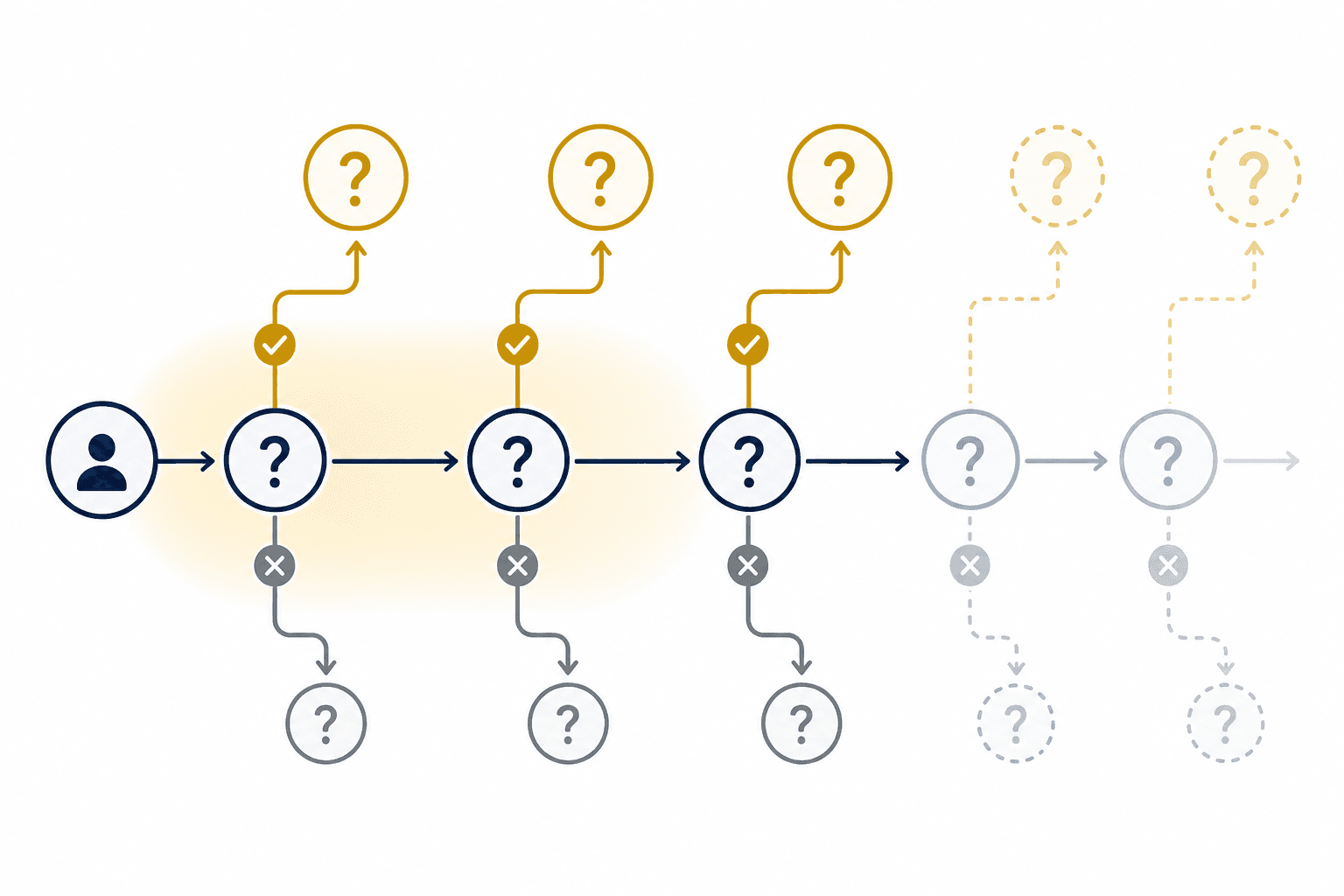
In an adaptive test, each question you answer determines the difficulty of the next one. Answer correctly, and the algorithm presents a harder question. Answer incorrectly, and it presents an easier one. The system is continuously estimating your ability level throughout the subtest.
The critical behavioral implication: once you submit an answer on the CAT-ASVAB, you cannot go back and change it. There is no reviewing previous questions. Each answer is final the moment you confirm it.
Strategic Implications for Test Day
- Treat early questions with extra care. Early questions in each subtest play a disproportionate role in establishing your ability estimate. Rushing through the first few questions to save time for later is a counterproductive strategy on an adaptive test.
- Answer confidently, not hastily. Take the time you need to reason through each question before submitting. There is no benefit to finishing a subtest early on the CAT.
- Do not second-guess yourself into submission errors. Changing your answer at the last second without a clear reason is a common test-taking error. If you have worked through a problem and reached an answer, commit to it.
- Guessing on the CAT is a last resort, not a strategy. Unlike the paper-and-pencil format (where guessing on unknowns is always recommended), on the CAT you should guess only when you have genuinely exhausted your thinking time. An incorrect answer on an early question has a more disruptive effect on your ability estimate than on the P&P format.
Test-Day Checklist
The night before and morning of your ASVAB, you do not need to review content — you need to execute logistics cleanly. Here is a concise checklist.
The Night Before
- Confirm your testing location, start time, and any specific instructions from your recruiter.
- Prepare your government-issued photo ID — this is required for entry. A driver's license or passport is acceptable; a school ID is not.
- Get at least 7–8 hours of sleep. Sleep consolidates the memory of everything you studied and directly affects reasoning performance.
- Do not cram. A light 20-minute review of your WK flashcards is fine; a three-hour late-night study session is not.
The Morning Of
- Eat a real breakfast — protein and complex carbohydrates, not sugar. Your brain needs sustained energy for a multi-hour test.
- Arrive 30–45 minutes before your scheduled start time. Late arrivals may be turned away.
- Leave your phone in your car or at home if possible — phones are not permitted in the testing area.
- No calculator is allowed on the ASVAB. You will have scratch paper for math sections.
After the Test
- If you took the CAT-ASVAB at MEPS, you will receive unofficial scores the same day. Your recruiter will review them with you.
- ASVAB scores are valid for up to two years from the date of testing. If your score meets your goal, you do not need to retake.
- If your score falls short, discuss a retake timeline with your recruiter. Use the diagnostic approach again — identify which AFQT subtests dragged your score and target those specifically in your next prep cycle.
Comments
Join the discussion with an anonymous comment.