
MCAT Planner
First Freshwater Transmissible Cancer – MCAT Biology Study Notes
For the MCAT, transmissible cancer is useful because it breaks a rule students usually treat as automatic: cancer cells are supposed to be the host’s own somatic cells. Once a tumor cell line can move between individuals, the passage stops being only “cancer biology” and becomes genetics, immune surveillance, ecology, and experimental design in one package. The July 2026 Nature report on brown bullhead catfish melanoma matters for that reason: it describes the fourth recognized type of naturally occurring transmissible cancer and the first identified in freshwater fish. [1]
Keep the content-review load light but organized. The four comparison anchors are canine transmissible venereal tumor, Tasmanian devil facial tumor disease, bivalve transmissible neoplasia, and brown bullhead catfish melanoma. The counting needs care: there are four recognized types, but more independent evolutionary origins, because devil facial tumors arose twice and bivalve neoplasias include at least ten independent events. [1][2]
If this topic appears inside a broader MCAT study plan, do not spend your time memorizing animal trivia. Spend it on the evidence pattern: tumor genomes should resemble each other more than they resemble their hosts.
The comparison grid to know before the passage starts
| Transmissible cancer | Host and route | High-yield feature | How a test writer can use it |
|---|---|---|---|
| CTVT | Dogs; sexually transmitted. | A 6,000–11,000-year-old clonal lineage that usually regresses and has spread globally, with human maritime travel implicated in that spread; mitochondrial genomes can be captured from hosts over generations. [2] | Tests clonal persistence, immune recognition, tumor regression, and the difference between a cancer lineage and an ordinary infection. |
| DFTD | Tasmanian devils; transmitted mainly through biting. | Discovered in 1996; about 90% fatal; associated with an 80%+ population decline; immune evasion involves MHC class I downregulation; DFT1 and DFT2 arose independently. [2] | Tests allograft rejection logic, MHC presentation, population bottlenecks, and why low genetic diversity can matter. |
| Bivalve transmissible neoplasia | Clams, mussels, and related bivalves; waterborne spread. | At least ten independent events across species; variable lethality; documented species jumping, including from P. aureus to other clam species; some lineages are more than 200 years old. [2] | Tests aquatic transmission, species barriers, phylogenetic inference, and why independent origins are not the same as one global outbreak. |
| Brown bullhead catfish melanoma | Brown bullhead catfish; transmission route unknown. | Detected in Lake Memphremagog in 2012 and reported in Nature in July 2026; primarily affects spawning-age fish; prevalence reported at 23–37%, averaging about 30%; geographic spread includes VT, NH, ME, MA, NB, and NS. [1][3] | Tests tumor-normal sequencing, shared tumor-specific variants, copy-number similarity, monophyletic tumor clades, and correlation-versus-causation around arsenic. |
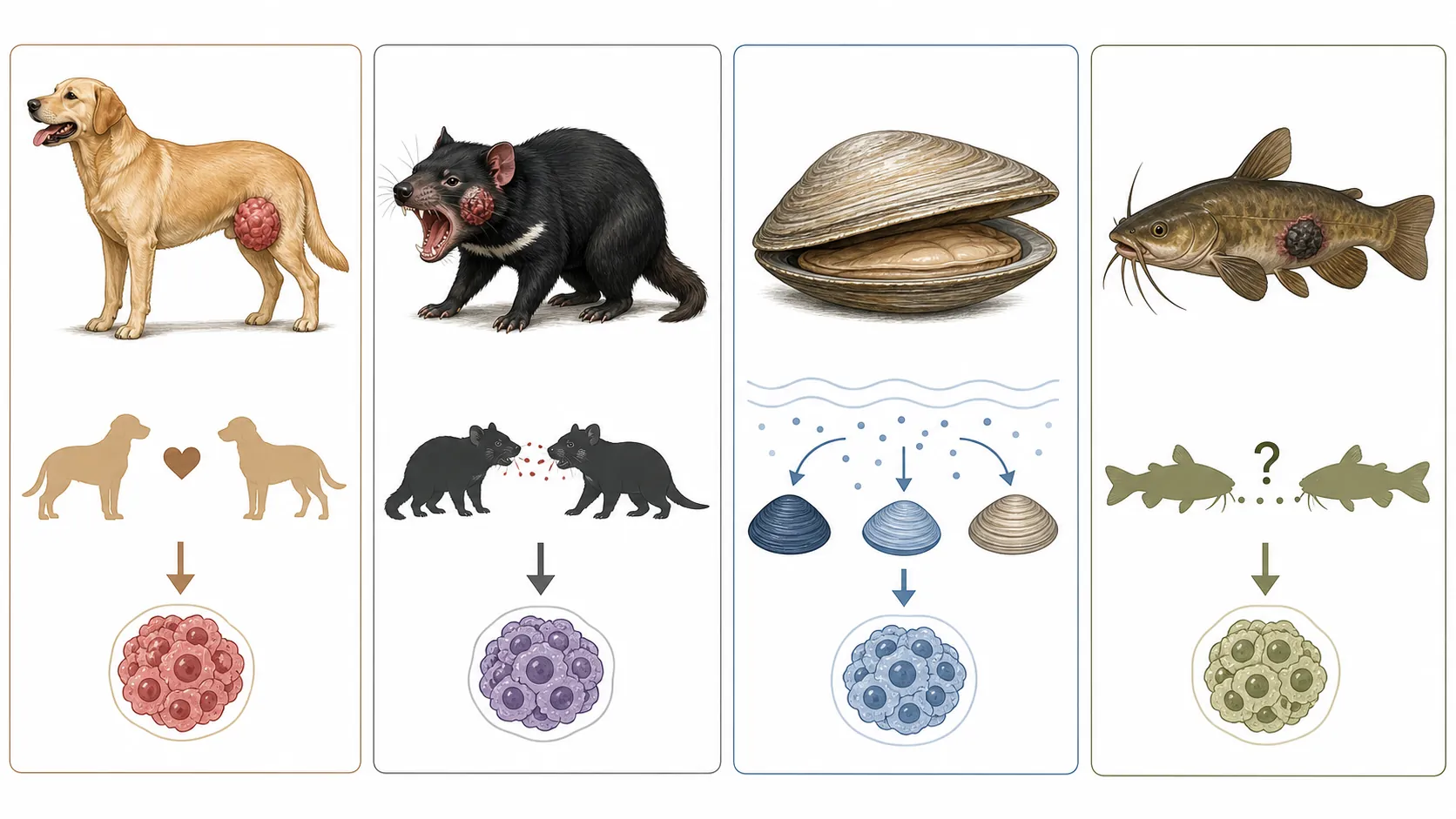
The catfish row is the one to practice deeply. The other three cancers give you comparison vocabulary. The catfish paper gives you the kind of dataset an MCAT passage could actually print.
The catfish case: what would prove the tumor is transmissible?
A brown bullhead with black melanoma lesions is visually memorable, but the photograph is not the proof. The proof has to separate two explanations that look similar at the level of the fish: either many fish independently developed similar melanomas, or one malignant cell lineage moved between fish and kept dividing in new hosts.

The clean design is paired tumor-normal whole-genome sequencing. For each fish, sequence the tumor and a normal tissue from the same animal. In this study, the normal comparison tissue was brain, and the dataset included paired tumor-normal tissues from 28 fish. [1]
That pairing matters because the host genome is not noise; it is the control. If each fish independently developed cancer, the tumor should mostly match that fish’s own normal genome, with its own private somatic mutations layered on top. If the melanoma is transmissible, the tumors from different fish should share many variants with one another that are absent from the hosts’ normal tissues.
The SNV distribution is the most testable part
The Nature study found 245,189 tumor-specific single nucleotide variants, compared with 61,699 brain-specific SNVs. More important than the raw count was the distribution: 59% of tumor variants were shared by at least 14 fish, while 83.4% of normal variants were unique to one fish. [1]
| Observation | Independent tumor expectation | Transmissible tumor expectation | Catfish result |
|---|---|---|---|
| Tumor-specific SNVs | Mostly private to each fish’s tumor. | Many shared across different hosts. | 245,189 tumor-specific SNVs; 59% shared by at least 14 fish. [1] |
| Normal-tissue SNVs | Host-specific background variation should differ among fish. | Normal tissues should not form one shared cancer lineage. | 61,699 brain-specific SNVs; 83.4% unique to one fish. [1] |
| Interpretation | Similar-looking tumors could result from similar selective pressures. | Shared tumor-only variants imply descent from a common malignant ancestor. | The converse tumor-versus-normal pattern supports clonal transmission. [1] |
This is where many students should slow down. Shared variants alone are not magic words. The key is that the shared variants are tumor-specific and appear across hosts, while normal host variants remain mostly private. That is the signature of a cell lineage moving between animals, not just separate fish accumulating mutations under similar conditions.
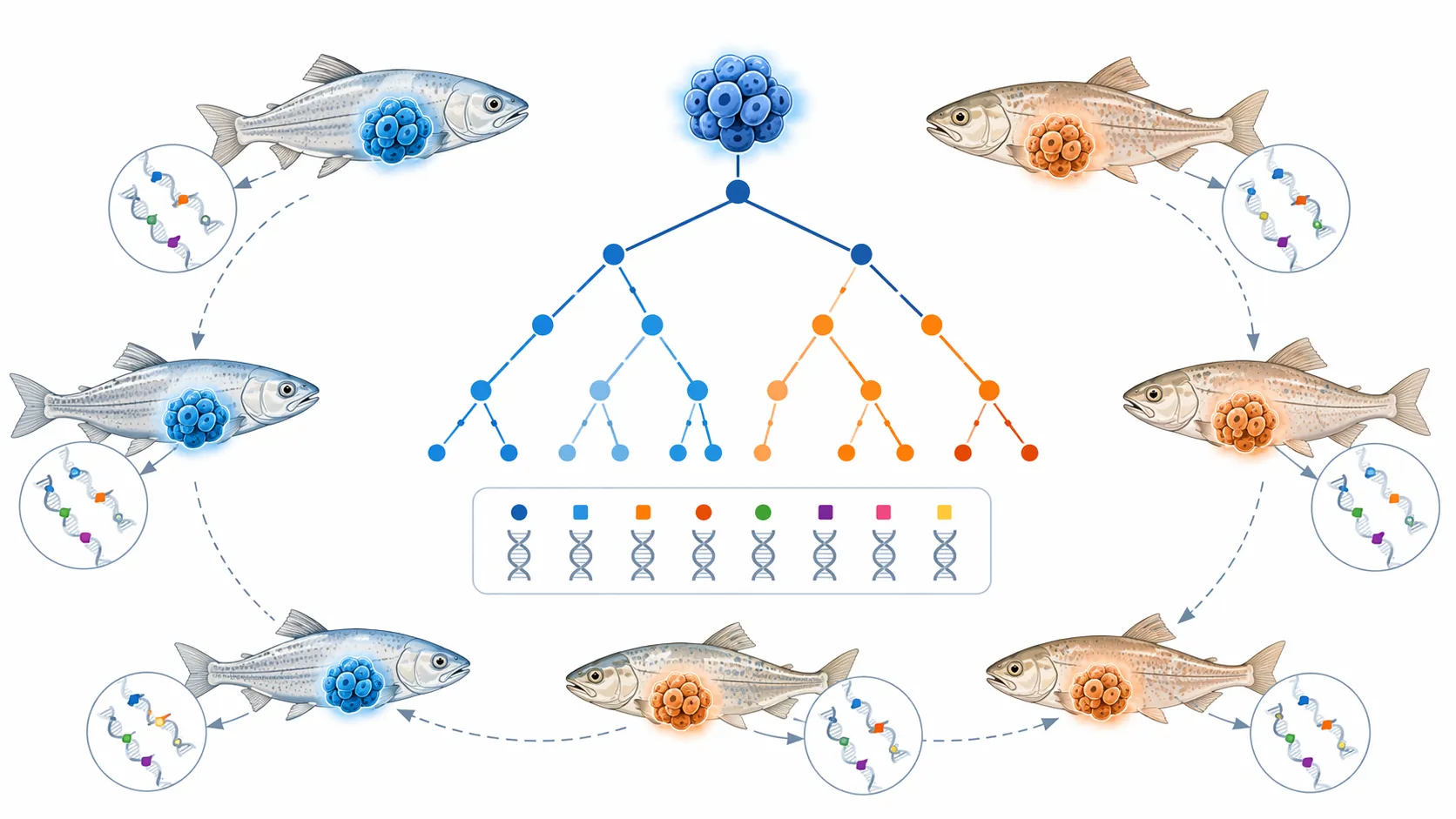
Copy-number variation tells the same story from another angle
The copy-number data are a second way to test the same clonal-transmission model. Tumor-to-tumor copy-number profiles were strongly correlated, with r=0.83. Tumor-to-host profiles were much less correlated, with r=0.22. Normal-to-normal profiles had r=0.73. [1]
On an exam, those values are not asking you to worship correlation coefficients. They are asking whether you can identify the meaningful comparison. The tumors resemble other tumors more than they resemble the fish carrying them. Normal tissues resemble other normal tissues reasonably well because they are all the same species, but that is not the cancer-lineage signal.
The human melanoma comparison closes a tempting loophole
A skeptical student might ask whether melanomas simply tend to mutate in similar ways. The authors compared the catfish pattern with 463 human melanomas from The Cancer Genome Atlas. In that human comparison, only 0.008% of mutations were shared across tumors, instead of the hundreds of thousands of shared tumor variants observed in the catfish dataset. [1]
That comparison does not mean human melanoma and catfish melanoma are biologically identical. It is used for a narrower point: ordinary independently arising melanomas do not usually share massive numbers of tumor-specific mutations across unrelated hosts.
Phylogenetic trees make the clonal claim visible
The study also found that tumor samples formed a monophyletic clade in both mitochondrial and nuclear phylogenetic trees. [1] In passage language, that means the tumors grouped with one another as a shared lineage rather than scattering among their respective host lineages.
If a question gives a tree, look for whether tumor samples cluster by host or by tumor lineage. A transmissible cancer should behave like a grafted cell population with its own ancestry. The host is the environment it enters; the tumor lineage is the organism-like entity being tracked.
How the MCAT could turn this into questions
A well-written passage would probably not ask, “What animal has the first freshwater transmissible cancer?” That is too easy and too headline-dependent. It would show you a dataset and ask what conclusion is justified.
- Tumor-normal sequencing: If tumor samples from many hosts share variants that are absent from each host’s normal tissue, clonal transmission is favored over independent tumor formation.
- Shared mutation trap: Shared mutations can reflect common ancestry, convergent evolution, or mutational hotspots. The catfish argument is strongest because the shared variants are widespread, tumor-specific, and paired with host-specific normal variants.
- Copy-number reasoning: A high tumor-tumor correlation and low tumor-host correlation support the idea that the tumor has its own lineage identity.
- Phylogeny: A monophyletic tumor clade supports one origin followed by spread, while multiple scattered tumor branches would fit independent origins better.
- Immune evasion: The test may compare catfish with DFTD, where MHC class I downregulation is a known immune-evasion mechanism. For the catfish, the route and immune-evasion mechanism are not yet established.
- Ecology versus mechanism: Prevalence, geography, spawning age, or pollutants can generate hypotheses, but they do not by themselves prove transmission route or causation.
A hypothetical MCAT item might describe two lakes with tumor-bearing catfish and ask which experiment best distinguishes contagious spread from independent pollution-induced cancer. The best answer would not be “measure more tumors.” It would be something like paired tumor-normal sequencing plus comparison of tumor phylogenies across hosts, because that directly tests whether the malignant cells share a clonal origin.
The four cancers differ most in route, immunity, and evolutionary timescale
Do not flatten the four examples into “cancer that spreads.” They are more useful as contrasts.
| Comparison axis | CTVT | DFTD | Bivalve neoplasia | Catfish melanoma |
|---|---|---|---|---|
| Transmission ecology | Sexual transmission. | Biting during social contact. | Waterborne spread. | Unknown; spawning contact and waterborne routes are hypotheses, not established. [1][4] |
| Immune angle | Often regresses, so immune control is part of the story. | MHC class I downregulation is a key immune-evasion mechanism. [2] | Aquatic cell transfer raises species-barrier and environmental-exposure questions. | Immune-evasion mechanism remains unresolved. |
| Outcome | Usually nonfatal after regression. | About 90% fatal and linked to major population decline. [2] | Variable lethality. | High prevalence in studied populations, reported at 23–37% with an average around 30%. [1][3] |
| Evolutionary timescale | Ancient lineage, estimated at 6,000–11,000 years old. [2] | Two independent devil facial tumor lineages since the disease was identified in 1996. [2] | At least ten independent events; some lineages exceed 200 years. [2] | Detected from photographic evidence back to 2012, but not necessarily new. [3] |
| Likely exam move | Ask why a cancer lineage can persist across many hosts. | Ask how reduced antigen presentation affects immune recognition. | Ask how waterborne spread or species jumping changes phylogenetic expectations. | Ask whether paired tumor-normal genomic evidence proves clonal transmission. |
The catfish case is especially clean for experimental-design questions because it does not require the passage to assume the route of spread. The sequencing evidence can establish clonal transmission even while the route remains open.
Boundaries: arsenic, route of spread, and the “first” label
The arsenic finding is exactly the kind of detail that can steal points. Arsenic levels were reported as elevated in tumor cells, and New England’s high-arsenic soils make that association worth studying, but this does not prove arsenic caused the transmissible melanoma. [4]
Fish pathologist Vicki Blazer, who had been involved with the research team, has argued that pollution or arsenic may be the primary cause. [4] That dissent does not erase the genomic evidence for a shared tumor lineage. It marks a different causal question: what initiated or promotes the disease, versus whether the cancer cells now show clonal transmission.
The transmission route is also unresolved. CTVT has sexual transmission, DFTD spreads through biting, and bivalve neoplasia can move through water. For brown bullhead catfish, spawning contact and waterborne movement are plausible hypotheses, but the Nature evidence does not establish either as the route. [1][4]
A little natural-history color is fair game once the mechanism is secure. Photographic evidence from the Fishbrain angler app helped trace tumor-bearing fish back to 2012, and reports place affected brown bullheads across parts of Vermont, New Hampshire, Maine, Massachusetts, New Brunswick, and Nova Scotia. [3] NPR also noted a possible 1852 Henry David Thoreau journal reference to a tumor-bearing fish, which is interesting mainly because it reminds students that “newly described” is not the same as “newly evolved.” [5]
For study purposes, memorize the four-category comparison lightly. Practice the catfish genomic evidence deeply. A modern biology passage is much more likely to hide the answer in tumor-normal contrasts, variant sharing, copy-number correlations, and phylogenetic trees than in the fact that the fish was a brown bullhead.
References
- Transmissible cancer in freshwater fish, Nature, July 2026
- Contagious Cancer Found in North American Catfish, WIRED
- More than parasites and tumors: Vermont scientists discover transmissible cancer in catfish, UVM News
- Contagious fish cancer overruns New England lake, Science.org
- Transmissible cancer catfish melanoma tumors, NPR, July 22, 2026
Fill in this timeline
This is a skeleton schedule, not a performance claim — for section-by-section strategy to fill in each slot, read the exam hub. For evidence that a similar timeline worked, compare against real outcome logs.
Do Military Fellowship Cuts Affect Your ASVAB Benefits?
- 8 Anki MCAT Mistakes That Keep Your Score in the Low 500s (And How to Fix Them)
- The Best AI Flashcard Generator for Lecture Notes: Which One Should You Use?
- How to Choose a Flashcard App for Language Learning
- Why the Algorithm Is the Most Important Feature in a Language Flashcard App
Compare each outcome's duration against this planner's study reference length manually.