
SAT, GRE, MCAT Planner
Does the $100k fee actually affect your US study plans?
As of August 1, 2026, there is no confirmed new $100,000 charge facing an F-1 applicant in this application cycle. If you are preparing for the SAT, GRE, or an MCAT-linked research pathway, do not pause test prep, skip a registration deadline, or rewrite your school list because of the “$100k fee” headline alone.
The headline is doing too much work. It is blending three different things: a proposed OPT fee that has not been formally announced, an H-1B fee that was real but is currently blocked in court, and six-figure college sticker prices that are already published at some institutions but are not the same as a typical net bill.
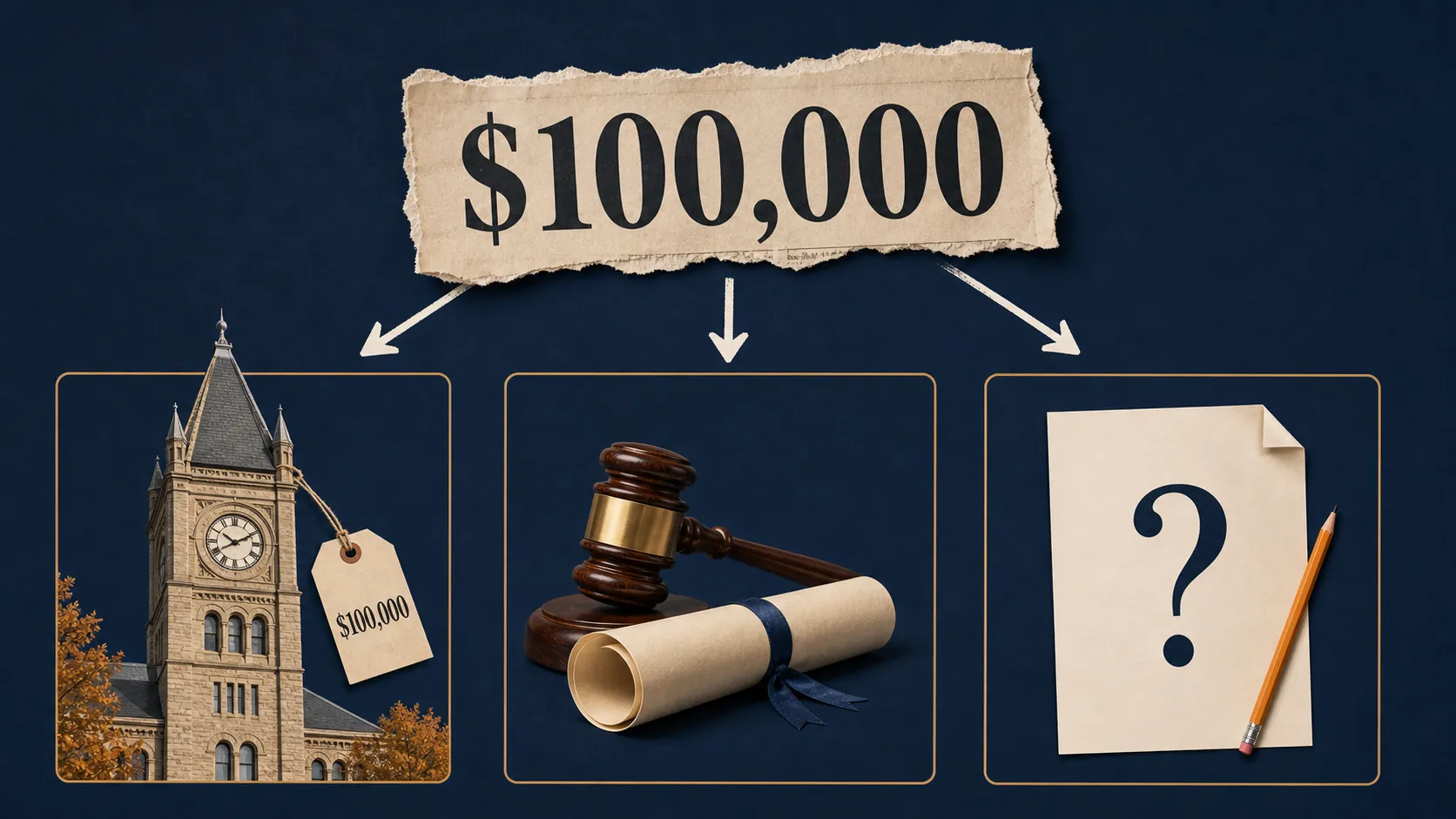
The three “$100k” stories, separated
| What the headline may mean | Status as of August 1, 2026 | Who would pay | Does it affect an F-1 applicant right now? | What changes today |
|---|---|---|---|---|
| Proposed OPT fee | Reported as something the administration is weighing; DHS said no policy should be considered final until formally announced.[1] | Unresolved: reporting has not settled whether a future fee would fall on students, employers, or another payer.[1] | No confirmed current charge. | Keep your application and test schedule. Monitor formal DHS announcements, not just headlines. |
| H-1B $100,000 fee | A September 19, 2025 proclamation created a one-time employer-paid fee for certain new H-1B petitions filed from abroad, but the rule was vacated on June 8, 2026, and the government’s stay request was denied on July 24, 2026.[2][3] | Employer-paid under the proclamation, not a student tuition or visa-application charge.[3] | Not now. F-1 students changing status inside the United States were exempt under USCIS guidance.[3] | Do not treat this as a current study-abroad cost. Re-check before a future H-1B sponsorship step. |
| Six-figure college sticker price | Sixteen colleges list more than $100,000 per year for 2026–27, according to CNBC’s reporting on The Princeton Review data.[4] | The family, unless grants, scholarships, or other aid reduce the net price. | Yes, but only as a published cost of attendance at specific schools — not as a new immigration fee. | Run net-price estimates and compare aid offers. Do not assume the sticker is the bill. |
That table is the planning answer. The OPT item is not final. The H-1B item is not currently being collected. The tuition item is real, but it belongs in the college-affordability column of your spreadsheet, not in the immigration-fee column.
OPT: important enough to monitor, not settled enough to plan around as a bill
The OPT story deserves attention because Optional Practical Training sits directly in the study-to-work path many international students care about. PIE News summarized Wall Street Journal and Bloomberg reporting that the administration was weighing a $100,000 fee for foreign students who want to work after graduation; the same coverage said a White House official declined to deny the idea, while DHS said no policy should be considered final until formally announced.[1]
That last clause matters. “Weighing” is not the same as “published rule.” “Declined to deny” is not the same as “effective date.” And as of this date, the available reporting does not resolve who would pay if a fee were ever proposed in binding form: the student, the employer, or someone else.[1]
There is also a numbers problem in the public discussion. PIE News, citing IIE Open Doors, reported about 295,000 OPT participants in 2024/25, up 21%.[1] TechTimes separately described about 419,000 people employed under OPT in 2024.[2] Those figures should not be merged into one made-up total; they are different reported counts from different coverage.
OPT still belongs on your long-range risk list. PIE News also cited a NAFSA and Institute for Progress finding that more than half of international postgraduates surveyed said they would not have enrolled in the United States if OPT had not been available.[1] That supports taking the policy seriously. It does not support canceling a SAT date this week or abandoning a GRE-driven application list before a formal rule exists.
H-1B: real proclamation, blocked collection, and a crucial F-1 exemption
The H-1B fee is the easiest place for a family budget conversation to go wrong, because it sounds official — and part of it was. A September 19, 2025 proclamation created a $100,000 one-time fee tied to new H-1B petitions filed for workers outside the United States, and USCIS described the fee as employer-paid.[3]
But two details change the study-planning answer. First, USCIS guidance said the proclamation did not apply to petitions requesting a change of status, including an F-1 student changing status to H-1B from inside the United States.[3] Second, the fee is currently blocked: TechTimes reported that the rule was vacated on June 8, 2026, in State of California v. Mullin, and that the First Circuit denied the government’s stay request on July 24, 2026.[2]
Blocked does not mean impossible forever. USCIS says it would resume collection if the court order is lifted.[3] That is why this belongs in your re-check file before a future work-visa step. It does not belong as a current line item in an F-1 student’s tuition budget.

The live $100k number is a sticker price, not the usual bill
The only $100,000 figure in this set that is already live for applicants is the published cost of attendance at a small group of colleges. CNBC reported that 16 colleges list more than $100,000 per year for 2026–27, naming institutions including Duke, Georgetown, NYU, UChicago, Smith, and Vassar, with Brown, Northwestern, and Pepperdine just below that threshold.[4]
That is serious money. It is also not the same as a confirmed invoice for every admitted student. CNBC reported that the average private-college tuition discount reached 57%, and that the 16 six-figure-sticker schools awarded average need-based grants ranging from $42,000 to $79,000.[4] The same reporting noted that Harvard, Penn, and MIT have tuition-free thresholds up to $200,000 in family income.[4]
For application planning, the tuition story changes your financial-aid work, not your immigration assumptions. If a college appears unaffordable by sticker price, the next step is not panic; it is net-price calculation, aid-policy checking, and comparing actual offers after admission.
What to do if you are applying now
Your immediate plan depends less on the headline and more on where you are in the pipeline.
- If you are an undergraduate applicant preparing for the SAT: keep the test date, keep the application calendar, and add a financial-aid pass to your college list. The relevant live risk is published cost versus net price, not a confirmed new F-1 fee. For test planning, use the SAT Exam Prep Guide or the Score-Gap Method for the SAT rather than letting an unfinalized policy story take over your week.
- If you are a GRE applicant: do not cut US programs from the list just because the headline says “$100k.” Separate immigration monitoring from admissions execution. If your programs depend on federal research funding, that is a different policy risk; the closer planning comparison is how grant freezes can affect PhD slots, not a vague fee headline.
- If you are an MCAT or research-track applicant: keep the exam plan tied to your actual pathway. A possible future OPT rule could matter later, especially if your plan depends on US-based research work after graduation, but it is not a current MCAT registration cost. If your calendar is tight, protect the study block first; a 12-week MCAT study plan is a better object of attention than an unresolved payer question.
- If your family is comparing the US with another country: build a dated risk column instead of making one emergency decision. Mark OPT as “proposal only,” H-1B fee as “blocked; F-1 status-change exemption noted,” and tuition as “school-specific sticker; net price pending.”
The emotional part is real. Families are being asked to make expensive decisions under policy uncertainty, and “wait and monitor” is easier advice for people with more financial cushion. Still, a planning decision needs a trigger. A headline is not a trigger. A formally announced rule with an effective date, named payer, and clear application to your status is a trigger.
Use decision gates, not headline reactions
| When to re-check | What to verify | What would actually change your plan |
|---|---|---|
| Now, before test registration or application submission | Whether any confirmed charge applies to F-1 applicants this cycle. | Only a formally effective rule that names F-1 applicants or current student-visa steps as covered. |
| Before finalizing the college list | Sticker price, need-based aid, merit aid, international-student aid limits, and net-price assumptions. | A school remains unaffordable after realistic aid estimates, not merely because its sticker price crosses six figures. |
| After admission offers arrive | Actual aid package, required family contribution, health insurance, living-cost estimate, and renewal rules. | The net cost is unsustainable across all years, or aid cannot be renewed under conditions you can meet. |
| One to two years before graduation | Whether DHS has formally announced any OPT fee, who must pay it, and when it applies. | A final OPT rule applies to your cohort and creates a cost or employer behavior change you cannot absorb. |
| Before H-1B sponsorship becomes relevant | Whether the H-1B court order remains in place and whether USCIS is collecting the fee. | The court order is lifted and the revived rule applies to your petition type, location, and employer. |
For the next 2–4 years, that re-check habit is more useful than a one-time yes-or-no answer. A student applying in 2026 may not face OPT or H-1B decisions until much later. By then, the relevant facts could be a formal DHS rule, a court ruling, a school-specific aid offer, or an employer sponsorship policy — not the July headline that started the panic.
So the working answer to “how 100k fee affects my US study abroad plans” is narrow but practical: it should not change your current test prep, application deadlines, or F-1 study plan as of August 1, 2026. It should change your monitoring system. Label the OPT story as unfinalized, the H-1B fee as blocked and exempt for F-1 changes of status under current guidance, and six-figure tuition as a sticker-price question that must be tested against aid.
If another federal-policy story is already affecting your access to preparation or program funding, handle that as its own issue. The planning method is similar to the one used for DEI funding cuts and test-prep access: identify the rule, the institution affected, the timeline, and the applicant action. Do not let three unlike $100,000 figures become one fake invoice.
References
- Trump eyes $100,000 OPT fee, PIE News.
- White House Weighs $100K OPT Fee: Court Already Killed Its H-1B Equivalent, TechTimes, July 30, 2026.
- H-1B FAQ, U.S. Citizenship and Immigration Services.
- College six-figure sticker price, CNBC, June 10, 2026.
Fill in this timeline
This is a skeleton schedule, not a performance claim — for section-by-section strategy to fill in each slot, read the exam hub. For evidence that a similar timeline worked, compare against real outcome logs.