
The Science-Backed Weekly Study Schedule Template: How to Build a Template Around How Memory Actually Works
Most study schedules are just time management. This guide shows you how to build a weekly template that embeds spaced repetition intervals, the forgetting curve, and active recall into the layout itself — so your schedule works with your brain, not against it.
The Forgetting Curve Problem: Why Most Weekly Schedules Fail at Retention
Most study schedules are built around one question: "When do I have time to study?" They treat the week as a container to be filled with hours, assuming that as long as the time is logged, the learning will follow. That assumption is wrong — and the data is stark.
The Ebbinghaus forgetting curve describes a brutal reality: without any review, memory retention drops from 100% to roughly 20% within seven days. A 2006 meta-analysis covering 317 experiments on the spacing effect, published in PubMed (PMC5126970), confirmed that distributed practice produces dramatically better retention than massed practice. In plain terms, the material you study on Monday is mostly gone by the following Monday unless your schedule deliberately interrupts that decay.
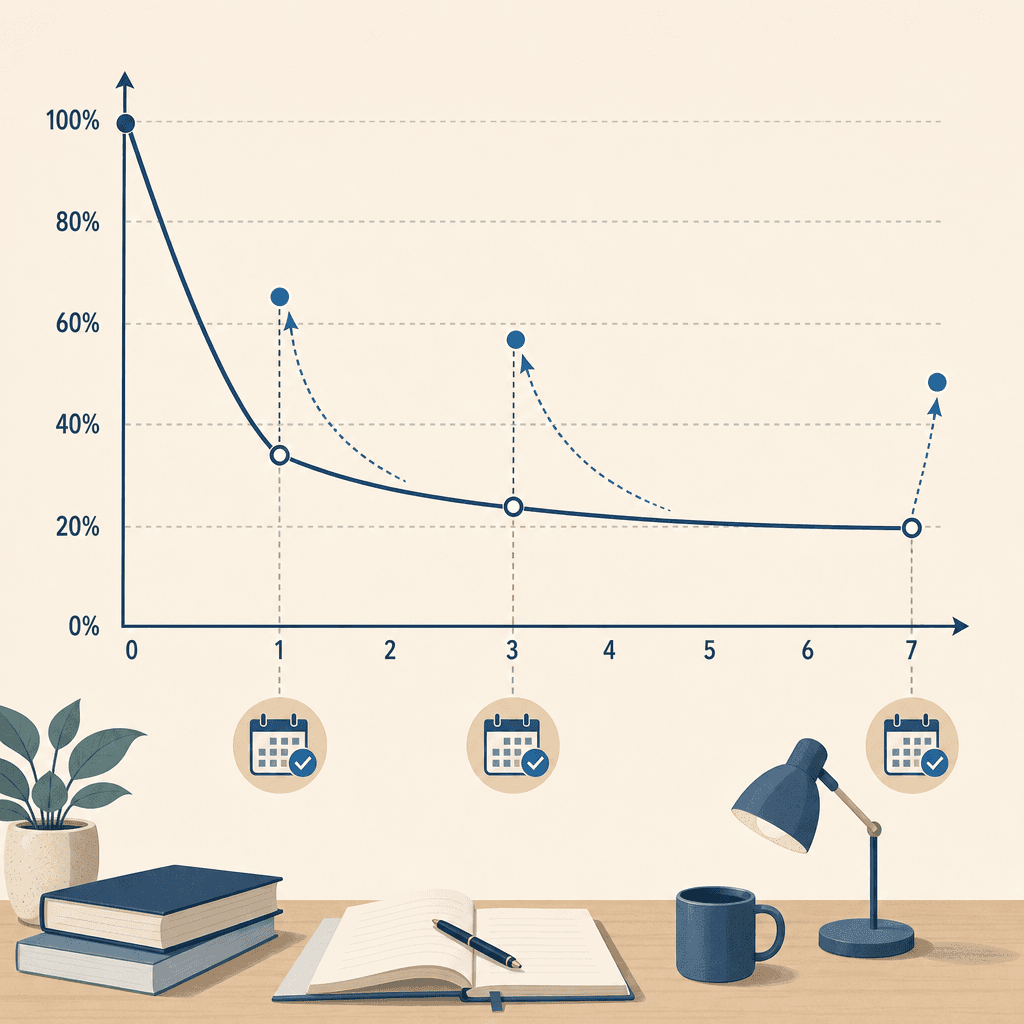
Apply This Method
Related Methods
- How to Build a Weekly Study Schedule That Actually Sticks (Evidence-Based Guide)
Most study schedule templates fail within a week. This evidence-based guide walks you through the foundational steps — auditing your real week, mapping subjects to energy windows, and building in buffer time — so your schedule works with your brain, not against it. Includes a free downloadable template.
- Cornell Notes Template: Free Printable and Digital Formats for Students
A complete guide to the Cornell note-taking system for middle school, high school, and college students — explains what every section of the template is for, how to use the 5-Rs study loop, and where to download free templates in PDF, Google Docs, Microsoft Word, and Notion.
- Weekly Study Planner Template for Students: 5 Must-Have Sections, Format Options, and How to Make It Stick
Most students abandon study planners within three weeks — not from lack of discipline, but because their template is missing key structural sections. This guide walks high school and college students through the five sections every effective weekly study planner needs, how to choose the right format for their situation, and a simple Sunday reset routine that turns a template into a lasting habit.
Comments
Join the discussion with an anonymous comment.