
Adapting the Pomodoro Technique for an ADHD Brain
The classic 25/5 Pomodoro model often falls short for students with ADHD. This guide explains how to adjust intervals, breaks, and reward timing so the technique supports your natural attention patterns instead of fighting against them.
Best for: General academic tasks
A student sits down to try Pomodoro the “right” way: 25 minutes of work, 5 minutes of break. The timer starts. Ten minutes go into finding the file, rereading the assignment, changing the playlist, and arguing with the feeling that the task is already too late to begin. Around minute 18, the document finally opens. At minute 25, the alarm rings just as the student has started to understand what the paragraph needs to say.
That is not a discipline problem. It is also not proof that Pomodoro is useless. It is a sign that the standard version is asking the timer to do the wrong job.
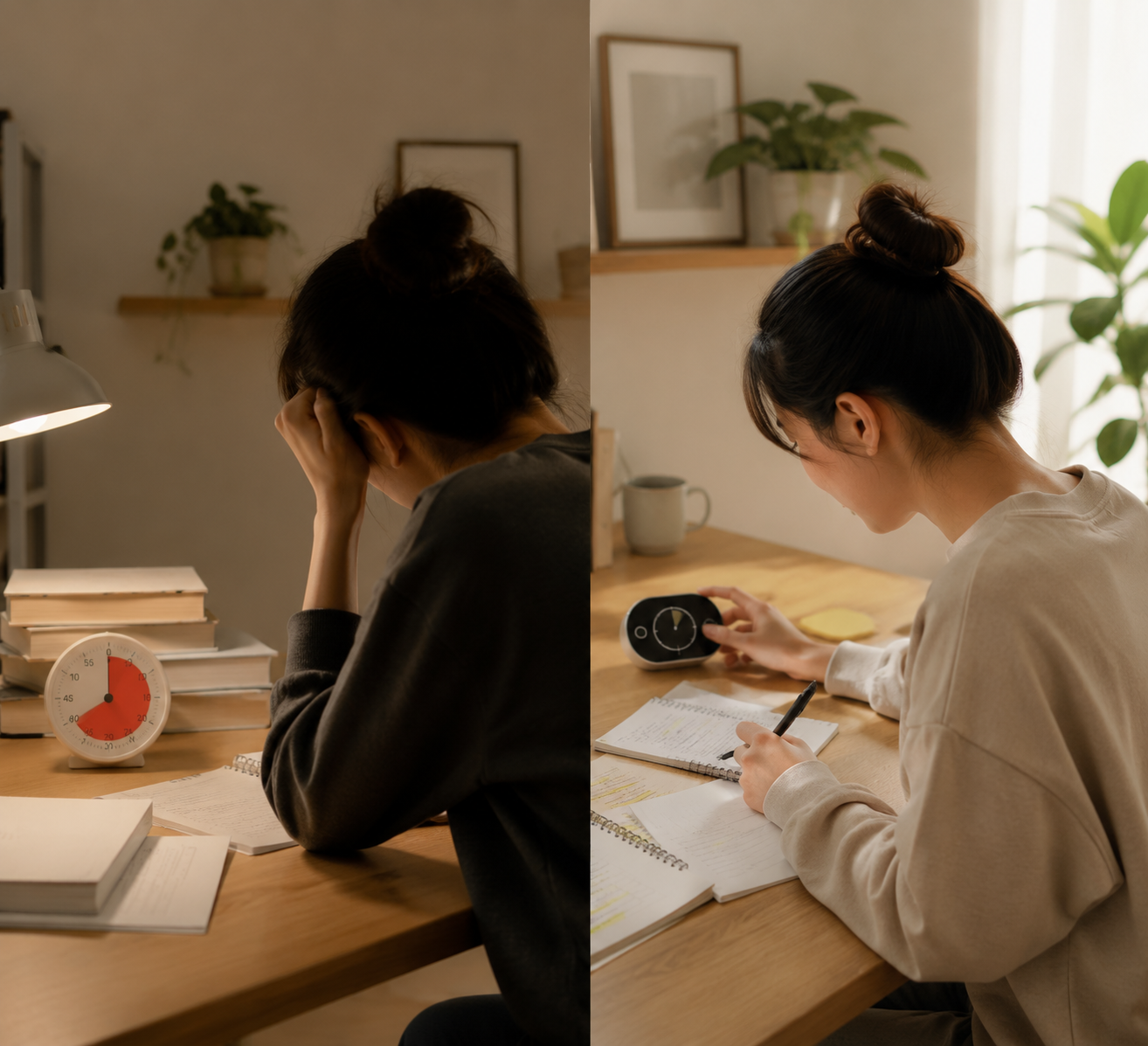
For many ADHD students, a timer helps only when it externalizes time, lowers the cost of starting, and creates a reward soon enough for the brain to care. It stops helping when it becomes another rule to fail. The useful question is not “Can you make yourself obey 25/5?” It is “What timer setting would help you begin, notice time passing, and stop before the assignment expands into the whole afternoon?”
Why the classic 25/5 version often breaks down
The classic Pomodoro rhythm assumes that 25 minutes is short enough to start and long enough to produce meaningful work. Sometimes it is. On a steady day, with a familiar task and low emotional resistance, 25 minutes can give a student a clean container. On a high-anxiety day, it can feel like being asked to climb a wall before earning any relief.
ADHD attention is not simply “short.” It can be slippery, delayed, intense, or hard to disengage from. A student may spend half of a work block trying to initiate, lose track of the timer entirely, or fall into focus and resent the alarm for pulling them out. When that happens, the rigid timer is measuring compliance more than it is supporting learning.
This is where time blindness matters. Stanford’s Center for Teaching and Learning recommends external timers and time chunking as strategies for neurodiverse students who struggle to sense time passing accurately.[1] ADDA describes ADHD time blindness as connected to differences in time perception, including executive-function demands and dopamine signaling, which helps explain why “just keep track of time” is not a realistic instruction for many students.[2]
A timer can be useful precisely because it moves time out of the student’s head and into the room. The problem is treating one interval length as sacred.
Use the timer for the problem you actually have today
Before setting any timer, name the bottleneck. Not the whole diagnosis. Not your entire relationship with school. Just the thing most likely to derail the next study session.
| If today’s problem is... | Use the timer to... | Try... |
|---|---|---|
| Starting feels impossible | Make the first commitment too small to argue with | A 3- to 10-minute opening sprint |
| Time disappears while you drift | Keep time visible and the task narrow | A visible countdown plus one concrete subtask |
| You stop too abruptly | Protect the landing | A wrap-up buffer before the real break |
| Breaks turn into escape hatches | Make rest predictable and low-friction | A pre-chosen non-screen break |
| You are deeply focused on meaningful work | Avoid shattering useful attention | A check-in alarm, not a forced stop |
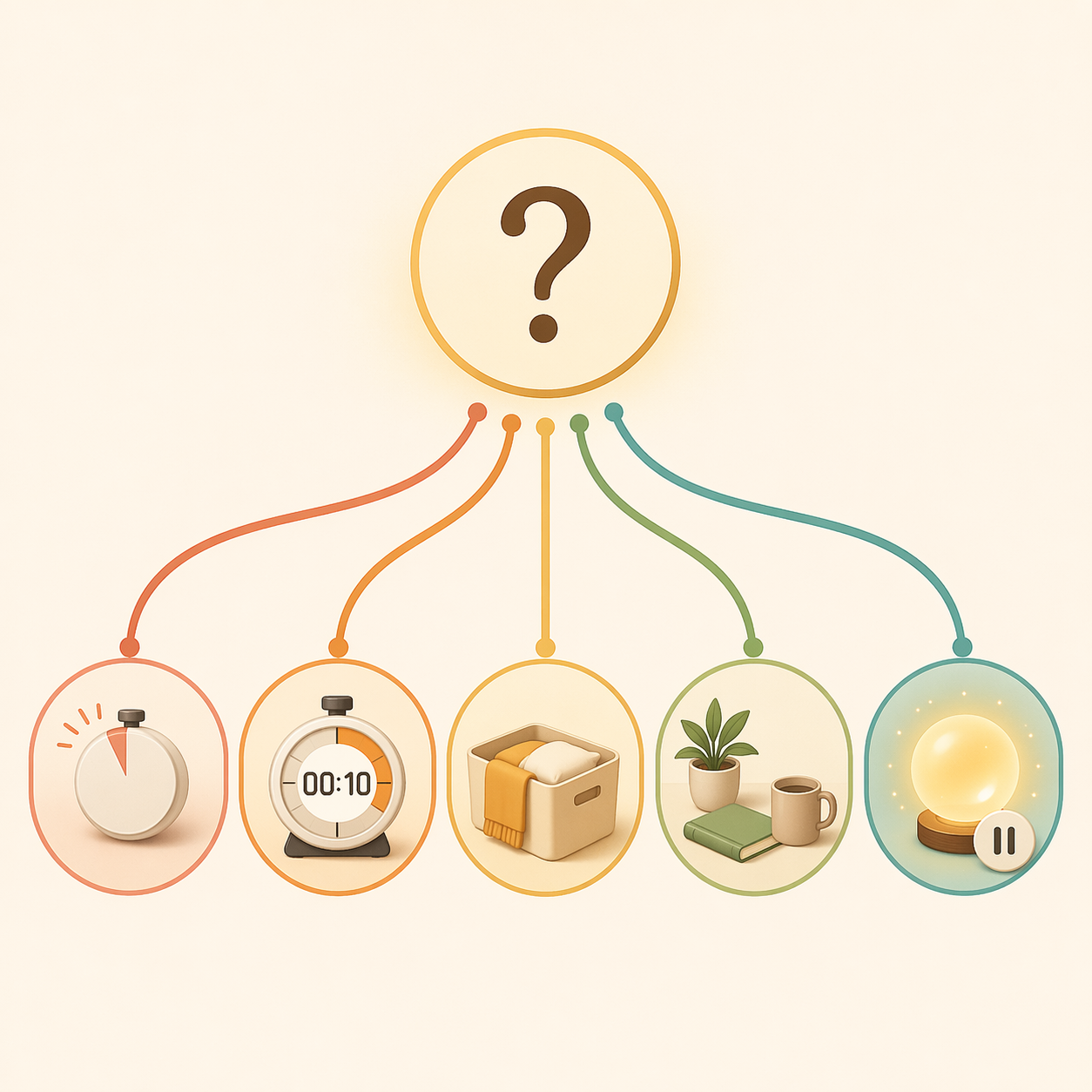
This decision matters more than the exact number. Life Skills Advocate recommends matching the timer to your current attention span instead of forcing your attention to match the timer.[4] Psych Central similarly discusses ADHD-specific adjustments such as shorter work intervals, wrap-up buffers, and non-screen breaks.[5] Those are not cosmetic tweaks. They change what the timer is asking from the student.
If starting is the problem, make the first timer almost embarrassingly short
A 25-minute block can be too large when the real task is not “write the essay” but “tolerate looking at the essay without shutting down.” In that state, the first interval should not be designed for productivity. It should be designed for contact.
- Open the assignment page.
- Write the date and course name at the top of the document.
- Copy the assignment instructions into the document.
- Underline the main verb: compare, analyze, define, solve.
- Write one bad first sentence and leave it there.
A 5-minute timer is not a baby version of studying. It is a way to get past the locked door. If the student continues after the bell, fine. If not, they still replaced avoidance with a visible start, which is often the hardest move of the session.
Kreider and colleagues studied 52 college students with learning disabilities and ADHD and found that participants deliberately used the Pomodoro technique as one strategy to reduce anxiety around long study sessions.[3] That does not prove Pomodoro works as a controlled ADHD intervention; the study reports students’ strategy use, not a randomized test of the method. Still, the finding fits what many students discover in practice: a smaller container can make a large task feel survivable enough to approach.
If drifting is the problem, make time and task boundaries visible
When a student starts but keeps sliding sideways, the timer needs to do more than ring later. It should stay visible. A phone timer hidden under another app is easy to lose. A visual timer, browser countdown, analog kitchen timer, or clock placed beside the notebook gives the student repeated evidence that time is moving.
Pair that visible timer with a task small enough to finish or clearly advance within the interval. “Study biology” is too foggy. “Label the heart diagram once without checking notes” gives the brain a target. “Work on research paper” invites wandering. “Find two sources that directly discuss the counterargument” gives the timer a job.
For drifting, the best interval may be 10, 15, 20, or 25 minutes. The right length is the one that catches attention before it has been gone so long that returning feels like starting over.
If stopping is the problem, add a landing strip
Some students do not ignore the alarm because they are rebellious. They ignore it because stopping has its own executive-function cost. The timer rings, but the student still has to decide where to pause, what to save, what to write down, and how to return later. Without a landing strip, “break time” can feel like dropping the task midair.
A wrap-up buffer solves a different problem than a break. When the work timer ends, set 2 to 5 minutes for closure before leaving the desk. Psych Central includes wrap-up buffers among ADHD-specific Pomodoro adaptations.[5] The buffer can be used to finish the sentence, mark the next problem, jot the next step, save files, or write “start here” in the margin.
- End by writing the next physical action: “Open slides 18–24,” not “keep studying.”
- Leave the document open if you will return soon.
- Put a sticky note on the exact problem or paragraph where you stopped.
- Reset the next timer before the break starts, if returning is likely to be hard.
If breaks swallow the session, decide the break before you earn it
The 5-minute break is often where a study plan quietly dies. A student checks one message, falls into a feed, then comes back 47 minutes later carrying shame and less energy than before. That does not mean breaks are bad. It means the break needs boundaries as much as the work block does.
Non-screen breaks are usually safer when the next work block matters. Psych Central specifically notes non-screen breaks as an ADHD Pomodoro modification.[5] Stand up. Refill water. Stretch against the wall. Step outside the room. Eat the snack already chosen before the session. The break should give the brain a reward without handing it a more stimulating task than the one it needs to return to.
If a screen break is the only reward that feels motivating, contain it with more structure: one song, one short video already saved, or a timer placed across the room so standing up is required to stop it. The point is not moral purity around phones. The point is making return possible.
When the alarm should not be obeyed
The most honest ADHD version of Pomodoro includes permission not to stop. ADHD UK warns that Pomodoro can interrupt hyperfocus and may be a poor fit for big projects when focus has finally locked in, while still being useful for small tasks and for preventing too much time from being spent on one activity.[6]

This is the trade-off many generic Pomodoro guides miss. If the student is sorting citations, answering routine homework questions, clearing email, reviewing flashcards, or trying not to spend two hours formatting a title page, the alarm protects them. It creates an exit. It prevents a small task from taking the whole evening.
If the student has finally entered a meaningful writing session, a design project, a lab analysis, or a difficult proof, the same alarm can damage the very attention the method was supposed to support. In that case, change the alarm’s meaning. It can become a check-in instead of a command.
| Use a firm stop when... | Use a check-in alarm when... |
|---|---|
| The task is small, boring, or easy to overdo | The task is meaningful and focus is hard-won |
| You are avoiding another priority | You are producing useful work and can safely continue |
| You need to leave for class, sleep, food, or an appointment | You have enough time and the next stopping point is visible |
| The work is turning into perfectionism | The work is deepening rather than spiraling |
At a check-in alarm, the student does not automatically stop. They ask: Am I still doing the intended task? Do I need water, food, medication, movement, or the bathroom? Is this focus useful, or am I polishing the wrong thing because switching feels hard? If the answers support continuing, reset a longer check-in and keep going.
Build one study cycle that can survive a real day
A workable ADHD Pomodoro cycle is less like a metronome and more like a set of adjustable rails. It should be simple enough to use when tired, but flexible enough not to punish the student for having a different attention profile at 9 p.m. than they had at 10 a.m.
Start by choosing the first interval based on resistance, not ambition. If the task feels emotionally loaded, choose 3 to 10 minutes. If it feels neutral but slippery, choose 10 to 20. If attention is already warm, 25 may be fine. If focus is already strong and the task is meaningful, set a check-in for 30 to 45 minutes rather than forcing a stop. These numbers are not universal prescriptions; they are starting ranges to test.
Then attach a specific task to the interval. The timer should not carry all the structure by itself. “Read chapter” leaves too many decisions open. “Read pages 12–16 and write three margin questions” gives the brain fewer places to leak energy. A timer plus a vague task often becomes a timed session of deciding what to do.
Next, decide the reward before starting. ADHD brains often respond better when the payoff is close enough to feel real. The reward can be small: tea, a stretch, a song, a walk to the mailbox, a few minutes with a pet. If the reward requires negotiation after the timer rings, it is too late; the brain will choose the most available stimulation.
Finally, decide the return cue. This is the part many students skip, and it is why breaks become cliffs. Before standing up, leave a visible next step. Put the book open to the next page. Type a bracketed note in the essay: “[next: explain why this quote matters].” Place the problem set on top of the laptop. The return cue should reduce the number of decisions waiting after the break.
A sample session
Suppose a student has a short history response due tomorrow and has been avoiding it all day. A rigid plan might say: four Pomodoros, 25 minutes each. A more ADHD-aware plan would start smaller.
- Set a 7-minute starter timer: open the assignment instructions, create the document, and write one rough claim.
- Take a 3-minute non-screen break: stand up, drink water, and return before checking messages.
- Set a 15-minute work timer: find one quote and explain it in plain language.
- Use a 3-minute wrap-up buffer: write the next sentence fragment and mark where to continue.
- If focus has arrived, set a 30-minute check-in alarm instead of taking a forced break.
Nothing about that plan is glamorous. That is part of its value. It gives the student a way to enter the assignment without pretending the only valid study session is a perfectly completed set of four blocks.
Use the overlooked parts of Pomodoro, not just the bell
The simplified internet version of Pomodoro often reduces the method to “work, break, repeat.” The more useful version includes planning what will fit in a session, noticing interruptions, and estimating effort. Those pieces can be especially helpful for ADHD students because they externalize decisions that otherwise stay invisible.
Interruption logging does not need to become another elaborate tracker. A scrap of paper beside the laptop is enough. When a thought appears — email professor, buy shampoo, look up scholarship deadline, text roommate — write it down instead of following it. The note reassures the brain that the thought has not been lost. The student can review the list during the break or after the session.
Effort estimation can be just as simple. Before starting, guess how many intervals the task might take. Afterward, write what actually happened. Not to scold yourself. To build a more accurate sense of time. If a “quick” worksheet repeatedly takes three intervals, that is information for future planning, not evidence of failure.
What to change when it stops working
If Pomodoro worked once and then stopped, do not immediately throw it out or double down on the same setting. Check which part failed.
| What happened | Likely adjustment |
|---|---|
| You never started | Shorten the first interval and make the task physical: open, copy, circle, label, title |
| You started but drifted | Use a visible timer and define a smaller output for the block |
| You hated stopping | Add a wrap-up buffer or turn the next alarm into a check-in |
| Breaks became scrolling | Pre-select a non-screen break and move the phone away before starting |
| You used the timer to avoid hard work | Set the task before the timer; do not let timing become the task |
| You worked too long and crashed | Use firmer stop rules for sleep, meals, class, and recovery |
There is a difference between adapting a structure and avoiding structure. “My brain is different” is a good reason not to force 25/5 when it keeps failing. It is not a reason to leave the whole afternoon uncontained. If a full study plan feels intolerable, choose the smallest structure that still creates a beginning and an ending.
For the next session, that might be one 8-minute starter timer, one non-screen break, and one note that says where to resume. That is enough structure to test. The adapted Pomodoro Technique is not an ADHD cure and not a universal study system. It can, however, become a low-friction way to start, contain, and recover from study sessions when the timer is allowed to fit the day’s actual brain.
References
- Managing Time Blindness, Stanford Center for Teaching and Learning
- ADHD Time Blindness, ADDA
- A Study of the Experiences of Postsecondary Students with Disabilities Participating in a First-Year Learning Community, PMC
- Pomodoro Technique for ADHD, Life Skills Advocate
- How to Adapt the Pomodoro Technique for ADHD, Psych Central
- Pomodoro Technique: The Good and the Bad, ADHD UK, 2023
Apply This Method
Related Methods
- How to Adapt AVID Focused Notes for STEM vs. Humanities Classes (with AI Integration Workflows)
A practical guide for high school and college students who know the basics of AVID Focused Notes but need subject-specific guidance. This article compares how the 5-phase process differs between STEM and humanities coursework and shows how to pair each phase with the right AI tool using the 'Show AI Your Thinking First' protocol.
- How to Use Retrieval Practice as a Study Method: A Weekly Schedule That Actually Works
Knowing about retrieval practice and spaced repetition separately isn't enough — this guide shows high school and college students how to combine them into a concrete weekly schedule, including which retrieval format to use for each content type, how to build spaced intervals into existing study time, and how to avoid the common mistakes that break the system.
- Cornell Notes Method Guide: The Four-Phase System Most Students Only Half-Use
Most students who claim to use Cornell notes are only using the page layout — and skipping the two phases that make it work. This guide walks high school and college students through all four phases of the Cornell system: lecture capture, cue column writing, summary, and spaced review, with subject-specific instructions for STEM, humanities, and language courses.
Comments
Join the discussion with an anonymous comment.