
Active Recall Examples for Biology: How to Study Every Type of Content Effectively
Learn how to apply active recall to biology with four content-specific strategies — one for molecular pathways, one for physiology systems, one for ecology and evolution, and one for anatomy — each with step-by-step worked examples you can use immediately.
Best for: biology
A flashcard that asks “What enzyme converts citrate to isocitrate?” can be useful. It is also a very small slice of what you need to know. If that card is the whole study method, the Krebs cycle becomes a stack of isolated answers instead of a route carbon takes through a cell, with inputs, outputs, control points, and consequences when one step slows down.
That is where many active recall examples for biology go wrong. They correctly tell students to test themselves, but they do not say what kind of retrieval the content requires. Biology is not one content type. A molecular pathway, a nephron, a natural-selection scenario, and the bones of the hand should not all be studied with the same card format.
The evidence base for retrieval practice is real enough to take seriously. Osmosis frames active recall as a high-yield learning technique because it forces learners to retrieve information rather than simply re-expose themselves to it.[1] NSCS also summarizes the broader testing-effect argument: students tend to learn more durably when they practice producing answers, not just recognizing them on a page.[2] The practical question is narrower and more useful: what should the act of retrieval look like for this biology topic?
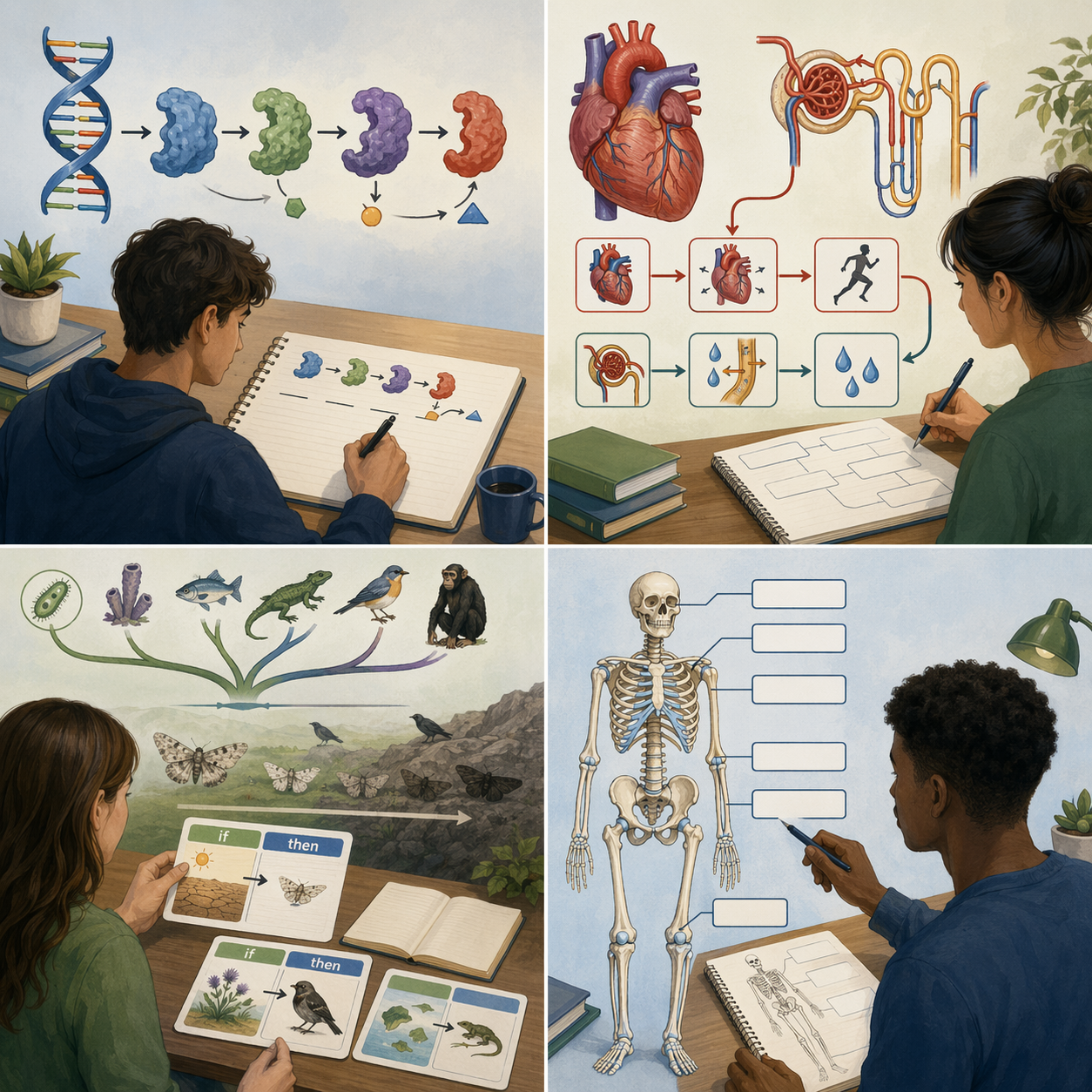
A workable study session usually starts by sorting the topic into one of four shapes:
| Biology content type | What you retrieve | Best recall format |
|---|---|---|
| Molecular pathway | Sequence, enzymes, inputs, outputs, regulation | Rebuild the pathway from memory |
| Physiology system | Structure, action, effect, feedback | Draw a functional map |
| Ecology or evolution pattern | Conditions, mechanism, predicted outcome | Answer if-then prompts |
| Anatomy structure | Name, location, spatial relationship | Label blank or occluded diagrams |
Molecular Pathways: Rebuild the Route, Not the Card Stack
Linear molecular processes reward sequence reconstruction. Glycolysis, DNA replication, transcription, translation, oxidative phosphorylation, and the Krebs cycle all have details worth memorizing, but the details only make sense inside a route. StudyCardsAI describes biology active recall for pathways as reconstructing the sequence, then adding substrates, enzymes, products, and regulation rather than memorizing disconnected facts.[3]
Use flashcards here, but do not let them become the main event too early. A card can test one enzyme. The real retrieval task is whether you can close the notes and rebuild the pathway well enough to notice what each enzyme is doing.
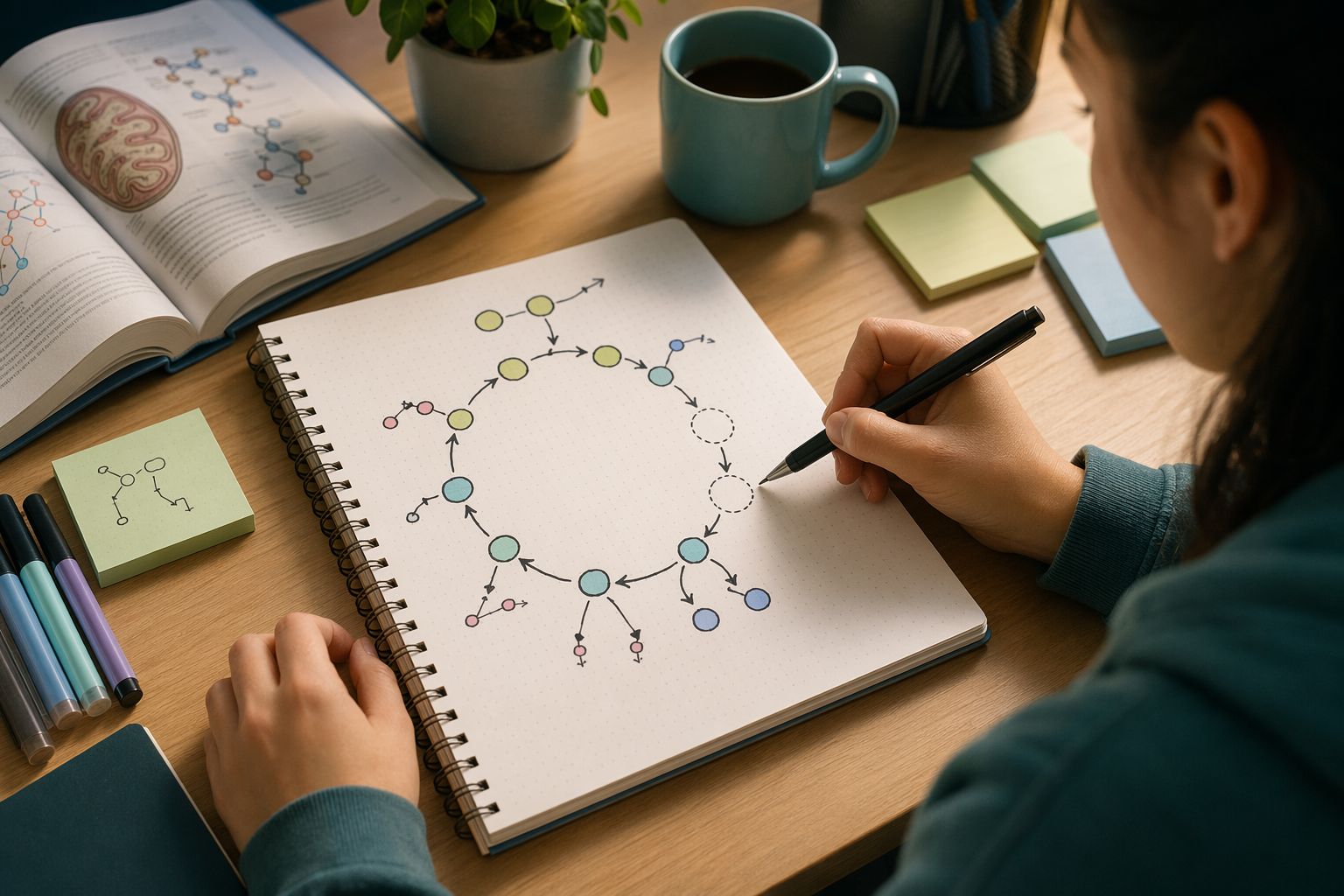
Worked Example: Krebs Cycle Reconstruction
Start with a blank page. Do not open the diagram. Do not keep the textbook beside you “just in case.” The page should make your memory do the work.
- Write the starting molecule at the top: acetyl-CoA entering the cycle by combining with oxaloacetate.
- Draw the full sequence of carbon compounds around the cycle from memory. Leave blanks if you get stuck.
- Go around again and add the enzyme for each conversion.
- Go around a third time and mark where CO2, NADH, FADH2, GTP or ATP are produced.
- Add the entry and exit logic: what enters, what leaves, and why the cycle must regenerate oxaloacetate.
- Only then open the correct diagram and repair the page in a different color.
The repair step matters. If you forgot succinyl-CoA, that is not just a spelling error in the middle of a diagram. It is a missing transition between alpha-ketoglutarate and succinate, and it may also hide a missed CO2 release or energy-capture step. The correction should say what broke in the chain, not merely add the missing word.
After the reconstruction, add one short explanation prompt. For example: “If the enzyme that converts alpha-ketoglutarate to succinyl-CoA is inhibited, what accumulates, what downstream products decrease, and why?” This is still active recall, but now it asks you to use the pathway instead of reciting it.
This is also where ordinary flashcards can re-enter. Make small cards for the specific weak links discovered during reconstruction: one enzyme you repeatedly miss, one product you place in the wrong step, one regulation point you cannot explain. Zach Highley’s caution about using active recall poorly fits this problem well: retrieval fails when the prompt is too bloated, too vague, or aimed at the wrong grain size.[4] For pathways, the large blank-page reconstruction finds the weak point; the smaller card drills it.
A useful pathway session therefore has two layers. First, rebuild the whole process. Second, isolate the errors. Reversing that order is how students end up with thirty correct cards and no working pathway.
Physiology Systems: Map Structure to Action to Outcome
Physiology usually breaks when students memorize parts without retrieving the behavior of the system. The nephron is not a list of proximal tubule, loop of Henle, distal tubule, and collecting duct. It is a sequence of regions doing different transport jobs under changing hormonal and osmotic conditions.
For this kind of biology, the better recall format is a functional map: structure → action → immediate effect → whole-body consequence. StudyCardsAI gives this same kind of physiology blueprint through nephron function, emphasizing the move from a named structure to what it does and what outcome follows.[3]
Worked Example: Nephron Functional Map
Take a blank sheet and draw only a rough nephron outline. It does not need to be pretty. It needs enough space for arrows, substances, and consequences.
- Label the major regions from memory: glomerulus, Bowman’s capsule, proximal tubule, descending limb, ascending limb, distal tubule, collecting duct.
- For each region, write the main movement: filtration, reabsorption, secretion, water movement, ion movement, or hormonal adjustment.
- Add arrows for substances instead of writing only sentences. Show where water, sodium, glucose, urea, potassium, and hydrogen ions move.
- Add the outcome: filtrate becomes more dilute, medullary gradient is maintained, blood volume changes, urine concentration changes.
- Add one condition: dehydration, high blood pressure, low blood pressure, or altered antidiuretic hormone.
- Trace what changes through the map under that condition.
A weak answer says, “The collecting duct reabsorbs water.” A stronger retrieved answer says, “When antidiuretic hormone is present, the collecting duct becomes more permeable to water, more water leaves the filtrate, urine becomes more concentrated, and blood water is conserved.” The second answer has a chain. That chain is what exam questions usually punish or reward.
Now test the map without redrawing the whole thing. Cover the labels and ask targeted prompts:
- Where is glucose normally reclaimed, and what would appear in the filtrate if that process is overwhelmed?
- Which region helps maintain the medullary gradient, and why does that matter for water conservation?
- If water reabsorption increases in the collecting duct, what happens to urine concentration?
- Which movement affects blood pH regulation, and where does it occur?
Notice the shape of these questions. They do not ask for an isolated definition. They force you to move from location to mechanism to result.
A Cardiac Cycle Variant
The same format works for the cardiac cycle. Instead of trying to memorize “systole” and “diastole” as vocabulary, draw a loop with chamber pressure, valve state, blood movement, and heart sound. A retrieval prompt might ask: “During ventricular systole, which valves are closed first, which open later, and what pressure change explains that sequence?”
This kind of prompt is less convenient than a one-line card. It is also closer to the way physiology behaves. Parts matter because they change flows, pressures, gradients, and feedback loops.
Ecology and Evolution: Practice Conditional Logic
Ecology and evolution often look less memorization-heavy, so students sometimes under-test themselves. They reread examples of natural selection and feel that the explanation makes sense. Then the exam changes the organism, the pressure, or the population structure, and the memorized example no longer carries them.
The active recall format here is conditional: if the environment changes, if variation is absent, if a bottleneck occurs, if gene flow increases, what follows and why? StudyCardsAI frames ecology and evolution recall around this kind of if-then logic, and SuperKnowva also uses biology examples where students explain a process in their own words rather than only name it.[3][5]
Worked Example: Natural Selection Under a Changed Pressure
Use a prompt like this:
A population has heritable variation in beak size. A change in available food favors individuals that can crack harder seeds. Predict what happens over generations, and state what must be true for natural selection to occur.
A good active recall answer should include more than “the birds adapt.” It should retrieve the conditions and the mechanism:
- Individuals vary in beak size.
- Some of that variation is heritable.
- The new food source creates differential survival or reproduction.
- Alleles associated with advantageous beak traits become more common over generations.
- If heritable variation is absent, selection cannot shift the population in that trait, even if the pressure is strong.
Then change one condition and answer again. If the pressure favors smaller seeds instead, what changes? If the trait is not heritable, what changes? If a random bottleneck removes many individuals regardless of beak size, how is that different from selection? The study value comes from forcing the mechanism to survive a new scenario.
The Feynman technique fits naturally here, but only if it stays precise. Explaining natural selection “like teaching a friend” is useful when the explanation includes variation, inheritance, differential reproductive success, and allele-frequency change. If the explanation slides into “organisms try to adapt,” active recall has revealed the misconception instead of hiding it.
Anatomy: Remove the Labels Before You Trust Yourself
Anatomy has a different trap: recognition feels like recall. A labeled diagram of the hand can feel familiar after several passes, but familiarity is not the same as being able to place “triquetrum,” “capitate,” or “proximal phalanx” on an unlabeled image.
Kenhub’s anatomy guidance is especially useful here because it focuses on active recall through image occlusion, blank diagrams, and atlas-based self-testing. The point is to block the answer and force retrieval of the structure’s name, location, and relationship to nearby structures.[6]
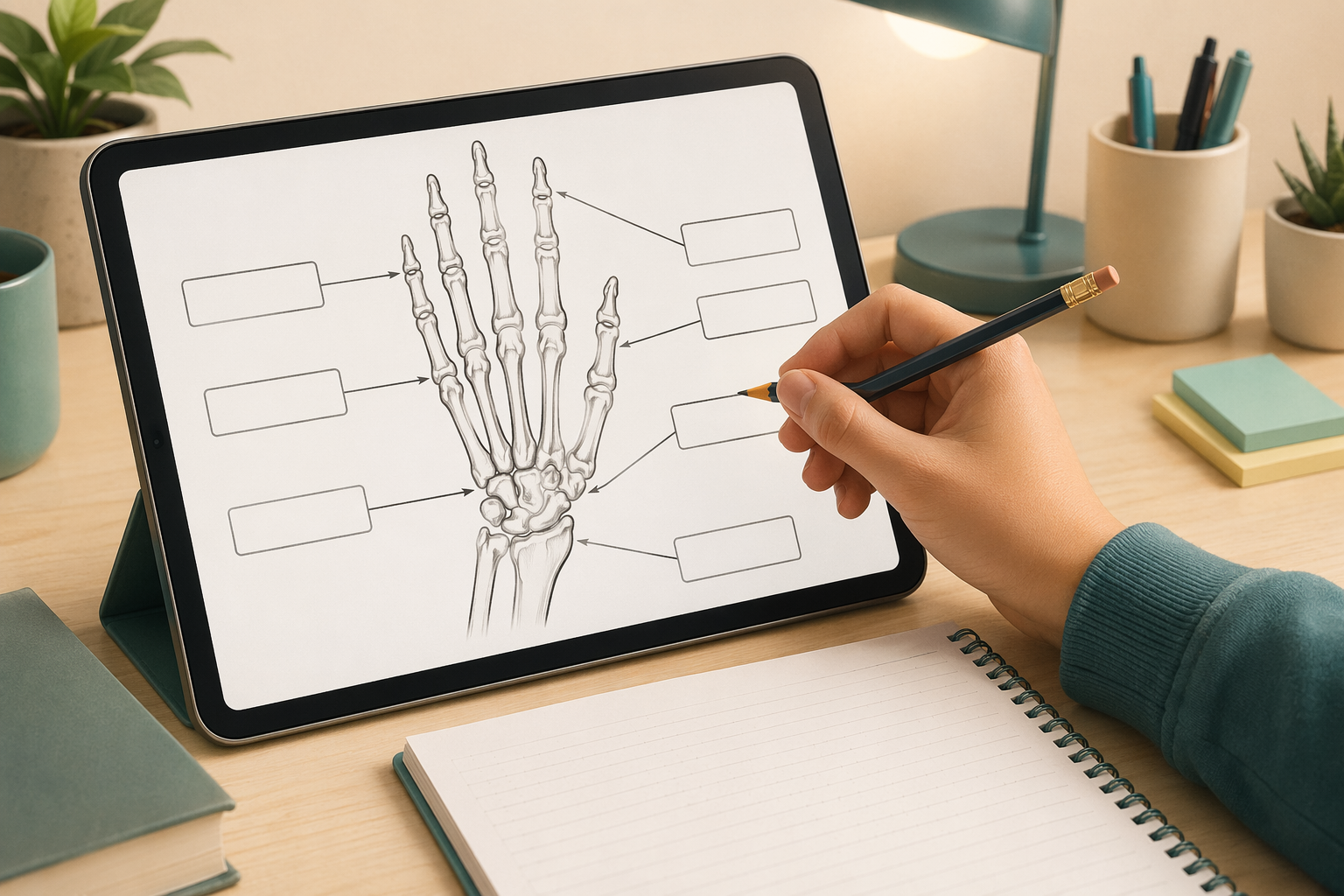
Worked Example: Bones of the Hand
Print a blank hand diagram or use an atlas image with labels hidden. If you use Anki, an image occlusion add-on can cover labels one by one. If you study on paper, a blank worksheet works just as well.
- Look at the unlabeled hand skeleton and label every bone you can without checking.
- Mark uncertain labels with a question mark instead of guessing silently.
- Check the atlas or answer key.
- Rewrite missed labels on a clean copy, not just beside the answer key.
- Add one relationship prompt: “Which carpal is lateral to this one?” or “Which metacarpal articulates here?”
- Repeat from a different view if your course expects three-dimensional recognition.
The relationship prompt is the difference between labeling and anatomical understanding. In lab practicals, structures are not always shown from the same clean angle as the study diagram. You need the name, but you also need position, adjacency, and orientation.
Blurting can help after the first labeling round. Close the diagram and write everything you remember about the carpal bones: rows, order, articulations, and any landmarks your course emphasizes. Then return to the image and correct the omissions. SuperKnowva describes blurting as a biology recall technique in which students write what they know from memory before checking gaps, which works best here when paired with a visual source rather than used as a vague brain dump.[5]
Where Flashcards Still Belong
Flashcards are not the enemy. They are just not equally good at every job. They are excellent for vocabulary, enzyme names, hormone effects, bone landmarks, and quick discrimination between similar terms. They are weaker when the real task is to reconstruct a sequence, trace a feedback loop, or interpret a changed condition.
A better rule is to make cards from the errors your larger retrieval task exposes. If the nephron map shows that you always confuse the descending and ascending limbs, make cards for that contrast. If the pathway reconstruction shows that you miss where NADH is produced, make cards for those steps. If the blank hand diagram shows that you confuse trapezium and trapezoid, make an image occlusion card for that pair.
Digital tools can make this easier, especially when they support spaced repetition or image occlusion, but the tool should serve the retrieval format. A beautiful deck built around the wrong prompt still trains the wrong behavior.
Choose the Retrieval Format Before You Start
Before studying a biology topic, pause for a few seconds and name what kind of thing it is. If it is a pathway, rebuild the route. If it is a system, map structure to action to outcome. If it is ecology or evolution, change the conditions and predict the result. If it is anatomy, hide the labels and retrieve the structure in space.
That small decision changes the study session. You stop asking active recall to mean one generic habit and start making it match the biology in front of you.
References
- Active Recall: The Most Effective High-Yield Learning Technique, Osmosis
- Why Top Students Swear by Active Recall (And You Should Too), NSCS
- Active Recall for Biology: The High-Yield Study Guide, StudyCardsAI
- Why Most People Are Using Active Recall All Wrong, Zach Highley
- Active Recall: The Best Way to Study Biology, SuperKnowva
- How to Learn Anatomy Using Active Recall, Kenhub
Apply This Method
Related Methods
- Cornell vs. Digital vs. Sentence: What a 2026 RCT Reveals About Note-Taking Forms, Motivation, and Cognitive Load
A 2026 randomized controlled trial compared four note-taking forms (Cornell, Parallel, Digital, Sentence) and found that structured methods boost motivation and retention, while digital notes lower cognitive load without improving test scores. This article breaks down the research and gives evidence-based recommendations for students.
- Interleaving Study Method Examples for Math: 7 Sequences from Research
See how to apply the interleaving study method to math with seven concrete example sequences drawn from cognitive science research. Learn why mixing similar problem types—rather than practicing one skill at a time—produces stronger long-term retention for high school and college math students.
- Cornell Note Taking Samples by Subject: Real Examples for Biology, History, Math, and Language
See exactly how Cornell notes work across four different subjects with annotated, real-world examples. This guide helps middle school, high school, and college students understand how to adapt the cue column, notes section, and summary for science, history, math, and language classes.
Comments
Join the discussion with an anonymous comment.