
How Penn's Campus Climate Affects Your Study Environment and Scores
The practical question behind Penn’s campus-climate controversy is narrower than most campus arguments make it. If the room feels tense, if students are choosing words carefully, if a disagreement can follow you back to a seminar table or group chat, does that actually show up when you try to study for the MCAT, GRE, SAT, or ACT?
The honest answer is: sometimes, and not in a neat one-point-per-stressor way. Campus climate is not a simple score predictor. But it is a study-condition variable. It can raise the mental cost of getting to the desk, staying at the desk, asking for help, sleeping well enough to retain material, and sitting through a full timed section without rumination taking over.
Penn is a useful case because the evidence is concrete without being clean enough to overclaim. In a 2016 Brandeis/Steinhardt survey of University of Pennsylvania undergraduates, nearly 90% identified student mental health as the most pressing campus issue, and nearly half disagreed that unpopular opinions could be expressed freely on campus. The survey sampled 2,500 students, had a 44.7% response rate, and included 1,113 respondents.[1]

That survey is now old, and Penn’s post-October 7, 2023 campus dynamics cannot be reduced to a 2016 snapshot. More current speech-climate data points in the same direction but measures a different thing. In FIRE’s 2026 College Free Speech Rankings, Penn ranked 231st out of 257 schools, with a score of 51.5 out of 100 and an F grade, though it improved 17 spots from the prior year. The ranking came from FIRE’s largest-ever survey, with 68,510 respondents across 257 schools, fielded from January 3 to June 5, 2025.[2]
The faculty signal matters too, not because faculty behavior automatically predicts student scores, but because it tells you caution is not confined to undergraduates. A 2024 FIRE faculty survey reported that 32% of UPenn faculty had recently toned down something they wrote to avoid causing controversy.[3] When both students and faculty are navigating speech carefully, the academic atmosphere can start to feel less like a stable container for learning and more like another task to manage.
What “atmosphere” can change before it changes a score
A tense campus does not usually walk into your test booklet and erase answers. The pathway is more ordinary: it interrupts the conditions that make preparation work.
High-stakes exams reward boring consistency. You need enough quiet repetitions to notice the same algebra trap, the same reading-comprehension mistake, the same chemistry recall gap, the same careless timing decision. Campus pressure interferes when it turns that repetition into a negotiation: Where can I study without running into that conversation? Can I ask this question in class without being read the wrong way? Should I skip office hours because the discussion has become socially loaded? Do I have enough energy for a timed practice test after managing all of that?
| Campus-climate pressure | Study consequence that can matter for scores |
|---|---|
| Feeling unable to express unpopular opinions | Less class participation, fewer clarifying questions, more private confusion |
| Social pressure around identity or politics | More monitoring of speech and behavior, leaving less attention for the academic task |
| Discrimination or feeling unwelcome | Higher emotional load, more avoidance of spaces where help or quiet study might be available |
| Mental-health strain | Worse sleep, weaker planning, lower tolerance for difficult practice sessions |
| Faculty caution | Less open modeling of disagreement and inquiry, which can make students more cautious too |
The table is not a causal proof. It is the map a test-taker needs. If a student’s study routine depends on a particular library, class, lab, peer group, or office-hour relationship, then campus atmosphere is no longer abstract. It has entered the prep system.
The evidence is stronger for “moderate academic burden” than for “Penn lowers scores”
The broader research does support taking climate seriously. Meta-analyses of approximately 90 studies have found that campus climate has a moderate positive effect on student achievement, meaning the learning environment is associated with academic outcomes in a measurable way.[4]
That finding is useful, but it should not be inflated. A moderate relationship is not destiny. It does not mean every student on a tense campus will underperform. It does not mean Penn students’ standardized-test scores can be predicted from a free-speech ranking. It also does not tell us how much of a student’s MCAT, GRE, SAT, or ACT performance is caused by campus atmosphere rather than preparation hours, prior academic foundation, family stress, financial strain, sleep, tutoring access, or health.
The Penn-specific mental-health and speech-expression data come from 2016, so they cannot be treated as a current diagnostic scan of today’s undergraduate experience. The newer FIRE ranking is current, but it measures speech climate, not exam performance. The 2024 faculty self-censorship figure is another climate signal, not a student-achievement study. Put together, the materials justify a bounded judgment: Penn’s atmosphere has enough documented strain to be relevant to study planning, but not enough evidence to support a clean claim that the controversy directly lowers individual test scores.
The mechanism: cognitive load before content load
A student preparing for a high-stakes exam already has a heavy content load. The MCAT adds biology, chemistry, physics, psychology, sociology, critical analysis, and stamina. The GRE adds vocabulary, reading precision, quantitative fluency, and writing under time. The SAT and ACT reward fast switching between skills while mistakes accumulate quietly. The work is demanding even in a calm room.
A tense campus adds cognitive load before the student even opens the book. Self-censorship is one version of it. The student is not only listening to a seminar or reviewing notes; they are also tracking how a comment might land, who might repeat it, whether a disagreement is worth it, and whether silence is safer. That kind of monitoring uses attention. It may be socially rational, but it is still mentally expensive.
The study damage often arrives later, disguised as ordinary fatigue. A student leaves class with an unresolved question because asking it felt risky. The question becomes a gap in the chapter review. The gap becomes a missed practice problem. The missed practice problem becomes a discouraging timed set. None of those steps looks dramatic, but standardized-test prep is built out of exactly those small corrections.
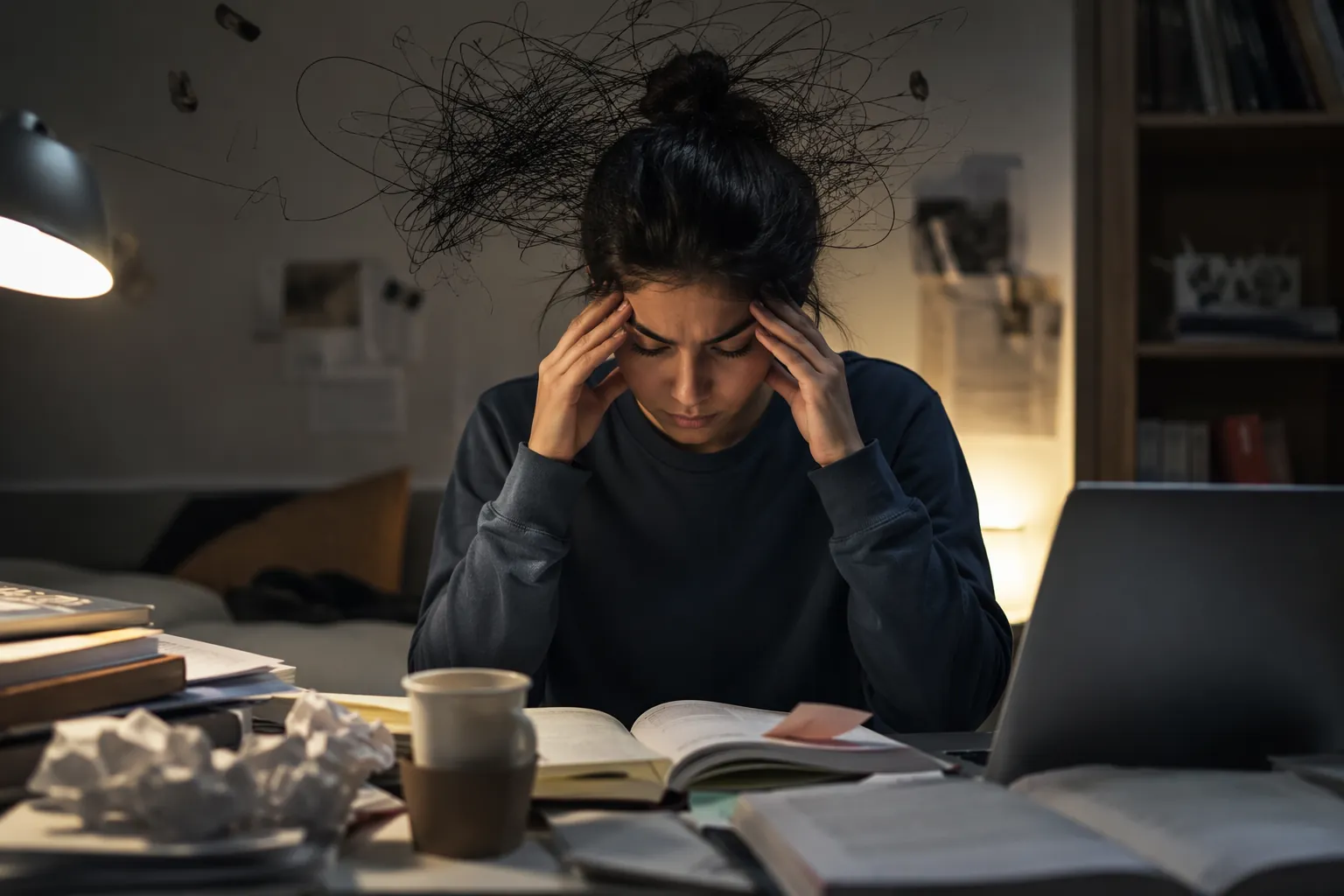
Mental-health strain works through a different door. The 2016 Penn survey’s finding that nearly 90% of undergraduates identified student mental health as the most pressing campus issue does not prove that political climate caused that strain.[1] But for studying, the practical concern is still sharp: anxiety, exhaustion, and poor sleep make it harder to plan, start, persist, and review mistakes without spiraling.
Sleep is one of the first things students sacrifice when the day has been emotionally cluttered. They still want the practice set done, so they push it later. Then they review poorly, wake up foggy, and decide they are “bad at timing” or “not improving.” Sometimes the real problem is that the study session has been moved into the worst part of the day because the better hours were spent recovering from campus noise, not academic work.
Help-seeking is another quiet casualty. A student who feels unwelcome, targeted, or socially exposed may avoid the very settings where confusion gets resolved: office hours, study groups, tutoring centers, review sessions, even casual conversations after class. The 2016 Penn study reported that students of color and LGBTQ students had higher rates of feeling unwelcome or experiencing discrimination, which means the study burden is not evenly distributed.[1]
That matters for scores because help-seeking is not decorative. It is how students turn vague weakness into an assignable task. “I’m bad at CARS” becomes “I lose the author’s contrast in dense passages.” “I can’t do math fast enough” becomes “I am spending too long deciding which equation applies.” If the student has to do that diagnostic work alone because the available rooms feel unsafe or socially costly, prep gets slower.
A useful score question: does the climate change behavior this week?
The most useful way to evaluate campus atmosphere is not to ask whether it is “bad enough” in general. Ask whether it changed a study behavior in the last seven days.
- Did you leave a study space earlier than planned because the environment felt tense, distracting, or socially uncomfortable?
- Did you avoid asking a content question because the conversation around it felt politically or socially risky?
- Did you postpone a timed section because you were too emotionally activated to get a fair read on performance?
- Did you sleep worse after a campus conflict, argument, protest, seminar discussion, or group-chat exchange?
- Did you spend more time managing where to be and whom to avoid than actually studying?
If the answer is yes once, that may just be a hard week. If the answer is yes repeatedly, the climate has become part of the study plan whether anyone has named it or not.
This is also where students should be careful with self-blame. Discipline matters, but discipline is not the same as pretending the room has no effect. A student who needs a quieter library, a different study group, or a more protected practice-test ritual is not being fragile. They are reducing interference.
How to reduce the damage without pretending the larger climate is fixed
The goal is not to solve Penn’s campus climate before your exam date. The goal is to stop the climate from making daily decisions for you. That starts with separating what you can control from what you have to route around.
A practical first move is to audit your study spaces by output, not by loyalty. Many students keep returning to the library, café, dorm lounge, or department building that used to work. If the space now produces fragmented sessions, repeated social vigilance, or a habit of leaving early, it is no longer your primary prep room.

Make the decision with a small tracking sheet. For one week, write down where you studied, what you intended to do, what you actually completed, and whether you left mentally steadier or more drained. You do not need a perfect system. You need enough evidence to stop confusing a prestigious or familiar room with a productive one.
| If this keeps happening | Change this variable first |
|---|---|
| You reread without retaining | Move to a lower-stimulation room before changing the whole study plan |
| You avoid practice tests because the day feels too charged | Schedule full-lengths in a protected morning block or off-campus location |
| You lose time after difficult seminars or campus events | Put lighter review after those periods and reserve new learning for calmer hours |
| You stop asking questions | Use a smaller help channel: one tutor, one teaching assistant, one trusted peer |
| You study late to make up for disrupted afternoons | Protect sleep first, then reduce the task size instead of pushing later |
Protect the timed-practice ritual
Timed practice is where campus stress can distort feedback. If you take a section while angry, shaken, underslept, or still replaying a conversation, the score may tell you more about that day’s interference than about your underlying skill. Do not throw the result away automatically, but label it honestly.
Use a simple tag after each timed set: normal conditions, tired, emotionally activated, interrupted, or poor sleep. Over several sessions, patterns become visible. If every “poor sleep” tag comes with timing collapse, the answer may not be another timing strategy. It may be moving hard practice earlier, reducing evening exposure to campus conflict, or refusing to begin a full section after a draining event.
Students preparing through structured exam plans can treat this the same way they treat content diagnostics. A GRE quant weakness, an SAT reading timing problem, or an MCAT CARS slump should be separated from environmental interference as much as possible. The cleaner the practice conditions, the more trustworthy the score data.
Build smaller help routes
If the broad classroom or campus discussion feels too exposed, the answer is not always to force yourself into it. Sometimes the better move is a narrower route: one office-hour slot, one recurring tutor appointment, one peer who can trade problem explanations without turning the session into a debate, one online forum used only for content questions.
This is especially important for students who already feel unwelcome or watched. The burden of finding a safer route is unfair, and it still may be necessary before test day. A student should not have to engineer every layer of protection. But if the exam date is fixed, a smaller, steadier help channel can keep confusion from hardening into a score ceiling.
Change the schedule before changing the goal
When students are under social and emotional pressure, they often make the largest decision first: maybe I should postpone, maybe I am not cut out for this, maybe I should abandon the score goal. Sometimes postponing is the right call, especially when sleep, health, or safety has deteriorated. But before making that decision, check whether the schedule is carrying avoidable damage.
- Move new learning to the time of day when campus exposure is lowest.
- Put review, flashcards, or error-log work after emotionally heavier classes or events.
- Take full-length practice tests away from the locations most associated with conflict or interruption.
- Set a cutoff time for campus discourse, group chats, or news before sleep.
- Keep one weekly recovery block that is not secretly used for extra practice.
For students who need a more general reset, the useful principle is simple: control the inputs closest to performance first. Room, time, sleep, practice-test conditions, and help access usually change faster than institutional culture. A student can also use a broader framework for focusing on what you can control when studying if the surrounding situation keeps pulling attention away from the exam plan.
Use tools only when they solve the actual problem
Some environmental fixes are concrete. Noise-canceling headphones can help if the problem is sound, interruptions, or the feeling that every nearby conversation is entering your study session. They will not fix social isolation, discrimination, or sleep debt. They are a tool, not a coping strategy by themselves. If sound is the main barrier, a guide to noise-canceling headphones for studying and focus may be worth using; if the problem is fear of being targeted or unwelcome, the solution has to include people and place, not just equipment.
What parents and applicants should take from Penn’s example
For parents and applicants, Penn’s case should not be turned into a one-word verdict on the university. A campus can be academically powerful and still have study-climate problems. A free-speech ranking can signal caution and tension without directly measuring whether a particular student will thrive. An old survey can still raise useful questions while failing to describe the present perfectly.
The better campus-visit questions are practical. Where do students go when they need quiet? Are there enough study spaces outside the main symbolic centers of campus? Do students describe office hours as usable? Can students find peer groups that are academically serious without being socially punishing? What happens when students disagree in class? Are mental-health and academic-support systems reachable before a crisis?
For a current test-taker, the decision is even more immediate. If the atmosphere is costing you concentration, do not wait for the institution to become less tense before changing your prep conditions. Move the work. Shrink the help route. Protect the full-length test. Track sleep. Label distorted practice results. Keep the exam plan specific enough that campus noise cannot rewrite it every afternoon.
A tense campus atmosphere is not destiny, and it should not be treated as a simple score predictor. But it is a real study-condition variable. It belongs in the same planning conversation as hours per week, practice-test timing, sleep, tutoring access, and the room where you are actually able to think.
References
- Diversity, Pressure, and Divisions on the University of Pennsylvania Campus — Steinhardt Social Research Institute / Brandeis University
- 2026 College Free Speech Rankings — FIRE
- Majority of faculty at Penn State, UPenn have self-censored at some point, new report finds — Pittsburgh Post-Gazette — December 12, 2024
- Meta-analyses of approximately 90 studies on campus climate and student achievement
Related case links
Did a similar plan work for you?
Share whether a comparable timeline and starting point produced a similar result — this is verification discussion, not general commentary.
Comments
Join the discussion with an anonymous comment.