
Why the Algorithm Is the Most Important Feature in a Language Flashcard App
Spaced repetition algorithms like FSRS can cut your daily reviews by 20–30% compared to older methods, reducing burnout and saving hours each month. This guide explains which flashcard apps use true modern scheduling and which ones rely on outdated or proprietary systems—so you can choose the tool that fits your vocabulary size and study habits.
The best flashcard app for language learning is not the one that feels nicest during your first week. It is the one that still feels survivable after the deck has grown past a few thousand words, the novelty has worn off, and your morning review queue is deciding whether language study remains a habit or turns into unpaid clerical work.
At small scale, almost every flashcard app looks competent. A clean card editor, a few public decks, audio support, and a bright “learn” button are enough when you have 80 cards. At 5,000 cards, the real feature is subtraction: which cards does the app have the nerve not to show today, while still keeping your retention where you asked it to be?
That is why the algorithm matters. In benchmark modeling discussed by Zhong Chinese, FSRS produced roughly 20–30% fewer reviews than SM-2 at equivalent retention; the same analysis shows the familiar review snowball, where adding 20 new cards per day can push an SM-2 schedule past 220 daily reviews by Day 30 before any life interruptions enter the picture.[1] A 20–30% reduction is not a decorative optimization there. It is the difference between a review session that fits before work and one that starts eating the rest of your study time.
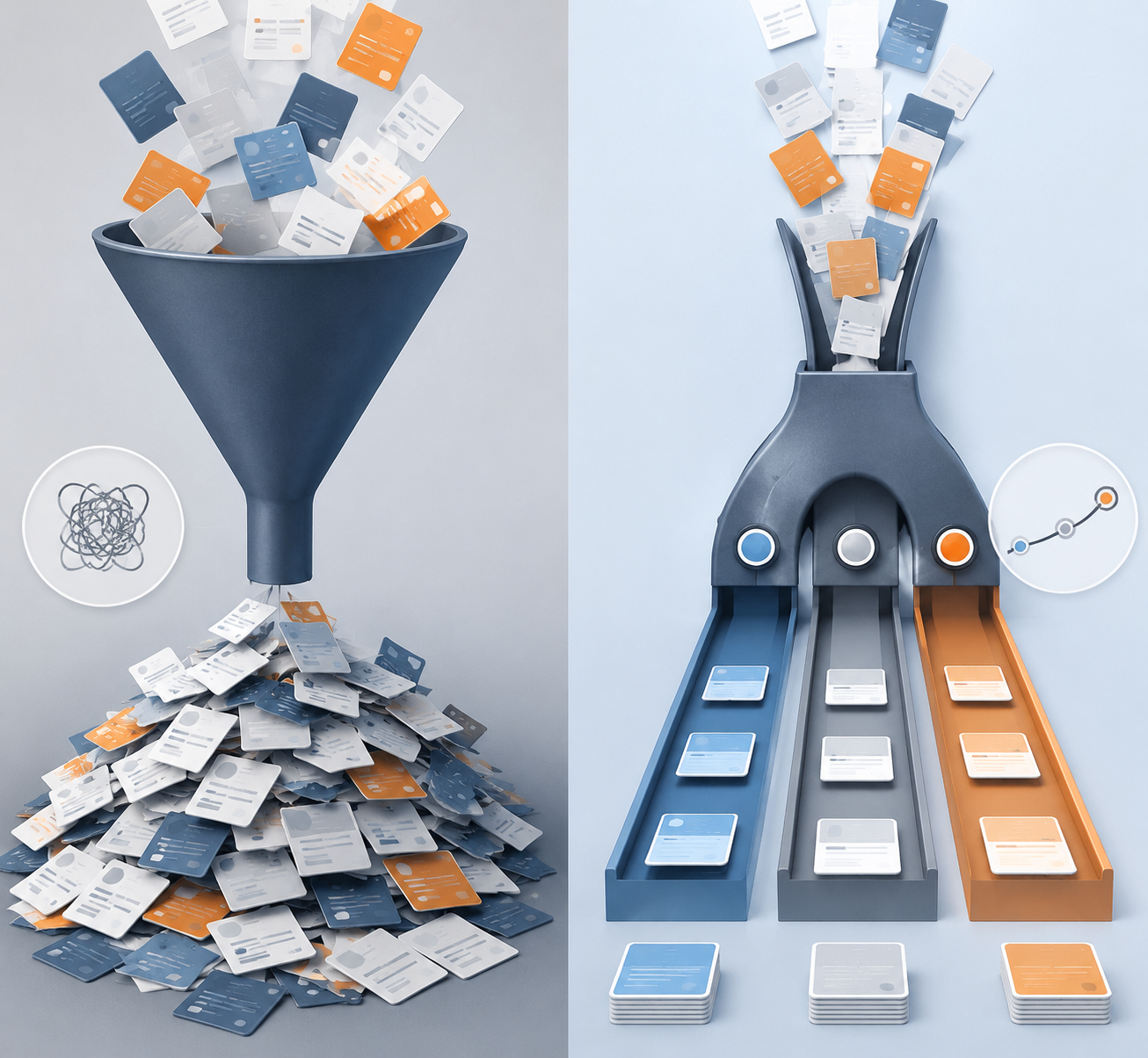
Once the Deck Is Large, Scheduling Becomes the Product
Language vocabulary is especially good at exposing weak scheduling. A learner does not add one isolated fact and then stop. They add verbs, readings, gender, tones, kanji, collocations, false friends, example sentences, and the embarrassing little words that look easy until they keep slipping away. The deck keeps receiving new material while old material keeps asking to be protected.
This changes the question. “Can the app teach me this word today?” is a beginner question. The harder question is: “Can the app keep thousands of old words out of my way until the right moment, then bring back the fragile ones before they decay?” A motivational study mode can help you start. It cannot replace a cross-session memory model that remembers how each card behaved last week and adjusts tomorrow because of it.
This is also where public deck libraries become less impressive than they look on comparison pages. A huge shared deck can save setup time, but it can also import thousands of cards into a scheduler that is not ready to carry them. The bill arrives later, one review at a time.
SM-2 Was Durable, but FSRS Models More of the Problem
SM-2 deserves respect. It is old, blunt, and still more serious than many glossy “smart learning” systems. The original SuperMemo 2 algorithm dates to 1987 and uses a single ease factor with hand-tuned parameters to stretch or shrink future intervals based on how well you rated a review.[1] That design helped define what many learners now think of as spaced repetition.
Its limitation is that it compresses too much of memory into one main per-card adjustment. A card that is inherently hard, a card that is temporarily shaky, and a card that has become durable after repeated success can all end up being handled through a relatively narrow heuristic. At low volume, the waste is tolerable. At high volume, tolerable waste becomes a queue.
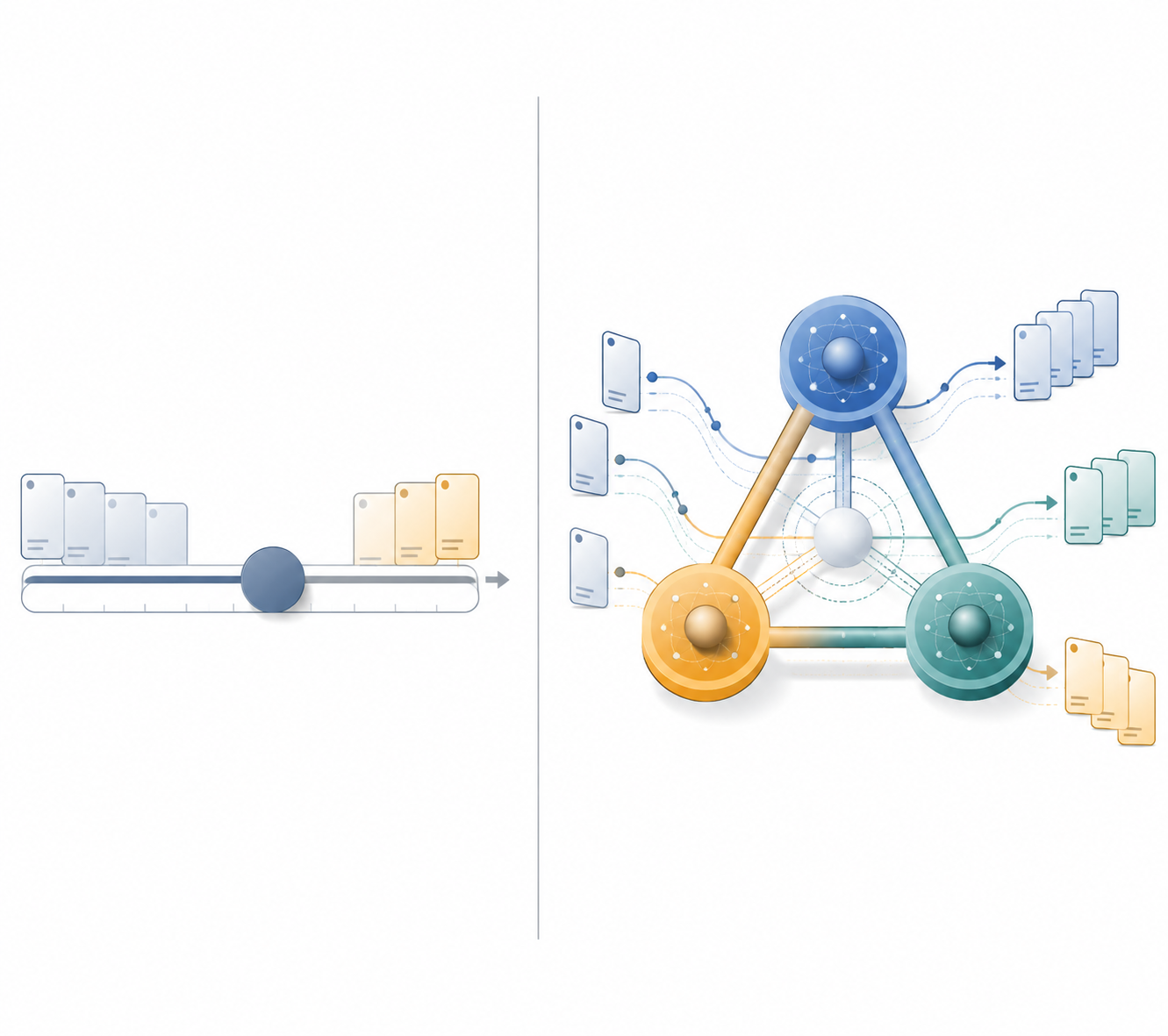
FSRS, short for Free Spaced Repetition Scheduler, changes the shape of the model. Instead of leaning on a single ease factor, it uses a DSR model: difficulty, stability, and retrievability. Difficulty estimates how stubborn a card is. Stability estimates how long the memory is likely to last. Retrievability estimates the probability that you can recall the card at a given moment.[1]
Those three variables matter because language cards fail in different ways. A transparent cognate may become stable quickly. A minimal pair in pronunciation may stay difficult even after several correct reviews. A word you knew last month may be retrievable today but close to the edge. Treating those as different states lets the scheduler avoid two common wastes: reviewing easy cards too soon and letting truly hard cards disappear behind optimistic intervals.
The modern FSRS line also trains its weights on large review histories rather than relying only on fixed hand-tuned assumptions. Migaku describes FSRS as using 17 trainable weights, with training data drawn from roughly 700 million reviews submitted by about 20,000 volunteer users; it also notes that FSRS-6 shipped in late 2025.[2] That does not make every benchmark a settled peer-reviewed conclusion, and it does not mean every learner will see exactly the same reduction. It does mean FSRS is trying to fit memory behavior from actual review logs rather than guessing with one old knob.
What the Three FSRS Variables Feel Like in a Language Deck
| FSRS variable | What it means | Language-learning consequence |
|---|---|---|
| Difficulty | How hard the card tends to be for you | A slippery verb form or similar-looking character can be treated as genuinely stubborn instead of merely unlucky. |
| Stability | How long the memory is expected to last | A word that has survived several reviews can be left alone longer without pretending every card deserves the same interval growth. |
| Retrievability | How likely you are to recall it now | The app can choose whether today is worth spending a review on, instead of showing cards just because a fixed interval expired. |
The practical mercy is not magic recall. It is fewer unnecessary touches. If the app can predict that a card is still safely retrievable, it can leave it alone. If it can see that a card is hard despite recent success, it can keep it closer. That is where the 20–30% fewer reviews figure becomes believable as a daily-study improvement rather than a marketing number.[1]
The Evidence Is Strong Enough to Use, Not Strong Enough to Worship
The best reason to take FSRS seriously is not that it sounds modern. Plenty of learning software sounds modern. The reason is that its reported advantage shows up in the part of studying that learners actually feel: review count at the same target retention. Zhong Chinese’s analysis places the reduction around 20–30% compared with SM-2 under equivalent retention assumptions, including the Day 30 modeling where 20 new cards per day creates a heavy SM-2 review load.[1]
There is a caveat worth keeping in view. Much of the most accessible FSRS benchmarking comes from practitioner and toolmaker sources, including a Mandarin-learning platform and an SRS company. That does not make it useless; serious language learners often have to make tool decisions before the ideal academic literature arrives. It does mean the honest claim is narrower: FSRS has strong community and practitioner evidence for reducing reviews at equivalent retention, but independent peer-reviewed confirmation remains limited.
The broader spacing principle is less controversial. Migaku cites Cepeda et al.’s 2008 work on spacing, including the finding that optimal review gaps scale roughly with the desired retention interval, often in the 10–20% range.[2] That supports the general idea that timing matters. It does not, by itself, prove that one commercial app’s implementation is better than another’s.
Algorithm Tiers for Language Learners in 2026
For a learner with thousands of cards, I would sort flashcard apps by scheduling architecture before sorting them by interface. That does not mean design is irrelevant. It means a beautiful app with weak cross-session scheduling can become expensive in time, even if its subscription price looks reasonable.
| Tier | Apps | Scheduling judgment | Who should care most |
|---|---|---|---|
| Tier 1: true FSRS | Anki 23.12+, MintDeck, RemNote | Modern scheduling built around FSRS-style memory modeling; best fit when review load is already a constraint. | Learners maintaining thousands of vocabulary, sentence, kanji, or character cards. |
| Tier 2: SM-2 or SM-2 variants | Anki legacy scheduler, Flashcards Deluxe, Mnemosyne | Real spaced repetition, but older heuristic scheduling with less efficient modeling at scale. | Learners who value stability, control, or existing workflows and can tolerate a larger queue. |
| Tier 3: proprietary or basic systems | Quizlet, Brainscape, Duolingo | Useful for practice or motivation, but weaker as long-term vocabulary infrastructure when cross-session memory state is unclear or simplified. | Casual learners, short-term class review, or people with small decks. |
Anki is still the reference point because it combines FSRS with uncomfortable amounts of control. Since Anki 23.12, FSRS has been available as the built-in modern scheduler, which means the app no longer has to be defended only as the ugly-but-powerful SM-2 tool many learners remember.[2] It remains less polished than many competitors, but its ugliness is at least attached to a scheduler that knows what yesterday meant.
MintDeck is interesting for a different reason: it tries to make FSRS less hostile to normal people. That matters, because many learners do not fail spaced repetition because the concept is bad; they fail because setup, card creation, sync, and review settings become little points of drag. Its own materials position it around modern language-learning flashcards and FSRS-style scheduling, but vendor claims deserve the usual caution until they are tested in your actual routine.[4]
RemNote belongs in the same top scheduling tier when the learner wants notes and flashcards in the same knowledge system. That is not automatically better for language study. Some people benefit from connecting grammar notes, example sentences, and vocabulary; others turn their study system into a filing cabinet. The scheduling architecture makes it viable at scale, but the surrounding workflow still has to stay light enough to use daily.
The SM-2 tier is not obsolete in the sense of being useless. Flashcards Deluxe, Mnemosyne, and older Anki scheduling can still support serious study. The problem is economic: if FSRS can preserve the same retention target with fewer reviews, then staying on an older scheduler has a recurring cost. You pay it in minutes, attention, and eventually skipped days.
Where Quizlet, Brainscape, and Duolingo Fit
Quizlet is the clearest warning that popularity and long-term scheduling are not the same thing. FLTMAG notes that Quizlet discontinued its Long Term Learning feature in 2020.[3] Current Learn-style flows can still be useful for short sessions, class lists, and cramming, but MintDeck argues that Quizlet’s current Learn mode resets session-to-session rather than maintaining the kind of cross-session memory state serious SRS users expect.[4]
That distinction matters more than the branding. A session-based “learn” mode can decide what to ask next inside today’s activity. A long-term SRS has to remember the card’s history across days and weeks, then schedule the next review based on the state of that memory. Those are not interchangeable once the deck becomes a long-running vocabulary archive.
Brainscape and Duolingo can both have a place, but I would not treat either as the main memory system for a large self-managed vocabulary deck. Brainscape’s confidence-based repetition is easier to understand than many black-box systems, yet it does not occupy the same algorithm tier as FSRS. Duolingo is better understood as a course and habit product than as a transparent, user-controlled spaced-repetition database for thousands of custom language cards.
This is not a moral judgment. If an app gets you through a semester list or helps you practice on the bus, it has done something useful. The mistake is promoting that same tool into the central memory system for a multi-year language project without asking whether it can model memory across sessions.
When the Algorithm Does Not Matter Much Yet
If you have fewer than about 500 cards, the algorithm difference may be hard to feel. Your daily reviews are still small enough that interface friction, audio quality, card creation speed, and whether you enjoy opening the app can dominate. A casual learner who wants survival phrases for travel does not need to optimize like someone maintaining years of reading vocabulary.
There is also a personality cost to powerful tools. Anki can be configured badly. RemNote can tempt you into overbuilding. Any FSRS app can still fail if you add too many new cards, write vague prompts, or avoid reviews for a week and then blame the scheduler for the crater. Algorithms reduce waste; they do not abolish consequences.
The Spanish-learning evidence is a useful reminder here. FLTMAG summarizes a 2019 study by Seibert Hanson and Brown in which Anki use correlated with improved Spanish proficiency, but most students did not maintain regular use.[3] That is the quiet catch in every spaced repetition recommendation: the best scheduler is only better if you actually keep meeting it.
A Practical Decision Path
Before comparing app stores, narrow the decision by workload.
- If you are under 500 cards, choose the app you will actually open and keep your card format clean.
- If you are moving toward 1,000–2,000 cards, make sure the app has true cross-session spaced repetition, not only a same-day learn mode.
- If you are maintaining several thousand cards, put FSRS near the top of the requirements list.
- If you are already drowning in reviews, reduce new cards first, then consider migrating to an FSRS scheduler rather than chasing a prettier interface.
- If you need a broad app comparison beyond scheduling, treat pricing, platform support, and content libraries as secondary filters after the memory model.
Pricing deserves a smaller role than most comparison pages give it. Subscription prices for Quizlet, Brainscape, Duolingo, and newer flashcard tools change often, so any figure should be verified at checkout; treat prices as current only as of July 2026. A cheap app that creates 30% more review work is not necessarily cheap. A paid app that you abandon after two weeks is not efficient either.
The Conditional Verdict
For serious language learners carrying thousands of cards, the best flashcard app for language learning is one with true FSRS scheduling. In 2026, that points first to Anki, MintDeck, and RemNote, with the choice depending on whether you prefer maximum control, a more language-focused workflow, or integrated notes and cards.
For smaller decks, short-term classes, or casual vocabulary practice, Quizlet, Brainscape, Duolingo, and SM-2-based tools can still be reasonable. The threshold is not ideological. It arrives when the review queue starts shaping your day. At that point, the app’s prettiest screen matters less than whether its scheduler can save you hundreds of unnecessary reviews without letting the language leak away.
References
- FSRS Algorithm, Zhong Chinese, https://zhongchinese.com/articles/deepdives/fsrs-algorithm/
- Spaced Repetition in 2026: How It Actually Works, Migaku, https://migaku.com/blog/language-fun/spaced-repetition-in-2026-how-it-actually-works
- Spaced Repetition Flashcard Apps, FLTMAG, https://fltmag.com/spaced-repetition-flashcard-apps/
- Flashcard App for Language Learning, MintDeck, https://www.mintdeck.app/blog/flashcard-app-language-learning
Related Resources
- Quizlet Flashcard Maker vs. AI Alternatives in 2026: Is It Still the Best Tool for Making Flashcards? →
This article helps students evaluate whether to stick with Quizlet or switch to an AI-native flashcard tool like Knowt, Anki, or StudyPDF. It compares each tool's flashcard creation workflow — manual, import, and AI generation — to help you decide which platform fits your study habits and budget.
- Free Online Flashcard Makers with AI Generation: Which Tools Actually Turn Your Notes into Cards for Free? →
Many flashcard apps promise free AI generation, but the reality varies wildly. This guide cuts through the marketing to reveal exactly what each free tier delivers—deck limits, file caps, and output quality—so you can choose the tool that actually works for your study load without paying.
- Best Flashcard Apps for Language Learning in 2026: A Side-by-Side Comparison →
A comprehensive comparison of the top flashcard apps for language learners in 2026, evaluating algorithm quality, audio support, AI generation, and pricing to help you choose the right tool for your goals and budget.
Comments
Join the discussion with an anonymous comment.