GENERAL Exam Hub
How the TR Presidential Library Made AI Research Verifiable
The TR Presidential Library's Campfire AI answers from a curated archive the library staff verified — not the open internet — with confidence-scored transcriptions, human review, and a source citation attached to every claim. It's a working example of verification-first AI research, and a concrete standard for judging any AI study tool before trusting its output.
- gre
- mcat
- asvab
- sat
- act
- digital-adaptive
- official-material
- section-strategy
- test-date-timeline
General-purpose AI can make weak research look finished. It can smooth out uncertainty, invent a citation-shaped sentence, and hand a student something that reads as if a source must exist somewhere. The useful question behind Theodore Roosevelt Presidential Library research and archives is therefore not whether an AI answer sounds scholarly. It is whether the system can show the chain between the answer, the document, the transcription, the reviewer, and the citation.
That is where the Theodore Roosevelt Presidential Library’s Campfire system is worth attention. It is not a historical skin placed over a public chatbot. The strongest claim for it is narrower and more useful: Campfire answers from a curated archival pipeline, not from the open internet, and the pipeline is built to keep source verification close to the answer.
Start with the evidence labels
The evidence base for this article is not all the same kind of evidence. Microsoft Signal is a corporate-published account, useful for Microsoft’s role in Box 1, the AI For Good Lab, and the library’s description of the archive problem.[1] Terentia’s case study is vendor-published, so its workflow details are useful but its promotional tone should not be mistaken for independent evaluation.[2] The library’s own Archives and Research pages provide the official institutional framing of its scattered Roosevelt record and digital research mission.[3][4] Opening dates are time-sensitive: the library announced a July 1, 2026 dedication and a July 4, 2026 public opening.[5]
That source posture matters because AI research tools are unusually easy to overstate. A vendor case study can explain a workflow. It cannot, by itself, prove that every future AI archive will be reliable. A corporate article can describe a system its company helped build. It should still be read as a company source. The useful standard is to keep each claim tied to the kind of source that can actually support it.
Roosevelt’s record was messy enough to make verification matter
The Roosevelt archive problem was not a tidy shelf waiting to be scanned. Microsoft says Theodore Roosevelt’s record was spread across 32 separate collections at 18 institutions.[1] Terentia describes Campfire as drawing on primary sources from 33 collections at 18 institutions.[2] That one-collection difference should not be polished away. It is exactly the kind of discrepancy a research system has to preserve rather than hide.
The library’s official Archives page frames Roosevelt materials as widely dispersed, with the digital library serving as a way to make those records discoverable rather than pretending they all physically moved to one place.[3] Its Research page likewise presents the library as a digital research destination, not simply a building with boxes in the basement.[4] For an AI system, that distinction is critical. If the source material comes from many institutions, the answer has to carry enough provenance to survive normal scholarly suspicion.
A student using a chatbot for a deadline usually meets the problem at the end, when a teacher asks, “Where did that claim come from?” Campfire tries to move that question to the beginning. Before an answer can be treated as usable, the document has to enter the curated corpus, be transcribed, receive metadata, pass review, and remain attached to its source.
The machinery: from scattered documents to citable answers
The backbone is Box 1, the library’s AI-powered knowledge base. Microsoft says archivists uploaded hundreds of thousands of documents into Box 1, built with help from Microsoft’s AI For Good Lab; Microsoft also says the lab donated much of the work, plans to publish a paper on the technology, and intends to open-source the software.[1] Those details do not prove the system is perfect. They do show that Campfire sits on top of an archival infrastructure rather than a loose query sent into the open web.
| Stage | What happens | Why it matters for trust |
|---|---|---|
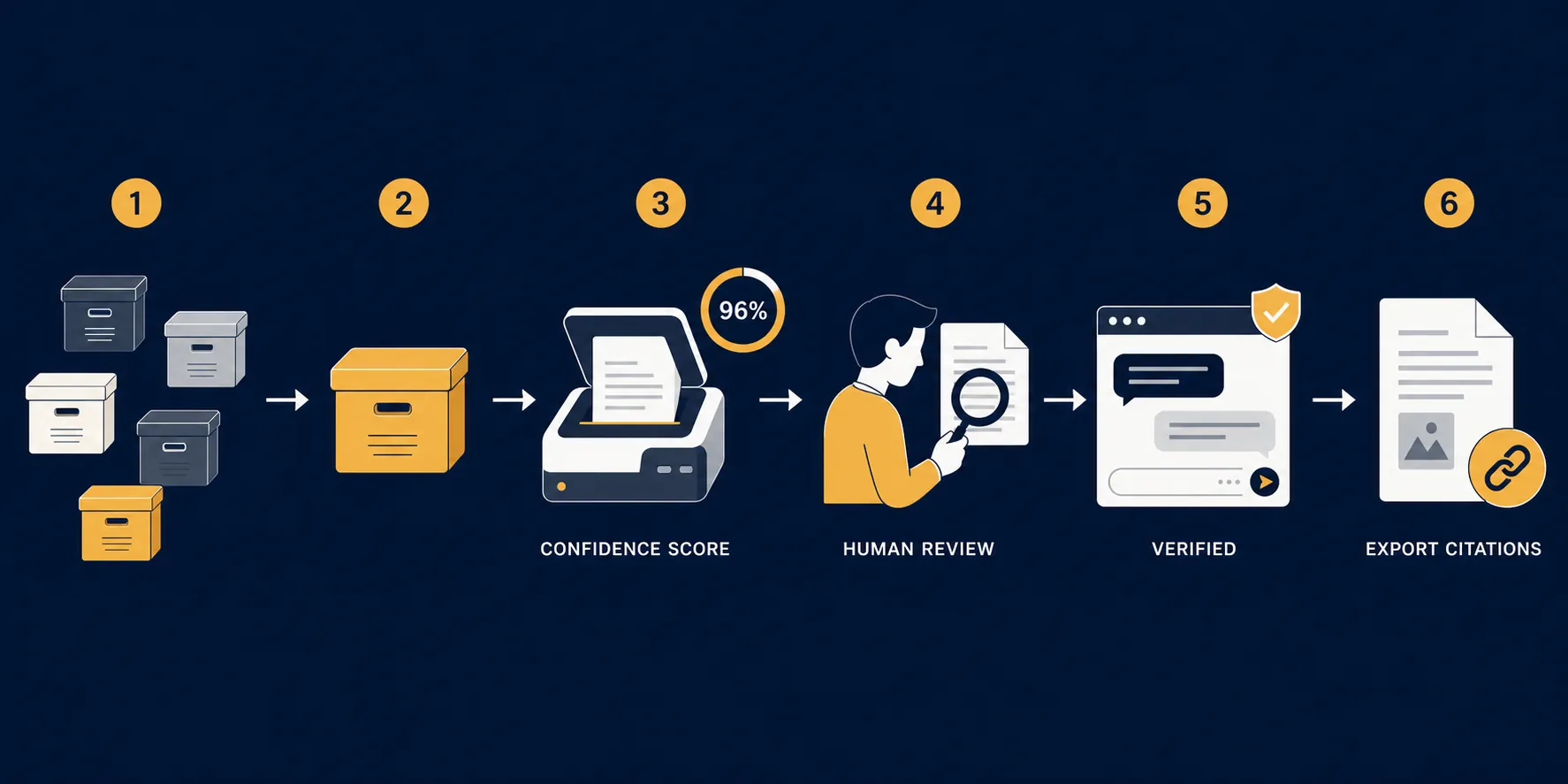
| Scattered records are gathered into Box 1 | Archivists upload large numbers of Roosevelt-related documents into a consolidated AI-powered knowledge base.[1] | The system begins with a defined corpus instead of treating the internet as a source. |
| Documents pass through the Archivist App | Terentia describes an app, built with Terentia, Microsoft, and OpenAI, that generates OCR transcripts and metadata.[2] | The machine work is visible as a processing step, not hidden inside the final answer. |
| Transcripts and metadata receive confidence scores | The case study says the vast majority of records reach 90% confidence or higher.[2] | A confidence label gives staff a reason to batch-approve some records and slow down on others. |
| Humans review the records | Staff batch-approve high-confidence material and manually review records that need more attention.[2] | The archive does not rely on OCR confidence alone. |
| Sensitive material is kept out | Terentia says sensitive family letters are excluded from AI access.[2] | Verification is paired with access control, not treated as a reason to expose everything. |
| Campfire answers from the verified corpus | The private GPT is described as grounded in Roosevelt primary sources, with secondary sources such as biographies used to help adjust for historical bias.[2] | The answer is constrained by a known source base. |
| The answer exports with citations | Terentia says users can export answers as PDFs with full citations.[2] | The student or researcher leaves with a paper trail, not just prose. |
The OCR confidence score is one of the least glamorous details and one of the most important. Old documents are not friendly to machines: handwriting, fading, odd punctuation, marginal notes, and damaged paper all create opportunities for confident nonsense. A system that tells staff which records are high-confidence and which need closer review gives the human reviewer a place to intervene before the AI answer becomes the public-facing product.
That is different from a chatbot politely apologizing after it fabricates a source. In a verification-first archive, the cleaner answer is not enough. The source has to be recoverable, the transcription has to be inspectable, and the citation has to travel with the claim.
Campfire is not just one chat box
Terentia describes Campfire as a “virtual historian” with different modes for Discovery, Research, teachers, and students, plus an on-site “Talk with the President” avatar grounded in Roosevelt’s actual words.[2] The interface variety is less important than the common rule underneath it: the same verified-source principle has to hold whether the user is browsing casually, preparing a lesson, or asking a research question.
Discovery mode can afford to be more exploratory. Research mode has to be stricter about citations. Teacher and student modes need age-appropriate presentation without loosening the source chain. The avatar may be the most public-facing feature, but it is also the easiest place to see why guardrails matter. Terentia says the system uses PG-rated responses, staff corrections, and source-linked exports.[2] A historical avatar without that grounding would be a performance. A grounded one is at least forced to answer from a controlled record.
What ordinary chatbots do not give you
The failure mode is familiar from AI study tools: the answer arrives before the evidence. A general-purpose chatbot may be useful for brainstorming a research question, simplifying a difficult passage, or drafting a study plan. But unless it is restricted to verified sources and can show its work, it should not be treated as a research authority.
The court-filing hallucination problem is the blunt version of this. In our guide to AI in court filings and legal ethics, the issue is not that AI wrote awkward prose. It is that citation-shaped output can be worse than no output when the source does not exist. Campfire’s source-linked PDF export is designed to prevent that exact kind of last-mile collapse: the answer and the evidence are not supposed to separate.
The same lesson shows up in student-facing AI controversies. A public correction or apology after a bad AI answer may be responsible, but it does not help the student who already submitted the unsupported claim. That is why the workflow lessons in Hank Green’s ChatGPT apology for student researchers point back to the same practical rule: verify before you depend on the answer, not after someone challenges it.
Campfire’s advantage is not that it uses AI more elegantly. It is that the AI is boxed in. The corpus is curated. Machine readings carry confidence information. Staff review sits inside the pipeline. Sensitive documents can be excluded. Citations export with the answer. Those are infrastructure choices, not vibes.
Where the vendor story should be narrowed
The most tempting number in Terentia’s case study is the cost-and-time contrast. The case study quotes library communications chief Matt Briney comparing the TRPL effort with one unnamed institution’s digitization project running from 1969 to 2030 at roughly $30 million.[2] That is striking. It should also stay in its lane.
That comparison is not an industry benchmark. It is not proof that every archival digitization project can be compressed the same way. It is a single-institution contrast reported in a vendor-published case study. The safer conclusion is still meaningful: when the task is to consolidate and process a dispersed documentary record, AI-assisted OCR, metadata generation, confidence scoring, and review tools can change the labor pattern. The source does not support a universal savings claim.
The same restraint applies to Campfire as a whole. The system is a strong working model for Roosevelt research because its scope is bounded. It does not show that an open-ended chatbot can be trusted on chemistry, case law, history, and test prep simply because it sounds fluent. The trust comes from the restrictions.
A student standard for AI research tools
If you are using AI for school, Campfire gives you a practical checklist for trust. The tool does not have to be about Theodore Roosevelt. It does have to answer the same verification questions before its output becomes usable in a paper, outline, or exam-prep note.
- What sources is the AI allowed to use? A serious research tool should define its corpus. “The internet” is not a source policy.
- Can the tool show the exact document behind a claim? A citation should lead somewhere inspectable.
- Does the system label confidence or uncertainty before you rely on the output? A polished paragraph without confidence information is still only a polished paragraph.
- Where does human review enter the workflow? Review after publication is weaker than review before material becomes part of the answer base.
- Can citations export with the answer? If you have to reconstruct the evidence trail by hand, the tool has not solved the research problem.
- Are some materials deliberately excluded? Access control is part of trust, especially when private, sensitive, or restricted records are involved.
That standard also explains why brand comparisons alone are weak. A model can be impressive and still be the wrong tool for a sourced assignment. As with any AI study assistant, the question is not only whether the answer is helpful, but whether the verification pass is built into the workflow. That is the same rule behind our guide to whether Claude AI is safe for studying: use the tool for the task it can actually support, and do not promote a fluent answer into an authority without evidence.
Campfire deserves attention because it makes verification part of the architecture: curated sources, confidence-scored processing, human review, exclusions for sensitive material, and citations attached to the output. That makes it a strong model for AI research inside Theodore Roosevelt materials. It does not make general-purpose chatbots reliable research authorities. For student work, treat tools without those safeguards as drafting and brainstorming aids, not as sources.
References
- AI-powered Theodore Roosevelt Presidential Library now open, Microsoft Signal
- Case Study: Theodore Roosevelt Presidential Library, Terentia
- Archives, Theodore Roosevelt Presidential Library
- Research, Theodore Roosevelt Presidential Library
- Theodore Roosevelt Presidential Library Opening Celebrations July 4, 2026, Theodore Roosevelt Presidential Library
Related exhibits & inventory
Verified outcomes
No verified outcomes on file for this exam yet
See Methodology for how outcome evidence is disclosed once logged.
Planners
No planner filed for this exam yet
A downloadable timeline template for this exam hasn't been published yet.
Tool verdicts
AI-tool cautions
No AI tools tested for this exam yet
No hands-on AI-accuracy logs have been filed for this exam.
Questions about this plan
Ask a question about a specific section, timeline, or citation in this plan — or flag something that needs correcting.
Comments
Join the discussion with an anonymous comment.