
LAW-SCHOOL Exam Hub
How to Study Supreme Court Cases for Law School Exams
For 1Ls, the modern Supreme Court docket is small enough to master — about 56–67 merits cases per term — but only with a system that turns each opinion into an exam-ready rule. This guide lays out the triage-to-IRAC pipeline: one-page briefs, rule cards, spaced repetition, and practice application to new fact patterns.
- gre
- mcat
- asvab
- sat
- act
- digital-adaptive
- official-material
- section-strategy
- test-date-timeline
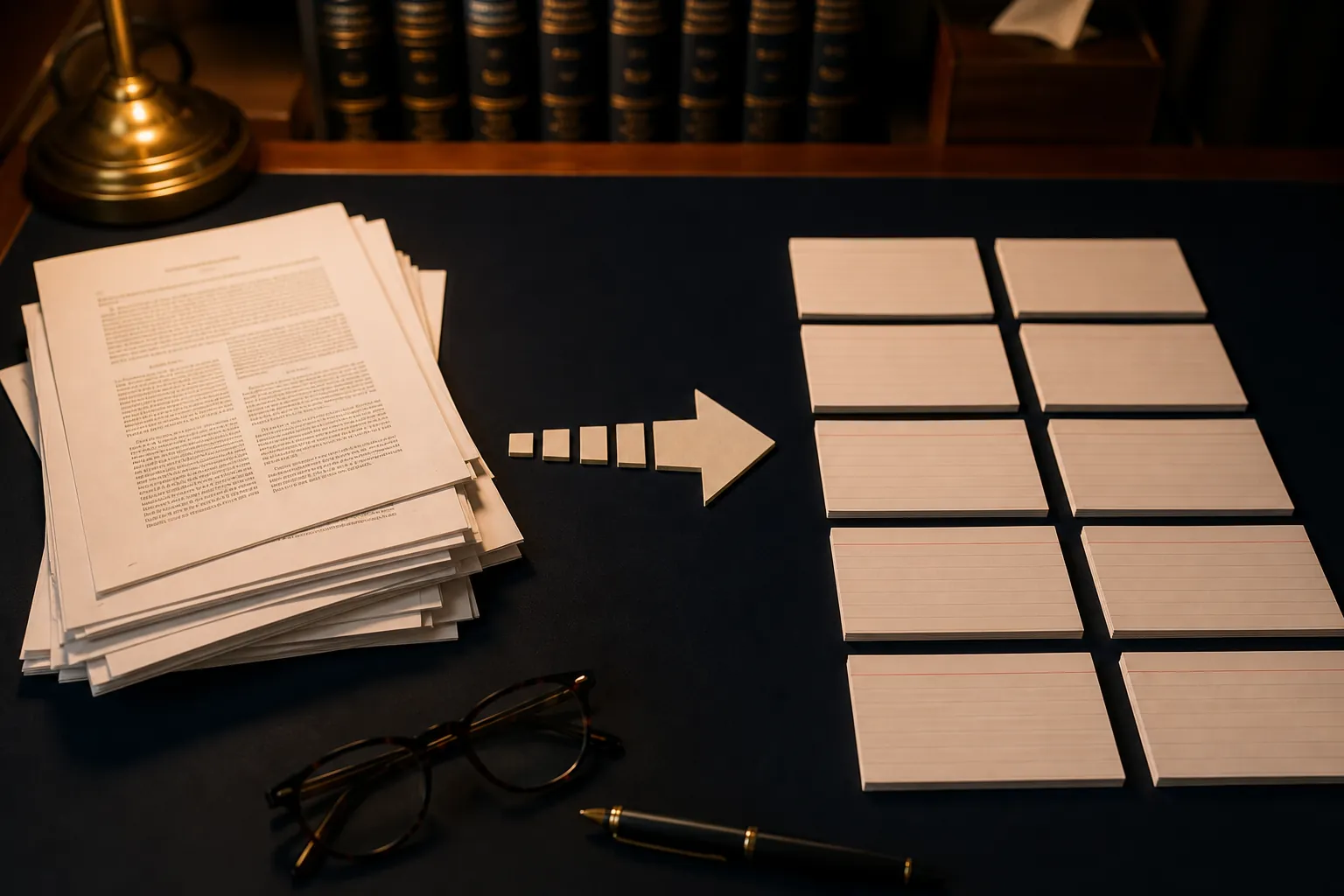
A useful Supreme Court cases study guide for law students should start with relief: the modern Supreme Court merits docket is not infinite. In October Term 2024, the Court issued 56 merits cases with signed opinions. The term before had 59. Each of the two terms before that had 58. That is a different world from the 160-plus merits decisions per term in the 1980s, and still smaller than the 85 cases in Chief Justice Rehnquist’s last term. [1]
The Court can feel bottomless because the funnel is enormous: roughly 7,000 to 8,000 new cases are filed each year, plenary review is granted in about 80, and fewer than 3% of filings receive plenary disposition. [2] But that funnel is not your exam burden. Your burden is the assigned set of holdings your professor expects you to use. That set is finite enough to systematize. The part that usually breaks is the conversion: opinion to rule, rule to memory, memory to application.
If you are reading every page, highlighting conscientiously, and still falling behind, the problem may not be effort. It may be that you are preparing for class when you think you are preparing for the exam. A cold-call brief helps you survive Tuesday. An exam answer requires something harsher and cleaner: a rule you can state without the case name and apply to facts you have not seen before.
The closed loop: from assigned opinion to exam answer
Do not start by building a museum of landmark cases. Start with a pipeline. Every assigned Supreme Court case should move through the same loop, but not every stage deserves the same amount of time.
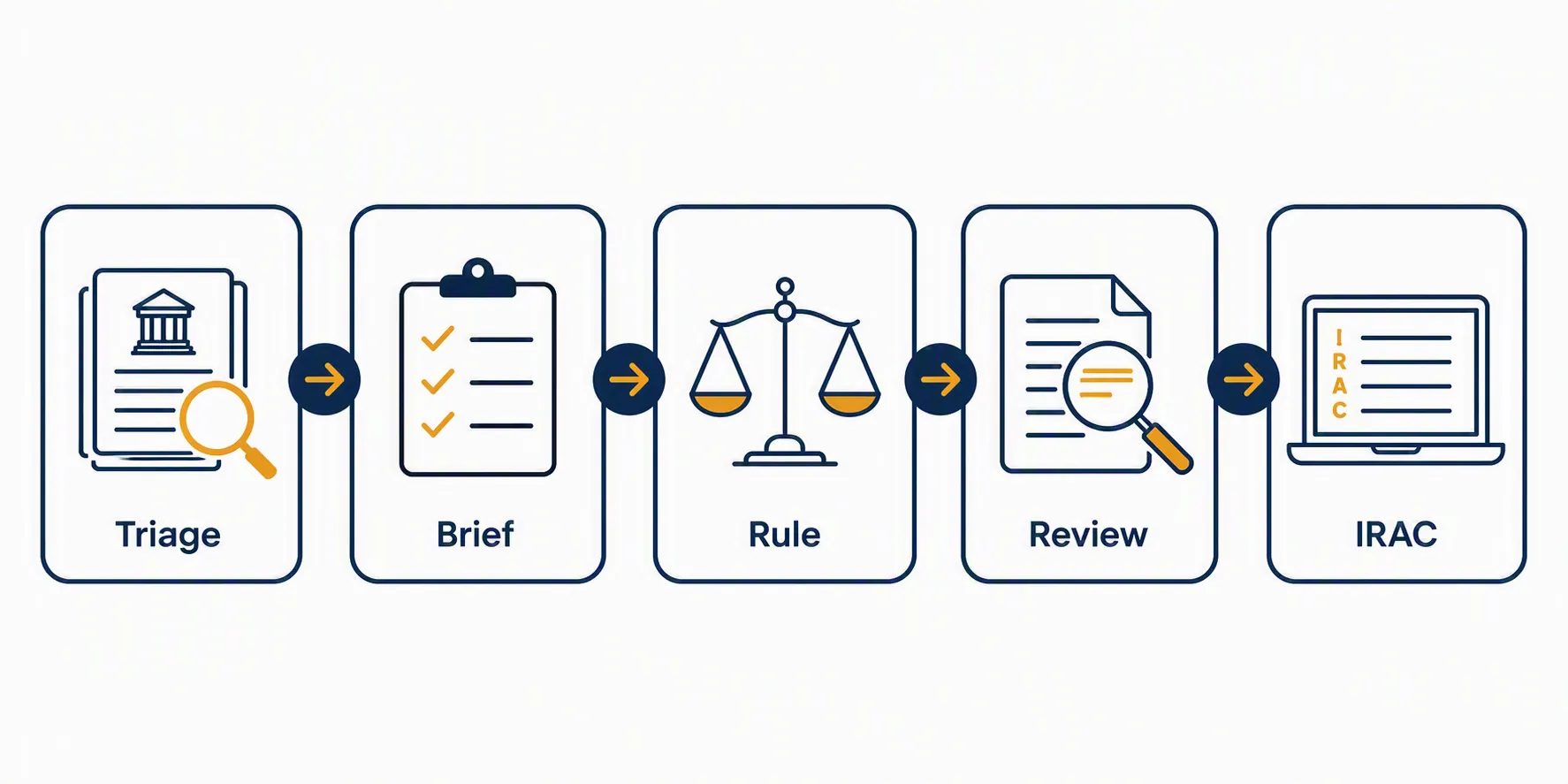
| Stage | What you produce | When to stop |
|---|---|---|
| Triage the opinion | A map of what matters: procedural posture, question presented, majority rule, useful concurrence or dissent if assigned | When you know where the rule is likely to come from |
| Make a one-page brief | Caption, facts, issue, rule, holding, and reasoning | When the case is understandable enough to reduce |
| Compress into a rule card | A portable test with triggers, boundaries, and contrasts | When you can state the rule without narrating the whole case |
| Review on a schedule | Repeated recall of the rule, not passive rereading | When the card can be recalled cold |
| Force into IRAC practice | A written application to new facts | Only when the rule survives unfamiliar facts |
The one-page brief is not the trophy. The rule card is not the trophy either. The test is whether the rule earns points in an answer under time pressure.
Triage before you brief
Before reading deeply, identify the job the case is doing in the assignment. A Supreme Court opinion in a 1L casebook is rarely there because every paragraph is equally important. It may introduce a test, limit an older doctrine, create a standard of review, show a split between formal and functional reasoning, or give you a fact pattern that marks the edge of a rule.
For the first pass, mark four things: the issue the Court agreed to decide, the rule announced or applied by the majority, the facts the Court treated as legally important, and the boundary of the holding. If the professor assigned a dissent or concurrence, read it for contrast, not decoration. Ask what mistake that separate opinion warns you not to make on an exam.
This is where many students lose an hour polishing details that will never become points. Procedural history matters when it changes the standard, the posture, or the available remedy. It does not matter because a longer brief feels safer.
Use the one-page brief as a workbench
The classic law-school case brief format usually includes the caption, relevant facts, issue, rule, holding, and reasoning. [3] Keep those parts, but keep them on one page. The point is not to prove you read the case. The point is to build a temporary workbench for extracting the rule.
What belongs in the brief
- Caption: the case name and court, just enough to identify it later.
- Facts: only the facts the Court used to reach the legal conclusion. Leave out background that does not affect the rule.
- Issue: the legal question in a form that can be answered yes or no, or by choosing between competing standards.
- Rule: the test, standard, presumption, burden, or exception the case gives you.
- Holding: what the Court did with the rule on these facts.
- Reasoning: the two or three moves that explain why the facts satisfied, failed, narrowed, or expanded the rule.
A one-page brief should be ugly if ugliness means useful. Arrows, brackets, and short labels are fine. The danger is a brief that reads beautifully and leaves you unable to answer the exam’s actual question: what happens when the facts change?
After class, revise the brief quickly. Add what the professor emphasized. Cross out what never came up and does not affect the doctrine. Then stop treating the brief as the final study product.
Compress the case into a rule card
The rule card is the most important conversion step. It is also the step that most “know these cases” lists skip. A case name is a label. A holding is a result. A rule card is the thing you can actually use in an IRAC answer.
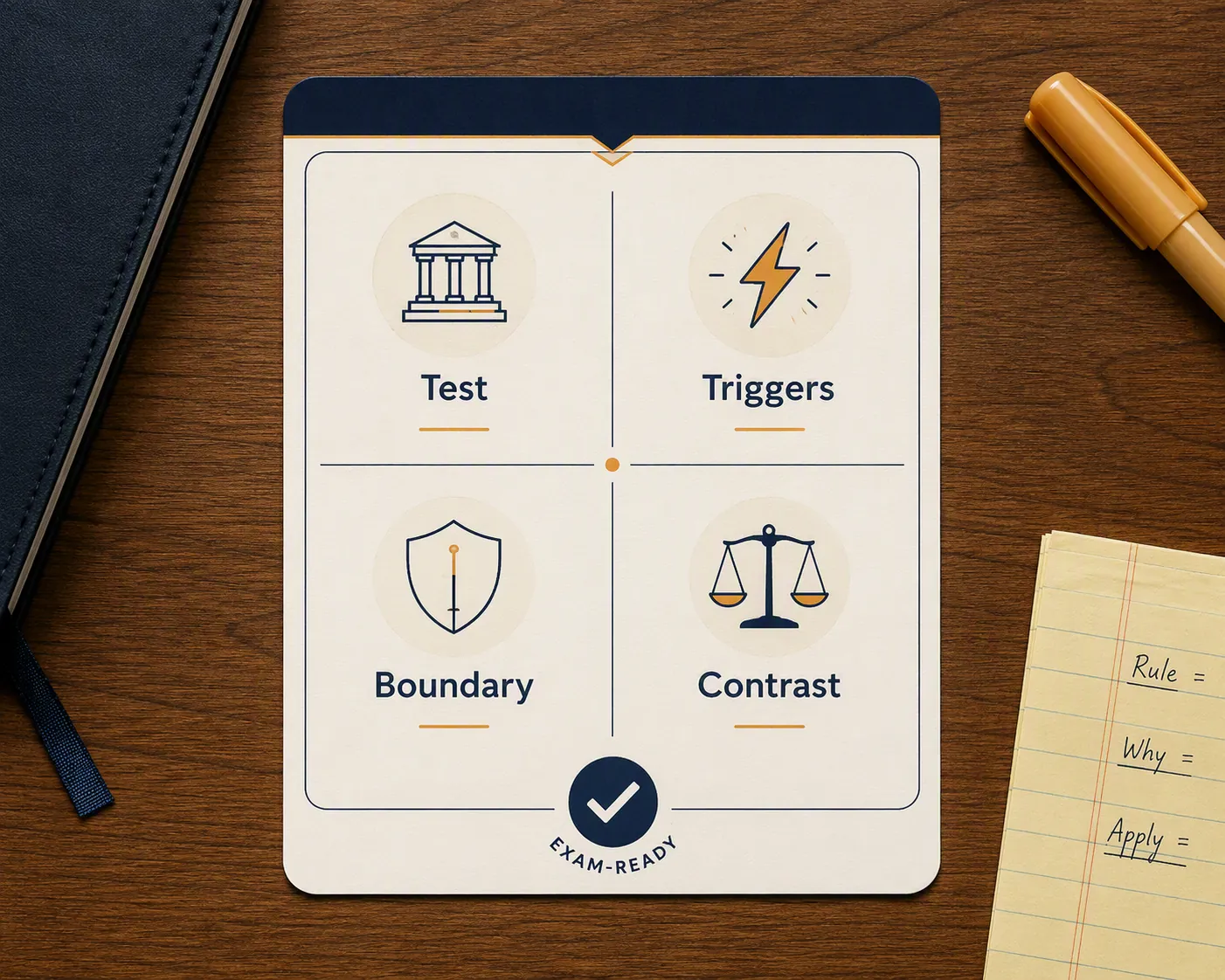
A good Supreme Court rule card has four parts.
- Test: the legal rule, standard, elements, burden, or framework.
- Triggers: the facts or procedural conditions that make the rule relevant.
- Boundary: what the holding does not decide, or where the rule stops.
- Contrast: the nearby case, dissent, exception, or hypothetical that prevents overgeneralization.
Here is a hypothetical card format. The example is deliberately generic; it is a template, not a substitute for your professor’s doctrine.
| Card field | What you write |
|---|---|
| Front | When does Rule X apply to government action affecting protected interest Y? |
| Test | Rule X applies when the claimant shows A and B; the government may prevail by showing C. |
| Triggers | Look for state action, a burden on the protected interest, and facts showing whether the burden is direct or incidental. |
| Boundary | The case does not resolve a different protected interest, a private actor, or a materially different burden. |
| Contrast | Compare with the case where the Court treated the burden as too indirect, or where a different level of scrutiny controlled. |
| Exam use | State the rule, classify the new facts under A, B, and C, then explain which side has the stronger argument. |
Notice what is missing: a long plot summary. If the fact matters, it appears because it triggers, satisfies, or limits the rule. If it does not do that work, it belongs in the old brief, not on the card.
The boundary field is where a lot of exam points live. Students often turn a narrow holding into a broad slogan because the case felt important. Resist that. If the Court decided a question under a particular posture, with a particular record, or against a particular doctrinal background, preserve that constraint. Professors write fact patterns to find out whether you can see the constraint.
A quick audit before a card enters your deck
- Can you state the rule without saying the case name?
- Does the card tell you what facts make the rule appear?
- Does it identify at least one limit, exception, or unresolved edge?
- Could you use it in a paragraph of analysis, not just in a flashcard answer?
- If an AI tool drafted it, have you checked the rule against the assigned opinion and your class notes?
AI-generated flashcards can help with first drafts, especially when you are turning a batch of briefs into review cards. But a card that sounds legal is not the same as a card that is legally safe. If you use an AI flashcard generator, make it produce structured fields—test, triggers, boundary, contrast—and then verify each field against the case. The machine can draft. You still have to notice when the rule is too broad.
Review rules on a schedule, not when panic reminds you
A rule card that sits untouched until reading week is just a smaller version of an unread outline. The point of spaced repetition is not to make memory feel scientific and tidy. It is to put the rule back in front of you before it decays into recognition-only familiarity.

Law School Toolbox describes Ebbinghaus’s forgetting-curve finding as roughly 90% of new information being forgotten within three days without review, and recommends a box-based schedule moving cards through daily, every-other-day, weekly, bi-weekly, and pre-test review. [4] Treat that as a scheduling warning, not a magic number for every student and every doctrine.
For Supreme Court cases, the schedule can be simple:
- Same day: create the rule card after class, while the professor’s emphasis is fresh.
- Next day: recall the rule from the front of the card before looking.
- Three to four days later: recall the rule and explain one boundary.
- One week later: compare it with a nearby case or exception.
- Before the unit practice exam: use the rule in a written IRAC answer.
If you already have a review system, plug the cards into it. If not, start with a basic spaced repetition method and adjust the intervals during finals. A finals-week spaced repetition schedule is especially useful when your cards include both doctrine and case boundaries.
Penn Carey Law Library’s exam-prep guidance makes the next point explicit: spaced repetition should be paired with practice exams and case-analysis exercises. [5] That pairing matters. Repetition keeps the rule available. Practice tells you whether you can use it.
Make IRAC the proof of mastery
The exam does not award much for admiring the opinion. BARBRI’s IRAC guidance puts the reason plainly: memorizing rules is insufficient because law exams and the bar test issue-spotting and application through issue, rule, analysis, and conclusion. [6]
That means every important Supreme Court rule card needs a practice prompt. It can be a professor’s old exam, a commercial practice question, a study-group hypothetical, or a short fact pattern you write yourself. The source matters less than the unfamiliarity. If the facts are identical to the case, you are rehearsing recall, not application.
How to turn a rule card into an IRAC paragraph
- Issue: name the legal problem raised by the new facts, not the case that inspired the rule.
- Rule: state the test from the card in exam-ready language.
- Application: match specific facts to the test’s elements, triggers, and boundaries.
- Counterargument: use the card’s contrast field to explain the other side’s best move.
- Conclusion: give the likely result, with the confidence level the facts justify.
Here is the difference in practice. A weak answer says, “This is like Case A, so the plaintiff wins.” A stronger answer says, “The rule applies when A and B are present. The plaintiff has A because of these facts. B is closer because the burden is indirect, but the record shows the same practical effect that made the burden legally significant in the assigned case. The defendant’s best argument is the boundary: the Court did not decide situations involving a different actor or a weaker causal link. On balance, the plaintiff has the better argument.”
That paragraph can earn points even if the case name never appears. The doctrine is doing the work.
This is also where retrieval practice beats rereading. Rereading lets you recognize the rule when the casebook hands it to you. Retrieval and IRAC force you to produce the rule, choose it among competitors, and apply it to a problem that does not announce its doctrinal category in the heading.
What to do with case names
Do not throw case names away. They are useful shorthand, especially when your professor expects citation to major cases or uses cases as doctrinal landmarks. But do not let the name become the card. The name should cue the rule, the facts that triggered it, and the holding’s boundary.
A practical compromise is to put the case name in small type on the back of the card, after the rule. If you can state the test and apply it before looking at the name, the name becomes reinforcement. If you need the name to remember what the rule is, the card is not finished.
Build the deck by course, not by “top cases”
Lists of landmark Supreme Court cases can be useful orientation, but they are a poor substitute for your course map. Your Civil Procedure, Constitutional Law, Criminal Procedure, or Federal Courts professor is not grading a national trivia contest. The exam tests the rules, tensions, and applications taught in that class.
Organize your cards by doctrinal unit. Within each unit, group cards that compete or qualify one another. For example, keep the broad rule, exception, standard-of-review case, and limiting case close enough that review naturally forces comparison. Many wrong answers come from using the right rule in the wrong doctrinal neighborhood.
A flashcard app can help if your bottleneck is scheduling, tagging, or mobile review. Choose the tool around the bottleneck, not the largest advertised library. If you are comparing options, use a spaced repetition flashcard app guide and look for features that support custom rule cards, not just premade decks. The same principle behind durable vocabulary flashcards applies here: the card has to prompt recall and use, not recognition.
Use free resources to fill gaps, not replace the case
When an opinion is dense, a secondary source can help you regain your footing. Oyez is useful for Supreme Court case pages, oral-argument materials, and accessible summaries. [7] Justia organizes Supreme Court cases by topic, which can help when you need to see where a case sits doctrinally. [8] Penn Carey Law Library also points students toward tools such as Anki resources in the context of spaced-repetition exam prep. [5]
Use those resources in the right order. First, read enough of the assigned opinion to know the issue, rule, and reasoning. Second, use a reliable summary to check whether you missed the structure. Third, return to the opinion and your class notes before making the rule card. A summary can clarify. It cannot tell you which nuance your professor will grade.
Be especially careful with vendor inventories and premade libraries. A large self-reported number of briefs or videos may be convenient, but it does not prove that a particular card is accurate, current, or tailored to your professor’s exam. Treat premade materials as raw inputs. Your exam deck should contain rules you have verified and applied.
The weekly operating rhythm
For a normal week of assigned Supreme Court cases, the system can be blunt.
- Before class, triage the opinion and mark the likely rule, triggering facts, and boundary.
- During or right after class, complete a one-page brief and add the professor’s emphasis.
- Within 24 hours, compress the brief into a rule card with test, triggers, boundary, and contrast.
- During the week, review the card by recall, not rereading.
- Before moving to the next unit, write at least one IRAC paragraph using the rule on new facts.
The work product at the end is not a pile of beautiful briefs. It is a deck of usable rules and a record of practice answers showing which rules still collapse under pressure. That is the information you need before reading week, not after.
Run the loop for every assigned Supreme Court case: read selectively, brief once, reduce to a rule, review on a schedule, and prove mastery by applying the rule to facts the casebook did not hand you.
References
- By the numbers — SCOTUSblog, July 2025
- Number of U.S. Supreme Court cases decided by year — Wikipedia
- How to Write a Case Brief for Law School — LexisNexis
- How Spaced Repetition Can Help You as a Law Student – Part 1 — Law School Toolbox
- Exam Prep Success: Spaced Repetition & Other Resources — Penn Carey Law Library
- How to Use the IRAC Method to Pass the Bar — BARBRI
- Oyez — Oyez
- Supreme Court Cases By Topic — Justia
Related exhibits & inventory
Verified outcomes
No verified outcomes on file for this exam yet
See Methodology for how outcome evidence is disclosed once logged.
Planners
No planner filed for this exam yet
A downloadable timeline template for this exam hasn't been published yet.
Tool verdicts
AI-tool cautions
No AI tools tested for this exam yet
No hands-on AI-accuracy logs have been filed for this exam.
Questions about this plan
Ask a question about a specific section, timeline, or citation in this plan — or flag something that needs correcting.
Comments
Join the discussion with an anonymous comment.