
ASVAB Exam Hub
Perseid Viewing Tips and ASVAB Astronomy Study Guide
ASVAB General Science test-takers get one resource for two purposes: a practical viewing plan for the Perseids at their moon-free peak, and a review that maps each visible streak to the tested astronomy concepts — meteoroid, meteor, meteorite, and the mesosphere burn-up zone — plus a short self-quiz.
- gre
- mcat
- asvab
- sat
- act
- digital-adaptive
- official-material
- section-strategy
- test-date-timeline
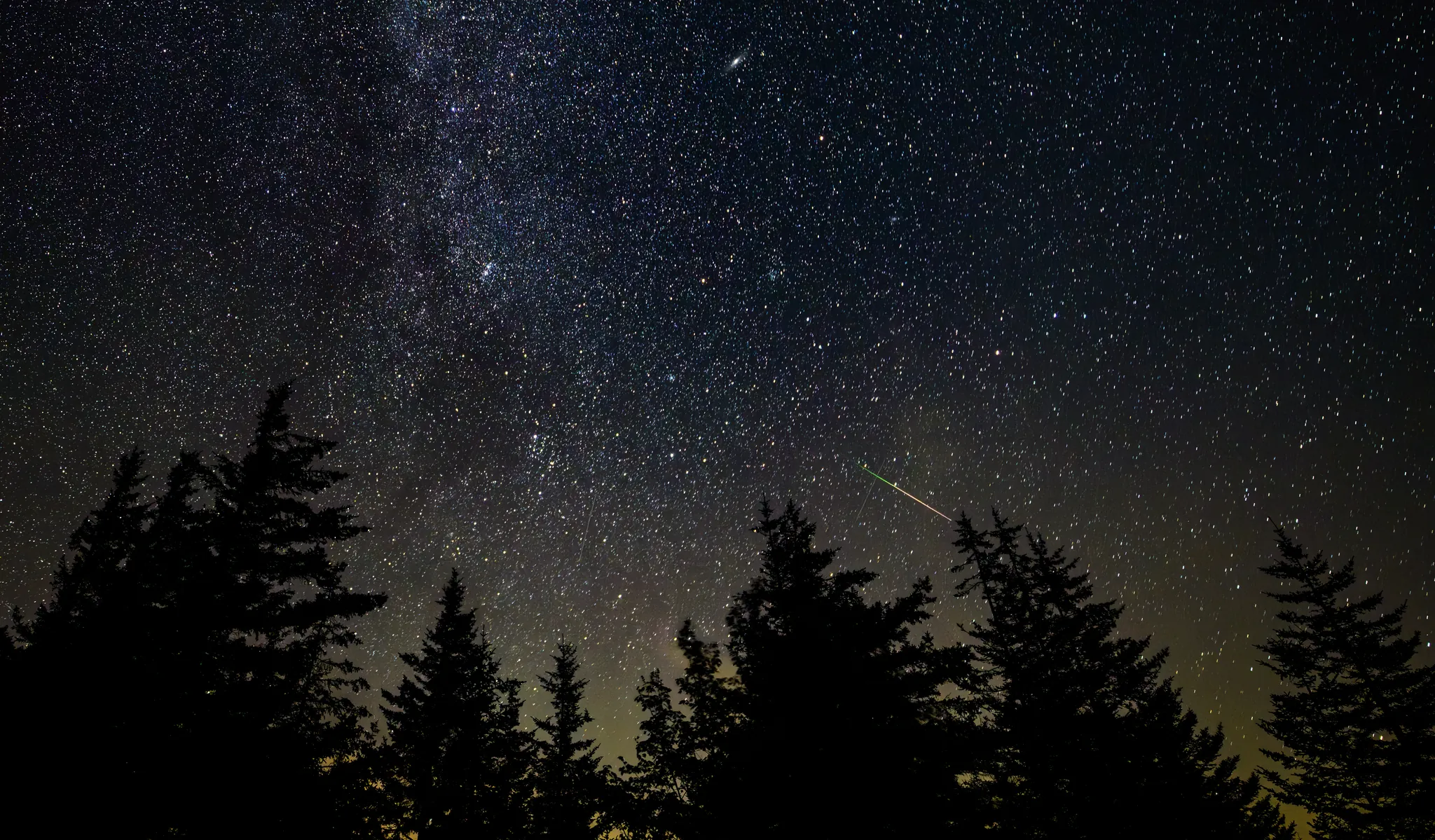
The 2026 Perseid peak has already passed, so this is not a “run outside tonight” alert. Use it for something more durable: a repeatable Perseid viewing plan for future Augusts, and an ASVAB General Science study guide built around one thing you can actually see — a bright streak crossing the atmosphere.
For 2026, the clean worked example was the night of Aug. 12–13, during an active season that runs from mid-July to about Aug. 24. The timing was unusually kind: new moon fell on Aug. 12 at 17:37 UTC, keeping moonlight out of the peak-night sky; the same date also brought a total solar eclipse, which is interesting but not the reason this shower matters for test prep. [1][2]
The exam payoff is simple. The ASVAB General Science section can ask about comets, meteoroids, meteors, meteorites, and the atmospheric layer where most meteors burn up. Commercial ASVAB study guides list those astronomy and Earth science topics, while NASA and the American Meteor Society provide the physical explanation behind the shower itself. [3][4]
First, fix the expectation problem
Meteor shower headlines often lead with the biggest possible rate. That is a lousy standard for a student standing in a driveway under streetlights. The number you see in a headline is often the zenithal hourly rate, or ZHR: an idealized rate for a dark sky, with the radiant overhead, under conditions most people do not have.
For the Aug. 12–13 Perseid peak, the American Meteor Society’s realistic table is the better planning tool: about 10 meteors per hour in a city sky, about 20 per hour in a suburban sky, about 50 per hour in a rural moonless sky, with a ZHR of 100. [5]
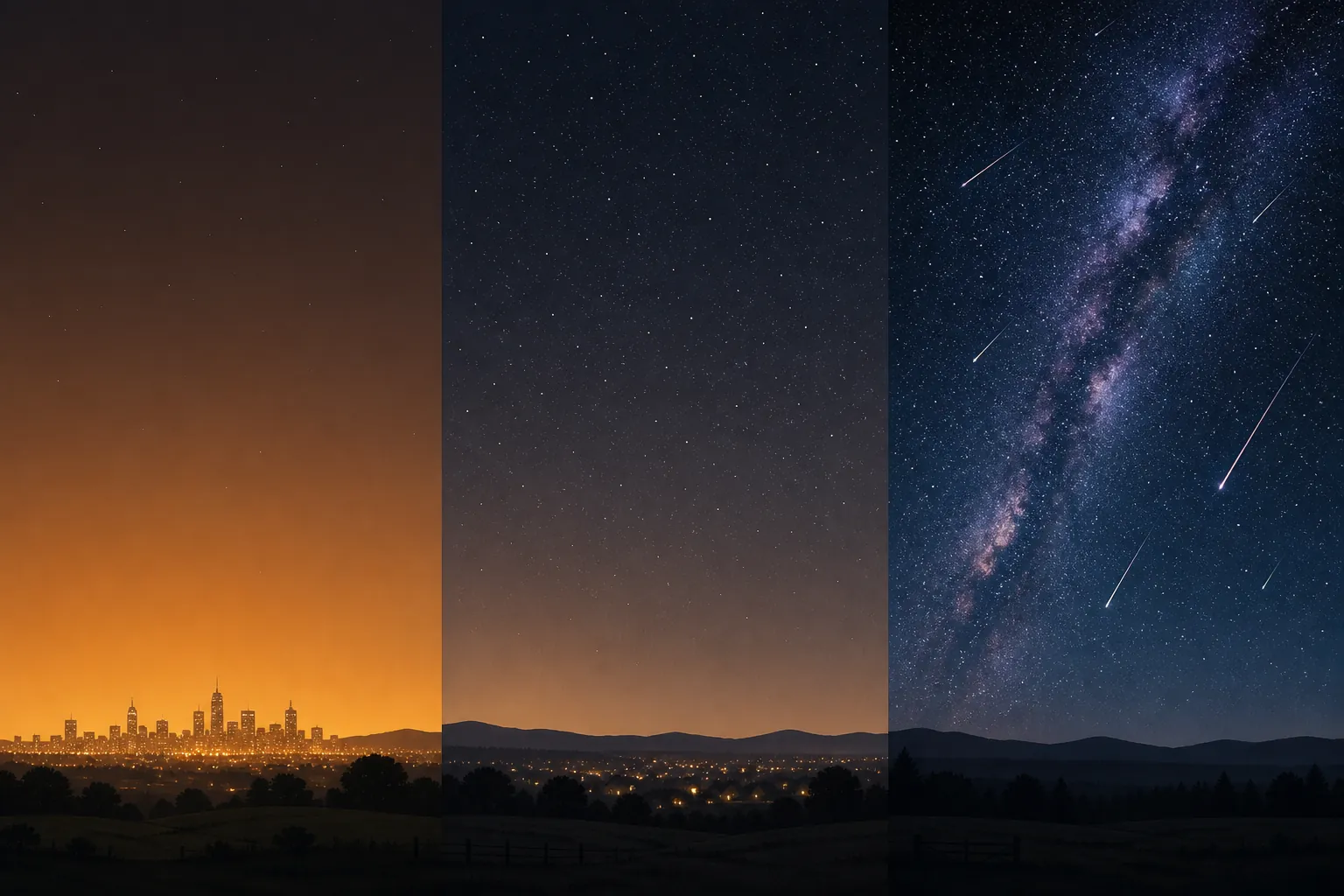
That table also explains why different reputable sources sound inconsistent. NASA describes the Perseids as producing about 50 to 100 meteors per hour in favorable conditions, while another NASA fast-fact-style figure gives about 25 per hour for dark skies; Space.com and the American Meteor Society discuss a ZHR around 100, and other astronomy outlets may print still higher peak estimates. [2][5][6] These are not all promising the same thing to the same observer. They are mixing ideal rates, broad descriptive ranges, and real-sky estimates.
So use the Perseids like a lab, not like a fireworks guarantee. If you are in a suburb and see far fewer meteors than a “100 per hour” headline, you did not fail the sky. You compared the wrong number to your actual conditions.
The practical viewing plan
The Perseids are annual, so the plan is reusable even though the 2026 peak is behind us. In most years, start watching the forecast and moon phase in late July, then give special attention to the nights around Aug. 11–13. For the 2026 example, Aug. 12–13 was the peak-night target because it aligned with a moon-free sky. [1][2]
| Viewing choice | What to do | Why it matters |
|---|---|---|
| Time of night | Favor the hours after midnight, especially roughly 2 a.m. to dawn. | Earth’s morning side sweeps into the debris stream, so meteor rates usually improve before dawn. |
| Location | Pick the darkest safe place you can reach without turning the session into a travel project. | Light pollution cuts visible meteors sharply; a rural moonless sky may show several times more than a city sky. |
| Equipment | Do not bring a telescope or binoculars for meteor hunting. | Meteors cross wide areas of sky; magnifying equipment narrows your view. |
| Eyes | Give your eyes time in darkness before judging the sky. | Meteor watching punishes impatience; you need sensitivity to faint streaks. |
| Comfort | Use a reclining chair, warm layers if needed, and a clear view of as much sky as possible. | A stiff neck ends study sessions faster than bad astronomy. |
The no-equipment part is not a cute tradition; it is correct technique. Meteors are fast, brief, and spread across the sky. A telescope is wonderful for planets and deep-sky objects, but for this job it mostly helps you miss the thing you came to see.
Give your eyes at least 15 to 30 minutes to adapt to the dark; the American Meteor Society notes that full dark adaptation can take up to an hour. [2][5] If you check your phone every few minutes, you keep resetting the experiment. Use a red-light setting if you must look at something, but the better plan is to put the phone away after you confirm the time, weather, and direction.
Where to look
The Perseids appear to radiate from the direction of Perseus, near the W-shaped constellation Cassiopeia. [5] That does not mean you should stare at one tiny point. Find Cassiopeia’s W if you can, use it to orient yourself, then watch a broad patch of dark sky.
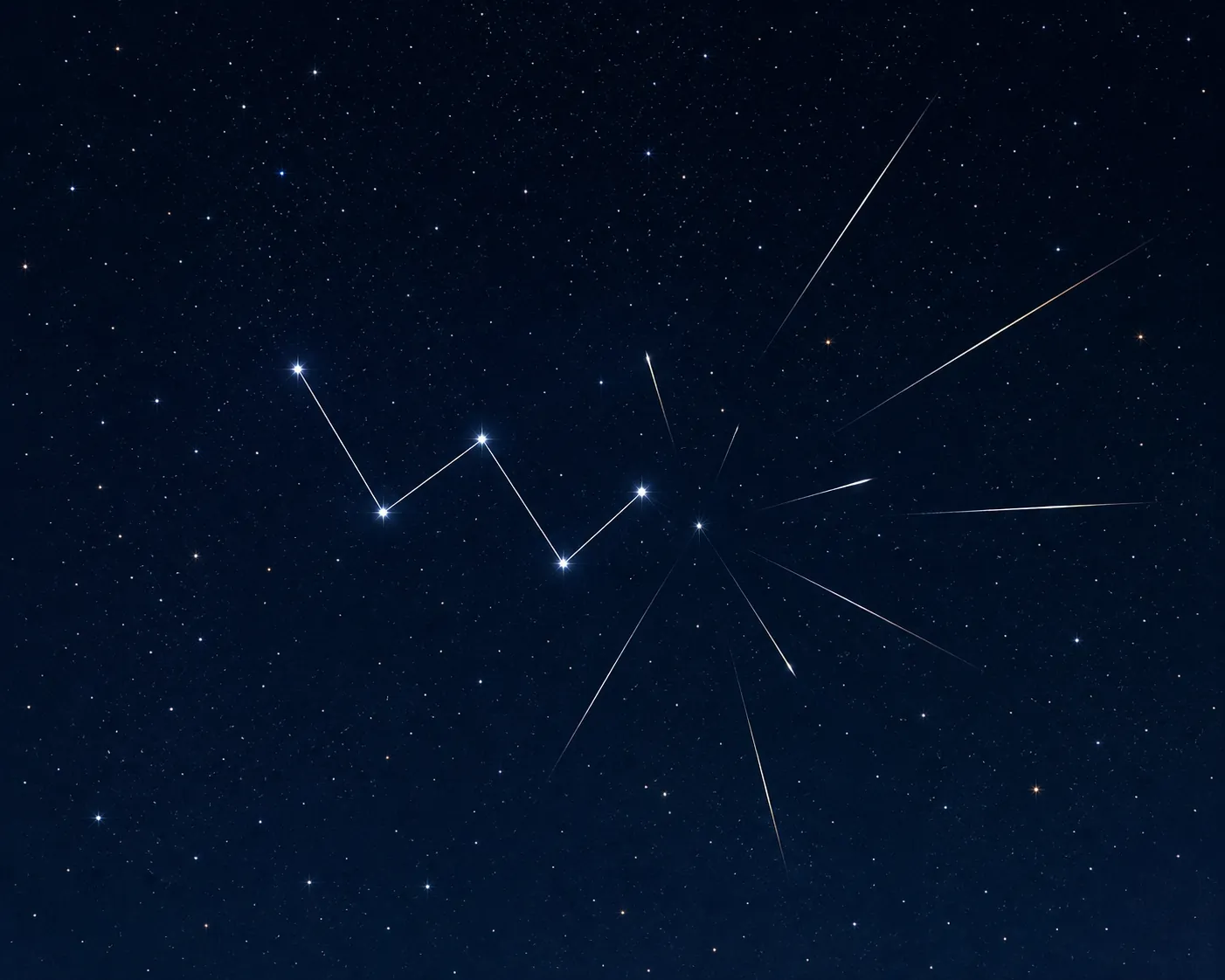
The pre-dawn preference has a physical reason worth remembering for the ASVAB. After midnight, your location is rotating onto Earth’s forward-facing side in its orbit. That morning side runs into more debris, like the front windshield of a moving car collecting more rain than the rear window. [5]
Now track one streak from space to test answer
This is the part that turns a pretty sky event into a usable memory hook. Pick one visible streak — real if you saw one, imagined if you are studying on a cloudy night — and follow the object through the vocabulary chain.
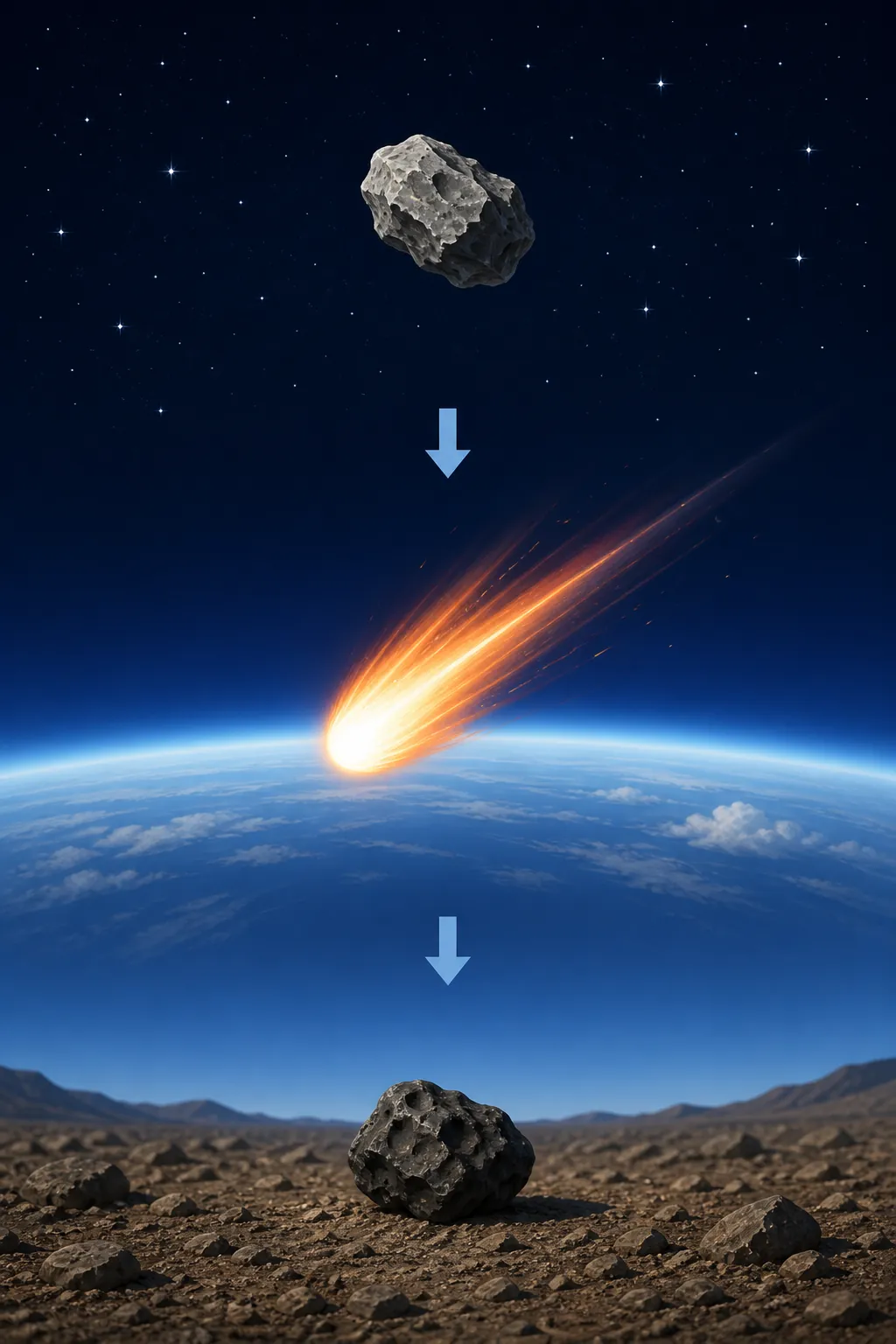
Before it enters Earth’s atmosphere, the object is a meteoroid. In the Perseids, the particles are debris from Comet 109P/Swift-Tuttle, and NASA describes most Perseid particles as about the size of a grain of sand. [6]
When that meteoroid hits the atmosphere and produces the visible streak, the event you see is a meteor. The Perseids enter at about 37 miles per second, or 59 kilometers per second. [6] At that speed, the useful classroom phrase is not “it catches fire like paper.” The better idea is kinetic energy. The particle slams into atmospheric gases, compresses and heats the air around it, and produces the glowing trail.
Most Perseid meteors burn up roughly 60 to 100 kilometers above Earth, in the mesosphere. [6] That detail is test-prep gold because the mesosphere is commonly taught as the layer where most meteors burn up. If the question asks which atmospheric layer is associated with meteor burn-up, do not wander off into the troposphere because weather happens there, or the stratosphere because ozone sounds science-y. The meteor clue points to the mesosphere.
Only if material survives the trip and reaches the ground do you call it a meteorite. That is the endpoint students often overuse. The streak in the sky is not a meteorite. The sand-grain-sized particle before atmospheric entry is not yet a meteor. Say the chain out loud if you have to: meteoroid in space, meteor in the atmosphere, meteorite on the ground.
Why the Perseids happen every year
A meteor shower is not random space gravel arriving on a whim. Earth crosses a stream of debris left behind by a parent body. For the Perseids, that parent is Comet 109P/Swift-Tuttle. NASA describes Swift-Tuttle’s nucleus as about 16 miles, or 26 kilometers, across, and gives the comet an orbital period of 133 years. [6]
Swift-Tuttle was discovered in 1862 by Lewis Swift and Horace Tuttle. The connection between the Perseid meteors and the comet was established by Giovanni Schiaparelli in 1865–66. [6][7] That history is supporting context, not the main exam move. The main move is recognizing the pattern: comet leaves debris, Earth crosses debris stream, debris enters atmosphere, observer sees meteors.
This is also why the shower has a season rather than a single appointment. Earth takes time to move through the debris stream. The peak is when the encounter is densest or most favorable, but the active window stretches across weeks. [1][2]
The ASVAB terms to lock in
ASVAB astronomy questions are rarely improved by vague wonder. They reward clean labels. Use the Perseid sequence as a compact study card:
| Term | Use it when... | Perseid example |
|---|---|---|
| Comet | You mean an icy parent body orbiting the Sun. | 109P/Swift-Tuttle leaves the debris stream that creates the Perseids. |
| Meteoroid | The small object is still in space. | A sand-grain-sized Swift-Tuttle fragment approaches Earth. |
| Meteor | The object enters the atmosphere and makes a visible streak. | You see the glowing Perseid streak overhead. |
| Meteorite | A surviving piece reaches the ground. | This is not what you usually see during a Perseid viewing session. |
| Mesosphere | The atmospheric layer where most meteors burn up. | The Perseid streak forms roughly 60–100 km up. |
If you are building a General Science study routine around real events, this is the same pattern used in our Perseverance rover study guide and earthquake preparedness ASVAB guide: start with a real observable event, then attach the tested science terms to the thing happening in front of you.
A note on future Perseid seasons
The exact viewing quality changes from year to year because the Moon changes the sky. A moon-free peak like 2026 is especially useful as a clean example, but the study lesson does not expire when the peak passes. The vocabulary chain is the same in a bright year, a cloudy year, or a year when you only catch one meteor before dawn.
There is also a longer-range forecast worth treating carefully. A calculation by Esko Lyytinen has been cited for a possible Perseid outburst of more than 1,000 meteors per hour on Aug. 11–12, 2028. [7] That is a projection, not a promise you should build your whole study plan around. If it happens, great. If it does not, the normal Perseids are still enough to teach the terms.
References
- Everything you need to know: Perseid meteor shower, EarthSky
- Perseid meteor shower 2026 guide, Space.com
- ASVAB Free Online Study Guide: Science, ASVAB Practice Tests
- ASVAB General Science Study Guide, ASVAB Test Bank
- Meteor Shower FAQs, American Meteor Society
- Perseids, NASA Science
- Perseids, Wikipedia
Self-quiz
- Before a Perseid particle enters Earth’s atmosphere, is it a meteoroid, meteor, or meteorite?
- What do you call the bright streak you see in the sky?
- What term applies only if a piece reaches the ground?
- Which atmospheric layer is associated with most meteors burning up?
- Why are the pre-dawn hours usually better for meteor watching?
- Why might a city observer see far fewer meteors than a headline rate suggests?
- What parent comet produces the debris stream responsible for the Perseids?
Answers
- Meteoroid.
- Meteor.
- Meteorite.
- Mesosphere.
- After midnight, your location rotates onto Earth’s morning side, which sweeps into more debris.
- Light pollution reduces the number of visible meteors, and headline rates often refer to idealized ZHR conditions.
- Comet 109P/Swift-Tuttle.
Related exhibits & inventory
Verified outcomes
No verified outcomes on file for this exam yet
See Methodology for how outcome evidence is disclosed once logged.
Planners
No planner filed for this exam yet
A downloadable timeline template for this exam hasn't been published yet.
Tool verdicts
AI-tool cautions
No AI tools tested for this exam yet
No hands-on AI-accuracy logs have been filed for this exam.
Questions about this plan
Ask a question about a specific section, timeline, or citation in this plan — or flag something that needs correcting.
Comments
Join the discussion with an anonymous comment.