
Method
Earthquake Preparedness Study Guide for the ASVAB General Science
Prepare for earthquake-related questions on the ASVAB General Science subtest with this focused study guide covering plate tectonics, seismic waves, magnitude scales, and safety protocols — all the earth science concepts you need to know.
Evidence panel
- Evidence level
- Moderate
- Primary citation
- U.S. Geological Survey - Moment magnitude and Richter scale
If you came here looking for an earthquake preparedness study guide for the ASVAB, treat “preparedness” as exam readiness first. This is not a household emergency-kit checklist, and it is not a geology course. It is a focused General Science review of the earthquake ideas that can turn into answer choices: plate motion, faults, seismic waves, magnitude scales, and one basic safety protocol.
That boundary matters because the General Science subtest is broad and fast. The CAT-ASVAB version gives roughly 15 General Science questions in about 12 minutes, while the paper-and-pencil version uses more questions in an even tighter per-question window; General Science itself draws from life science, physical science, earth and space science, and scientific principles rather than from earthquake science alone. [1][2] If you spend a week memorizing every named fault system, you are probably stealing time from chemistry, biology, weather, and basic physics.
For broader scheduling, use the ASVAB Exam Prep Guide. For this one subtopic, keep the target smaller: know enough earthquake science to recognize the tested distinction quickly, then move on.
What Earthquake Questions Usually Reduce To
Earthquake material on ASVAB-style General Science prep is not endless. The useful map is short:
| Concept | What to know for ASVAB General Science | What not to over-study |
|---|---|---|
| Plate boundaries and faults | Divergent plates pull apart, convergent plates collide or subduct, transform plates slide past each other; stress builds and releases as elastic rebound. | Detailed global tectonic maps, named plates beyond common examples, or advanced structural geology. |
| Seismic waves | P waves arrive first and can move through solids and liquids; S waves arrive second and cannot move through liquids; surface waves travel along the ground and tend to be damaging. | Wave equations, instrument design, or graduate-level seismology vocabulary. |
| Magnitude scales | Each whole-number increase on the Richter scale means about 10 times greater wave amplitude and about 32 times more energy; moment magnitude is now used for large earthquakes. | Advanced logarithms or calculating seismic moment from fault area, slip, and rock rigidity. |
| Basic safety | Drop, Cover, and Hold On is the standard short response during shaking. | Full disaster planning, retrofitting, insurance, evacuation routes, or emergency supply inventories. |
That table is the study boundary. The rest of this guide adds the precision that keeps those facts from turning into vague flashcard mush.
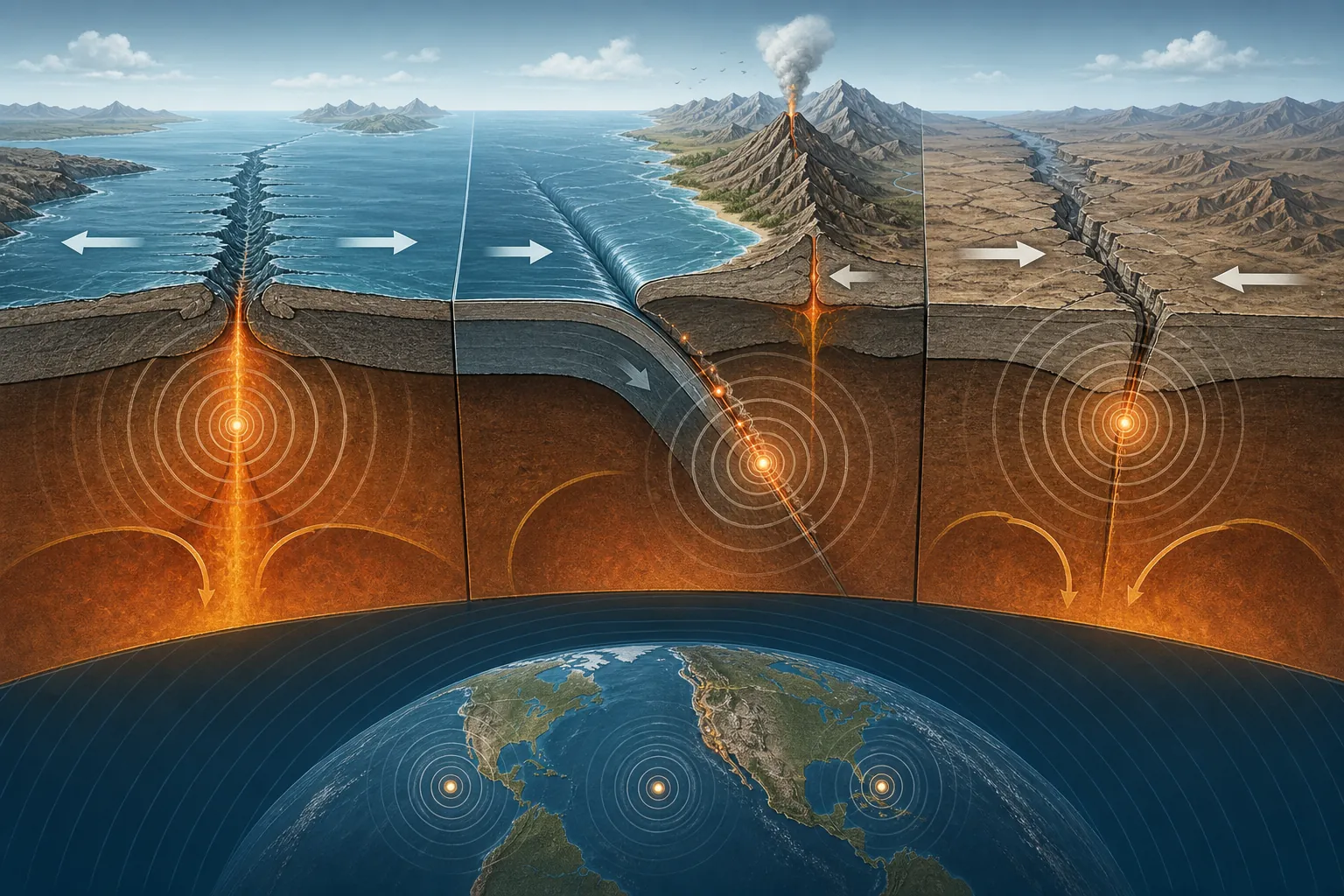
Plate Boundaries: Learn the Motion, Then the Earthquake Pattern
A plate-boundary question is usually asking you to match motion to result. Do not start by memorizing a long list of locations. Start with the verb.
- Divergent boundaries: plates move apart. These are associated with shallow earthquakes.
- Convergent boundaries: plates move toward each other. Where one plate subducts beneath another, these boundaries can produce the deepest and largest earthquakes.
- Transform boundaries: plates slide past each other. The San Andreas Fault is the common classroom example.
ASVAB General Science study materials commonly group earthquakes with plate tectonics and fault boundaries, especially these divergent, convergent, and transform categories. [3] The test-level idea is cause and location: plates move, stress builds in rocks near faults, and when the stress exceeds the rock’s ability to hold, stored energy releases as an earthquake.
That release is the elastic rebound idea. Picture a stuck section of crust being slowly bent or strained as plates continue moving. It does not slide smoothly forever. When it finally slips, the rocks rebound toward a less strained shape and energy travels outward as seismic waves. For the ASVAB, that mechanism is more useful than memorizing dramatic descriptions of earthquake damage.
How this becomes an answer choice
If the question says two plates are sliding horizontally past each other, think transform. If it says one plate is forced beneath another, think convergent/subduction. If it says plates are pulling apart, think divergent. A candidate loses time when every boundary becomes a paragraph in memory instead of a motion cue.
Seismic Waves: The P/S Distinction Is Worth Extra Attention
Seismic-wave questions are some of the cleanest earthquake questions to prepare for because the answer choices tend to separate by speed, motion, and what material the wave can pass through. The Pacific Northwest Seismic Network describes P waves as compressional waves that often travel about 5–6 km/s in rock, move through both solids and liquids, and arrive first; S waves are shear waves that travel around 3 km/s, arrive second, and do not travel through liquids. [4]
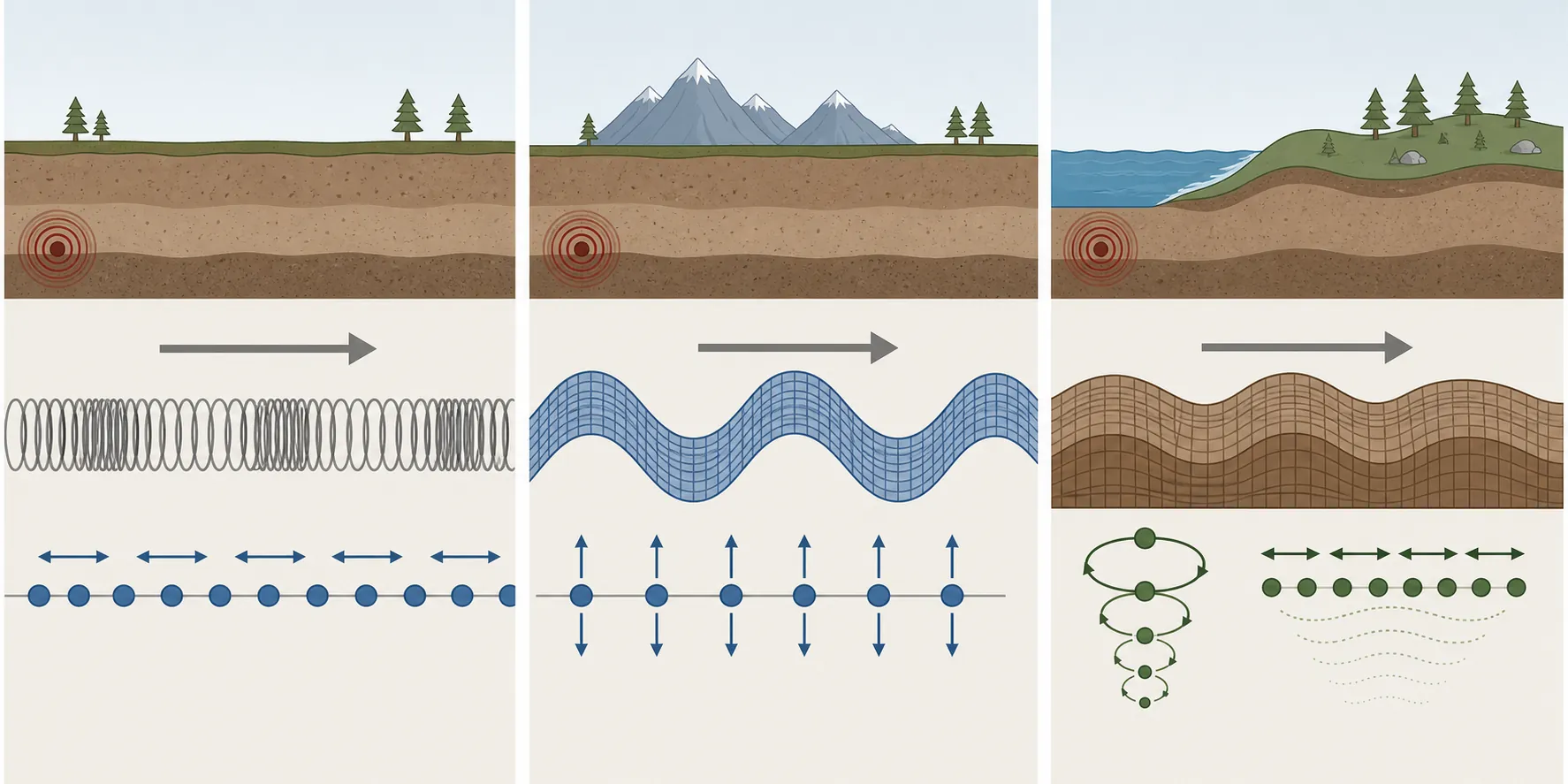
| Wave type | Motion | Speed/order | Material clue | ASVAB-style cue |
|---|---|---|---|---|
| P wave | Compression and expansion in the direction the wave travels | Fastest; arrives first | Travels through solids and liquids | Primary, pressure, push-pull, first arrival |
| S wave | Shearing motion perpendicular to travel direction | Slower; arrives after P waves | Travels through solids, not liquids | Secondary, shear, cannot pass through liquid |
| Surface wave | Motion along Earth’s surface, including rolling or side-to-side movement | Generally arrives after body waves | Confined near the surface | Often linked with strong ground shaking and damage |
Do not flatten P waves into “fast” and S waves into “slow” only. That helps, but it is not enough if the question asks why S waves do not pass through Earth’s liquid outer core or which wave arrives first at a seismic station. The liquid clue belongs to S waves. The first-arrival clue belongs to P waves.
Surface waves are worth knowing, but they usually do not need the same study time. PNSN identifies Rayleigh waves as rolling waves and Love waves as side-to-side horizontal waves. [4] For a General Science question, the safest level is: P and S waves travel through Earth’s interior as body waves; surface waves travel along the surface and are often associated with greater shaking at the ground.
A quick self-check
- Which wave arrives first? P wave.
- Which wave is compressional? P wave.
- Which wave is shear? S wave.
- Which wave cannot travel through liquids? S wave.
- Which waves move along the ground surface? Surface waves.
Magnitude Scales: The Richter Comparison You Actually Need
Richter-scale questions keep showing up in ASVAB-style practice because they test a simple logarithmic relationship without requiring advanced math. Mometrix and CrackASVAB practice materials both use earthquake magnitude reasoning as General Science content. [5][6]
Here is the part to memorize cleanly: each whole-number increase in Richter magnitude corresponds to about 10 times greater measured wave amplitude and about 32 times more energy. [6] That means the jump from magnitude 3 to magnitude 6 is not “twice as strong” or “three times as strong.” For wave amplitude, it is 10 × 10 × 10, or 1,000 times.
| Magnitude comparison | Whole-number difference | Wave amplitude comparison |
|---|---|---|
| Magnitude 4 vs. magnitude 3 | 1 | 10 times greater |
| Magnitude 5 vs. magnitude 3 | 2 | 100 times greater |
| Magnitude 6 vs. magnitude 3 | 3 | 1,000 times greater |
Keep the amplitude and energy facts separate. The 10-times rule is for wave amplitude per whole-number step. The roughly 32-times rule is for energy per whole-number step. If an answer choice mixes those up, the test is checking whether you memorized the mechanism or only remembered that “Richter is logarithmic.”
Richter versus moment magnitude
There is one modern-science correction worth knowing. The U.S. Geological Survey explains that moment magnitude is now used for large earthquakes, even though “Richter scale” remains familiar and still appears in many school and test-prep contexts. [7] For ASVAB purposes, do not throw Richter away; just do not treat it as the whole current story.
A fair high-school-level distinction is this: Richter magnitude is the older local magnitude scale many practice questions use for logarithmic comparisons; moment magnitude is the modern scale scientists use especially for larger earthquakes because it better represents the total energy released. That is enough. You do not need to calculate seismic moment.
Basic Earthquake Safety: Keep It Short
A true disaster-preparedness article would spend much more time on supplies, home hazards, structural risk, communication plans, and local emergency guidance. For ASVAB General Science, the safety piece is usually much narrower: know the immediate protective action during shaking.
The Great ShakeOut’s protocol is “Drop, Cover, and Hold On”: drop to the ground, take cover under a sturdy desk or table if possible, and hold on until shaking stops. [8]
- Drop: get down before shaking knocks you down.
- Cover: protect your head and neck, preferably under sturdy furniture.
- Hold On: stay in place and hold your cover until the shaking ends.
If an answer choice says to run outside during shaking, stand in a doorway as the main rule, or use elevators, be cautious. The ASVAB is more likely to reward the simple recognized protocol than a dramatic escape plan.
How to Study This Without Turning It Into Geology Week
Use one short study block for the map, one for waves, and one for magnitude. If you are already close to your test date, put waves and Richter comparisons first because they convert cleanly into multiple-choice questions.
- Draw the three boundary motions from memory: apart, together/subduction, slide past.
- Recite the P/S wave differences aloud: first versus second, compression versus shear, liquids versus no liquids.
- Work three Richter comparisons: one-step, two-step, and three-step amplitude differences.
- State Richter versus moment magnitude in one sentence.
- Finish with Drop, Cover, and Hold On.
Then test yourself with mixed General Science questions, not only earthquake questions. The real subtest will not politely stay on tectonics after you have warmed up. It may move from a seismic-wave item to a biology, chemistry, weather, or scientific-method item within the same short section.
If earth science is one of your weaker areas, pair this review with nearby weather topics such as hurricane science study tips and tornado watch versus warning. Keep the same rule: study the tested distinction, not every interesting side trail.
Done Means You Can Answer These
You are prepared enough for earthquake-related ASVAB General Science questions when you can answer these without looking:
- What kind of plate boundary has plates pulling apart, colliding/subducting, or sliding past each other?
- Why does elastic rebound cause an earthquake?
- Which seismic wave arrives first, and which one cannot travel through liquids?
- How much greater is the wave amplitude of a magnitude 6 earthquake than a magnitude 3 earthquake?
- Why might a modern source mention moment magnitude instead of Richter for large earthquakes?
- What should you do during shaking?
If those answers are solid, stop expanding the topic. Earthquakes are a predictable subtopic inside ASVAB General Science, not a separate exam.
References
- ASVAB General Science Study Guide for Every Key Topic — ASVAB Advantage
- General Science (GS) — Official ASVAB Sample Questions
- ASVAB General Science Study Guide — ASVAB Test Bank
- Earthquake Waves — Pacific Northwest Seismic Network
- ASVAB General Science Practice Test (updated 2026) — Mometrix
- ASVAB General Science Question 162 (Richter Scale) — CrackASVAB
- Moment magnitude, Richter scale - what are the different magnitude scales, and why are there so many? — USGS
- Drop, Cover, Hold On — Great ShakeOut
Comments
Join the discussion with an anonymous comment.