
SAT Exam Hub
Your SAT prep plan for 2026 Miami-Dade school closures
Learn how to keep your SAT and ACT prep on track despite the nine Miami-Dade school closures in 2026, backed by research on the real impact of closures and a practical front-loaded study plan.
- gre
- mcat
- asvab
- sat
- act
- digital-adaptive
- official-material
- section-strategy
- test-date-timeline
Miami-Dade students do not have a long runway this year. The School Board approved nine school closures and consolidations on June 17, 2026, and Miami-Dade County Public Schools starts the 2026-27 year on August 13.[1][2] The August SAT follows on August 22, nine days after students walk into a reassigned building, a new schedule, or a changed commute.[3] For affected students, that calendar is the first problem.
Nine days is not enough time to rebuild a testing routine. It is barely enough time to learn where the new bus drops off, which teacher opens a quiet classroom after school, and whether the library is still usable before pickup. If a junior or senior is testing in late August, September, October, or early fall ACT windows, the prep plan has to become portable before school starts.
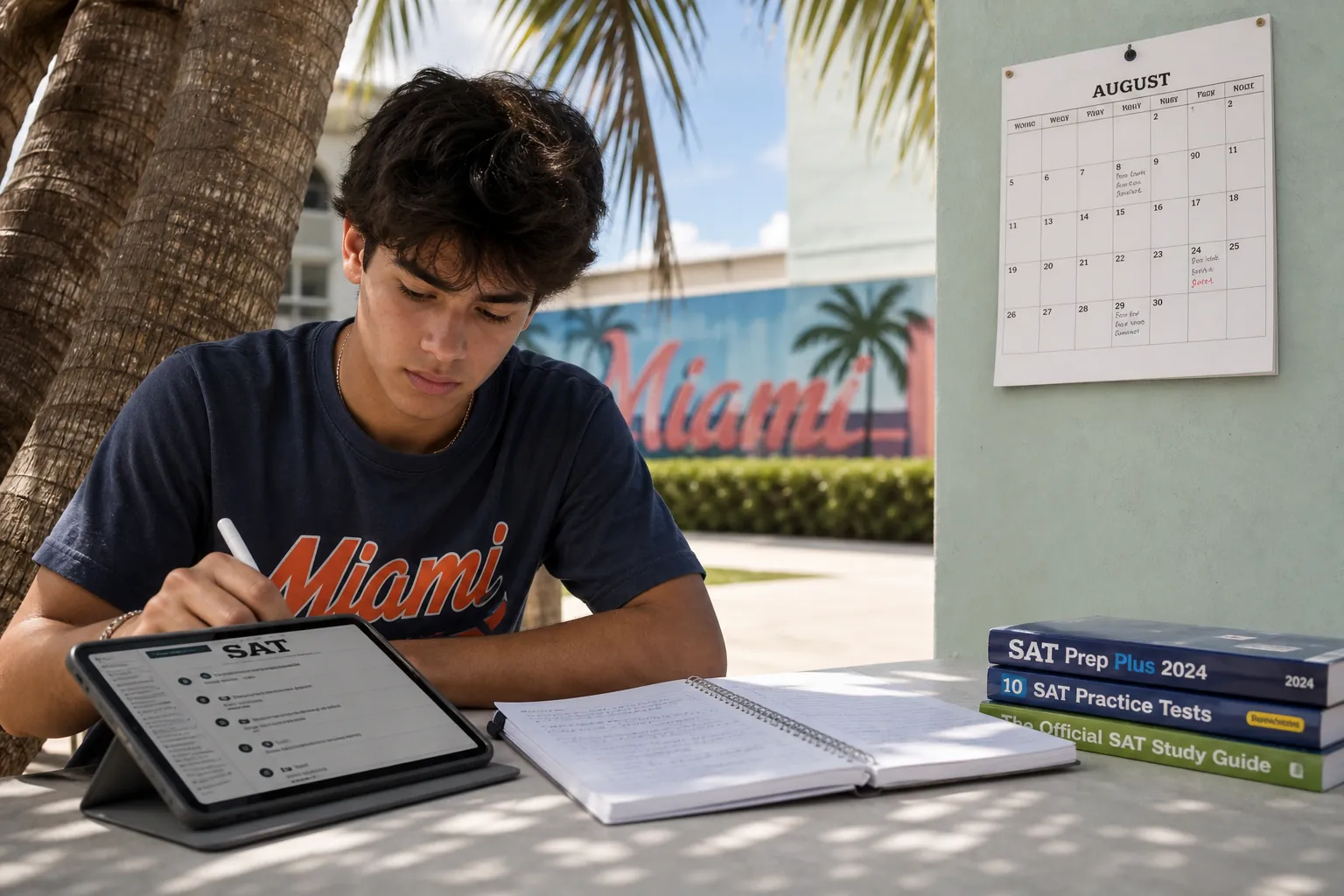
The realistic score risk is not zero. A careful planning estimate is roughly 30 to 40 SAT points on average for affected students if closure disruption is left unmanaged. That is not a Miami-Dade SAT study, and it should not be treated as one. It comes from translating a school-closure test-score effect found in Danish consolidation research - a 5.9% standard-deviation decline driven by closings - into a practical SAT planning buffer.[4]
That estimate is serious enough to plan around. It is also small enough to offset with a focused, front-loaded prep block. The mistake is waiting until the student has "settled in" after the move. For the August 22 SAT, settled in means the test is already here.
What the closure risk actually means for test prep
School closure effects are often discussed as if they are either catastrophic or harmless. The evidence is more useful than that. Beuchert, Humlum, Nielsen, and Smith studied Danish school consolidations and found a 5.9% standard-deviation decline in test scores from school closings, with effects diminishing over two to four years.[4] Denmark is not Florida, and that study is not an SAT paper. Still, it gives families a reasonable warning: when a school closes, the academic effect can show up even if the student is not changing ability, motivation, or long-term goals.
For SAT planning, the translation is intentionally rough. The 30 to 40 point range is not published Miami-Dade data, and it is not a direct College Board conversion. It is a planning buffer for the way closure disruption can reach test day: missed practice, fatigue from transportation changes, lost tutoring access, and inconsistent weekly review.
The more worrying research is not only about test scores. Education Week's reporting on a 2024 Kim study of 470 Texas school closures from 1998 to 2015 found students were 4.8% less likely to attend college and 4.7% less likely to complete college after closures.[5] The same reporting noted sharper attendance and discipline effects for groups that already tend to carry more logistical burden: Hispanic students had 6.4% more absences after closure compared with 1.8% for all students, while economically disadvantaged students had 7.3% more absences and a 38% increase in disciplinary days.[5]
Those numbers do not mean a Miami-Dade student is destined to miss college because a campus closed. They do mean the plan cannot stop at "keep studying." Attendance, transportation, sleep, and a stable place to work are part of SAT and ACT prep now. A student who loses the after-school practice room, gets home 40 minutes later, and no longer sees the teacher who reminded them to finish a weekly section is not facing a motivation problem. They are facing a systems problem.
Why this is happening matters, but only up to a point
The closures did not appear out of nowhere. NBC 6 reported that Miami-Dade's enrollment fell by about 13,000 students and that the district's enrollment dropped from 327,754 in 2006-07 to a projected 217,100 in 2026-27, a 38.3% decline over two decades.[1] WLRN reported that the district cut $89 million mid-year from its budget and cut 168 positions in June 2026.[6]
Those facts explain why supports may be uneven. A school-based SAT club can disappear when a campus closes. A counselor's caseload can change. A teacher who informally ran ACT English practice may be reassigned. None of that shows up neatly on a boundary map, but students feel it by the second week of August.
There is also a legitimate upside in some of the new configurations. Local 10 reported that the School Board vote was unanimous, included boundary redrawing, and involved consolidations into 6-12 academies; board member Monica Colucci Espino said students in the new setup could earn up to eight high school credits before ninth grade.[7] That may matter a lot for middle-school families and younger students. It does not solve the immediate problem for a rising senior with an August 22 SAT registration.
Build the plan backward from August 22
The useful prep question is not "Will the new school be better?" It is "What needs to be finished before August 13 so the test plan does not depend on the new school being organized immediately?"
| Timing | Student action | Why it matters |
|---|---|---|
| Now through early August | Take a full baseline SAT or ACT and identify the two highest-value weak areas. | A school move is a bad time to discover that the real problem is pacing, algebra, grammar, or reading endurance. |
| Before August 13 | Set up prep that works from any device, any quiet room, and any school assignment. | Portable resources survive a reassigned teacher, changed bus route, or closed classroom. |
| August 13-21 | Run a light maintenance week: targeted drills, review log, sleep protection, and test-center verification. | The first week of school should not be the heaviest study week. |
| August 22 | Take the SAT with logistics already confirmed. | The student should be thinking about the test, not whether the test center changed. |
| After August 22 | Use the score report to decide whether to retest in the fall. | The closure disruption should inform the retake plan, not derail it. |
Start with a baseline, not a pile of resources
A baseline test is the fastest way to stop guessing. Students should take one official-style SAT practice test or one full ACT practice test under timed conditions, then sort errors into a short list: content gap, careless error, time pressure, question misread, or stamina. The goal is not to label the student as a "math person" or "reading person." The goal is to decide which two areas can realistically move before the first fall test.
For many students, the best first target is not the lowest section. It is the section where missed points are easiest to reclaim. A student missing grammar rules because they never learned punctuation can improve faster than a student trying to overhaul reading speed in nine days. A student losing math points to calculator setup and formula recognition may need a tighter review sheet more than another chapter of explanation.
Students who need help choosing tools quickly can use a SAT prep comparison guide to decide whether they need a structured course, a free practice path, or a tutor-supported plan. The choice should be made after the baseline, not before it.
Make every resource portable
A portable prep plan has three pieces: the student can access it from home or school, the parent can see whether it happened, and the work does not depend on one adult in one building. That matters more in a closure year than the brand name on the course.

Miami-Dade announced a Google Gemini SAT prep partnership in February 2026 offering free Princeton Review-grounded SAT prep for all high school students, accessible from any device.[8] That is exactly the type of resource families should look for in a closure year. Before relying on it, students should verify that the program is still active for the 2026-27 school year and that their account access works before the first day of school.
- Log in before August 13 and confirm the student can open lessons, drills, and practice questions.
- Save the login method somewhere the student and parent can both find it.
- Download or bookmark any official practice materials needed for the first two weeks.
- Create a one-page error log that travels with the student, either in a notebook or shared document.
- Choose a backup study location in case the new school schedule removes the old quiet place.
The parent role here is boring and important. Do not ask every night, "Did you study?" Ask to see the error log twice a week. If the log is empty, the student may be watching lessons without converting mistakes into points.
Protect the week school starts
The week of August 13 should be a maintenance week, not a heroic cram week. Affected students will be learning a new schedule, new routes, new teachers, and possibly a new lunch pattern. That is not the week to add three-hour night sessions.
A better rhythm is simple: 25 to 40 minutes on school nights, one targeted section at a time, with one short review of old mistakes before bed. If the student has already done the heavy work in July and early August, the first school week becomes about preserving timing and confidence.
- Monday or first school night: review the top 20 missed-question patterns.
- Midweek: complete one timed module or one ACT passage set, then review every miss.
- Two nights before the test: stop learning new content and review formulas, grammar rules, and pacing notes.
- Night before: pack ID, calculator if applicable, approved supplies, snack, water, and admission materials.
Students who want a low-friction study break during this same August stretch can use a planned break instead of drifting into an unplanned one. StudyMethod's August 2026 scheduling guide is useful only if the break is scheduled around sleep, not traded for it.
Verify the test center like it can change
Students should confirm their SAT registration, test date, and test center through College Board, then check College Board's test-center closings page as the date approaches.[3][9] This is not paranoia. In a closure and consolidation year, families should not assume the familiar campus, route, or drop-off routine is still the right one.
The test-center check belongs on the calendar twice: once before school starts and once during test week. If the assigned center is unfamiliar, the student should map the route, estimate travel time at the correct time of day, and decide who is responsible for transportation. A parent saying "we'll figure it out Saturday morning" is how a prepared student becomes a late student.
Use the closure research without turning it into doom
Not every consolidation produces academic harm. Research on Arkansas's Act 60 consolidation policy found null or small positive effects, which is a useful counterweight to blanket claims that consolidation is always damaging.[10] Execution matters. Support matters. Whether students keep consistent attendance, relationships, transportation, and academic routines matters.
For SAT and ACT planning, that means families should treat closure as a risk factor, not a verdict. A student does not need to solve district finance or boundary policy before the fall test dates. They need to prevent the predictable points of failure: no baseline, no quiet place, no verified test center, no weekly rhythm, no adult checking whether practice is actually happening.
The affected students who are most vulnerable are not necessarily the ones with the lowest scores today. They are the ones whose prep depends on fragile conditions: a specific classroom after school, a ride that only worked for the old campus, a teacher reminder, a parent who does not know the test date, or a study app that has never been opened outside school Wi-Fi.
A practical six-week workflow
If there are six weeks before the student's first SAT or ACT, the plan should be front-loaded. Put the hardest work before the school move, then use the first school week for maintenance and logistics.
| Phase | Main work | What to avoid |
|---|---|---|
| Week 1 | Full baseline test, score review, error categories, target score decision. | Buying three resources before knowing the real weak spots. |
| Weeks 2-3 | Content repair in the two highest-value areas, with short timed sets. | Untimed practice that feels productive but hides pacing problems. |
| Week 4 | Mixed practice, section timing, and a second full or half-length check. | Changing the whole plan because of one bad practice day. |
| Week 5 | Test-specific review, formula and grammar sheet, reading or science pacing. | Heavy new content that will not stabilize before test day. |
| Week 6 | Light maintenance, sleep, test-center confirmation, transportation plan. | Cramming during the first week in a new school. |
For SAT students, the first diagnostic decision is usually section-specific: Math, Reading and Writing, or timing across both. For ACT students, the decision may be more about section order and stamina, especially if Science or Reading collapses late in the test. Students starting from scratch can begin with a general SAT planning hub and then narrow quickly to the weakest score-producing habits.
The plan should also name the backup conditions in advance. If the new commute removes after-school study time, the student studies before dinner. If the new school blocks access to a familiar prep site, the student uses the phone hotspot or home device. If a counselor meeting is delayed, the parent checks registration deadlines directly instead of waiting. None of this is elegant. It is how a test plan survives a building change.
What parents should check before August 13
Parents do not need to become test-prep instructors. They do need to remove avoidable uncertainty. In a normal year, a family can sometimes recover from a slow August start. In a closure year with an August 22 SAT, the avoidable uncertainty piles up too close to the test.
- Confirm the student's first SAT or ACT date and whether a fall retake is likely.
- Verify test-center location, transportation, arrival time, and backup driver.
- Ask where the student will study if the new school does not provide a quiet after-school option.
- Check that online prep access works outside the old school building.
- Look at the error log twice a week instead of relying on verbal updates.
- Set a sleep cutoff for the first week of school, especially before a Saturday test.
If the student is aiming for scholarships, selective admissions, or a score-dependent application plan, add one more check: whether the current score is already usable. Sometimes the best move after a disruptive school start is not another test date immediately. Sometimes it is protecting grades, rebuilding attendance, and choosing the next SAT or ACT window with a calmer schedule.
The decision point
If your school is closing or consolidating, your August goal is not to win the closure debate. It is to make your SAT or ACT routine independent of the building you attend. The research is strong enough to take disruption seriously, but not strong enough to treat a lower score as inevitable.
A 30 to 40 point SAT planning buffer is manageable if the student starts before the move, uses resources that travel, checks the test center, and keeps a weekly error log. It becomes expensive only when the family waits for the new school year to feel normal. For the August 22 SAT, normal arrives too late.
References
- Miami-Dade School Board approves closing 9 schools, NBC 6 South Florida, June 17, 2026, link
- Miami-Dade County school closures, consolidations upcoming year, USA Today, July 27, 2026, link
- SAT Dates and Deadlines, College Board, link
- The short-term effects of school consolidation on student achievement: Evidence of disruption?, Economics of Education Review, 2018, link
- The Harm of School Closures Can Last a Lifetime, New Research Shows, Education Week, June 2024, link
- Unprecedented drops in enrollment in Miami-Dade schools loom over budget, WLRN, March 17, 2026, link
- Miami-Dade School Board unanimously votes to close multiple schools, redraw boundaries, Local 10 News, June 17, 2026, link
- M-DCPS, Google and The Princeton Review Team Up to Offer Free AI-Powered SAT Prep for All High School Students, M-DCPS Office of Communications, February 2026, link
- SAT Test Center Closings, College Board, link
- Can Consolidation Improve Students' Academic Outcomes? Evidence from Arkansas, Annenberg Institute at Brown University, 2021, link
Related exhibits & inventory
Verified outcomes
No verified outcomes on file for this exam yet
See Methodology for how outcome evidence is disclosed once logged.
Planners
No planner filed for this exam yet
A downloadable timeline template for this exam hasn't been published yet.
Tool verdicts
AI-tool cautions
No AI tools tested for this exam yet
No hands-on AI-accuracy logs have been filed for this exam.
Questions about this plan
Ask a question about a specific section, timeline, or citation in this plan — or flag something that needs correcting.
Comments
Join the discussion with an anonymous comment.