
MULTI Exam Hub
Is Hank Green's Crash Course Good for Exam Prep?
An exam-by-exam verdict on whether Hank Green's Crash Course earns study time before the GRE, MCAT, ASVAB, SAT, or ACT. It helps most as a free concept primer for MCAT and ASVAB, but it barely overlaps with GRE and SAT/ACT and can't replace format-specific practice.
- gre
- mcat
- asvab
- sat
- act
- digital-adaptive
- official-material
- section-strategy
- test-date-timeline
The verdict: Crash Course is a primer, not a prep system
If the search that brought you here was “hank green crash course for exam prep,” the useful answer is blunt: Crash Course can help you understand topics, but it is not built to prepare you for the GRE, MCAT, ASVAB, SAT, or ACT by itself.
That distinction matters because Crash Course has earned real trust. The series launched in January 2012, and by March 2026 Wikipedia listed it at more than 17 million subscribers, more than 2.2 billion views, more than 44 main series, and about 1,548 episodes.[1] The official Crash Course site presents a large free catalog around AP high school curriculum topics, including series such as Statistics that are explicitly tied to the 2018 AP Statistics curriculum, but it does not offer official GRE, MCAT, ASVAB, SAT, or ACT prep courses.[2]
The app does not change that verdict. The official listings present Crash Course as free and highly rated, with flashcards and quiz decks for Anatomy & Physiology, Chemistry, and Organic Chemistry, but they do not show full-length practice tests, score prediction, section timing, adaptive review, or exam-format training.[3][4]

Exam-by-exam fit
| Exam | Where Crash Course can help | What it does not train | Study-time verdict |
|---|---|---|---|
| MCAT | Strongest partial fit: Biology, Chemistry, Organic Chemistry, Physics, Psychology, Sociology, and Anatomy & Physiology overlap with parts of MCAT content review.[2] | No official MCAT course; missing or shallow coverage in areas MCAT students commonly flag, especially biochemistry and deeper organic chemistry.[5] | Use as a capped concept warm-up before MCAT-specific passages, question banks, and full-lengths. |
| ASVAB | Narrow partial fit: General Science review can benefit from Biology, Chemistry, and Earth science-style content.[2] | Does not prepare Word Knowledge, Math, pacing, or ASVAB-style item practice. | Use only for science familiarity, then move quickly to ASVAB-specific practice. |
| GRE | Almost no direct content fit, except general Study Skills material such as the Studying for Exams episode.[2] | Does not train GRE Quant, Verbal, Analytical Writing, adaptive section strategy, or GRE timing. | Skip it unless you need a brief study-habits reset. |
| SAT | Almost no direct content fit, except general Study Skills material.[2] | Does not train digital SAT Reading and Writing, Math, module pacing, Bluebook interface habits, or official question style. | Spend the time on SAT-format practice instead. |
| ACT | Almost no direct content fit, except general Study Skills material.[2] | Does not train ACT English, Math, Reading, Science timing, or section-specific pacing. | Spend the time on ACT-format practice instead. |
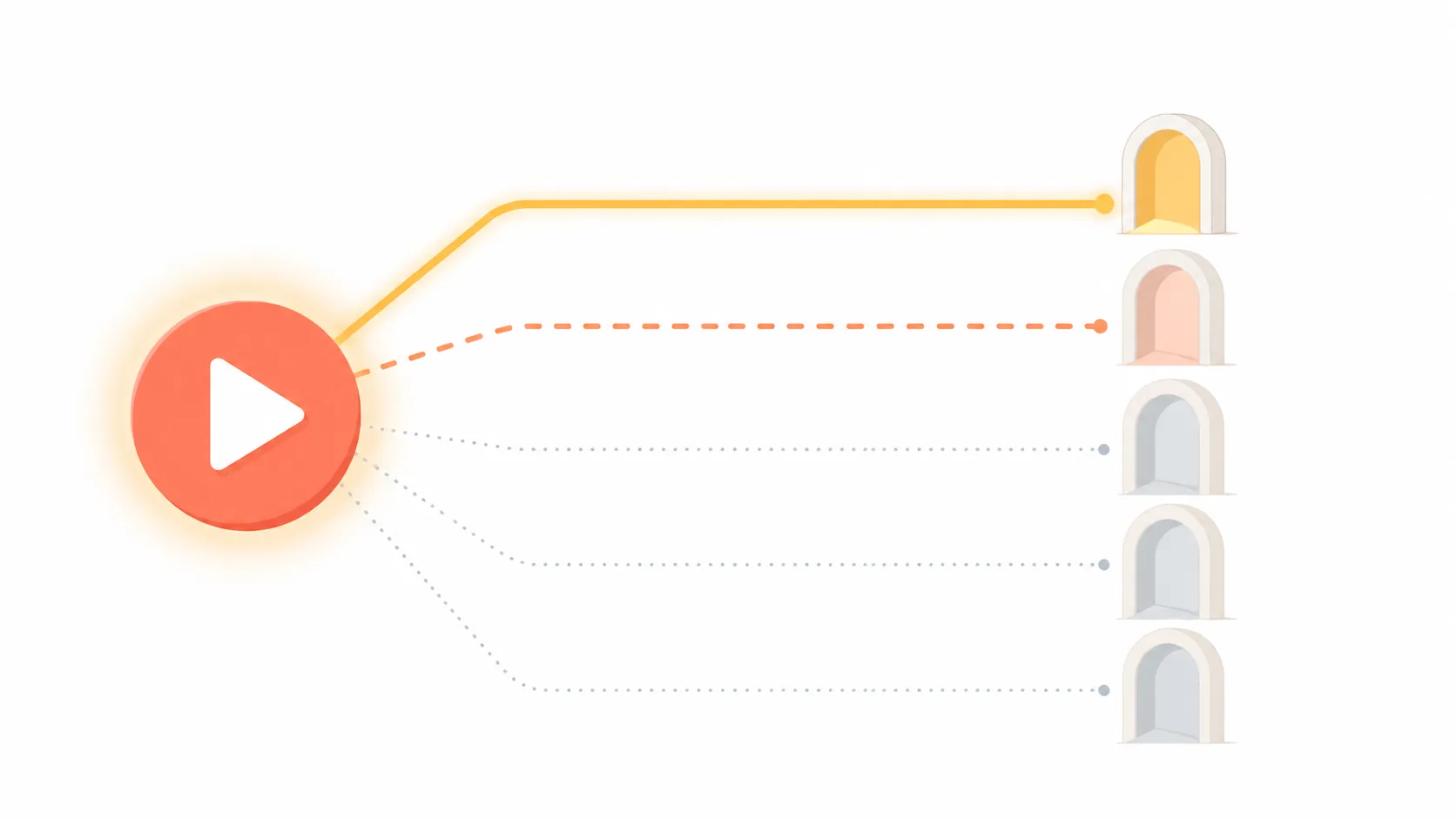
This table is the practical center of the decision. Crash Course earns attention where the exam rewards content familiarity. It loses value where the exam mostly rewards format recognition, pacing, official question style, and a feedback loop from scored practice.
MCAT: useful, tempting, and easy to overuse
The MCAT is the exam where Crash Course looks most attractive. If you are rusty on cell biology, chemical bonding, basic physics, psychology terms, or sociology concepts, the relevant series can make the first pass less painful. That is not a trivial benefit. A student who cannot remember what an enzyme does or why functional groups matter may need a low-friction re-entry point before serious MCAT work becomes productive.
The danger is treating that re-entry point as the course. The “Crash Course: MCAT” playlist that circulates on YouTube is a third-party fan curation, not an official Crash Course MCAT product.[6] That matters because a playlist can gather useful episodes without solving the hard prep problems: which AAMC skills are being tested, how the concept appears inside passages, how much depth is enough, and what to do when your practice scores stall.
The limited community evidence points in the same direction. In one r/Mcat thread, users with 524 and 511 flairs described Crash Course as strong for overviews but not enough for full content review; the thread specifically flags no biochemistry and recommends Khan Academy as the primary resource.[5] Flair and Reddit comments are not verified score-outcome evidence, so they should not be treated as proof. They are still useful because the warning is exactly the allocation problem: the videos can make a topic understandable before they make it test-ready.
A sensible MCAT use case is narrow: watch selected episodes before or after your main content source when a topic feels opaque, then immediately convert that understanding into MCAT-style questions. If you watch a Psychology episode and then cannot answer passage-based questions about research design or application, the video did not fail; it simply did the job it was designed to do, not the job your score report requires.
ASVAB: General Science help does not transfer to the whole test
For the ASVAB, Crash Course belongs in an even smaller box. The overlap is real for General Science. Biology, chemistry, and Earth science-style explanations can help if your science background is thin or old. A short run of targeted videos may make basic terms less foreign before you start ASVAB-specific drills.
But that is where the transfer mostly stops. A clear explanation of photosynthesis does not improve Word Knowledge. A chemistry episode does not train Math. A friendly science overview does not teach you how quickly you need to move through the actual test or which answer traps appear in ASVAB-style items.
The practical allocation is therefore simple: if General Science is one of your weak areas, Crash Course can be a warm-up. If your score problem is vocabulary, arithmetic, algebra, mechanical reasoning, or pacing, it should not get the hour. That hour belongs to ASVAB-specific practice.
GRE, SAT, and ACT: the overlap is too thin
GRE students should be especially careful. Crash Course has a general Study Skills series, including an episode on studying for exams, but that is not the same as GRE preparation.[2] The GRE asks you to handle Quant, Verbal, Analytical Writing, timing, and computer-based test behavior. A good study-skills video may help you plan a week; it will not teach you how GRE answer choices are written.
SAT and ACT students have the same problem. Crash Course may help with school subjects in a broad sense, but the SAT and ACT are not asking whether you enjoyed a concise lecture. They are asking whether you can read official-style passages, identify grammar or math moves quickly, manage section timing, and learn from missed questions. For SAT-specific format practice, the saved time is better spent with official digital practice and tools that expose test-interface mistakes, such as StudyMethod’s guide to Bluebook digital SAT practice mistakes.
The missing piece: the practice-test loop
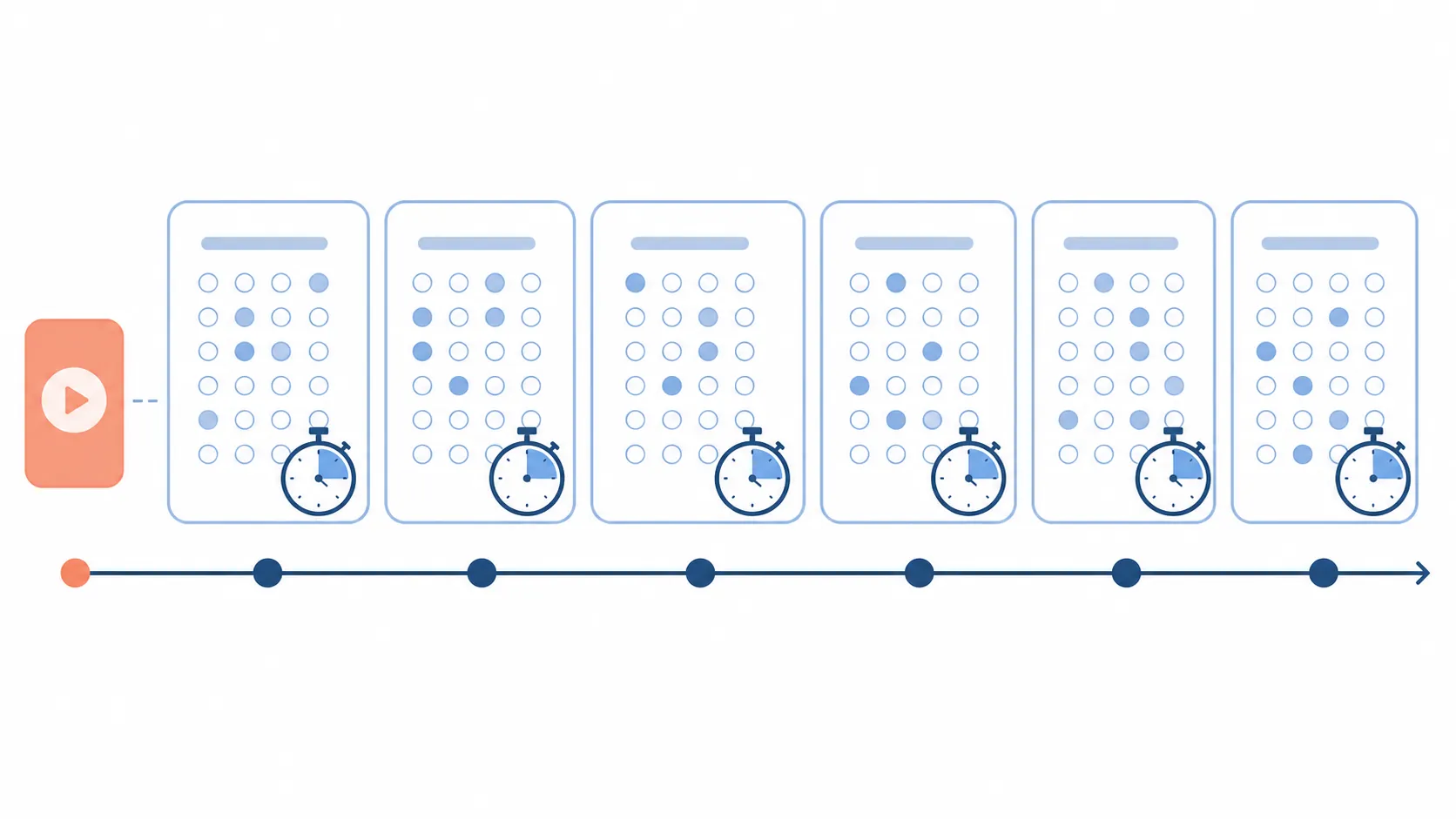
For every exam here, the cap on Crash Course comes from the same missing loop. A prep system has to do more than explain. It needs to reveal what you miss under test conditions, sort those misses by cause, send you back to the right content, and then test whether the fix worked.
- A diagnostic or full-length test shows the current score problem.
- Timed practice shows whether the problem is knowledge, pacing, accuracy, or stamina.
- Review turns missed questions into specific tasks.
- A second practice set checks whether the repair actually held.
Crash Course can sit inside that loop as a content repair tool. It cannot supply the loop. The official app’s flashcards and quiz decks for Anatomy & Physiology, Chemistry, and Organic Chemistry are useful study features, but they are not a substitute for exam-length timing, official scoring, or test-specific feedback.[3][4]
What the evidence actually supports
The strongest claims about Crash Course are scope and credibility claims. Wikipedia and the official site support the basic picture: a huge, free educational catalog with AP-adjacent coverage and no official prep course for these five exams.[1][2] That explains why students and teachers trust it. It does not show score gains on the GRE, MCAT, ASVAB, SAT, or ACT.
The AP-season behavior data shows demand, not results. Tubefilter reported that Crash Course watch time rose 41% during AP exam season in 2016, and Hank Green advised viewers to study over weeks instead of relying on last-minute cramming.[7] That is a useful reminder about how students actually use the channel, but a watch-time spike is not an outcome measure.
The closest controlled learning evidence comes from a University of South Carolina history case study by Marsh and Johnson: in a sample of 317 students, video-based general-education history sections outscored textbook sections on the final.[8] That supports the modest claim that well-designed educational videos can help students learn course material. It should not be stretched into a claim about MCAT passage performance, SAT module pacing, ASVAB AFQT outcomes, GRE Quant, or ACT Science timing.
Teacher adoption evidence is also adjacent. A Journal of Social Studies Research survey of 181 social studies teachers documents classroom use and teacher perspectives, but it does not provide standardized-test score outcomes.[9] Likewise, APStudents Reddit threads include self-reported AP World History 4s and 5s, alongside a counterexample from a student who wrote, “I tried to use it for my semester 1 final, but it was useless and I ended up scoring lower.”[10][11] Those anecdotes can warn you about fit, but they cannot verify a general effect.
The supplementary design is not hidden. In the ASU Study Hall partnership context, ASU said the content “won’t offer credit or replace any degree programs.”[12] Different project, same useful caution: Crash Course is strongest when it lowers the entry cost to a subject. It should not be promoted into the thing that certifies readiness.
For another example of how StudyMethod separates adoption, self-reported experience, and reasoned inference across GRE, MCAT, SAT, ACT, and ASVAB resources, see the exam-by-exam structure in DeepSeek AI tested for exam prep. The same standard applies here: a resource earns time because it covers tested content, trains tested format, or improves your review loop.
How to allocate it in a real study plan
| If you are taking... | Give Crash Course this job | Do next |
|---|---|---|
| MCAT | Concept warm-up for selected science and behavioral-science topics. | Move to MCAT-specific content review, passage practice, AAMC-style questions, and full-length exams. |
| ASVAB | General Science refresher only. | Use ASVAB-specific practice for Word Knowledge, Math, pacing, and score-relevant sections. |
| GRE | Optional study-habits reset. | Use GRE Quant, Verbal, Writing, and timed practice materials instead. |
| SAT | Optional study-habits reset. | Use official digital SAT practice, Bluebook-style review, and section-specific drills. |
| ACT | Optional study-habits reset. | Use ACT English, Math, Reading, Science, and pacing practice. |
There is nothing embarrassing about using a free video to make a subject less scary. The mistake is letting that feeling of understanding consume the time that should be spent proving readiness under exam conditions. Crash Course may deserve a small slot in an MCAT or ASVAB plan. For GRE, SAT, and ACT, it usually deserves only a very small one, if any.
References
- Crash Course (web series) — Wikipedia.
- Crash Course — TheCrashCourse.com.
- Crash Course: Watch and Study — App Store.
- Crash Course — Google Play.
- Opinions/experiences on Crash Course videos for... — Reddit r/Mcat.
- Crash Course: MCAT — YouTube playlist.
- Crash Course Watch Time AP Exams — Tubefilter, May 26, 2016.
- Marsh & Johnson Crash Course case study — Isis, 2020.
- Journal of Social Studies Research 48(3), 190–203 teacher survey — SAGE.
- r/APStudents thread — Reddit r/APStudents.
- r/APStudents thread — Reddit r/APStudents.
- ASU, Crash Course partner on series of educational YouTube videos — ASU News, March 31, 2020.
Related exhibits & inventory
Verified outcomes
No verified outcomes on file for this exam yet
See Methodology for how outcome evidence is disclosed once logged.
Planners
No planner filed for this exam yet
A downloadable timeline template for this exam hasn't been published yet.
Tool verdicts
AI-tool cautions
No AI tools tested for this exam yet
No hands-on AI-accuracy logs have been filed for this exam.
Questions about this plan
Ask a question about a specific section, timeline, or citation in this plan — or flag something that needs correcting.
Comments
Join the discussion with an anonymous comment.