
GRE Exam Hub
'Fool Me Once, Shame on You' Meaning for English Learners
To English learners, 'fool me once, shame on you' can be confusing because the blame shifts: the first clause falls on the deceiver, and the second on the person who fell for the trick. Get the plain-language meaning, the word order that decides who is blamed, and a structural decode you can reuse on unfamiliar idioms in SAT, ACT, ASVAB, and GRE reading passages.
- gre
- mcat
- asvab
- sat
- act
- digital-adaptive
- official-material
- section-strategy
- test-date-timeline

“Fool me once, shame on you; fool me twice, shame on me” means: if you trick me one time, you are responsible for the wrongdoing. If you trick me again in the same way, I am responsible for failing to learn from the first experience.
The phrase fool me once is also commonly used as shorthand for the complete proverb. When someone says only those three words, listeners usually supply the familiar second half: “shame on you; fool me twice, shame on me.”
Read the blame order before memorizing the idiom
The easiest way to decode the proverb is to identify the action and then follow the pronouns:
| Part | What happens | Who is blamed |
|---|---|---|
| Fool me once | You trick me one time. | You, the deceiver |
| Shame on you | The first deception is condemned. | You |
| Fool me twice | You trick me again. | The situation repeats |
| Shame on me | I failed to recognize or avoid the repeated trick. | Me, the person deceived |
The crucial shift is between you and me. In the first half, “you” performs the deception and “me” receives it. In the second half, “me” accepts the criticism because the experience should have taught me to be more careful. [2][3][4]
What does “fool” mean here?
In this proverb, “fool” is a verb, not a noun. It means “to trick someone” or “to make someone believe something untrue.” The learner’s-dictionary entry also gives the useful pattern “fool someone into doing something”: one person causes another person to accept a false idea or take an action through deception. [1]
That grammatical role changes the reading. In “fool me once,” me is the object of the verb: the person being fooled. The person doing the fooling is understood as “you,” even though the phrase does not state the subject in a normal sentence. A learner who reads “fool” only as a noun may lose the action entirely.
For example, imagine that a classmate tells you that an assignment is due next week, although it is actually due today. You believe the false information once. The classmate has fooled you, so the first “shame on you” points toward the deceiver. If the same classmate gives you the same false information again and you accept it without checking, the proverb says “shame on me.” The example is hypothetical; its purpose is to show the roles of the verb and pronouns.
Why “shame on me” cannot come first
A common learner error is to reverse the first judgment and say “fool me once, shame on me.” That reversal changes the proverb’s logic. It blames the person who was deceived immediately, before there has been a repeated opportunity to learn. The documented mistake is a useful warning because the two versions contain the same words; only their order changes. [6]
Compare the two statements:
- “Fool me once, shame on you” — the deceiver is blamed for the first trick.
- “Fool me twice, shame on me” — the deceived person is blamed for not learning from the first trick.
The judgment is conventional rather than universal. Someone who is deceived twice may have been under unusual pressure, lacked important information, or faced a more sophisticated deception. The proverb still uses “shame on me” to express its conventional lesson: repeated trust in the same kind of false claim calls for self-correction.
Modern reference entries show the expression in ordinary dialogue, where a speaker uses it to comment on a repeated mistake or warn that a second deception will be treated differently from the first. Those examples are useful after the structure is clear, not instead of understanding it. [3]
A three-step decode for unfamiliar figurative language
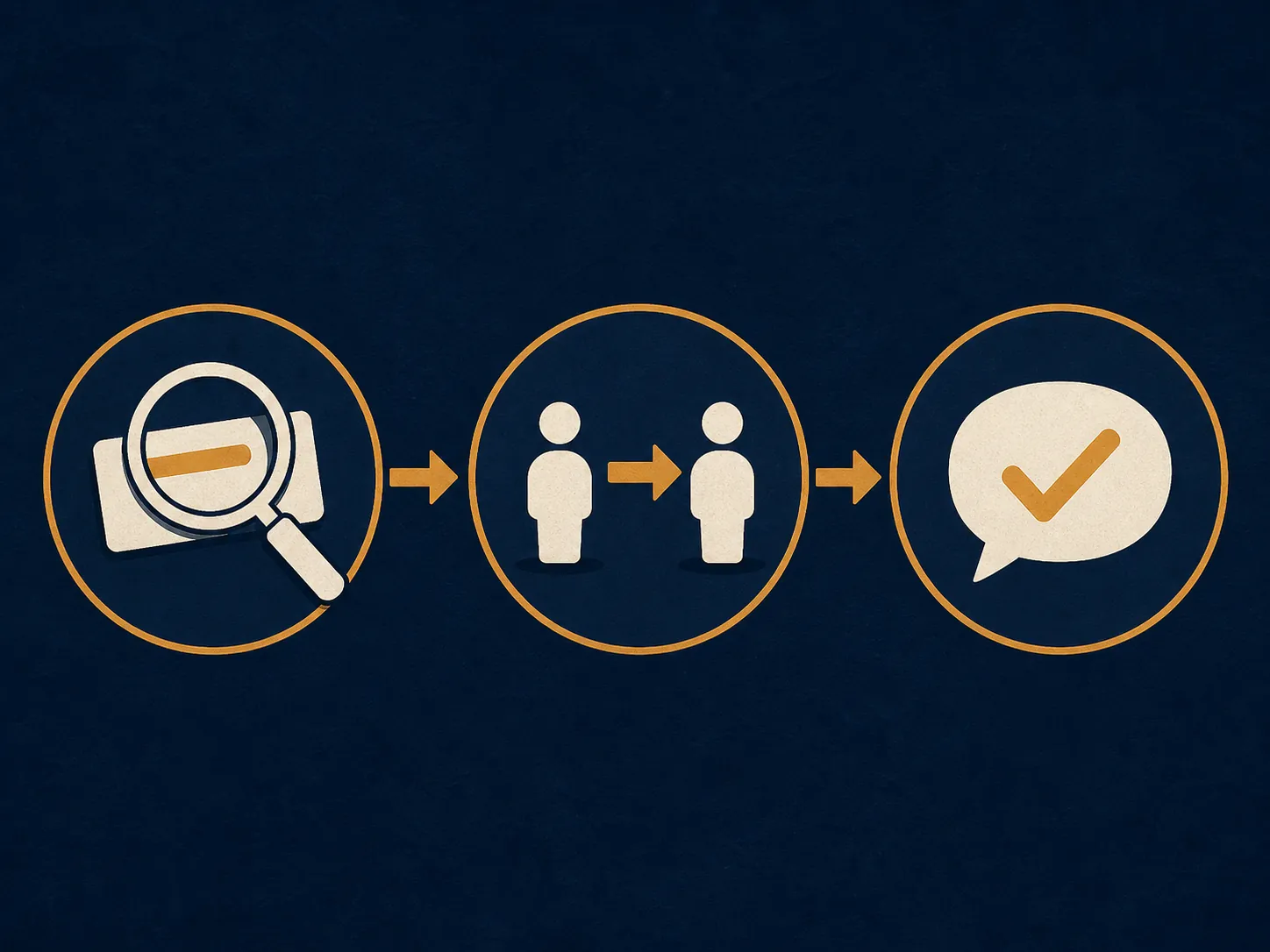
This proverb offers a compact reading procedure. When an unfamiliar expression appears in a passage, work through three questions:
- Define the key action. Decide whether the important word is functioning as a verb, noun, adjective, or something else. Here, “fool” is the verb “to trick.”
- Track the participants. Identify who performs the action, who receives it, and who is praised or blamed. Here, “you” tricks “me,” and the blame later shifts from “you” to “me.”
- Use the later clause as a check. The second half should confirm or revise your first interpretation. Here, “fool me twice” explains why the second judgment falls on the person who failed to learn.
The third step matters because figurative expressions often provide their own explanation through contrast, repetition, or consequence. In this proverb, “once” and “twice” establish a timeline, while “you” and “me” identify the changing target of blame. You do not need to know the proverb in advance to notice those relationships.
This is a useful habit for SAT and ACT reading, ASVAB Paragraph Comprehension, and GRE Verbal passages when a writer uses an idiom or figurative phrase inside a larger argument. It is a decoding strategy, not a claim about how often any particular exam asks idiom questions. First determine what the words are doing in the sentence; then use the surrounding passage to test the interpretation.
For a broader routine that places this kind of vocabulary work inside daily passage practice, see Can a reading study plan actually improve test scores?. The same no-background approach appears in GRE reading-comprehension case studies and in the Amani na Umoja GRE Verbal strategy.
A brief note on the proverb’s history
The first documented English appearance is generally traced to Anthony Weldon’s The Court and Character of King James in 1651. A proposed Italian root is sometimes mentioned, but that origin remains unproven. [2][5]
The proverb has also been altered for humor and public effect. On September 17, 2002, in Nashville, George W. Bush used the memorable mangled version, “Fool me — you can't get fooled again,” which was documented in discussions of his “Bushisms.” [7]
Those variations are interesting, but they are not needed to answer the meaning question. The dependable reading move is simpler: “fool” is the action, “me” is the person affected, and the order of “shame on you” followed by “shame on me” determines who is blamed at each stage.
References
- fool — Britannica Learner's Dictionary
- Fool Me Once, Shame on You; Fool Me Twice, Shame on Me — Grammarist
- fool me once, shame on you; fool me twice, shame on me — The Free Dictionary
- Fool Me Once Shame on You Fool Me Twice Shame on Me — UsingEnglish.com
- Fool Me Once, Shame on You — 7ESL
- Fool Me Once, Shame on You — English-Grammar-Lessons.com
- Bushism — Wikipedia
Related exhibits & inventory
Verified outcomes
Planners
No planner filed for this exam yet
A downloadable timeline template for this exam hasn't been published yet.
Tool verdicts
AI-tool cautions
No AI tools tested for this exam yet
No hands-on AI-accuracy logs have been filed for this exam.
Questions about this plan
Ask a question about a specific section, timeline, or citation in this plan — or flag something that needs correcting.
Comments
Join the discussion with an anonymous comment.