
SAT, ACT, MCAT, GRE Exam Hub
Schedule Your Fall 2026 Exam Study Plan Around the Blood Moon
The August 27, 2026 blood moon (96% partial lunar eclipse) can be more than a distraction. This 4-week study plan uses it as a built-in consolidation milestone and evening reward for SAT, ACT, MCAT, and GRE test-takers, with a timed viewing schedule and post-eclipse recall exercise to reinforce learning.
- gre
- mcat
- asvab
- sat
- act
- digital-adaptive
- official-material
- section-strategy
- test-date-timeline
Today is July 28, 2026. That gives you 30 days until the August 27–28 blood moon eclipse, which is just long enough to run a serious fall exam reset without pretending you are about to become a different person overnight. Searchers may call it a total lunar eclipse, but the honest label matters: this one is a 96.2% partial lunar eclipse, not a total eclipse, with the partial phase beginning around 10:33 p.m. EDT / 7:33 p.m. PDT and maximum eclipse at 12:12 a.m. EDT / 9:12 p.m. PDT.[1]
That timing is why it works as a study anchor. It does not take over a Saturday afternoon, collide with a practice test, or ask you to choose between a review block and the sky. It sits at the end of the day, where a reward belongs.
The same 30-day window also lands in a crowded fall testing stretch: the SAT is listed for August 22 and September 12, the ACT for September 19, and MCAT dates for September 4 and September 11, with those dates verified through ConnectPrep as of July 13, 2026 and still worth confirming against the official testing organizations before you lock travel, accommodations, or registration decisions.[2]

The 30-Day Calendar Fit
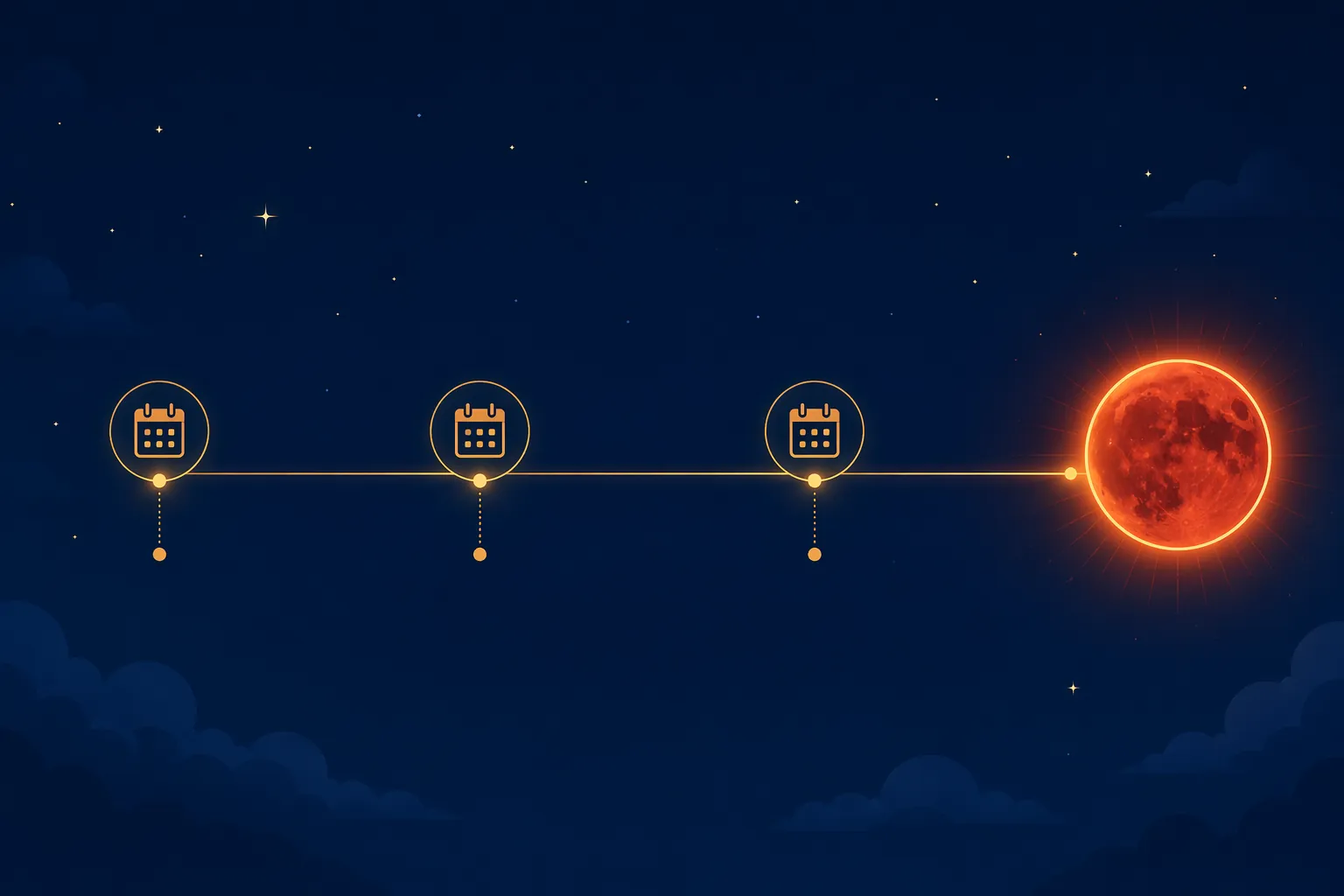
The plan is simple enough to write on one page: diagnose, repair, test, consolidate, then use eclipse night as the Week 4 milestone. It is not a superstition and it is not a promise that moonlight improves scores. It is a dated checkpoint with a memorable evening reward attached.
| Date Range | Main Job | Output By The End |
|---|---|---|
| July 28–August 3 | Diagnostic baseline | Current score range, weak sections, error categories |
| August 4–10 | Content review push | Targeted drills in the two or three areas costing the most points |
| August 11–17 | Timed practice-test week | Full-length score, timing notes, pacing failures, final-priority list |
| August 18–26 | Consolidation and quick recall | Compressed review sheets, flashcard cleanup, high-yield recall set |
| August 27–28 | Eclipse-night break protocol | Finished review block, scheduled viewing, 10-minute post-eclipse recall |
| August 28–test date | Final push | Adjusted plan based on the practice-test evidence |
If you already have a planner system, use it. If your system is a scatter of screenshots, half-used apps, and a notebook you only open when panic rises, pick one tracking format today. A weekly paper layout, a digital calendar, or a hybrid can all work; what matters is that the next four weeks are visible in one place. If you need help choosing the format, the comparison of a paper planner vs. digital app is the better detour than downloading one more tool at midnight.
Week 1: Diagnose Before You Start Fixing
From July 28 to August 3, your job is not to prove you are motivated. Your job is to find out what is actually broken. A diagnostic week should feel slightly uncomfortable because it removes the comforting fog of “I need to study everything.”
Start with one timed baseline. SAT and ACT students can use a full official-style practice test if they have the stamina and time; if not, use timed sections and mark the result as a partial baseline. MCAT students should be more careful: a full-length exam is a major cognitive and calendar commitment, so use a full-length only if it fits your current prep phase. GRE students can use a timed quantitative and verbal set if a full practice exam would cause more chaos than clarity.
After the baseline, do not just record a score. Sort every missed or guessed question into a small number of error categories:
- Content gap: you did not know the rule, formula, concept, vocabulary, or passage detail being tested.
- Process error: you knew enough but chose the wrong setup, skipped a step, misread a question, or changed a correct answer.
- Timing pressure: you could solve it untimed, but the clock changed your behavior.
- Endurance failure: accuracy dropped late in the section or late in the test.
- Tool-stack problem: your notes, flashcards, videos, question bank, or planner are not helping you retrieve what you studied.
The last category is easy to ignore because it feels less official than a score report. Do not ignore it. Many students are not short on resources; they are buried under them. If your “system” requires three apps, two browser tabs, a question bank, a flashcard deck, and a spreadsheet before you can begin, Week 1 should end with fewer tools than you started with.
By August 3, you should be able to say: these are my two highest-cost weaknesses, this is the kind of mistake I keep repeating, and this is the score evidence behind that judgment. Without that, the next three weeks become a motivational poster with dates on it.
Week 2: Repair The Highest-Cost Weaknesses
From August 4 to August 10, the plan narrows. You are not “reviewing math” or “working on CARS” or “getting better at reading.” You are choosing the few weaknesses that cost the most points and building drills around them.
A useful Week 2 block has three parts: a short concept refresh, a focused drill, and an error review. The concept refresh should be the shortest part. If you spend 45 minutes watching an explanation and five minutes trying questions, you have made the comforting part too large.
- SAT: rotate between weak math domains, grammar patterns, and reading question types rather than doing broad mixed sets every day.
- ACT: treat pacing as content. English, Math, Reading, and Science each punish hesitation differently.
- MCAT: keep content review tied to questions. If you are still choosing resources, use the MCAT study tools comparison before committing your whole month to a tool stack.
- GRE: separate computation mistakes from reasoning mistakes. They require different repairs.
The week should end with a cleaner mistake log, not just more completed questions. If you cannot explain why a miss happened, you are likely to reproduce it under time pressure.
Week 3: Take The Timed Practice Test Seriously
August 11 to August 17 is the week that protects you from a fake sense of progress. Timed practice is where improved understanding either turns into test behavior or stays trapped in your notes.
Choose the practice format that matches your exam distance. If your test is soon, use the most realistic full-length you can manage. If you are farther out or balancing school, work, or clinical commitments, use timed section sets that reproduce the pressure of the test without wrecking the entire week.
| After The Timed Test, Look For | What It Means For Week 4 |
|---|---|
| Score improved, but timing collapsed late | Add shorter recall sessions and pacing checkpoints instead of more passive review |
| Content misses are concentrated in one area | Build a high-yield review sheet and drill that area daily |
| Errors are scattered across easy questions | Prioritize process review, annotation habits, and careless-error triggers |
| Score did not move despite heavy studying | Audit the tool stack and stop repeating the same study mode |
| Stamina fell sharply | Schedule recovery and shorter high-quality blocks rather than forcing longer nights |
The review matters more than the test itself. For each miss, write the minimum useful note: what I did, what the test required, what I will do next time. Do not write a paragraph of apology to yourself. Do not write “be careful” 18 times. That is not a strategy; it is a mood.
This is also the week to notice whether your calendar is realistic. If every evening block is already sliding by an hour, do not drag the same fantasy into Week 4. Move the hardest work earlier in the day if possible, shrink some sessions, or build a weekly routine that can survive normal life. Students who need a sturdier cadence can use this guide to a weekly assignment planning routine and adapt it for exam prep.
Week 4: Consolidate, Do Not Cram
From August 18 to August 26, the plan changes texture. You still do practice questions, but the center of the week is consolidation: quick recall, cleaned-up notes, and repeated retrieval of the material most likely to appear and most likely to slip.
A good consolidation block is not a beautiful flashcard marathon. It is a short session that forces memory to do work. Close the book. Answer from memory. Check. Repair. Repeat later. If you are using flashcards, bury cards that are too easy, rewrite cards that are too vague, and delete cards that only make you feel busy.
MCAT students should be especially careful here. Flashcards can be useful, but they can also become a way to avoid passages, reasoning, and integration. If your deck is taking over the week, read The Trap of Anki for the MCAT before you mistake card volume for readiness.
Use the Week 3 practice-test review to build a compact Week 4 recall list. It should include formulas, grammar rules, recurring trap patterns, passage strategies, equations, definitions, or reasoning moves that your test actually exposed as weak. This is not the week to copy an entire prep book into a prettier notebook.
- August 18–20: rebuild the highest-yield weak areas from Week 3.
- August 21–23: alternate timed sets with recall sessions.
- August 24–25: run mixed review and identify what still fails under time.
- August 26: create the eclipse-night recall sheet and stop adding new study materials.
- August 27: finish the planned review block before the eclipse begins.
There is a reasonable cognitive explanation for putting a real break after retrieval work, but it needs to be stated carefully. NIH describes research showing that the brain can consolidate and replay learned material during short rest breaks.[3] The idea that a rare eclipse creates a stronger personal memory anchor for your study plan is a synthesis from that rest-and-consolidation mechanism, not an eclipse-specific finding.
That distinction matters. The eclipse is not doing the learning for you. It is giving the plan a memorable boundary: by this night, Week 4 review is complete enough to pause.
How The Plan Changes By Exam Date
August 22 SAT: Use The Eclipse As Post-Test Decompression
For August 22 SAT students, the eclipse lands five days after test day.[2] That changes its job. It is not a mid-prep checkpoint; it is a planned decompression night after the exam.
Your four-week plan should peak earlier. Week 1 still diagnoses, Week 2 repairs, and Week 3 tests, but August 18–21 becomes a taper: light review, sleep protection, logistics, and confidence maintenance. After the SAT, use August 23–26 for gentle cleanup only if you are planning a September retake. If you are done, be done. The eclipse can be a clean psychological endpoint rather than another excuse to evaluate yourself.
September SAT And ACT: Treat It As The Mid-Prep Audit
For the September 12 SAT and September 19 ACT dates, the eclipse sits far enough before the exam to be useful and close enough to create urgency.[2] By eclipse night, you should know your current score range, your worst timing pattern, and the two skills most likely to move your score before test day.
SAT students should leave eclipse night with a final two-week plan for reading accuracy, grammar patterns, and math timing. ACT students should be more ruthless about pacing because the test punishes slow decision-making. If a section is still running long after Week 3, the post-eclipse plan should include timed sets, not just more content review.
September MCAT: Keep The Milestone, Shrink The Experimenting
For September 4 and September 11 MCAT students, the eclipse comes late enough that tool changes should be rare.[2] You can adjust emphasis; you should not rebuild your entire prep system unless Week 3 made it obvious that the system is failing.
The post-eclipse plan should be driven by full-length or section evidence: CARS timing, missed content clusters, passage interpretation, stamina, and review quality. If your exam is September 4, August 28 is not the day to start a new resource. If your exam is September 11, you have more room, but not enough room for chaos.
GRE: Use The Date To Stop Drifting
GRE test-takers often have flexible dates, which sounds pleasant until the deadline dissolves. If you are testing in September or early fall, make August 27 the day your flexible plan becomes specific: target score, weakest section, next practice test, and registration decision if you have not already made one.
GRE and MCAT students who know they need more than a month can still use this as a four-week phase inside a longer plan. For a broader framework, pair it with the 12-week approach in A Study Plan for New Grads to Avoid Test Prep Financial Mistakes.
The Eclipse-Night Protocol
On August 27, finish your study work before the partial phase begins. That is the bargain. A break works better when it is not dragging unfinished guilt behind it.
| Time | What To Do |
|---|---|
| Before 9:45 p.m. EDT / 6:45 p.m. PDT | Finish the planned review block; no new topics |
| 9:45–10:10 p.m. EDT / 6:45–7:10 p.m. PDT | Write a one-page recall sheet from memory, then check it |
| 10:33 p.m. EDT / 7:33 p.m. PDT | Partial eclipse begins; step away from the desk |
| During the partial phase | View casually, take notes only if you want to, and let the break be a break |
| 12:12 a.m. EDT / 9:12 p.m. PDT | Maximum eclipse; observe the near-total darkening |
| After viewing | Run the 10-minute post-eclipse recall exercise |
The partial phase lasts 3 hours 18 minutes, so you do not need to stare at the Moon the entire time for the night to count.[1] Step outside near the start if your sky is clear, come back around maximum, and keep the rest of the evening calm. If you turn the whole event into an over-managed productivity ritual, you have missed part of its value.
After you finish viewing, set a timer for 10 minutes. Without opening notes, write or say the most important material from the day’s review: formulas, passage rules, grammar triggers, science concepts, vocabulary, timing reminders, or error patterns. Then check against your recall sheet and mark only the items that failed. Those failed items become the first small review set on August 28.
Keep the exercise short. The point is to close the loop between retrieval, rest, and the next day’s plan. It is not to restart studying at midnight.
What You Are Actually Looking At
The astronomy deserves accuracy, not melodrama. NASA’s eclipse tables identify the August 2026 event among the lunar eclipses of the decade, and the next more dramatic lunar eclipse visible from North America is the December 31, 2028 total lunar eclipse, creating a gap of about 28 months.[4]
At 96.2% coverage, the Moon should look close to total for many viewers, with a deep red or copper tone often associated with the “blood moon” label; Space.com also notes details such as the Danjon brightness scale and the increased visibility of background stars during maximum.[5] That is enough spectacle for a real reward without pretending the event has a different technical classification.
If you want a little structure while observing, adapt NASA JPL’s eclipse-watching guidance: note the Moon’s color, brightness, shadow edge, and surrounding sky, but keep it light.[6] You are not submitting a lab report. You are letting a rare evening event mark the end of a demanding study phase.
If Weather, Fatigue, Or Life Interferes
Clouds do not get to ruin the plan. If the sky is blocked, use a livestream or step outside for five minutes anyway and let the date remain the milestone. The calendar anchor is still useful even if the view is not.
If you are exhausted on August 27, shorten the protocol. Finish a smaller review block, watch for a few minutes, and do the 10-minute recall exercise the next morning. Protecting sleep before a fall exam is not laziness; it is part of the plan.
If Week 1 or Week 2 slips, do not “catch up” by doubling everything in Week 4. Cut scope. Keep the diagnostic, one timed checkpoint, one high-yield consolidation list, and the eclipse-night closure. A smaller plan that survives is better than a perfect plan you abandon on day six.
August 28 And The Final Push
The morning after the eclipse, do not open every resource you own. Open the failed-recall list from the night before and the Week 3 practice-test review. Those two documents decide the next phase.
- If your test is within one week, prioritize sleep, logistics, light recall, and avoiding new materials.
- If your test is two to three weeks away, schedule one more timed checkpoint and use it to confirm pacing repairs.
- If your test date is flexible, decide whether your evidence supports registering, delaying, or extending the plan.
- If anxiety is driving constant replanning, keep one written plan through the next practice test before changing tools again.
The eclipse will not magically raise a score. It can, however, give this 30-day fall prep plan something a generic timeline often lacks: a fixed end-of-week consolidation point, an evening reward that does not steal a study block, and a clear reason to pause without losing the thread.
References
- Partial Lunar Eclipse on 27–28 August 2026 – Where and When to See, TimeandDate.com.
- SAT & ACT Test Dates 2026–2027 + Deadlines, ConnectPrep.
- Study shows how taking short breaks may help our brains learn new skills, NIH.
- Lunar Eclipses: 2021–2030, NASA.
- August 2026 lunar eclipse — Everything you need to know about the 96% blood moon, Space.com.
- How to Watch a Total Lunar Eclipse – Teachable Moment, NASA JPL.
Related exhibits & inventory
Verified outcomes
No verified outcomes on file for this exam yet
See Methodology for how outcome evidence is disclosed once logged.
Planners
No planner filed for this exam yet
A downloadable timeline template for this exam hasn't been published yet.
Tool verdicts
AI-tool cautions
No AI tools tested for this exam yet
No hands-on AI-accuracy logs have been filed for this exam.
Questions about this plan
Ask a question about a specific section, timeline, or citation in this plan — or flag something that needs correcting.
Comments
Join the discussion with an anonymous comment.