
BEAR-ENCOUNTER-AVOIDANCE-LESSON Exam Hub
A Four-Phase Lesson for Avoiding Bear Encounters
Learn a structured four-phase protocol to avoid bear encounters on the trail and respond correctly if one occurs. The lesson covers pre-hike intelligence, on-trail avoidance, species identification, and species-specific response rules.
- SAT
- ACT
- GRE
- MCAT
- ASVAB
- digital-sat
- adaptive-testing
- registration-fee
- content-outline
- score-target
Bear safety advice often fails at the exact moment it is needed because the pieces are remembered in the wrong order. A nervous hiker may remember “make noise,” “do not run,” “carry spray,” “play dead,” “fight back,” and “identify the bear,” but that is not yet a usable lesson. Under stress, a pile of correct fragments can still be a bad procedure.
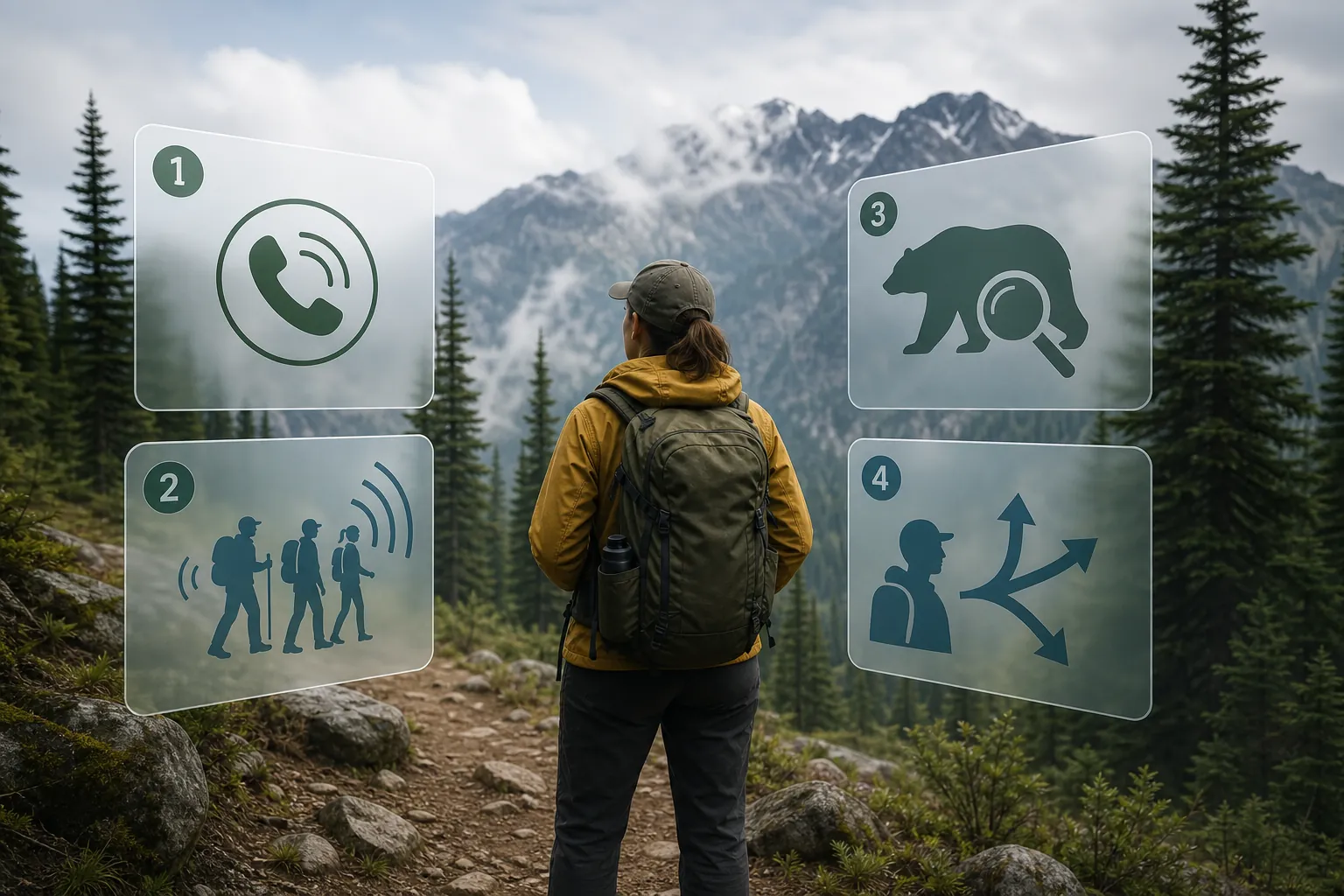
Use a four-phase protocol instead: prepare before the trail, avoid surprise on the trail, identify species and behavior during an encounter, then choose the response rule that fits. The most important rule to file correctly is this: playing dead applies to a defensive grizzly attack. Black bear attacks, and any predatory attack by any bear, require fighting back. The National Park Service separates those response rules by species and by attack type; mixing them up is the lesson’s biggest failure point.[1]
Panic does not need encouragement, so calibrate the risk first. The NPS gives the chance of being injured by a bear in Yellowstone as about 1 in 2.1 million visits, and describes bear attacks as rare.[2] BearVault’s compilation of fatal bear attacks in North America lists about 180 fatal attacks since 1784, averaging fewer than one per year, while also noting that fatality counts depend on how incidents are defined and compiled.[3] That is not permission to be casual. It is permission to stop rehearsing disaster scenes and start rehearsing the steps that prevent close-range surprise.
The Four Phases, Before Any Details
| Phase | The job | What you are trying to prevent |
|---|---|---|
| 1. Pre-hike intelligence | Call ahead, learn local bear activity, storage rules, dog rules, and spray expectations | Entering bear country with the wrong assumptions |
| 2. On-trail avoidance | Travel visibly and audibly, manage food scent, keep dogs controlled, avoid close surprise | Forcing a bear into a defensive decision |
| 3. Encounter triage | Slow down, identify species, read behavior, preserve distance | Applying the right rule to the wrong bear or wrong behavior |
| 4. Response | Use the species-and-behavior rule: back away, deploy spray, play dead, or fight back | Freezing while trying to remember every tip at once |
The order matters. If Phase 1 and Phase 2 are done well, Phase 4 may never be used. That is the goal. Bear encounter avoidance is not about winning a contest with a bear; it is about giving the bear no reason to resolve uncertainty at close range.
Phase 1: Do the Boring Work Before the Trailhead
The first bear safety decision happens before boots touch dirt: call or check with the land manager. Ask about current bear activity, recent closures, food-storage rules, carcasses near trails, cub sightings, campground requirements, dog restrictions, and whether bear spray is recommended or required locally. A general article cannot know what a ranger, state wildlife office, tribal land office, park bulletin, or forest district knows this week.
That local check also keeps the hiker from importing rules from the wrong place. Some areas require bear-resistant food storage; others allow hanging food only in specific ways; some backcountry sites provide lockers or poles. REI’s bear-country guidance emphasizes keeping food, trash, scented toiletries, and cooking gear secured and separated from sleeping areas, and following the storage method required for that land unit.[4]
Bear spray belongs in this phase, not as a vague comfort item but as a rehearsed tool. It should be EPA-registered, unexpired, and carried where a hand can reach it quickly, not buried in a pack. The NPS advises carrying bear spray in bear country and knowing how to use it before an encounter.[1] The Alaska Department of Fish and Game likewise treats bear spray as part of living and traveling in bear country, while stressing that prevention is still the first line of safety.[5]
Bear-spray effectiveness is often discussed more loudly than carefully. In an interview with The Trek, bear-conflict researcher Tom Smith described bear spray as preventing injury in 98 percent of cases and contrasted that with much poorer firearm outcomes; the same interview also relayed group-safety findings.[6] Those numbers are behavior-changing enough to matter, but they are still being used here through a secondary interview source. For a deeper look at the evidence rather than a gear argument, use the bear spray evidence review for hunters as the follow-up, not as a substitute for carrying and practicing with spray.
The other pre-hike decision is group structure. Solo hiking is not automatically reckless, but it gives less margin in bear country. Smith told The Trek there was no data of an attack on two people standing their ground and that groups of four or more are substantially safer.[6] Treat that as a strong planning signal: if the trail has active bear reports, hiking with others is not just social preference; it changes the problem a bear is evaluating.
Dogs need a decision before the hike, too. If the dog cannot be controlled, the safer choice may be leaving it home. BearVault’s review of more than 700 bear conflicts from 1955 to the present found that about half were preceded by identifiable human error, including unsecured food, off-leash dogs, approaching cubs, and recreating at dawn or dusk.[3] That does not mean every such choice causes an attack. It means those choices appear often enough in conflict histories that they deserve a place in the pre-hike checklist.
- Before leaving: check current bear activity, trail closures, carcass reports, cub reports, and food-storage rules.
- Before packing: put bear spray where it can be drawn fast, and practice removing the safety.
- Before choosing partners: prefer a group when local bear activity is elevated or terrain limits visibility.
- Before bringing a dog: confirm rules and be honest about leash control.
- Before setting camp: know the required food-storage method for that specific land unit.
Phase 2: Avoid Surprising the Bear You Never See
Most hikers imagine the visible bear. The more useful safety lesson starts with the unseen bear: behind brush, over a rise, near running water, feeding on berries, guarding a carcass, or moving with cubs. The NPS identifies sudden close encounters as a common setting for defensive bear behavior and warns hikers not to surprise bears.[1][2] That is why “make noise” is too vague as a standalone rule. The goal is not noise as decoration. The goal is useful human notice before distance collapses.
Useful noise is human, timely, and placed where visibility is poor. Talk with partners. Call out before blind corners, in dense vegetation, near streams, and when wind or water masks sound. Bear bells are not the main plan. In The Trek interview, Smith was bluntly skeptical of bear bells as a meaningful safety tool.[6] A bell may make the hiker feel prepared while doing little to solve the real problem: a bear understanding that people are approaching before they are close.
Distance is also a behavior, not just a measurement. If a bear is visible, do not move closer for a photo, do not block its path, and do not place yourself between a bear and cubs or food. The NPS tells visitors to stay at least 100 yards from bears in parks such as Yellowstone and to back away if a bear notices them.[1][2] Some places set their own rules, so local guidance still controls, but the principle is stable: your job is to give the bear an exit.
Food scent is part of avoidance because a food-conditioned bear is no longer solving the same problem as a bear that simply wants space. REI’s bear-country guidance separates eating, cooking, storage, and sleeping routines so that food odors and garbage do not lead bears into camp.[4] On day hikes, the same discipline applies at a smaller scale: snacks, wrappers, sunscreen, lip balm, and anything scented go back into controlled storage, not into side pockets left open during a break.
Time of day matters because animal movement and human visibility change. BearVault’s conflict review listed recreating at dawn or dusk among identifiable human errors found before some incidents.[3] That does not make every sunrise hike unsafe. It does mean that dawn, dusk, dense brush, loud water, solo travel, and off-leash dogs stack the lesson in the wrong direction.
A Simple Trail Habit
When the trail narrows, visibility drops, or sound is masked, do three things in order: close the spacing in your group, make clear human noise, and put a hand near bear spray without waving it around. That is not dramatics. It is rehearsal. The body remembers what it has practiced.
Phase 3: Triage the Encounter Before Choosing a Rule
If a bear is in view, the first job is not to win the species-ID quiz. The first job is to stop making the situation worse. Do not run. Do not scream. Pick up small children. Keep the group together. Speak calmly. Back away slowly if the bear is not approaching. The NPS gives those general encounter rules before the species-specific attack rules, which is exactly the right order.[1]
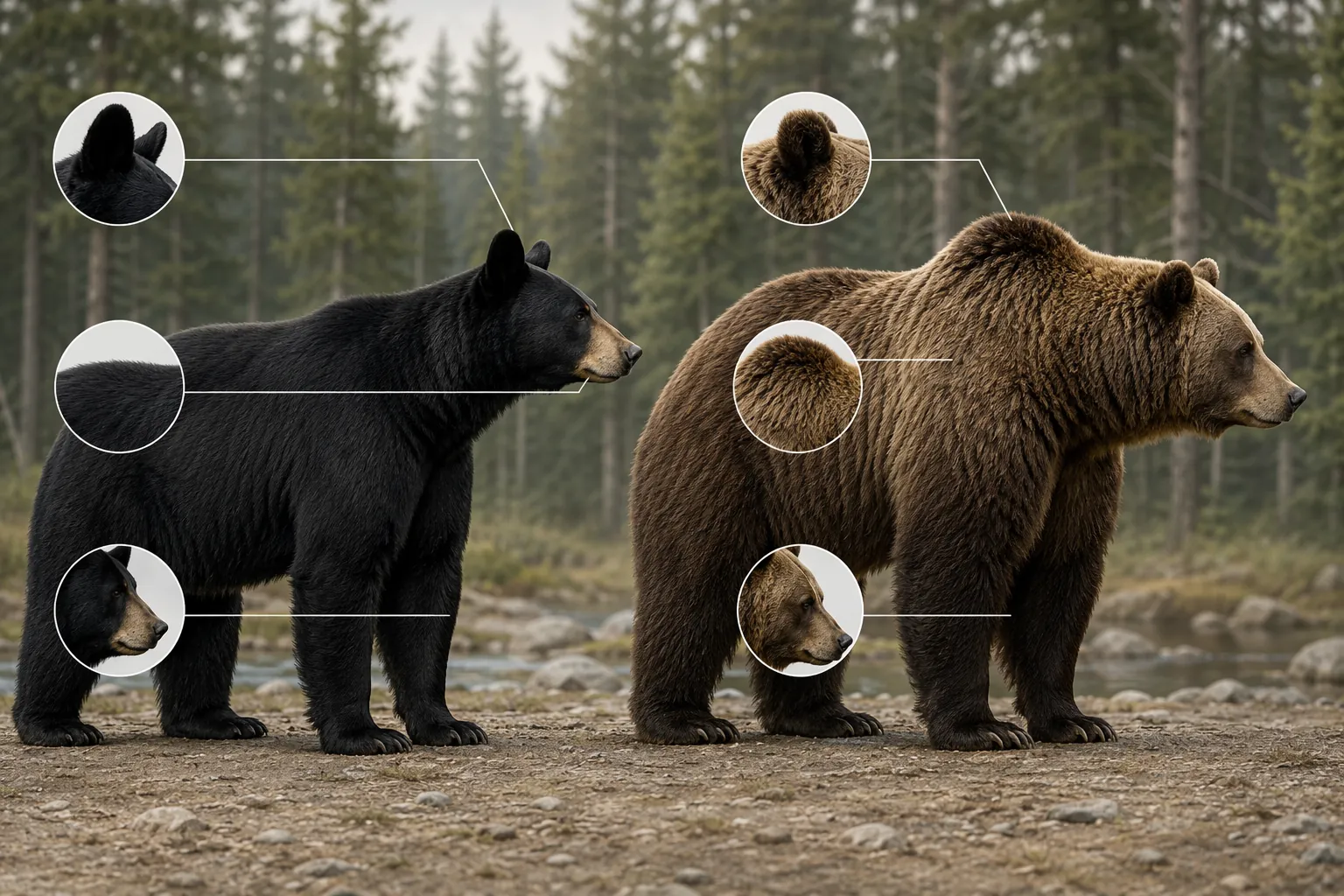
Then identify the bear using anatomy, not color. The NPS comparison is the cleanest field lesson: grizzly bears usually have a prominent shoulder hump, short rounded ears, a dished face profile, and long claws; black bears usually lack the shoulder hump, have taller more pointed ears, a straighter face profile, and shorter curved claws. Color alone is unreliable because black bears can be brown, cinnamon, or blond, and grizzlies vary too.[1]
| Cue | Grizzly bear | Black bear |
|---|---|---|
| Shoulders | Prominent shoulder hump | No prominent shoulder hump; rump may appear higher |
| Ears | Short and rounded | Taller and more pointed |
| Face | Dished profile | Straighter profile |
| Claws | Longer, often more visible | Shorter, more curved |
| Color | Variable, not enough by itself | Variable, not enough by itself |
Behavior is the second half of triage. BearWise describes defensive signs such as huffing, blowing, jaw popping, paw swatting, and short rushes, and the NPS notes that bears may bluff charge by running toward a person and veering away.[2][7] A defensive bear is often trying to make space around itself, cubs, or food. That can look terrifying, but the response problem is different from a bear that is quietly following, testing distance, or treating the person as possible prey.
A curious bear may approach without the same explosive defensive display. That does not make it safe. The hiker should still speak calmly, group up, prepare spray, and back away without running. A predatory approach is the category to take most seriously: the bear may appear focused, persistent, and interested in closing distance despite your attempts to leave. BearWise and NPS guidance both separate predatory behavior from defensive encounters because the response changes.[1][7]
This is where folk wisdom becomes dangerous. “Play dead” is memorable, but it is not a universal bear rule. “Fight back” is also memorable, and also not universal. The correct response depends on species and behavior. The hiker’s job in Phase 3 is to buy enough time and distance to choose the right branch.
Phase 4: Use the Smallest Correct Response Rule
The response phase should be short enough to retrieve. If you are still at distance, leave space. If the bear approaches, ready spray. If contact happens, the rule narrows by species and behavior.
| Situation | Response |
|---|---|
| Bear is unaware of you | Leave quietly. Do not approach for a look or photo. |
| Bear sees you but does not approach | Stay calm, speak in a low voice, group up, back away slowly. |
| Bear approaches or charges | Do not run. Stand your ground if necessary, prepare bear spray, and deploy it when the bear is within effective range according to the product instructions and local training. |
| Defensive grizzly attack with contact | Play dead: lie face down, keep your pack on, spread your legs for stability, and clasp your hands behind your neck. |
| Black bear attack | Fight back with everything available. Do not play dead. |
| Predatory attack by any bear | Fight back. A predatory bear is not merely asking for space. |
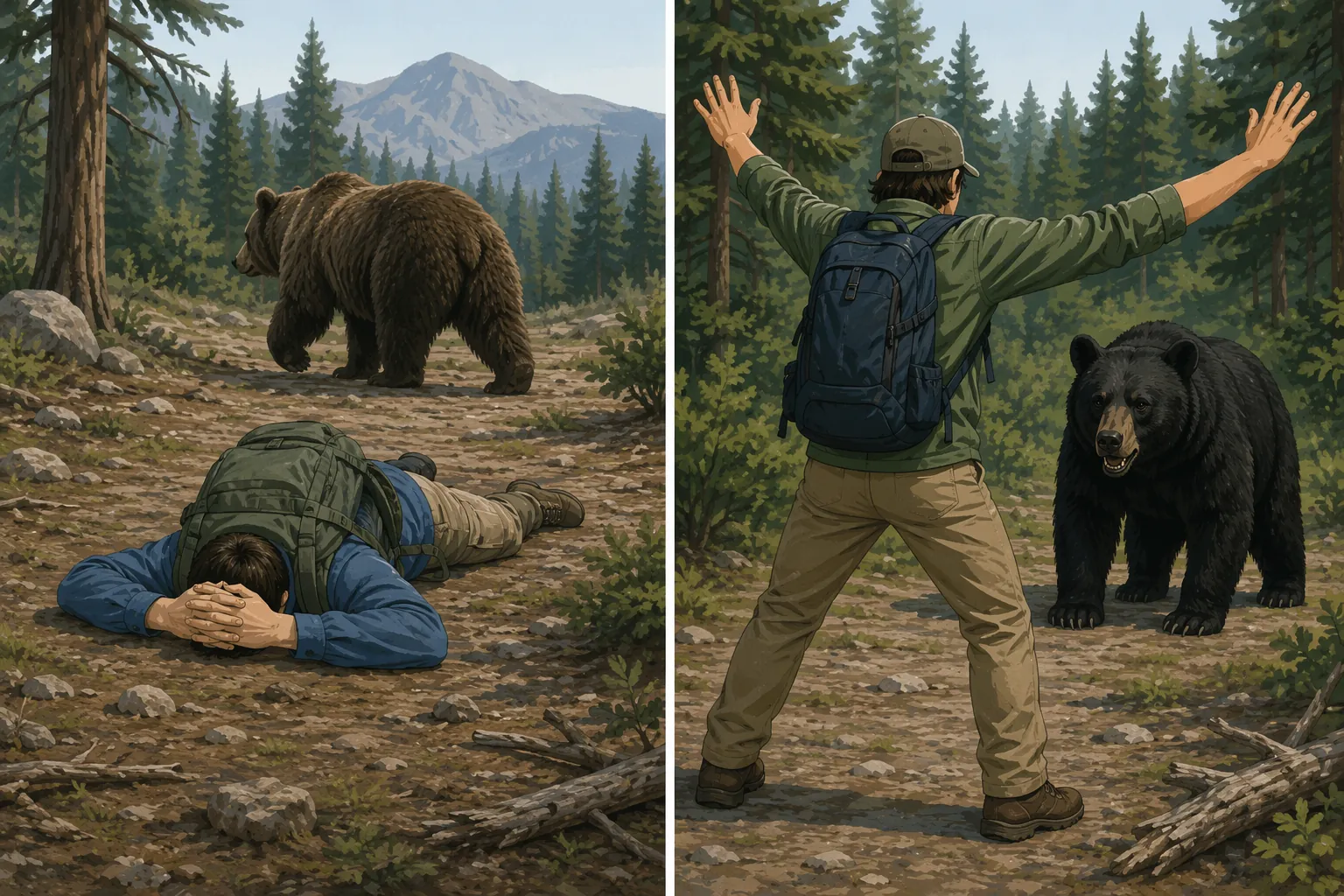
The NPS gives the grizzly-contact instruction plainly: if attacked by a brown or grizzly bear, leave your pack on and play dead by lying flat on your stomach with hands clasped behind your neck; if the attack persists, fight back.[1] The pack is not a random detail. In The Trek interview, Smith described bears as far more likely to bite the head and neck than other areas, making neck protection and keeping a pack on important defensive mechanics.[6]
For black bears, the NPS rule changes: do not play dead; try to escape to a secure place if possible, and if escape is impossible, fight back using any available object while concentrating blows on the bear’s face and muzzle.[1] The North American Bear Center argues that black bears are statistically much less dangerous than many people imagine, estimating about 750,000 black bears in North America and fewer than one human killed per year by black bears, but that less-alarming risk framing does not replace NPS and wildlife-agency response guidance during an actual attack.[8]
Bear spray fits before contact, not after the hiker is already on the ground. Carry it where it can be reached with either hand if possible, practice drawing it, and know the manufacturer’s range and spray duration. Do not let spray become a reason to approach, linger, or tolerate sloppy food storage. A tool that compensates for surprise should not be used to create surprise.
The Recall Version
Memorize the lesson as four verbs: check, announce, identify, respond.
- Check: call ahead, learn local bear activity, storage rules, dog rules, and carry reachable bear spray.
- Announce: hike in a group when possible, make clear human noise in low-visibility places, manage scent, and avoid dawn/dusk risk stacking.
- Identify: use anatomy first, then behavior; do not rely on color or one half-remembered cue.
- Respond: back away when you can, deploy spray before contact, play dead only for a defensive grizzly attack, and fight back against black bear attacks or any predatory attack.
For a field-ready version, keep the bear safety decision tree with your trip notes. If you like mnemonic practice, the companion lesson on bear encounter mnemonics turns the same protocol into memory cues. The purpose is not to collect more tips. It is to make the right rule easy to retrieve when the trail suddenly stops feeling theoretical.
References
- Bear Safety, National Park Service.
- Bear Attacks, National Park Service.
- Bear Attack Statistics, BearVault.
- Backpacking in Bear Country, REI.
- Living with Bears, Alaska Department of Fish and Game.
- One of the Foremost Experts in Human-Bear Conflict Explains Bear Safety, The Trek.
- Bear Encounters, BearWise.
- How Dangerous Are Black Bears?, North American Bear Center.
Related exhibits & inventory
Verified outcomes
No verified outcomes on file for this exam yet
See Methodology for how outcome evidence is disclosed once logged.
Planners
No planner filed for this exam yet
A downloadable timeline template for this exam hasn't been published yet.
Tool verdicts
AI-tool cautions
No AI tools tested for this exam yet
No hands-on AI-accuracy logs have been filed for this exam.
View the full BEAR-ENCOUNTER-AVOIDANCE-LESSON case dashboard
Questions about this plan
Ask a question about a specific section, timeline, or citation in this plan — or flag something that needs correcting.
Comments
Join the discussion with an anonymous comment.