
Method
What Bear Encounter Survival Rules Teach About Studying
The bear encounter rhyme works because it combines rhyme, rhythm, and imagery—but not all mnemonic techniques are equally effective for exam prep. This article explains which memory techniques have evidence backing and when to use them instead of relying on low-utility keyword mnemonics.
Evidence panel
- Evidence level
- Limited
- Primary citation
- Dunlosky et al. (2013) Strengthening the Student Toolbox: Study Strategies to Boost Learning. American Educator.
“If it’s brown, lie down; if it’s black, fight back” is useful here as a memory object, not as bear safety advice. The line belongs to the same family as wilderness survival mnemonics that stick because they rhyme, move quickly in the mouth, and paint a scene before you have time to overthink it.[1] That is also why students like mnemonics for exams: they feel fast. With a week left before the ASVAB, SAT, ACT, GRE, or MCAT, fast feels merciful.

The catch is that “I can recite it” and “I can use it under exam conditions” are not the same achievement. A bear encounter rhyme shows why mnemonics work at all: rhyme, rhythm, imagery, and compression reduce a messy situation into a compact cue. But exam prep has different memory problems. Some questions ask you to recognize a definition. Some ask you to reason through a passage. Some ask you to hold an ordered sequence in your head. A single catchy trick does not deserve the same trust across all of those jobs.
That distinction matters because the best-known evidence review for student study techniques gives keyword mnemonics a low-utility rating, while practice testing and distributed practice receive high-utility ratings.[2] That does not make mnemonics useless. It makes them specialized tools. The student who treats every chapter like a memory-palace project is wasting energy; the student who refuses mnemonics altogether is leaving easy points on the table.
Why the Bear Rhyme Sticks
The bear line is memorable before it is accurate enough to be trusted as a full field guide. “Brown” pairs with “lie down.” “Black” pairs with “fight back.” The color words are concrete. The actions are physical. The contrast arrives in one beat. That is almost everything a mnemonic wants: a cue, a rhythm, and a vivid response.
Outdoor mnemonics use the same machinery again and again. STOP turns getting lost into a sequence: Stop, Think, Observe, Plan. PASS turns fire-extinguisher use into Pull, Aim, Squeeze, Sweep. “Red on yellow kills a fellow” turns a snake-identification warning into rhyme and color contrast.[5] None of these phrases proves deep understanding. They create a retrieval handle.
That handle is valuable when the task is narrow. If you need to remember the order of compass directions, a phrase like “Never Eat Shredded Wheat” can do its job. If you need to solve a physics item, evaluate a reading passage, or apply biology to a new scenario, the handle may get you to the front door and then stop.
Match the Technique to the Exam Task
The useful question is not “Do mnemonics work?” It is “What kind of recall am I trying to produce?” A student memorizing ten GRE vocabulary roots is solving a different problem from a student reviewing MCAT metabolic pathways or practicing SAT reading inference questions. Use the wrong tool and the study session still feels productive, which is the dangerous part.
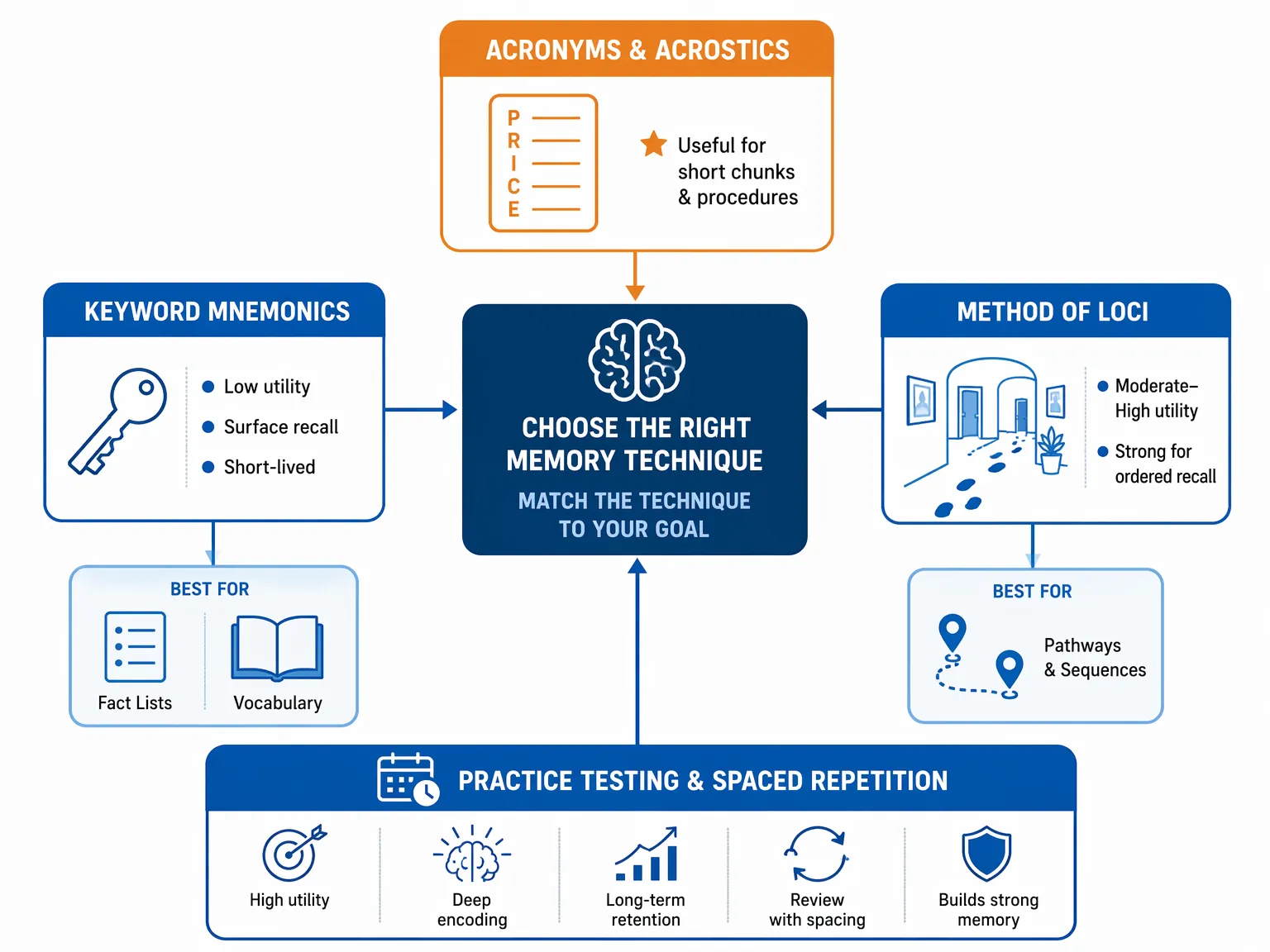
| Exam task | Best-fit technique | Evidence label | Use it for | Do not use it as |
|---|---|---|---|---|
| Definitions, vocabulary hooks, isolated facts | Keyword mnemonics | Limited | First-pass recall of terms, roots, formulas, and fact lists | Proof that you understand the concept |
| Ordered lists or sequences | Method of loci | Moderate to strong for ordered recall | Pathways, taxonomies, steps, grouped facts | A substitute for application practice |
| Short procedures or compact lists | Acronyms and acrostics | Moderate for narrow procedural recall | Multi-step routines, checklists, small content chunks | A complete study system |
| Durable exam readiness | Practice testing and distributed practice | High | Retrieval, timing, error correction, long-term retention | Something to save until the end |
Keyword Mnemonics: Good Hooks, Weak Foundations
A keyword mnemonic links unfamiliar material to a familiar cue. For a vocabulary word, you might connect the sound of the word to a vivid image, then connect that image to the meaning. The Learning Scientists describe mnemonic techniques as ways to connect new information with something easier to remember, often through imagery, organization, or verbal cues.[6]
For GRE vocabulary, that can help. If a word refuses to stick, a strange image may give it enough grip to survive the first few retrieval attempts. For ASVAB general science, a cue can help with a term that has no obvious meaning yet. For SAT or ACT grammar, a small phrase can remind you of a rule name.
But Dunlosky and colleagues rated the keyword mnemonic as low utility because its benefits are limited, often short-lived, and poorly suited to material that requires comprehension rather than simple association.[2] That is the line students most need to hear before they spend three hours inventing elaborate images for terms they have never practiced using.
Use keyword mnemonics when the exam demand is surface recall: “What does this word mean?” “Which term matches this definition?” “What is the name of this structure?” Then immediately make the cue earn its keep. Cover the answer. Retrieve it. Use the word in a sentence. Sort it against similar terms. If the mnemonic cannot survive a practice question, it was decoration.
Method of Loci: Better When Order Matters
The method of loci, often called a memory palace, asks you to place items along a familiar route. You might put one concept at the front door, the next on the stairs, the next at the kitchen table, and so on. The point is not theatrical cleverness. The point is structure. A route gives memory a stable order.
A 2021 meta-analysis by Twomey and Kroneisen found moderate-to-large effects for the method of loci on recall, especially for ordered lists.[3] That is exactly the kind of task where many exam students need help: stages in a biological pathway, grouped anatomy terms, historical sequences, formulas arranged by use case, or ASVAB science facts that keep blending together.
For MCAT prep, a loci route can hold the broad order of a pathway before practice questions force you to explain what changes at each step. For GRE prep, it can group vocabulary by tone or root family. For ASVAB review, it can place a short chain of mechanical or general science facts in a predictable sequence. The route is a filing system, not the final exam.
The method becomes wasteful when students build palaces for material that should be practiced directly. If an ACT reading question asks why an author included a detail, no hallway image will replace slow work with evidence, choices, and elimination. If an MCAT passage asks you to apply a principle to new data, a route may retrieve the principle, but the application still has to be trained.
Acronyms and Acrostics: Cheap Enough to Use, Small Enough to Contain
Acronyms and acrostics are the workhorses of mnemonic studying because they are quick. They do not require a full visual route. They compress a short sequence into initials or a sentence. OpenTextBC’s student success materials describe acronyms, acrostics, and loci as practical memory techniques for organizing information that would otherwise be harder to retrieve.[7]
There is also experimental support for narrow procedural use. A 2019 Frontiers study found that mnemonic acronyms improved recall of a procedural task and helped performance remain more resilient when interruptions occurred.[4] That is not a license to acronym your entire textbook. It is a reason to use acronyms for short, ordered routines where forgetting one step causes the rest to wobble.
For exam prep, that means formulas with a sequence of operations, lab procedures, mechanical-comprehension checks, grammar-editing routines, and short classification lists. If the acronym gets long enough that you need another mnemonic to remember it, the chunk is too large. Break it apart or switch to practice questions.
Where Practice Testing and Spaced Repetition Take Over
Practice testing is not just “checking what you know.” It is retrieval practice. It makes the brain produce an answer without looking, which is much closer to test day than rereading or admiring a clever mnemonic. Distributed practice, often called spaced repetition in everyday study language, spreads that retrieval across time instead of cramming it into one sitting. Dunlosky and colleagues rated both practice testing and distributed practice as high utility across learning conditions.[2]
This is where many students fool themselves. A mnemonic can make recognition feel smooth. Practice questions reveal whether retrieval is strong, whether the cue points to the right answer, and whether the idea transfers into a new format. If you can remember a biology term only when your invented image appears first, you have a fragile cue. If you can answer it after a delay, inside a passage, with tempting wrong choices nearby, you have something closer to readiness.
A sound study plan can still include mnemonics. Put them near the front of the cycle, where they help raw material become retrievable. Then move quickly into the cycle that actually changes exam performance: retrieve, check, correct, wait, retrieve again. The mnemonic opens the file. Practice testing proves whether the file is usable.
Exam Examples Without Turning Everything Into a Trick
For GRE vocabulary, use keyword mnemonics sparingly on stubborn words, then test them in mixed decks and sentence contexts. A word learned only through a funny image may fail when the answer choices include near-synonyms. The follow-up is comparison: how is this word different from the one beside it?
For MCAT content, use loci for ordered recall when the order itself matters. A route can hold a pathway, a hierarchy, or a sequence of organ-system facts. Then close the route and answer application questions. The MCAT rewards retrieval plus reasoning, not decorative storage.
For ASVAB review, acronyms can help with compact procedures and general science lists. They are especially useful when a missed step changes the answer. But mechanical comprehension still needs diagrams, force relationships, and practice items. A phrase can remind you what to check; it cannot do the checking.
For SAT and ACT prep, mnemonics belong mostly around grammar rules, math facts, and repeatable routines. They are much less useful for reading passages, where the work is evidence tracking, tone, inference, and trap-answer control. If a student wants a mnemonic for every reading question type, what they probably need is more timed passage review.
A Practical Verdict
Use mnemonics when the material is rote, verbal, ordered, or procedural. Use keyword mnemonics for terms and definitions, with a limited evidence label. Use the method of loci when order is part of the task, with a stronger evidence label for ordered recall. Use acronyms and acrostics when a short chunk needs to survive pressure or interruption. Psych Central and Art of Memory both catalog many mnemonic types, but the catalog is less important than the match between technique and task.[8][9]
Then build the real study plan around practice testing and spaced repetition. That is the backbone for GRE, MCAT, ASVAB, SAT, and ACT prep because it forces recall, exposes errors, and returns to material after enough time has passed for forgetting to matter. The bear encounter rhyme is a good doorway into memory science. It is not the house.
References
- 9 Lifesaving Mnemonics Every Man Should Know, Art of Manliness
- Strengthening the Student Toolbox, American Educator, Fall 2013
- The effects of the method of loci on recall: A meta-analysis, PubMed, 2021
- Mnemonic Acronyms: Improving Procedural Task Recall and Resilience to Interruptions, PMC, 2019
- Mnemonic Phrases for Outdoor Survival, Woodland Woman
- Mnemonic Techniques, The Learning Scientists, 2022
- Memory Techniques, OpenTextBC
- Mnemonic Devices: Types, Examples, and Benefits, Psych Central
- 36 Best Memory Techniques for Studying, Art of Memory
Comments
Join the discussion with an anonymous comment.