
Comparison
The Countries with the Most World Cup Titles, Ranked
This data study ranks the eight countries that have won the FIFA World Cup, from Brazil's five titles to England and Spain's single victories. It also reveals that all champions come from just two continents, making the winners' list one of the most exclusive in sports.
Verdict panel
- Compared
- not specified
- Target exam
- not specified
- Best for
- not specified
- Pricing last reviewed
- pricing currency unconfirmed
The FIFA World Cup winners list is much shorter than the tournament feels. Across 23 tournaments from 1930 through 2026, only eight countries have won the men’s World Cup, even though 84 nations have competed in the tournament’s history.[1][2] For a study set, that is the first fact to lock in: the champion pool is small, geographically concentrated, and easy to rank if Germany/West Germany and Uruguay’s jersey stars are handled carefully.
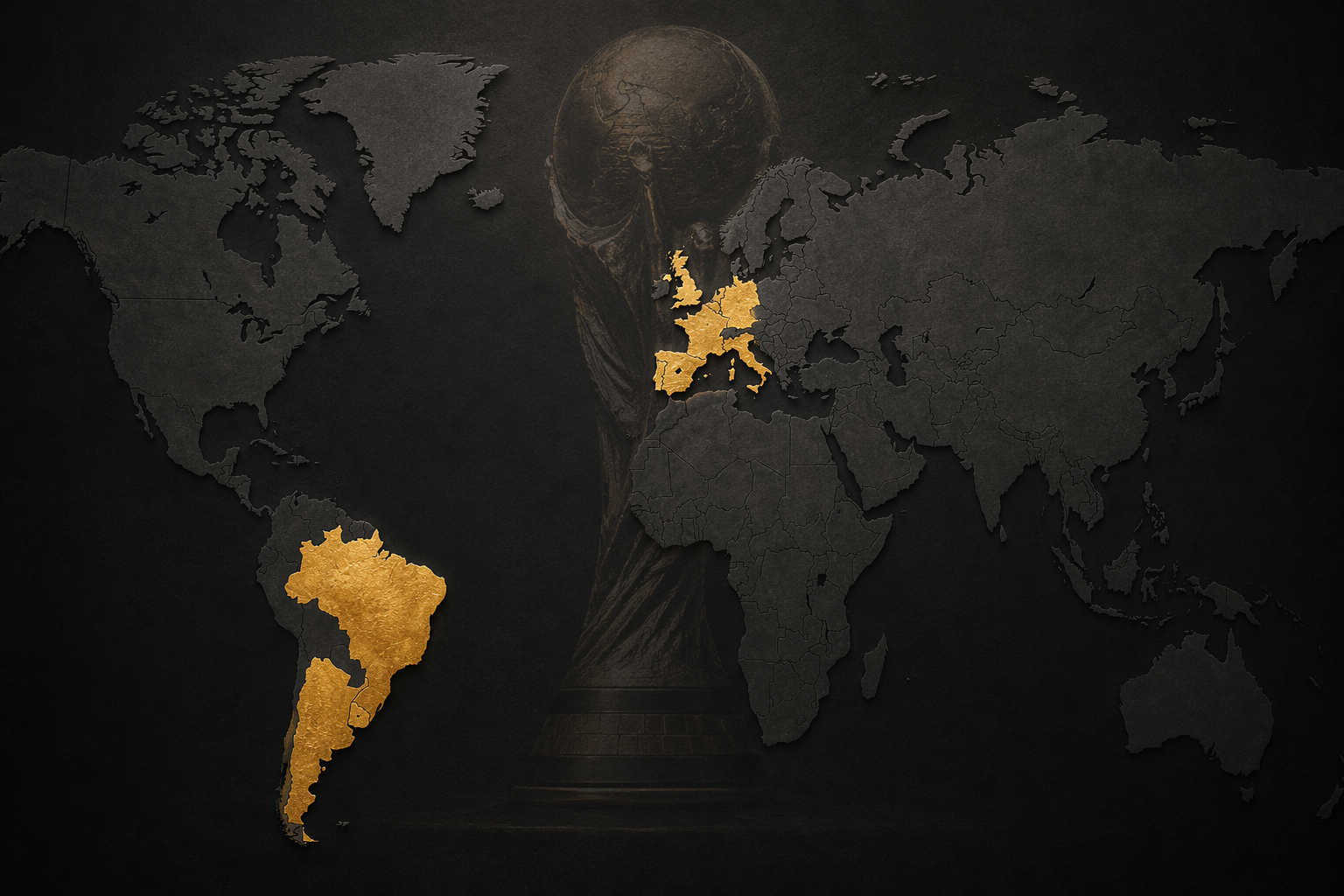
World Cup Titles by Country, Ranked
Brazil remains first with five titles. Germany and Italy follow with four each, Argentina has three, France and Uruguay have two each, and England and Spain sit at one apiece in the ranked title table used by Visual Capitalist and Olympics.com.[1][2]
| Rank | Country | World Cup titles | Continent | First title | Most recent title | Study note |
|---|---|---|---|---|---|---|
| 1 | Brazil | 5 | South America | 1958 | 2002 | The only country in this set with five titles. |
| 2 | Germany | 4 | Europe | 1954 | 2014 | Three titles were won as West Germany: 1954, 1974, and 1990. |
| 2 | Italy | 4 | Europe | 1934 | 2006 | Tied with Germany on total titles. |
| 4 | Argentina | 3 | South America | 1978 | 2022 | The most recent South American champion in the source set. |
| 5 | France | 2 | Europe | 1998 | 2018 | One of three European countries with multiple titles. |
| 5 | Uruguay | 2 | South America | 1930 | 1950 | Its shirt has four stars, but only two are World Cup titles. |
| 7 | England | 1 | Europe | 1966 | 1966 | A single-title champion with the longest wait among past winners. |
| 7 | Spain | 1 | Europe | 2026 | 2026 | Listed here with the 2026 title result supplied by Olympics.com. |
The ranking is compact enough to memorize, but the notes matter. Germany’s four titles are usually counted together under Germany, although the first three belonged to West Germany before reunification. Uruguay is the other common trap: the national team displays four stars because FIFA recognizes its 1924 and 1928 Olympic football titles alongside its 1930 and 1950 World Cup wins, but its World Cup title count is still two.[2]
Spain also needs a date note in this 2026 version of the list. Olympics.com’s winners list identifies Spain as the 2026 champion, while the ranked-count frame still places Spain among the one-title countries.[2] For a flashcard, the clean answer is “Spain — 1 — Europe — 2026” unless an instructor or data source asks for a different cutoff date.
The Champion Map Is Smaller Than the Tournament Map
The sharper pattern is continental. Europe has five champion nations: Germany, Italy, France, England, and Spain. South America has three: Brazil, Argentina, and Uruguay. No country from Africa, Asia, North America, or Oceania has won the men’s World Cup in the source set.[1][2]
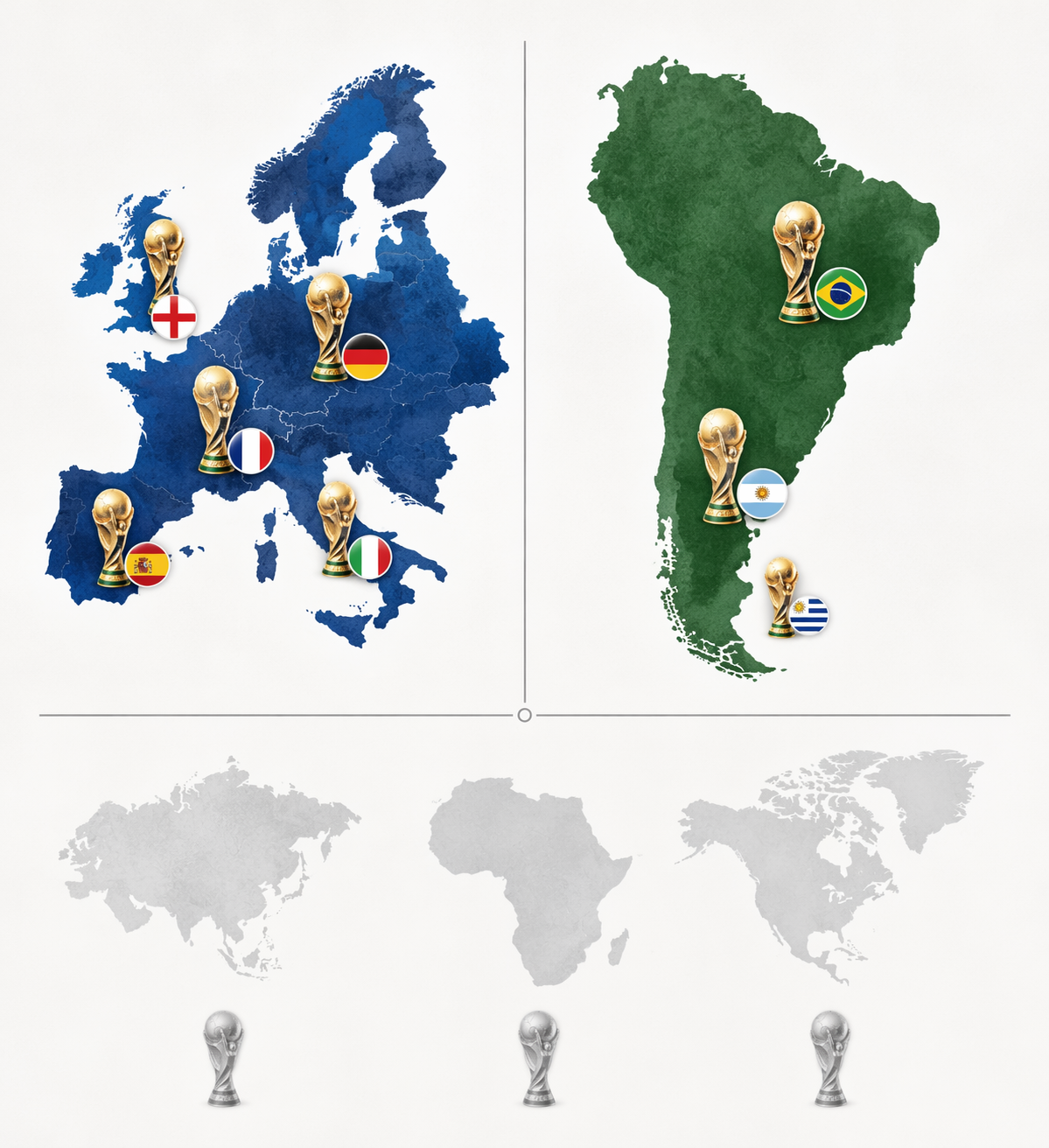
That is why the list works better as a geography-and-history memory map than as a loose sports trivia answer. The tournament has invited a wide field of national teams over time, but the winner column narrows to two regions. In the ranked data set, Europe accounts for five of the eight champion countries and 13 titles, while South America accounts for three champion countries and 9 titles.[1][2]
| Continent | Champion countries | Title total in the ranked data set | Countries |
|---|---|---|---|
| Europe | 5 | 13 | Germany, Italy, France, England, Spain |
| South America | 3 | 9 | Brazil, Argentina, Uruguay |
| All other continents | 0 | 0 | No World Cup-winning country in this source set |
The contrast is useful because it prevents overstudying. A student does not need to memorize a long global spread of champions. The correct map has two clusters: a European cluster with more countries, and a South American cluster with fewer countries but the single leader, Brazil.
Country Notes Worth Remembering
Brazil is the anchor fact: five titles, all alone at the top. It is also the easiest country to use as a starting card because no other nation shares its title count.[1]
Germany and Italy form the first tie. Both have four titles, but Germany’s record carries the West Germany caveat, while Italy’s four are usually read without that political-name complication.[2]
Argentina is the middle of the ranking at three titles. Its place matters because it keeps South America from being “Brazil plus early Uruguay” in a student’s memory map; the continent has three champion nations, not one dominant nation and a footnote.[1][2]
France and Uruguay share the two-title line for very different memory reasons. France is the modern European two-title country in the table. Uruguay is historically early and easy to misread if a learner uses jersey stars instead of World Cup titles as the counting rule.[2]
England and Spain close the list at one title each. England’s single win came in 1966, and Bolavip’s drought framing treats England as still waiting longer than any other past champion for another title.[4] Spain’s listing here uses the 2026 result in Olympics.com’s winners list.[2]
A Few Source Caveats Before You Turn This into Flashcards
Title counts are more stable than all-time performance statistics. Britannica’s records page is useful for broader measures such as matches played, goals scored, and win rates, but those figures can vary slightly across reference sites depending on cutoff date and whether a source has fully incorporated the latest tournament.[3]
For this article, the safest split is simple: use Visual Capitalist and Olympics.com for the ranked champion list and year-by-year winners, and use Britannica when checking broader all-time records.[1][2][3] Avoid mixing jersey symbolism, political-name changes, and all-time match statistics into the title-count column.
| Possible confusion | Correct study rule |
|---|---|
| Germany vs. West Germany | Count Germany’s four titles together, but remember that 1954, 1974, and 1990 were West Germany. |
| Uruguay’s four stars | Count only two World Cup titles: 1930 and 1950. |
| Spain’s 2026 title | Use the 2026 winners list supplied in the current source set. |
| All-time stats | Do not expect every site to match exactly if cutoff dates differ. |
How to Study the Ranking
The whole list can become a small spaced-repetition deck. One card can ask for the country from the title count: “5 World Cup titles.” Another can reverse it: “Brazil — how many titles?” A third can use geography: “Which continents have produced World Cup-winning countries?”
- Start with the title ladder: 5, 4, 4, 3, 2, 2, 1, 1.
- Attach countries to the ladder: Brazil; Germany and Italy; Argentina; France and Uruguay; England and Spain.
- Add the continent tag after the count is stable.
- Save caveats for final cards: West Germany, Uruguay’s stars, and Spain 2026.
If you already use flashcards for vocabulary or language study, the same method fits this ranking. A guide to choosing a flashcard app can help you decide where to build the deck, and a comparison of true adaptive SRS tools is useful if you want the app to resurface the countries you miss most often.
The essential memory target is small: eight countries, two continents, and one clear leader. Once those are automatic, the extra notes stop being traps and become the details that make the ranking reliable.
References
- Ranked: Countries With the Most World Cup Titles, Visual Capitalist.
- Most FIFA World Cup wins, Olympics.com; FIFA World Cup winners list, Olympics.com.
- FIFA World Cup Records, Britannica.
- England still waiting: What's the longest drought among World Cup-winning nations?, Bolavip.
Back to the exam this applies to
Target exam not specified — see all exam hubs.
Comments
Join the discussion with an anonymous comment.