
AI Study Tool
How Trump AI Cuts Affect College Research and Your Grad Plans
Tool: AI research
Trump's AI research funding cuts are reducing PhD slots, eliminating lab positions, and accelerating a brain drain. This article explains what test-takers should do to adapt their grad school and career plans.
Warning panel
- Verified against official source
- No
- Last reviewed
As of Q3 2026, the practical answer to how Trump AI cuts affect college research is already visible in graduate planning: fewer funded PhD seats, weaker certainty around research assistant positions, and a less predictable path from strong test scores to a supported lab placement. The point is not that every STEM program is closed, or that every AI-adjacent lab is losing money. The point is that the federal research machinery universities use to admit, fund, and train graduate students is being compressed while applicants are still making school lists as if the old odds apply.
The student-facing signals are not subtle. NSF grant success rates have been estimated to fall from about 26% to roughly 7% under the budget trajectory analyzed by Brookings, and more than 1,600 NSF grants worth over $1 billion have been terminated, according to the Brennan Center’s aggregation of the current funding record.[1][2] MIT and Duke cut biology PhD admissions by 20% in 2025, and 55 AAUDE member universities reported 15% fewer funded PhD slots in 2026.[1][3] For a GRE or MCAT test-taker, that translates into a colder admissions season: the same profile may now be competing for a smaller number of guaranteed seats.
The Funding Squeeze Reaches Applicants Before It Reaches Headlines
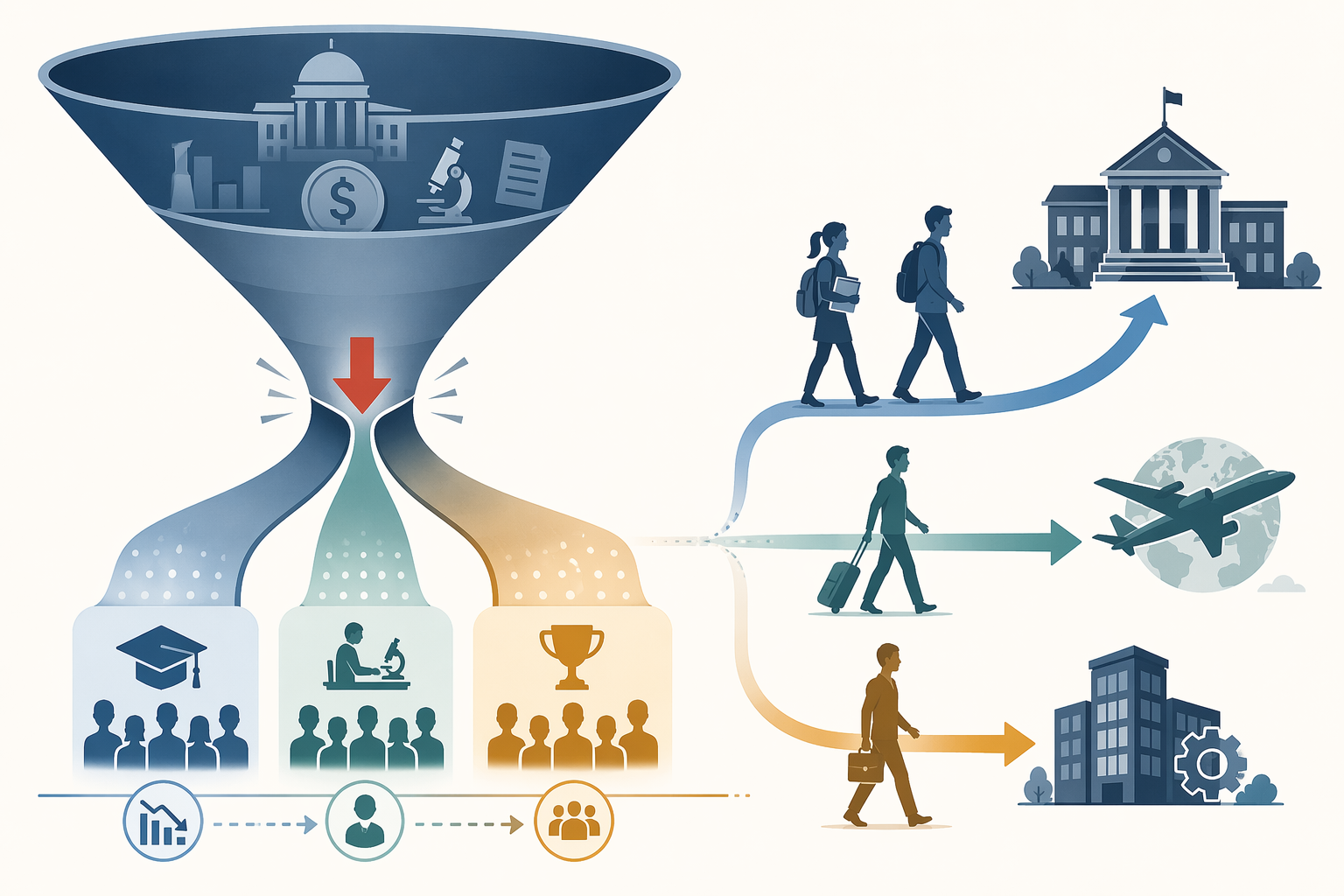
Graduate applicants usually feel a federal research cut only after it has passed through several layers: an agency budget, a grant competition, a principal investigator’s lab budget, a department’s admissions target, and finally a funding letter. By the time an applicant hears “we are taking a smaller cohort this year,” the decision may already have traveled through months of grant uncertainty.
That is why the grant success rate matters more than the press language around priorities. A professor who would normally admit a PhD student on an expected NSF renewal may wait. A department that cannot count on enough research assistant lines may reduce its cohort. A first-year student who expected to rotate into a grant-funded lab may find that the lab is conserving money for existing personnel. These are not abstract “innovation” losses; they are seat counts, stipend lines, summer funding decisions, and mentoring capacity.
The narrower admissions impact is already covered in StudyMethod’s grant-freeze PhD slots analysis. The larger issue here is that the admissions squeeze is only one layer of a broader research realignment: terminations, proposed agency cuts, indirect-cost pressure, reviewer losses, and a scientific workforce that is starting to move or advise students differently.
The AI Label Does Not Protect the Whole Training System
The administration has framed parts of the federal research shift around AI priority. That framing can be misleading for students if it sounds like a broad upgrade to the STEM pipeline. Brookings notes that some NSF computer science and AI-related categories may receive protection or small gains, but those gains are minimal when adjusted for inflation and are overwhelmed by broader cuts and pressure on university research infrastructure.[2]
The budget scale explains why. The NSF budget path discussed in the current analyses would move from about $9 billion to about $4 billion, a cut of roughly 55%, while NIH faces a proposed reduction from $47 billion to $27 billion, about 40%.[1][5] Those NIH numbers are proposals, not final enacted appropriations as of this writing, and Congress has rejected parts of the administration’s requested cuts in some areas. But proposed cuts still change behavior before they become final law: universities delay hiring, departments admit conservatively, and faculty avoid promising support they may not be able to renew.
Terminated grants are less theoretical. The Brennan Center reports more than 1,600 NSF grant terminations and 2,500 NIH grant cuts; the NIH cuts affected more than 74,000 clinical trial patients, citing JAMA Internal Medicine.[1] For students, terminated grants can remove the money that pays graduate researchers, technicians, data collection, summer salary, or the shared lab operations that make a training environment functional.
| Funding Signal | What It Means For Applicants |
|---|---|
| NSF budget path from about $9B to about $4B | Departments and labs become more cautious about admitting students who need multi-year support |
| Estimated NSF grant success rate falling from about 26% to about 7% | Faculty have fewer predictable grant wins to support new RA lines |
| More than 1,600 NSF grants terminated | Existing projects may lose the funds that would have supported rotations, assistantships, or lab jobs |
| NIH proposed reduction from $47B to $27B | Biomedical programs may reduce cohort size or avoid unfunded admissions offers |
| 55 AAUDE universities reporting 15% fewer funded PhD slots | A stronger applicant pool competes for fewer guaranteed seats |
How A Federal Cut Becomes A Smaller PhD Cohort
A funded PhD offer is not just an admissions decision. It is a financial promise. In many STEM fields, that promise is assembled from teaching assistantships, research assistantships, training grants, fellowships, and department reserves. When federal grant odds fall, a department may still want the same number of students, but wanting is not the same as being able to guarantee five or six years of support.
This is where applicants should be careful with program language. “We remain committed to graduate training” is not the same as “we can guarantee support through year five.” “AI is a university priority” is not the same as “your intended adviser has an active grant with enough RA money for a new student.” A department can be institutionally enthusiastic and financially constrained at the same time.
Campus-level cases can make this easier to see. StudyMethod’s UC Berkeley grant-freeze application analysis tracks how applicants have to read local funding signals rather than rely only on a university’s brand. That habit matters more in 2026 because national priority language and campus-level funding reality may point in different directions.
The admissions result is not uniform. A computational biology lab with protected funding may still recruit. A small experimental program dependent on NIH renewals may pause. A department with strong endowment support may hold its cohort steady while a peer program reduces admits. Applicants should not treat “STEM” as one market. They should treat each program as a funding ecosystem with its own exposure to NSF, NIH, institutional bridge funding, and faculty grant timing.
Research Assistant Jobs Are The First Warning Light
For undergraduates, the first consequence may not be a rejected PhD application. It may be the missing paid lab job that would have produced a senior thesis, a recommendation letter, or a stronger graduate school file. When grants disappear or renewals become less likely, faculty often protect current graduate students first. That leaves fewer openings for undergraduates, postbacs, technicians, and new rotation students.
That matters for test-takers because exams rarely stand alone in STEM admissions. A strong GRE, MCAT, SAT, or ACT score can keep options open, but research programs still look for evidence that a student understands lab work, persistence, and the methods of the field. If paid research opportunities shrink, students with unpaid flexibility, family support, or access to well-funded campuses may pull further ahead. The funding squeeze can become a pipeline squeeze.
That pipeline problem overlaps with other access pressures, including the changes discussed in StudyMethod’s DEI funding and test prep access article. The common thread is not simply politics. It is that fewer funded supports make it harder for students without private cushions to keep building competitive academic records.
Reviewer Cuts And Grant Terminations Also Weaken Mentoring Capacity
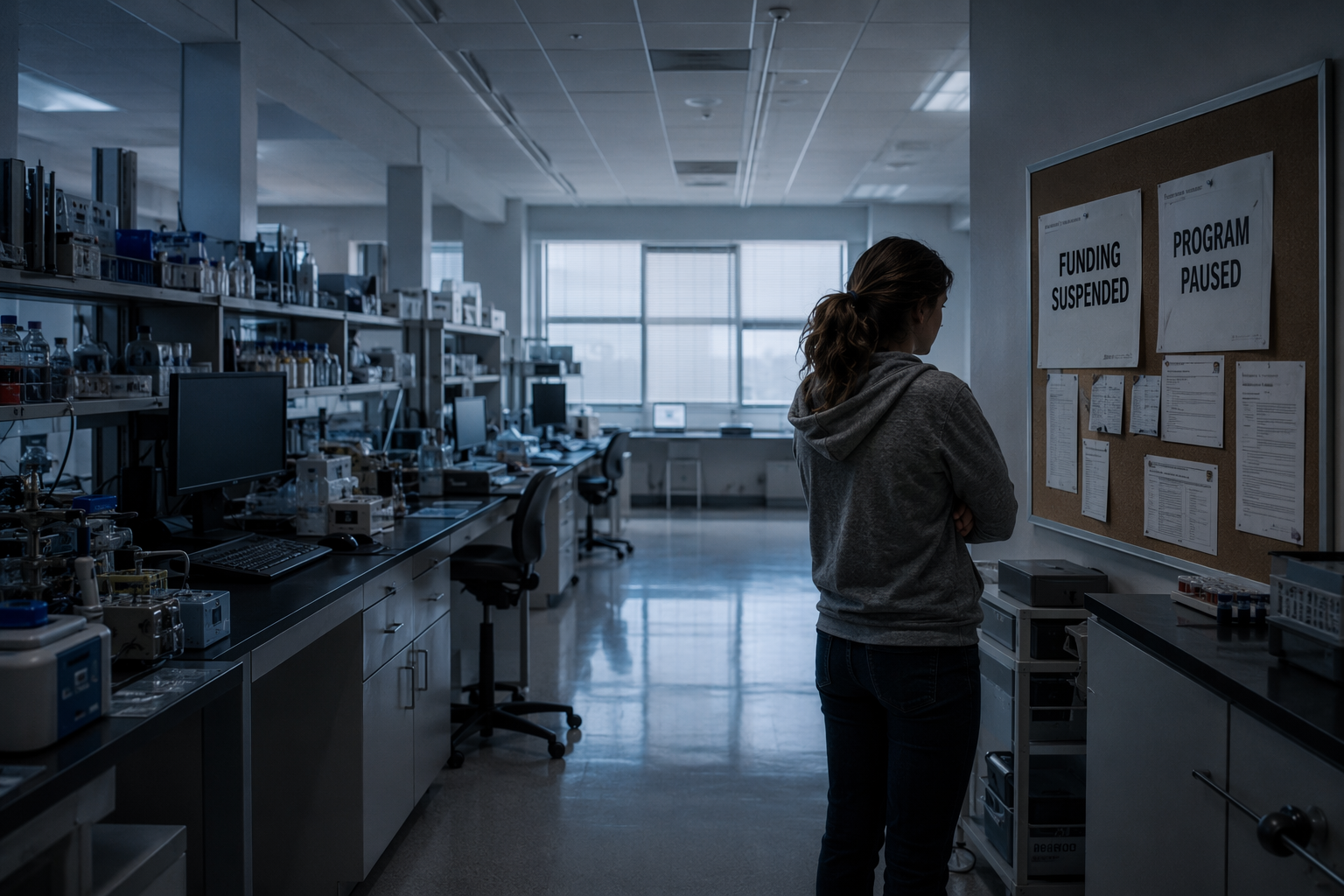
The damage is not limited to the size of agency budgets. Columbia SPS reported that NSF academic research reviewers were cut from 368 to 70 and that the agency’s science advisory board was fired; GovTech also described university researchers’ alarm over the plan to slash NSF funding by 55%.[4][5] Those details matter because research funding depends on review capacity. Fewer reviewers and disrupted advisory structures can slow decisions, reduce field expertise, and make it harder for faculty to plan hiring and student support.
An applicant may never see that administrative layer. They only see a professor who replies, “I may not be taking students this year,” or a program that says funding decisions will come later. But those replies often come from the same uncertainty: grant review timelines, renewal risk, and a department’s reluctance to over-admit when federal support is unstable.
The Brain Drain Changes The Career Calculation
The most important career signal is not just that students are competing for fewer seats. It is that some scientists already inside the system are changing their own plans. The Brennan Center cites reports that American scientists submitted 32% more applications for jobs abroad in 2025, and that 85 rising and established U.S. scientists moved to China in the past year, including a Princeton nuclear physicist and an NIH neurobiologist.[1] Those figures come from specific journalistic accounts and should not be read as a complete census of every field. They are still serious enough to affect how students should think about long-term stability.
A lab loses more than a name when a senior scientist leaves. It can lose a mentor, a grant-writing engine, a review network, a source of postdoc placements, and a reason students chose that university in the first place. A department can keep its catalog copy online long after a research group has stopped recruiting or shifted its work elsewhere.
The advising climate is also shifting. AAU reported that two-thirds of surveyed research scientists in Massachusetts were advising promising students to avoid academic careers, based on a local survey.[3] That does not mean every student should avoid a PhD. It does mean applicants should distinguish between wanting to do research and assuming the U.S. academic track is the default safest container for that research.
The long-run costs are not limited to individual careers. The Brennan Center cites Congressional Budget Office analysis that a 10% NIH funding reduction would mean 30 fewer drugs over 30 years, and notes that NIH provided foundational funding for 354 of 356 FDA-approved drugs between 2010 and 2019.[1] That is the part of the funding debate that applicants sometimes underestimate: today’s training cuts become tomorrow’s smaller research workforce.
What Test-Takers Should Change Before Applications Go Out
The right response is not to panic-submit applications to every recognizable program. It is to make the application list more funding-aware. In a stable cycle, a student might sort programs by ranking, adviser fit, geography, and test score range. In 2026, funding transparency needs to move up the list.
- Apply to a wider set of programs than you would have in a normal funding year, including departments that clearly state multi-year support policies.
- Ask whether admitted students are guaranteed support, for how many years, and through which mix of TA, RA, fellowship, or training-grant funding.
- Ask potential advisers whether they are taking new students, whether their current grants support new RA lines, and whether they expect funding changes to affect rotations.
- Treat “AI priority” language as a starting point for verification, not as proof that a lab or department has protected money.
- Keep at least one non-PhD route alive if your field has viable industry, clinical, government, postbac, or international research alternatives.
The questions can be direct without being rude. A concise email to a program coordinator can ask whether the department expects to reduce funded admissions this cycle. A message to a prospective adviser can ask whether they anticipate accepting rotation students and whether RA funding is available beyond the first year. Students do not need confidential budget data; they need enough signal to avoid building an application strategy around a lab that cannot fund them.
Exam timelines also deserve less casual treatment. When funded seats contract, committees have less room to take risks. A stronger GRE score will not create a grant-funded seat where none exists, and many programs weigh research fit more heavily than test scores. But a weak or late score can remove optionality when applicants need more programs, more deadlines, and more backup routes. The broader financing pressure also connects to the student debt risks discussed in StudyMethod’s 2026 student loan default and GRE planning article.
How To Read An AI-Focused Program Claim
A program advertising AI, machine learning, computational biology, robotics, or data science may still be a good target. The mistake is assuming that the label itself answers the funding question. Applicants should look one level lower: active grants, adviser capacity, recent student placements, rotation structure, and whether the department admits students centrally or into individual labs.
If a university says AI is a priority but the intended lab depends on a terminated or uncertain NIH project, the applicant’s risk remains high. If a less famous program can name guaranteed support years, active assistantship structures, and faculty actually recruiting in the student’s area, it may be the more rational application choice. Prestige matters less when the funding letter is vague.
International Applicants Need A Separate Risk Check
International STEM applicants face the same lab-funding uncertainty plus visa and post-degree planning risk. A department that can fund a domestic student through a teaching line may have different constraints for an international student, and a student considering U.S. doctoral training may also be comparing offers abroad in a labor market where U.S.-trained scientists are themselves applying internationally at higher rates.
That does not make the U.S. a bad choice by default. It does mean international applicants should coordinate admissions strategy with immigration timing, especially if the plan depends on optional practical training, later employment sponsorship, or a research-based immigration category. StudyMethod’s 2026 Visa Bulletin and GRE timeline guide and EB-2 NIW guide for international students are better places to work through that immigration-specific layer.
A More Durable STEM Plan In 2026
A durable plan now has more than one track. For a PhD-bound student, that may mean applying to research programs, funded master’s or postbac options where appropriate, and industry research assistant roles. For a premed or biomedical student, it may mean comparing PhD, MD, MD-PhD, clinical research, and gap-year lab options with more attention to who is actually paying. For a computational student, it may mean checking whether the attractive AI language is backed by grants, institutional fellowships, or employer demand outside academia.
The application list should include ambition, but it should not be built only around labs that are famous, federal-grant dependent, and vague about support. Add programs that answer funding questions clearly. Add advisers who are actively recruiting. Add at least one path that still works if a top-choice lab pauses admissions after applications are submitted.
Students should not abandon STEM solely because the funding climate is unstable. Ambitious research still needs talented people, and some AI-adjacent or computational areas will remain strong. But 2026 is not a year for treating research careers as a single-track calendar where a good score, strong grades, and enthusiasm automatically lead to a funded lab seat. The safer move is to prepare like the funding letter matters as much as the admission letter, because for most STEM students, it does.
References
- The Cost of the Trump Administration's Attacks on Research Funding, Brennan Center
- Attacks on research and development could hamper technological innovation, Brookings
- Federal Research Cuts Threaten U.S. Innovation and Leadership, AAU
- The Trump Administration's Destruction of American Scientific Innovation Marches On, Columbia SPS
- University Researchers Alarmed by Plan to Slash NSF Funding by 55%, GovTech
Comments
Join the discussion with an anonymous comment.