
Comparison
UC Berkeley Grant Freeze Reshapes PhD Application Decisions
Prospective PhD applicants need to understand how the UC Berkeley grant freeze and broader federal funding cuts affect admissions, stipends, and long-term risk. This article breaks down the key changes and offers a strategic framework for deciding whether and where to apply.
Verdict panel
- Compared
- UC Berkeley vs other AAU universities
- Target exam
- GRE
- Best for
- Prospective PhD applicants without financial backstop
- Pricing last reviewed
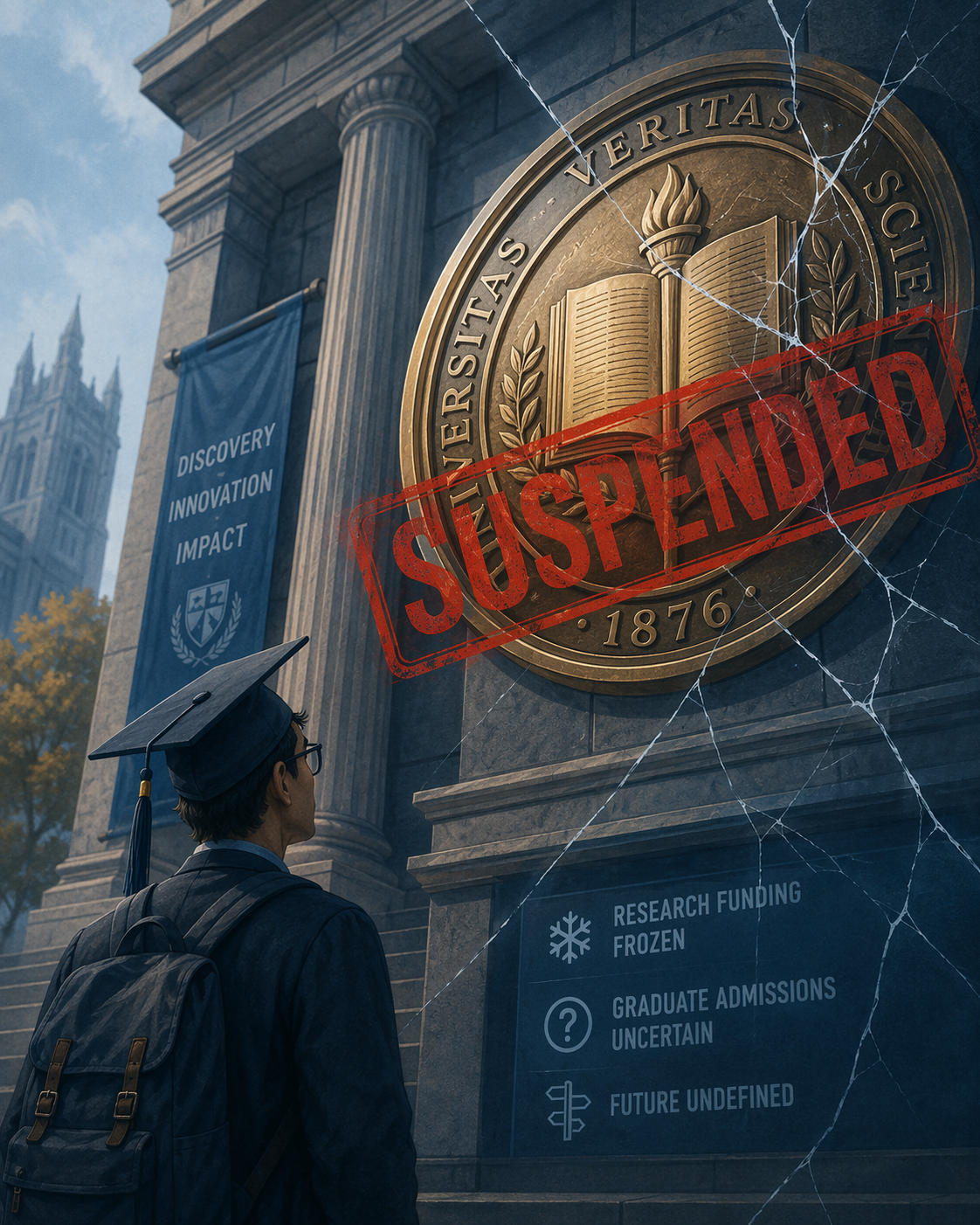
If a Berkeley principal investigator wants to admit you for a research PhD in 2026, the first question is no longer only whether the lab is exciting or whether your GRE profile is strong enough. It is whether the funding behind that offer can survive the next administrative interruption. That is the practical meaning of UC Berkeley Vice Chancellor for Research Kathy Yelick saying researchers “are afraid to admit graduate students” during the federal funding turmoil: the grant freeze is not just a budget story; it changes how many students faculty feel safe bringing into their labs.[1]
The clearest Berkeley-specific shock came in April 2026, when 18 National Science Foundation grants worth about $21 million were suspended. Two of the grants had already been terminated in 2025, restored by court order, and then suspended again.[2] For an applicant, that sequence matters because it shows that a restored grant is not always the same thing as a stable research appointment. A PI may still have a project, a student may still have a good fit, and the department may still want a cohort — but the line connecting grant money to a graduate student researcher position is now easier to interrupt.
Berkeley Is the Vivid Case, Not the Whole Market
It would be a mistake to turn Berkeley into the only story. Across 55 top Association of American Universities institutions, PhD admissions for fall 2026 were down 15%, according to data reported by The Washington Post.[3] That figure is not a Berkeley cohort number, and it should not be used as if Berkeley itself cut PhD admissions by 15%. It does, however, tell applicants that the hesitation visible at Berkeley sits inside a broader admissions pullback at research-intensive universities.
International applicants are reading the same signals with an additional layer of exposure. New international graduate enrollment declined 17% in 2025–26, according to Institute of International Education data reported by Nature.[4] That number measures enrollment, not just applications or interest, so it reflects decisions already made by students and institutions. For applicants weighing visa timing, funding risk, and post-degree options, this is where graduate school planning starts to overlap with immigration strategy; StudyMethod’s guide to EB-2 NIW options for international students in 2026 and its 2026 Visa Bulletin GRE timeline are adjacent reading for students whose application decision depends on both funding and immigration timing.
The conclusion is narrower than panic. Top research PhDs have not suddenly become irrational. A funded doctoral offer with a written, multi-year guarantee, a department-level bridge plan, and a real mentorship fit can still be a strong choice. What has become irrational is treating institutional prestige as a substitute for funding language.
The Old Funded-PhD Assumption Needs Rewriting
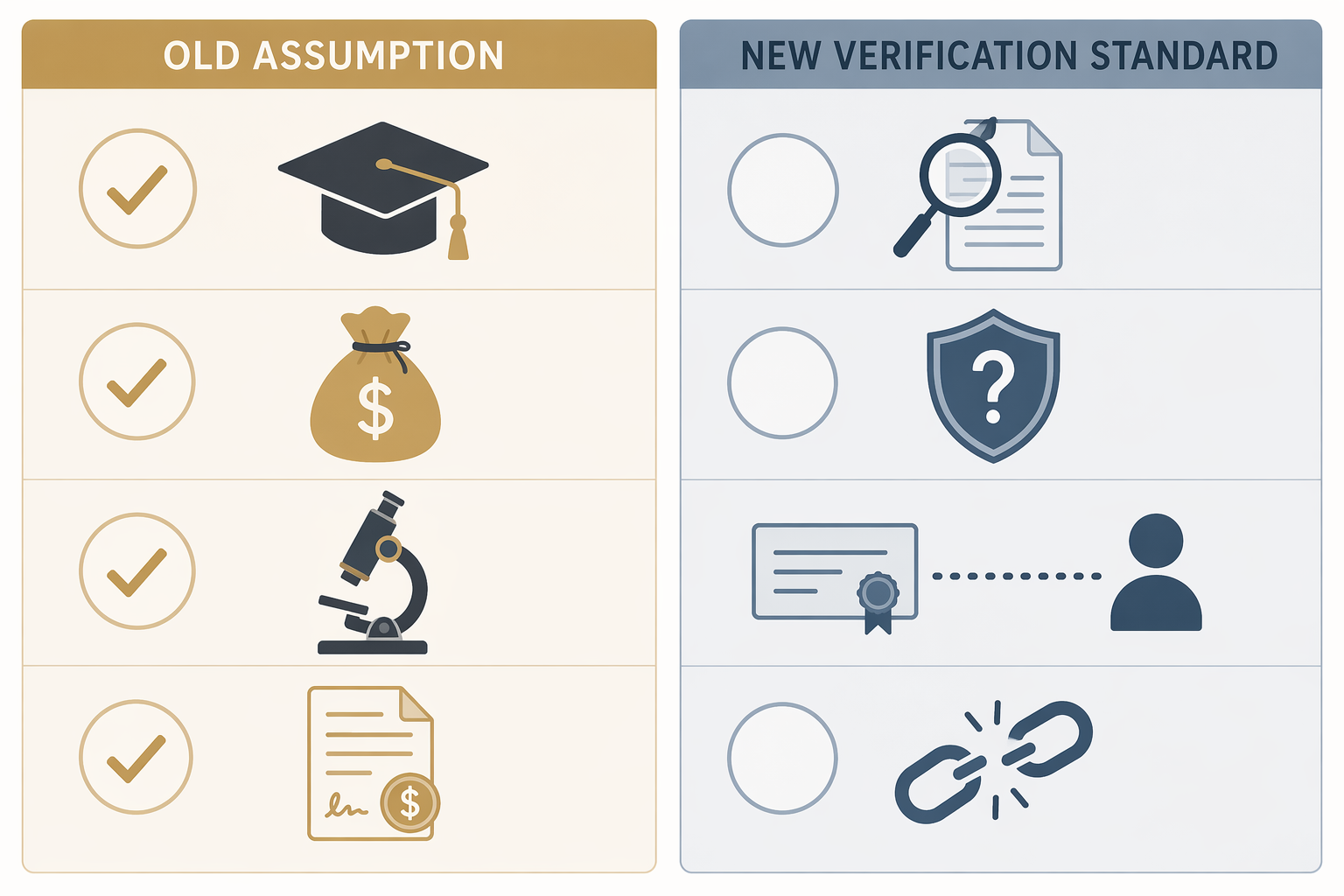
For years, many applicants used a simple rule: if a serious research PhD admits you, the program will find a way to fund you. That rule was never perfect, especially for students outside well-funded STEM fields, but it was often good enough to guide application lists. In the 2026–2028 cycle, it is too vague.
| Decision Area | Old Assumption | New Verification Standard |
|---|---|---|
| Admissions odds | Strong fit at a top lab means the department can probably admit the student. | Ask whether the department, program, or PI has reduced intended cohort size for the coming cycle. |
| Stipend security | A funded offer means the student is financially covered for the normal PhD timeline. | Require written language showing the number of guaranteed years, funding source, summer coverage, and what happens after a grant interruption. |
| Research placement | If the PI wants the student, the student can join the lab and start grant-funded work. | Verify whether the first year is rotation-funded, fellowship-funded, department-funded, or tied immediately to a PI grant. |
| Loan fallback | If a temporary gap appears, federal graduate borrowing can fill it. | Treat borrowing as sharply constrained after Grad PLUS elimination and the new federal caps. |
| Institutional buffer | A wealthy or elite university can absorb temporary disruption. | Ask for the specific bridge-funding mechanism, eligibility rules, and who approves emergency support. |
The loan line deserves special attention because it quietly changes applicant behavior. Beginning in July 2026, new federal graduate borrowing is capped at $20,500 per year and $100,000 total after the elimination of Grad PLUS loans.[5] I do not like debt-financed PhDs as a default plan, and most research applicants should not use loans to patch a program that cannot fund them. But the old emergency assumption — that a student could borrow through a shortfall while waiting for a fellowship, appointment, or grant decision — is now much weaker. StudyMethod’s breakdown of how the college student loan bill changes graduate school funding is worth reading before building an application list that depends on “backup” borrowing.
This also makes competitiveness more financial than cosmetic. A stronger GRE score or stronger research profile is not just about admission to a famous name; it can determine whether you are competitive for fellowships, centrally funded slots, or departments with enough flexibility to protect first-year students. That is the real connection between test preparation and funding risk, and it is why the 2026 student-loan default and GRE score analysis belongs in the same conversation as PhD admissions strategy.
What the Berkeley Freeze Can Change for a Research Student
The UC Berkeley grant freeze effects on research students are easiest to see in four places: whether a student is admitted at all, whether the stipend is secure, whether the intended research placement happens on time, and whether the institution can bridge a gap without pushing the student into debt or unpaid delay.
Admissions is the first pressure point. Faculty who are unsure whether a grant will pay a graduate student researcher may simply admit fewer students or avoid promising a slot in the lab. That is why Yelick’s “afraid to admit graduate students” line is more applicant-relevant than a general statement about fiscal uncertainty.[1] It describes a behavior change before the student ever receives an offer.
Stipends are the second pressure point. Berkeley has described PhD stipends in the $41,000 to $46,000 annual range, which is real money but not enough room for many students to absorb months of uncertainty in the Bay Area.[1] The question is not whether Berkeley’s posted stipend range is serious. The question is whether the student’s specific package is protected if the anticipated GSR line is delayed, suspended, or moved.
Research placement is the third pressure point. A student can be “funded” and still lose time if a lab cannot hire on schedule, if a rotation cannot convert into a research assistantship, or if a PI postpones a project that depended on federal funds. UC Berkeley’s hiring freeze page states that grant-funded graduate student researchers are exempt from the systemwide hiring freeze, but an exemption is not the same as frictionless hiring.[6] The LAO also described a UC systemwide hiring freeze that began in April 2025 and extended through 2026–27.[5]
The fourth pressure point is institutional buffering. Berkeley established an Emergency Research Fund, but the campus declined to specify the amount available.[2] California has also seen proposals for larger science-funding buffers, including a $23 billion science bond discussed for the November 2026 ballot, but a proposed bond is not a student-level guarantee until it is passed, allocated, and translated into actual graduate support.[2] Litigation may also change the funding landscape, but court movement is not the same thing as a stipend contract.
Questions to Ask Before You Apply
Applicants should ask these questions before paying application fees, not after getting emotionally attached to a lab. A program that is serious about protecting students should be able to answer without making you feel naive for asking.
- Is PhD funding guaranteed in writing, and for how many years?
- Does the guarantee cover tuition, stipend, fees, health insurance, and summer support?
- Is first-year funding tied to the department, a fellowship, rotations, teaching, or a specific PI grant?
- If the PI’s grant is suspended or delayed, who pays the student and for how long?
- Are GSR appointments exempt from hiring restrictions in practice, and how long does appointment approval currently take?
- Does the program have bridge funding, or is the student expected to wait for reinstatement, litigation, or a new grant?
The wording of the answer matters. “Students are normally funded” is not the same as “all admitted PhD students receive five years of guaranteed support independent of the admitting PI’s grant status.” “We expect the grant to continue” is not the same as “the department covers the stipend if the grant is suspended.” A student who cannot absorb a surprise shortfall needs the second kind of sentence.
Applicants should also ask who bears the delay. If a grant-funded GSR line is exempt from a hiring freeze but approvals take longer, does the department pay the student during the gap? Does the PI pay from discretionary funds? Does the student teach an extra section? Does the start date move? The answer changes the lived experience of the first year.
How to Read a Berkeley Offer in 2026
A Berkeley offer can still be excellent. The institution has world-class faculty, deep research infrastructure, and departments where the training environment may be exactly right. The risk is not the Berkeley name. The risk is assuming the Berkeley name answers questions that only the funding letter, department, and PI can answer.
Read the offer as three documents, even if only one PDF arrives. First, read the formal funding guarantee. Second, read the research-placement plan: rotations, lab match, GSR timing, and teaching expectations. Third, read the contingency plan, even if you have to extract it through email. If the third document does not exist, that is information.
Do not let a PI’s enthusiasm replace the department’s obligation. A PI may be honest, supportive, and still unable to protect a student if the relevant account is frozen. A department may sincerely intend to help and still have no defined bridge fund. A central campus emergency fund may exist and still be limited, discretionary, or slow.
This is also where applicants should compare Berkeley against less famous programs that can document stronger support. A lower-ranked program with a written multi-year guarantee, protected first-year funding, and a stable advising structure may be the better choice for a student who has no family backstop. Prestige can help a career; it cannot pay rent during an unfunded month.
How Broadly to Apply
The 15% admissions decline across top AAU PhD programs means a 2026 applicant should not build a list as if last cycle’s odds still hold.[3] That does not mean adding random programs. It means adding programs where the funding model is more transparent, where first-year support is centralized, or where the field has non-federal funding sources that reduce dependence on a single PI grant.
A sensible list now needs financial diversification as much as academic fit. Include some programs with rotation systems, some with strong fellowship cultures, some with department-funded first years, and some where your profile makes you competitive for nominated awards. If every program on the list depends on a grant-funded lab admitting exactly one student, the list is fragile even if every name on it is prestigious.
Applicants in fields with heavy NIH or NSF exposure should be especially careful. Grant Witness reported 19 new NSF terminations detected in April–May 2026 and described Berkeley as “the canary in the coal mine.”[7] That is a warning frame, not a statistical forecast for every department. Use it to ask better questions, not to assume every lab is equally unsafe.
What Counts as a Real Buffer
A real buffer has three qualities: it is funded, it is accessible to graduate students, and it can be activated quickly enough to prevent a stipend gap. General institutional wealth is not a buffer unless it has been committed to this purpose. A lawsuit is not a buffer unless the student is paid while the case moves. A proposed state bond is not a buffer until money reaches the department or student.
The UC system picture is mixed rather than simple. As of January 2026, the LAO reported 389 canceled UC awards totaling $173 million and 1,272 reinstated awards totaling $832 million; it also noted that UC’s total federal research funding had not declined substantially to date.[5] That matters because reinstatement is not meaningless. Universities are not helpless. But the April 2026 Berkeley NSF suspensions came after that January snapshot, so applicants should not use systemwide totals as proof that a specific lab appointment is safe.
The distinction is practical. A campus may be managing the macro-budget better than expected while an individual student still faces a delayed start, a changed advisor, or a teaching load that was not part of the original training plan. Applicants do not live inside aggregate research-funding charts. They live inside appointment letters.
The Conditional Answer
Yes, still apply to Berkeley if the research fit is strong and the program can document durable funding. Still apply to top research universities if your goals require doctoral training and your application is competitive for funded admission. But apply with a wider and more financially varied list if the programs you love are highly grant-exposed.
Do not accept “funding is expected” as a complete answer in 2026. Ask whether the guarantee survives a PI grant interruption. Ask how first-year students are paid before joining a lab. Ask whether GSR appointments are merely exempt on paper or actually moving on time. Ask what bridge funding exists and who controls it.
A prestigious research PhD can still be worth pursuing. It is not financially safe until the guarantee and the buffer have been verified.
References
- During campus visit, U.S. representatives vow to fight freeze on federal research funding, Berkeley News, Feb. 24, 2025.
- Donald Trump suspends UC Berkeley research grants from National Science Foundation, Berkeleyside, May 8, 2026.
- Admissions to top PhD programs are down 15% amid federal funding cuts, uncertainty, The Washington Post, July 6, 2026.
- How international students are navigating uncertainty in US graduate education, Nature, Jan. 2026.
- The 2026-27 Budget: Higher Education Analysis of H.R. 1, Legislative Analyst’s Office, Feb. 2026.
- 2025 Hiring Freeze, UC Berkeley Human Resources, Apr. 2025.
- New NSF Terminations: Berkeley Is the Canary in the Coal Mine, Grant Witness, May 27, 2026.
Comments
Join the discussion with an anonymous comment.