AI Study Tool
Route Your AI Safety Study by Background and Career Goal
Tool: Stanford CS120
Overwhelmed by the dozens of AI safety curricula and programs? This article routes you to the right first resource based on your background—technical alignment or governance—and your career aim, so you can start studying without wasting time on the wrong track.
Warning panel
- Verified against official source
- No
- Last reviewed
The hardest part of finding ai safety research and study resources is not scarcity. It is that the first page you find may give you thirty doors and no hallway.
AISafety.com’s self-study page is useful and current, with an update noted in July 2026 and more than 30 curricula gathered in one place, but it does not route a newcomer by background, career goal, or readiness level.[1] That matters. A policy student can lose weeks trying to decode math-heavy alignment material too early. A strong programmer can drift through broad ethics readings when what they need is a technical research ramp. Neither person is unserious; both were handed a library when they needed a map.

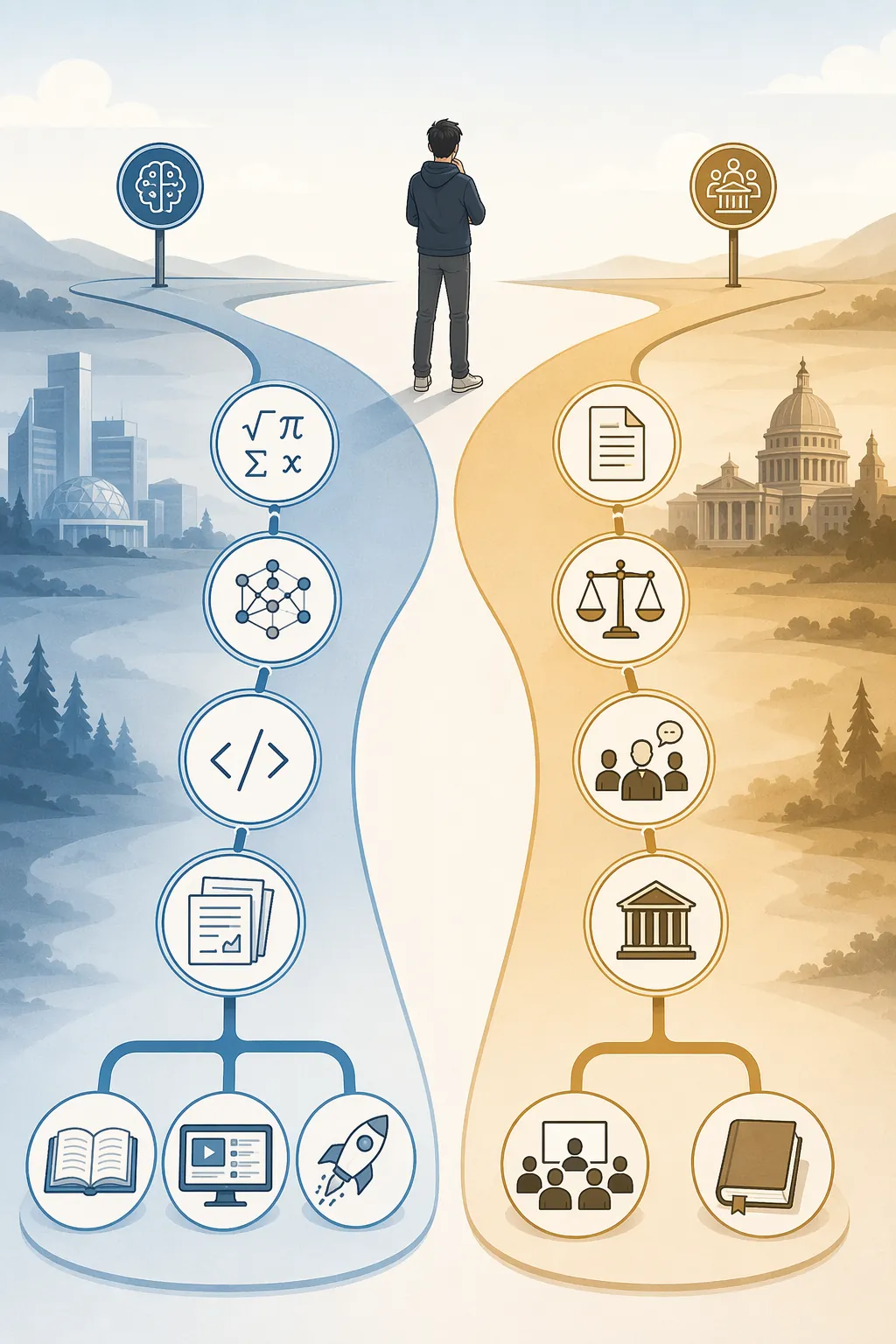
The rule is simple enough to state early: choose your track before you choose your resource. In practice, most beginners are choosing between two different study problems, not two versions of the same problem.
| If this sounds like you | Start with this track | Your first study goal |
|---|---|---|
| You have, or are willing to quickly build, machine learning, math, programming, and research-paper fluency. | Technical AI alignment | Learn how current ML systems fail, how safety researchers model those failures, and what a research contribution could look like. |
| You come from policy, law, social science, economics, security, public administration, philosophy, or institutional strategy. | AI governance | Learn how AI risks are governed through institutions, incentives, standards, law, policy, and public decision-making. |
| You are exam-focused and mainly want AI tools for studying GRE, MCAT, SAT, ACT, ASVAB, or similar tests. | Not this roadmap | Use StudyMethod’s exam hubs or AI-study-tool guides instead of treating AI safety as another test-prep category. |
On StudyMethod, this fits under ai-tools as a study-roadmap and resource-comparison piece, not as an exam-prep hub. If your actual need is test preparation, start with the relevant StudyMethod exam section. If you want to see how AI tools can supplement ordinary studying rather than become the subject of study, the site’s guide to OpenAI and Hugging Face as study tools is closer to that use case.
Why AI Safety Resource Lists Fail Serious Beginners
A long resource list feels generous to the person compiling it. To the beginner, it creates a hidden prerequisite: you must already understand the field well enough to know which recommendations are meant for you. That is backward.
AI safety is urgent enough to attract motivated people from computer science, law, public policy, economics, philosophy, security, cognitive science, and industry engineering. But urgency does not make those backgrounds interchangeable. A first-year ML PhD student and a legislative staffer may both be serious about frontier AI risk. Their first month of study should not look the same.
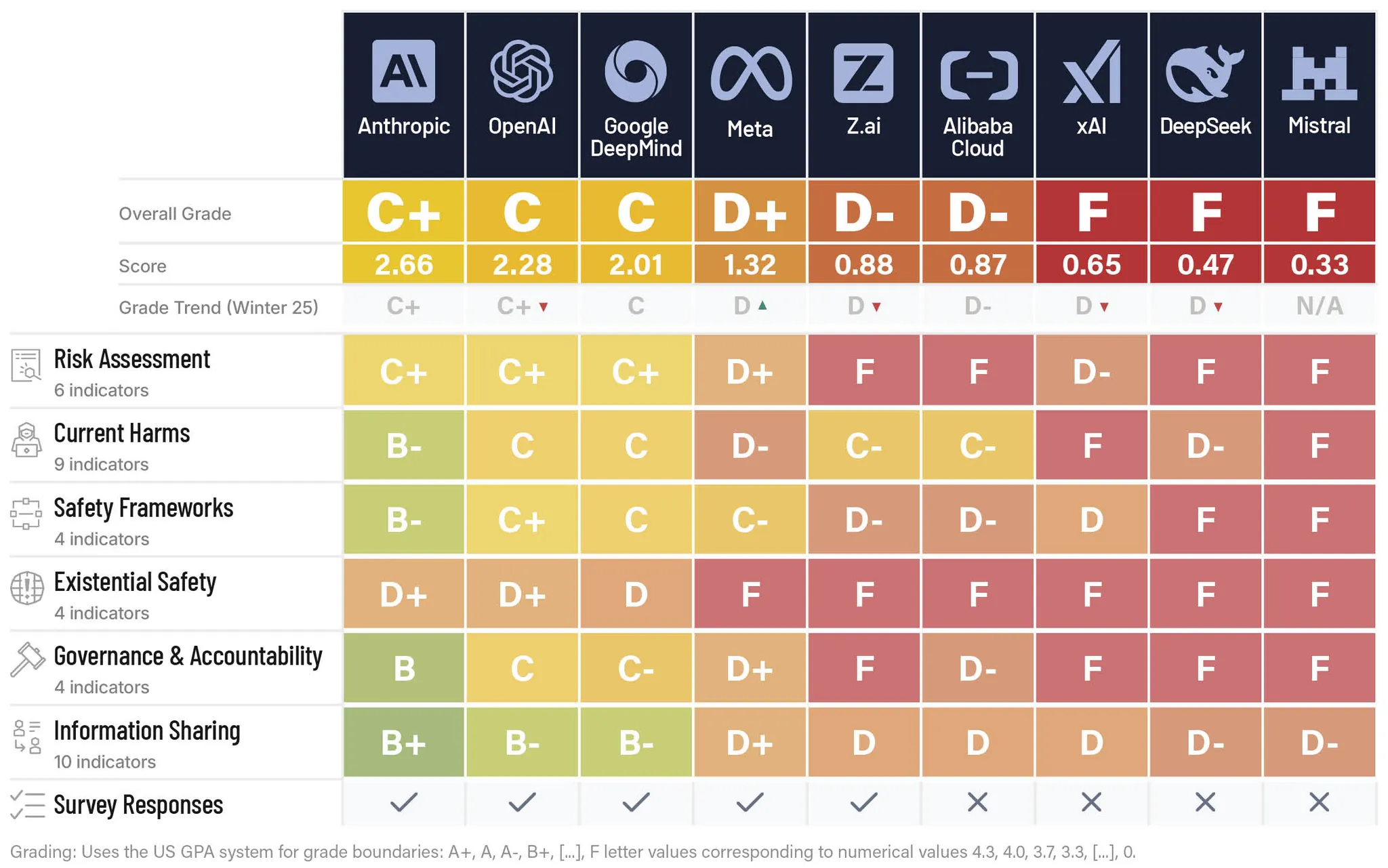
The need is not imaginary. The Future of Life Institute’s Summer 2026 AI Safety Index graded nine frontier AI companies across 37 indicators; Anthropic led with a C+ score of 2.66 out of 4.0, while xAI, DeepSeek, and Mistral received F grades.[2] That scorecard should not be used as a panic button. It is more useful as a sober signal that safety practice is still uneven at the organizations building powerful systems.
There is also a market signal, though it should be handled carefully. Research.com’s 2026 course roundup cites secondary figures such as McKinsey’s claim that 65% of enterprises report AI incidents while 35% adopt risk-mitigation practices, Deloitte’s claim that 73% of organizations prioritize responsible AI while 28% offer training, a 230% Coursera enrollment increase since 2018, and a median 14% salary increase after AI certification.[3] Those numbers are useful as moderate evidence that AI safety and responsible-AI training are becoming visible in education and employment. They are not a substitute for checking the original McKinsey, Deloitte, Coursera, or labor-market sources.
So the problem is not whether AI safety deserves study. The problem is that a motivated learner can behave rationally, collect every famous syllabus, and still end the week with no defensible first assignment.
First Decision: Technical Alignment or Governance
Do not begin by asking, “What is the best AI safety course?” Begin by asking, “What kind of work am I trying to become capable of doing?” The answer usually routes you into technical AI alignment or AI governance.
Choose Technical AI Alignment If You Want to Work on Models Directly
Technical alignment is the route for people who want to study how AI systems behave, fail, generalize, deceive, optimize, interpret goals, resist oversight, or respond to training pressure. It is the path most likely to ask for machine learning fluency, mathematical maturity, coding ability, and comfort reading research papers.
That does not mean you need a PhD before beginning. It does mean that if calculus, linear algebra, probability, Python, and basic ML feel distant, your first plan should include rebuilding those foundations rather than pretending an alignment syllabus will magically supply them in passing. The fastest route is not the route with the most advanced title; it is the one that exposes missing prerequisites early enough to fix them.
A good open starting point is Stanford CS120: Introduction to AI Safety, whose full course materials are freely available.[4] It is university-level material, which is exactly why it is helpful as a diagnostic. If the lectures and assignments feel demanding but tractable, you are probably in the right neighborhood. If the notation and ML assumptions are constantly blocking comprehension, pause and strengthen ML basics before stacking more AI safety readings on top.
The Intro to ML Safety MOOC associated with Dan Hendrycks is another realistic technical entry point for self-paced learners. Treat it as a structured way to enter ML safety concepts, not as proof that you are research-ready after finishing a playlist. The useful question after an introductory technical course is: can you now read a recent safety paper, reproduce the core setup, and explain where the uncertainty lives?
Competitive accelerators come later. ARENA and MATS are valuable precisely because they are intensive and selective; they are not the right default recommendation for a newcomer who has not yet tested whether technical alignment fits. Use them as later targets once you can show project work, research taste, and enough ML fluency to benefit from mentorship rather than merely survive the pace.
Choose AI Governance If You Want to Work on Institutions, Rules, and Deployment
AI governance is not the softer fallback for people who “cannot do the math.” That framing wastes excellent policy, legal, institutional, and social-science talent. Governance asks different questions: who should be allowed to deploy which systems, under what evidence requirements, with what liability, oversight, standards, export controls, incident reporting, audits, and international coordination?
If your background is law, public policy, political science, economics, international relations, sociology, philosophy, security studies, or organizational strategy, governance may be the direct route rather than a detour. You still need technical literacy. You do not need to pretend your comparative advantage is implementing transformer variants if your real strength is institutional design.
BlueDot Impact is a strong first stop for learners who want structure and peers. Its AI safety resources include free cohort-based courses with technical and governance tracks, and the organization reports thousands of learners enrolled globally.[5] The cohort format matters because governance study can otherwise become passive reading. A weekly group forces you to explain tradeoffs, defend claims, notice weak arguments, and meet people working from adjacent disciplines.
The AISES textbook and curriculum are better suited to learners who want a broad, self-paced reference. The free textbook covers AI safety, ethics, and society, making it useful when you need a comprehensive base rather than a discussion schedule.[6] It is not “better” or “worse” than a cohort. It solves a different study problem.
| Resource | Best first use | Watch out for |
|---|---|---|
| BlueDot AI Safety Fundamentals governance track | You want a guided, cohort-based introduction with discussion and accountability. | Cohort pacing may not match your schedule; check current availability before planning around a start date. |
| AISES textbook/curriculum | You want a free, comprehensive self-study base across safety, ethics, and society. | A textbook can become endless reading unless you pair it with written outputs or policy memos. |
| Stanford CS120 | You want an open university-level technical AI safety course. | It may reveal ML or math gaps; that is useful information, not failure. |
| Intro to ML Safety MOOC | You want a self-paced technical ML safety ramp. | Completion alone is not the same as research readiness. |
| ARENA or MATS | You already have technical momentum and want an intensive accelerator. | These are selective or competitive, so do not build your entire first plan around admission. |
What to Do in Your First Week
A first week should reduce uncertainty. It should not impress anyone. Pick one route, one primary resource, and one output you can finish.
- If you choose technical alignment: skim the Stanford CS120 course structure, complete one introductory lecture or module, and write a one-page note on which prerequisite blocked you most.
- If you choose governance: compare BlueDot’s governance course format with the AISES curriculum, then write a one-page memo on one governance problem you want to understand better.
- If you are unsure between tracks: spend two short sessions on each path, then choose based on the work you were willing to continue when nobody was watching.
- If both tracks feel too advanced: pause the AI safety syllabus hunt and repair the missing base, such as introductory ML for technical alignment or basic policy analysis for governance.
The output is important. Reading gives you the illusion of progress; a short written artifact shows whether you can explain anything yet. For technical learners, that artifact might be a summary of a failure mode, a reproduced toy example, or a list of math and ML gaps. For governance learners, it might be a policy memo, stakeholder map, standards comparison, or critique of an oversight proposal.
StudyMethod has used a similar fit-first approach in other specialized AI contexts, such as its guide to evaluating digital surveillance tools in criminal defense. The shared lesson is that high-stakes AI topics reward careful routing. The right question is rarely “which tool or resource is famous?” It is “what decision does this resource prepare me to make?”
How to Use Older and Community-Curated Syllabi
Older syllabi are not useless. They are just dangerous when treated as current onboarding plans.
The 80,000 Hours AI safety syllabus was last updated in April 2024, so it can still help as a reference point, especially for seeing how career-oriented AI safety reading has been organized.[7] But a 2024 syllabus should not be your only guide in Q3 2026, particularly when course formats, frontier-model practices, and governance debates keep moving.
The Future of Life Institute’s introductory AI safety resources page is even more clearly historical: it dates from 2016.[8] That does not make it bad. It makes it context. Use it to understand how earlier public-facing AI safety education was framed, not to decide your first assignment this week.
Community-curated posts can be valuable once you know what you are looking for. LessWrong’s technical AI safety resource post is a good example of the field’s dense, generous, fragmented knowledge culture.[9] It can help a technically inclined learner discover more material. It should not be mistaken for a beginner-routing system.
After the First Resource
Once you finish an introductory resource, do not immediately collect five more. Decide what the first resource proved.
| What happened | What it means | Next move |
|---|---|---|
| You understood the technical material and wanted more depth. | Technical alignment is still plausible. | Start a small replication, read one recent paper slowly, or prepare for a more intensive program later. |
| You liked the safety questions but kept getting blocked by ML basics. | The track may still fit, but the prerequisite plan is missing. | Study core ML and math before adding advanced alignment readings. |
| You found governance debates concrete and energizing. | Governance may fit your background and motivation. | Write short memos, join a cohort if available, and follow institutional developments. |
| You enjoyed reading broadly but produced no output. | Your plan is too passive. | Choose a weekly artifact: memo, critique, problem summary, replication note, or annotated bibliography. |
| You are mainly interested in AI’s impact on students and academic work. | You may want adjacent AI-literacy content, not an AI safety career route. | Read student-facing AI pieces such as StudyMethod’s article on AI intellectual property issues. |
For that last case, the related StudyMethod article on AI intellectual property theft and students may be closer to your immediate concern. AI safety study is narrower and more career-directed than general AI awareness.
The cleanest first move is not a master syllabus. It is a routed commitment: technical alignment if you are preparing to reason about models and research; governance if you are preparing to reason about institutions and deployment. Pick the first open resource that matches that route, produce one written artifact, and only then decide whether you need a deeper course, a cohort, a textbook, or a selective accelerator.
References
- AI Safety Courses and Curricula, AISafety.com, July 2026.
- AI Safety Index Summer 2026, Future of Life Institute, 2026.
- 2026 Best AI Safety Courses Online, Research.com, 2026.
- CS120: Introduction to AI Safety, Stanford University.
- AI Safety Resources, BlueDot Impact.
- AI Safety, Ethics, and Society Curriculum, AISES.
- AI safety syllabus, 80,000 Hours, April 2024.
- Introductory resources on AI safety research, Future of Life Institute, 2016.
- If you want to learn technical AI safety, LessWrong.
Verify against your exam's official source
Applicable exams not specified — see all exam hubs.
Comments
Join the discussion with an anonymous comment.