
AI Study Tool
How OpenAI and Hugging Face Can Help You Pass Exams
Tool: OpenAI Study Mode and Hugging Face
Comparing OpenAI Study Mode and Hugging Face for standardized exam prep. Neither replaces official materials, but each has a specific role as a supplement for conceptual review or building custom study tools.
Warning panel
- Verified against official source
- No
- Last reviewed
If your exam date is fixed, the answer is narrow: use OpenAI Study Mode for concept review after you have worked official questions; use Hugging Face only if you can realistically build or adapt a tool; use neither as your scoring system, content outline, adaptive practice engine, or final answer key.
That boundary matters more than the platform comparison itself. Bluebook, AAMC materials, ETS PowerPrep, and other official exam sources still define the format, scoring logic, timing, and content expectations. OpenAI and Hugging Face can sit next to that workflow. They should not quietly replace it.
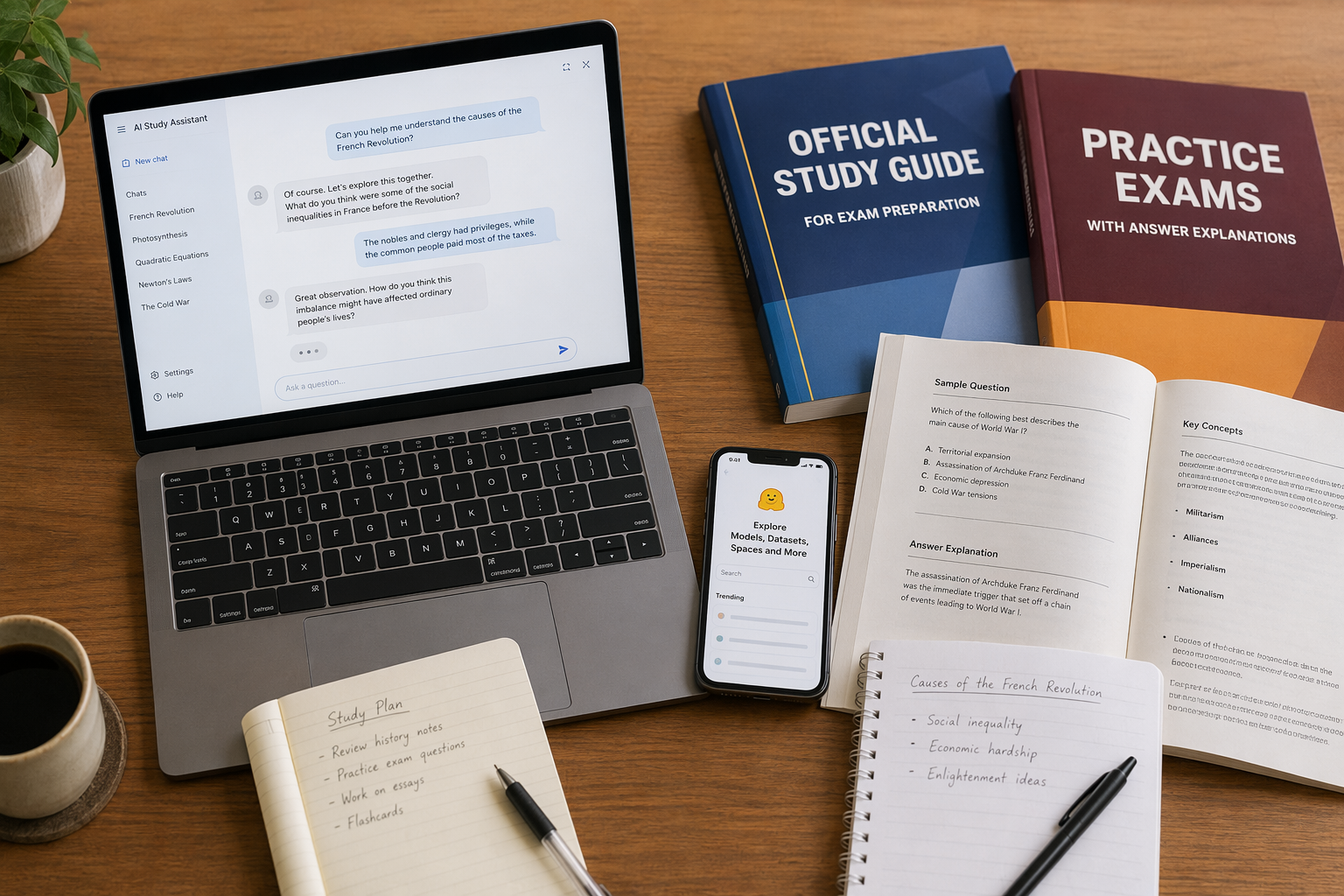
This is a synthesized comparison, not a head-to-head standardized-exam study. The strongest evidence for OpenAI comes from Study Mode launch details and independent testing of ChatGPT in study contexts. The strongest evidence for Hugging Face comes from its education ecosystem, open-model infrastructure, and benchmark reporting. Pricing and availability details are last reviewed July 22, 2026.
| Prep job | OpenAI Study Mode | Hugging Face | What still belongs to official materials |
|---|---|---|---|
| Understand a missed concept | Strongest fit: Socratic prompts, step-by-step explanation, wrong-answer review | Possible only through a model or app someone builds | Official explanation, content outline, and tested skill |
| Practice in the exam format | Not enough: can explain, but does not reproduce official adaptive scoring | Not ready-made for GRE, MCAT, SAT, ACT, or ASVAB practice | Bluebook, AAMC, ETS PowerPrep, and exam-specific official practice |
| Track progress over time | Weak fit: no reliable exam-prep analytics workflow | Possible if you build tracking into a custom app | Official score reports, timed sets, error logs |
| Verify an answer | Unsafe as final authority because wrong answers can sound confident | Depends entirely on model, data, and implementation | Official answer keys and scoring rubrics |
| Build a custom study tool | Useful for brainstorming prompts and explanations | Strongest fit for technical users using models, datasets, or Spaces | Still needs official content boundaries and validation |
Where OpenAI Actually Helps
OpenAI Study Mode is the easier tool to add to a study routine because it is already packaged as a tutoring experience. OpenAI launched Study Mode in ChatGPT in July 2025, making it available on Free, Plus, Pro, and Team plans, and described it as a Socratic-style feature developed with pedagogy experts from more than 40 institutions.[1] OpenAI’s help documentation describes Study Mode as a way to work through material with guided questions rather than simply receive a completed answer.[2]
That design is genuinely useful for a student who missed a question and does not yet know why. A good Study Mode exchange can slow down the panic cycle: identify the concept, ask what the question is testing, separate the trap answer from the credited reasoning, then make the student try the next step. That is close to what a careful tutor does after a timed set.
The best use comes after official practice, not before it. Work the official item first. Mark your answer. Read the official explanation. Then bring the question type, your reasoning, and the official answer into Study Mode and ask for diagnosis: What did I assume? Which phrase in the passage mattered? What rule or concept did I confuse? What would a similar trap look like?
For MCAT students, that might mean using ChatGPT to untangle an enzyme kinetics explanation after working AAMC-style practice, while keeping the official outline and practice sequence anchored in an MCAT study prep plan. For GRE students, it might mean asking why a quantitative comparison shortcut failed after finishing a timed PowerPrep set, rather than asking the model to invent a new “GRE-like” curriculum from scratch.
The Useful Prompt Is Not “Teach Me Everything”
A vague request gives you a polished lesson. A better request gives you a correction loop. The difference is not cosmetic; it decides whether the AI touches the exact failure that cost you points.
- Weak: “Explain algebra for the SAT.”
- Better: “I chose B on this official-style problem, but the answer is D. Ask me one question at a time until you find the reasoning error.”
- Weak: “Make me better at CARS.”
- Better: “I rejected the credited CARS answer because it sounded too mild. Help me compare my evidence to the passage wording without adding outside knowledge.”
- Weak: “Give me a GRE study plan.”
- Better: “Here are the last 20 official quantitative questions I missed, grouped by topic. Help me find the repeated error pattern.”
Study Mode’s Socratic framing is most valuable when the student is forced to answer before receiving the next explanation. If the conversation turns into a stream of elegant paragraphs, it may feel productive while avoiding retrieval practice. On a standardized exam, recognition is cheaper than performance. The tool should make you commit.
Where OpenAI Becomes Risky
The problem is not that ChatGPT cannot explain. The problem is that explanation quality and exam authority are different jobs. Edutopia’s January 2026 testing of ChatGPT Study Mode found that it could be useful for concept explanation, but unreliable as an assessment tool; the testing also found it could be tricked into writing essays and produced formulaic thesis statements.[3]
That matters for SAT, ACT, GRE, and MCAT prep because students under pressure often ask the tool to do the highest-stakes part: judge whether an answer is right, estimate a score, or certify that an essay would earn points. Those are exactly the places where confidence can be most damaging. PrepGraph’s SAT-focused evaluation warns that ChatGPT often states wrong answers confidently and cannot replace Bluebook for adaptive practice or accurate scoring.[4]
A wrong explanation that sounds uncertain is easy to catch. A wrong explanation that sounds like a teacher is expensive. It can send a student into three days of drilling a rule that was never tested, or persuade them that a timing problem is really a content problem. That is how AI study time becomes lost study time.
There is also a tracking issue. Standardized prep depends on trend lines: which question families repeat, which wrong-answer patterns survive review, which section collapses under time, and whether accuracy improves on fresh official material. Study Mode can talk through today’s mistake, but it is not a complete progress-management system for an exam season. If you do not keep your own error log, the tool will not rescue that missing structure.
A Safe OpenAI Workflow
The safest sequence is simple: official question first, official answer second, AI diagnosis third, human verification last. Do not let the model decide what the exam values before you have checked the source that actually writes or licenses the test.
- Complete a timed official set without AI help.
- Review the official answer and write one sentence explaining why your answer lost.
- Ask Study Mode to question your reasoning, not to replace the answer key.
- Turn the diagnosis into one small drill: a formula, passage habit, grammar rule, or content card.
- Retest later with fresh official or high-quality practice, not with the same AI-generated example.
Essay prep needs an even stricter line. Use AI to ask whether your thesis is specific, whether your evidence matches the prompt, or whether a paragraph has a clear job. Do not use it to produce the essay you intend to submit, and do not treat its scoring language as a substitute for the official rubric.
Hugging Face Is Not a Tutor in the Same Sense
Hugging Face belongs in a different category. It is not mainly a ready-made exam tutor. It is an ecosystem for models, datasets, demos, and machine-learning education. Its course catalog includes free courses on topics such as large language models, natural language processing, deep reinforcement learning, agents, and computer vision.[5] Its education push also includes institutional offerings and learning resources aimed at AI builders, not students trying to raise an ACT English score by next Saturday.[6]
That does not make it irrelevant. It makes the use case narrower. A technically capable student, tutor, or small prep team can use Hugging Face to build a flashcard classifier, a lightweight quiz app, a passage-tagging tool, or a demo that tests a specific workflow. Hugging Face Spaces can be used to deploy custom demos, and the broader platform gives builders access to open models and related infrastructure. But the student must still decide what content is valid, what counts as a good explanation, and how to verify outputs.
The institutional side is more useful for schools and programs than for individual test-takers. Hugging Face’s Academia Hub is listed at $10 per seat per month and includes features such as SSO and SOC 2; Hugging Face says it has been adopted by institutions including ETH Zurich, CMU, and EPFL.[7] That is a serious education infrastructure signal. It is not the same as saying Hugging Face has a polished GRE quantitative reasoning course or an MCAT section bank.
When Hugging Face Is Worth the Setup Time
Hugging Face starts to make sense when the tool-building itself is not a distraction. That is a high bar during exam season. If you have six weeks before the MCAT and your biochemistry accuracy is unstable, learning a deployment workflow is usually avoidance dressed as ambition. If you already code, already have a clean error log, and want a small tool that tags missed questions by concept, the calculation changes.
| Use Hugging Face if... | Avoid it if... |
|---|---|
| You can build or adapt a simple app without losing core study time. | You would need to learn the platform from zero during a short prep window. |
| You already have official or carefully vetted content to organize. | You expect the platform to supply exam-valid questions and scoring by itself. |
| You want a custom workflow, such as tagging errors or generating low-stakes drills. | You mainly need a tutor to explain a missed problem tonight. |
| You can validate model output against official sources. | You are likely to trust whatever the model says because it sounds technical. |
There is one clean exam-prep niche here: custom tools around your own materials. A tutor might build a small app that turns a student’s logged misses into review categories. A GRE student with programming experience might prototype a vocabulary review interface. A study group might create a demo that quizzes definitions from their own approved notes. Those are plausible uses. They are not proof that an open model understands the official scoring logic of a standardized test.
Capability Benchmarks Do Not Equal Exam Readiness
Hugging Face’s open-model ambition is real, and benchmark comparisons help show where open systems stand. In February 2025, TechCrunch reported that Hugging Face researchers were building an open version of OpenAI’s deep research tool; on the GAIA benchmark, the Hugging Face open version scored 54%, compared with 67.36% for OpenAI’s deep research.[8]
That is useful context, but it should not be smuggled into an exam-prep claim. GAIA is not the SAT. It is not the MCAT. A benchmark gap can suggest general capability differences between systems, but it does not tell you whether a model will grade an ACT essay accurately, mimic GRE section adaptivity, or decide which AAMC biology explanation is official enough to trust.
The same caution applies in the other direction. OpenAI’s stronger ready-to-use tutoring interface does not make it a complete prep platform. Hugging Face’s weaker consumer-facing fit does not make it useless. The relevant question is smaller: which platform improves the official-material workflow you already have?
Why Wrapper Tools Complicate the Choice
Many students meet “AI study tools” through polished apps rather than through OpenAI or Hugging Face directly. Commercial roundups of AI study-guide tools often include products that rely on large language models behind the scenes, which is useful context but not independent proof that the tools match official exam standards.[9]
That is why the direct comparison matters. If a product is mostly a wrapper around a general model, the same questions still apply: Does it use official-style practice? Does it track your misses over time? Does it distinguish a content weakness from a timing weakness? Does it show sources? Can it be wrong with confidence? A prettier interface does not remove those obligations.
For deadline-anchored prep, the burden of proof sits with the tool. A study app does not earn a place in the schedule because it is novel. It earns a place when it makes the next official practice session better.
How to Route Your Own Prep
Start with the exam you are actually taking. A GRE student preparing around application deadlines needs timed quantitative and verbal evidence, not a general AI curriculum. An MCAT student needs content review tied to AAMC-style reasoning and passage stamina. SAT and ACT students need official digital practice behavior, timing, and scoring expectations. ASVAB students need domain coverage and repeated practice, not a model’s confident guess at military entrance-test weighting.
Then assign the AI tool to one job only. If the job is “explain why I missed this,” OpenAI Study Mode is the first tool to try. If the job is “build a custom review app from my own tagged materials,” Hugging Face may be worth it. If the job is “tell me my real score,” “replace Bluebook,” “write my essay,” or “invent an official-style exam,” neither platform should get the job.
- Use OpenAI Study Mode after official practice to review missed concepts, rehearse reasoning, and pressure-test your explanation.
- Use Hugging Face if you already have the technical skill to build a narrow study aid without sacrificing core practice time.
- Use official materials for scoring, adaptive practice, content outlines, timing decisions, and final answer verification.
- Use your own error log to track patterns; do not assume a chat history is a study analytics system.
- Stop using any AI tool that makes you feel productive while reducing the number of official questions you actually complete and review.
The practical verdict is firm because the exam standard is firm. OpenAI can be a strong explanation partner and a poor exam authority. Hugging Face can be powerful infrastructure and a poor ready-made tutor. Neither should sit at the center of the study plan. Put the official materials there, then let AI do only the work it can do without blurring the source of truth.
References
- OpenAI launches study mode in ChatGPT, TechCrunch, July 29, 2025
- Using Study Mode in ChatGPT, OpenAI Help Center
- Putting ChatGPT’s Study Mode Through Its Paces, Edutopia, January 2026
- ChatGPT for SAT Prep, PrepGraph
- Learn, Hugging Face
- Education at Hugging Face, Hugging Face
- Academia Hub, Hugging Face
- Hugging Face researchers aim to build an open version of OpenAI’s deep research tool, TechCrunch, February 4, 2025
- AI Tools for Creating Study Guides, Fora Soft
Verify against your exam's official source
- SAT Prep Hub →
- ACT Prep Hub →
- GRE Prep Hub →
- MCAT Prep Hub →
- ASVAB Prep Hub →
No single strong official ASVAB source exists — weigh AI output here with extra caution.
Comments
Join the discussion with an anonymous comment.