Hands-On With Google Gemini's SAT Practice Test
Accuracy Warning — Google Gemini
Off-syllabus math, missing Bluebook tools, and session-bound progress; do not use for score prediction or as a substitute for official practice.
- Accuracy:
- Limited
- Tested:
- End-to-end SAT practice test; Reading & Writing and Math checked against Bluebook
- Last tested:
- 2026-08-25
This Google Gemini SAT practice test hands-on review is based on an end-to-end test run, published tester reports from early 2026, and a check against the real digital SAT experience in Bluebook. Several third-party reports cited here come from test-prep companies with commercial interests, so I treat them as expert tester findings rather than neutral validation studies. The short verdict: Gemini is worth using if you need free practice volume early in your SAT plan. It is not reliable enough for a baseline diagnostic, score prediction, final-weeks calibration, or as a replacement for official College Board practice tests.
That distinction matters because a free full-length test can look more official than it is. Gemini lowers the barrier to starting: no prep-course login, no paid practice bank, no waiting for a scheduled mock exam. But the moment a student treats its score-like feedback as a real SAT estimate, or studies off-syllabus math because Gemini asked it, the free test can become expensive in the only currency that matters before test day: time.
What Gemini’s SAT practice test is, and how you get into it
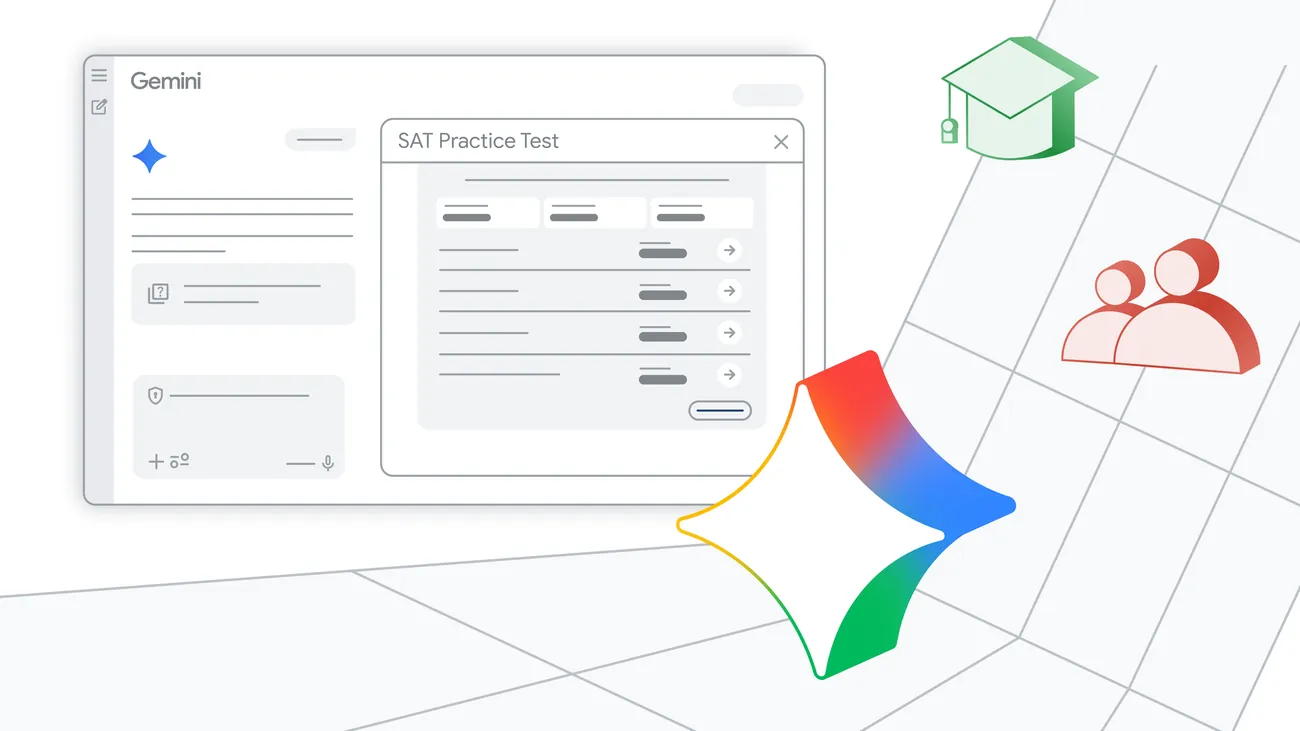
Google announced the Gemini practice SAT feature on January 21, 2026. The feature is free, full-length, and on demand; Google’s access instructions tell students to prompt Gemini with a request such as “I want to take a practice SAT test.” Google also says the experience is grounded in content from The Princeton Review, which separately described the collaboration as an SAT practice-test offering inside Gemini.[1][2]
That access model is the best thing about the tool. A student who has already burned through several official tests, or who cannot add another subscription, can open Gemini and get more timed practice with very little friction. For broader planning, it belongs beside other free resources rather than above them; our free SAT practice tests guide is the better place to compare that whole category.
The problem starts when the student’s brain reads “full-length SAT” and assumes “Bluebook-like SAT.” Those are different claims. Full-length means Gemini can occupy a similar amount of study time. Bluebook-like would mean the interface, tools, content distribution, module behavior, and score interpretation train the habits students need on the real digital SAT. Gemini does not consistently clear that second bar.
The first mismatch shows up before the questions do
Bluebook is not just a container for SAT questions. It is the testing environment students will actually use on exam day: question navigation, embedded tools, calculator access, annotation habits, pacing cues, and the small interface routines that keep a student from wasting attention under time pressure.
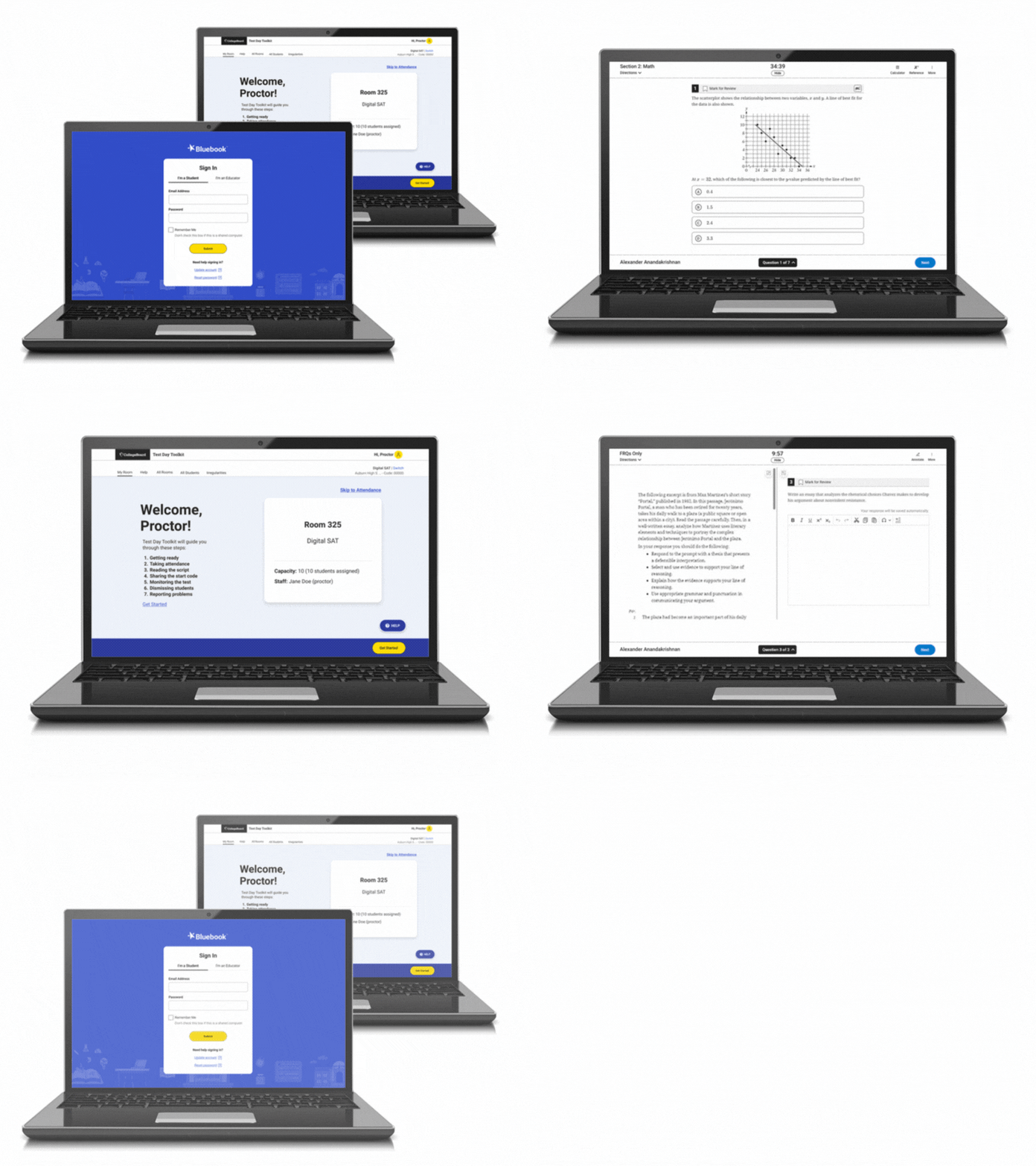
In documented early-2026 tester runs, Gemini did not reproduce several core Bluebook tools. The closely overlapping Private Prep and ArborBridge reports described no Desmos calculator, no highlighter, and no answer eliminator; MentoMind also flagged missing Bluebook-style functionality and noted interface friction that made the experience feel unlike the official app.[3][4][5]
I would not call every missing tool fatal in early practice. A student can still read passages, solve math, and build some stamina without a perfect replica. But the missing Desmos calculator is not a cosmetic gap. The digital SAT’s math section is built around a world where students have access to Desmos throughout the math modules. If a practice test changes that environment, it changes which strategies get rewarded.
Gemini also offered features Bluebook does not, including hint access and answer reveal options during the experience, according to the Private Prep/ArborBridge reports and MentoMind.[3][4][5] Those can be useful in a tutoring session or review mode. They are awkward inside something presented as a practice test. A student who peeks at a hint to stay unstuck is no longer getting test-condition data, even if the timer keeps moving.
The smaller interface annoyances add up too. Tester reports described hard-to-find scroll bars and other navigation friction.[3][4][5] On a casual weekday drill, that is tolerable. On a Saturday morning practice exam meant to rehearse timing, it trains the wrong kind of vigilance: hunting the interface instead of managing the section.
Reading and Writing: enough SAT flavor to practice, not enough fidelity to diagnose
Gemini’s Reading and Writing section is the part where a student can most easily be lulled into trusting the tool. The questions are short. The answer choices often look SAT-ish. The task feels familiar: read a small text, notice a claim, pick the best completion, fix a convention, or choose a transition.
But the digital SAT is not merely a pile of short verbal questions. The order and distribution of question types help students manage attention. The Private Prep/ArborBridge reports described scrambled Reading and Writing sequencing rather than the more predictable skill progression students see on the real test.[3][4] InGenius Prep also described AI-generated SAT practice as uneven in its match to official question patterns.[6]
That sequencing problem matters most for timing calibration. On the real SAT, many students learn when to expect vocabulary-in-context, command of evidence, expression of ideas, standard English conventions, and notes-based rhetorical synthesis. If Gemini scrambles the rhythm, a student may finish a module thinking, “I’m slow at Reading and Writing,” when the more accurate conclusion is, “I practiced in a section with a different shape.”
There were also content-distribution problems in documented runs. The Private Prep/ArborBridge reports said rhetorical synthesis was missing from at least one full module, and that the test included more than double the number of literary texts compared with the real SAT pattern in that run.[3][4] Those are individual tester findings, not a systematic sample of every Gemini test form, but they are exactly the kind of mismatch that can distort a student’s weakness map.
A missing rhetorical synthesis cluster does not just remove a question type. It removes practice with a task students can often improve quickly: reading notes, identifying the goal, and choosing the answer that uses the right information for that goal. Too many literary texts push in the other direction, making the section feel more like an older reading-heavy exam than the current digital SAT.
The grammar issues are more subtle but still important. The Private Prep/ArborBridge reports flagged non-SAT-like grammar patterns, including article-use questions and “none of the above” transition-style answer choices.[3][4] That does not mean every grammar item is useless. It does mean missed questions should be reviewed cautiously. If a student loses a point on a construction the SAT does not actually test in that form, the fix is not to build a new study unit around it.
Math is where the practice risk gets sharper
I am more forgiving of a slightly odd verbal passage than of off-syllabus math. A Reading and Writing mismatch can waste review time. A math mismatch can send a student into an entire week of studying material the SAT does not require.
Multiple early tester reports found math content outside the current SAT scope. The Private Prep/ArborBridge reports described imaginary numbers, logarithms, and the law of cosines. MentoMind and North American Tutors also flagged math-alignment issues, and Jason Robinovitz’s industry report criticized the illusion of SAT-like AI prep when practice content drifts from the actual exam.[3][4][5][7][8]
Those topics are not harmless stretch questions. A student who sees logarithms on a Gemini SAT module may reasonably assume, “I guess logs are fair game,” then spend limited prep time learning log rules instead of tightening linear functions, quadratics, ratios, data displays, or problem translation. That is the cleanup problem with unofficial practice: the student pays for the tool’s imprecision after the session is over.
The reported quality-control issues go beyond syllabus boundaries. Tester writeups described typos that made questions unsolvable, math items with multiple valid answers, and even a question labeled “advanced calculus.”[3][4][5][7] The “advanced calculus” label is almost comically out of place for SAT prep, but the less dramatic issues are the ones I would worry about more. An unsolvable or multiply valid question teaches students to distrust their own reasoning when their reasoning may have been fine.
That kind of error also weakens review. If an official-style practice problem has one defensible answer, the post-test conversation can be precise: what did you misread, which representation was faster, where did the algebra go off track? If the item itself is flawed, review becomes detective work. A strong tutor can catch that. A student practicing alone may just mark the topic as a weakness and move on.
The adaptive-module problem: harder should not become easier
The digital SAT is section-adaptive. A student’s performance on Module 1 determines whether Module 2 is easier or harder. That structure is one reason official Bluebook practice is so valuable: it lets students rehearse not only question formats, but also the psychological experience of earning a harder second module and needing to stay composed.
Private Prep and ArborBridge reported a troubling inversion in Gemini: testers who qualified for the harder Module 2 still received a second module that was significantly easier rather than harder.[3][4] Because those two writeups are closely overlapping and by the same author, I would not count them as two independent studies. I would count them as a serious documented tester finding that students should not ignore.
This is one of the cleanest reasons not to use Gemini for score prediction. If the module path does not behave like the real adaptive test, the resulting score-like output cannot carry the same meaning. A student might leave feeling overconfident because the second module was manageable, or discouraged because the feedback looks official enough to sting while being built on a different testing structure.
Scoring and feedback are useful only if you keep them in their lane
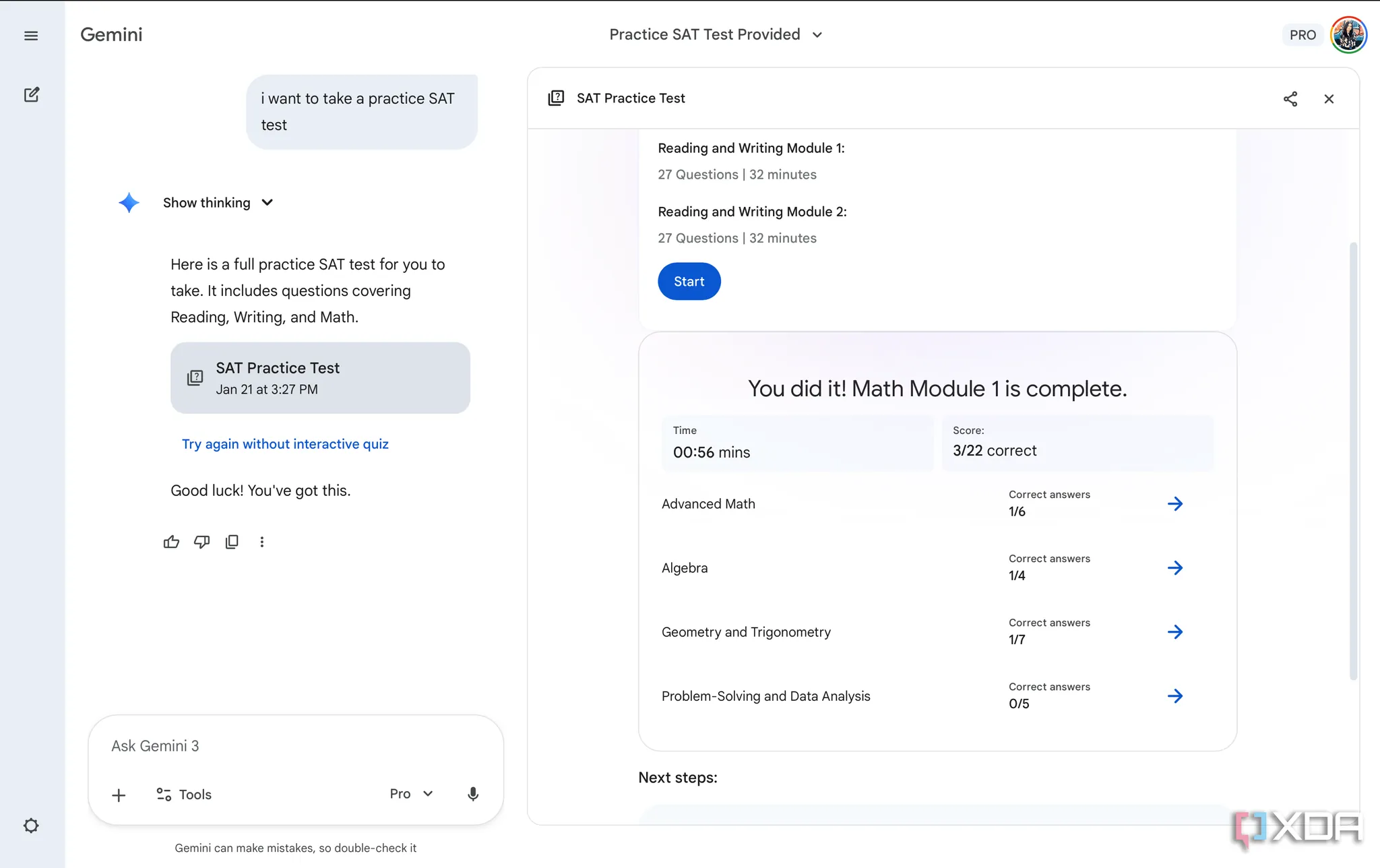
Gemini’s instant feedback is appealing. After a module, a student can see performance information quickly instead of waiting for a human to grade a paper test. MentoMind noted instant feedback and study-plan generation as part of the Gemini experience, while also warning that explanations could be hard to follow.[5]
Used carefully, that feedback can still help. If Gemini shows that a student repeatedly misses algebra-style items, transition questions, or data interpretation, it may point to a rough review area. The word “rough” is doing important work there. This is not a validated diagnostic instrument, and no verified data in the available materials links Gemini practice-test scores to real SAT outcomes.
The explanations also need adult supervision or at least student skepticism. InGenius Prep reported miscategorized question types in AI-generated SAT practice, and MentoMind described some Gemini explanations as bulleted and hard to follow.[5][6] Miscategorization is not a small issue in SAT prep. If the tool calls a question the wrong thing, the student may review the wrong skill and miss the actual fix.
Robinovitz’s industry report also argued that Princeton Review-style scoring can run substantially lower than official SAT outcomes, citing a 100–150 point gap as an industry concern rather than a published validation study.[8] I would not treat that as a universal conversion rule. I would treat it as one more reason to keep Gemini’s score-like numbers away from decisions such as whether to register, postpone, change a target school list, or stop studying.
Reliability: do not assume your progress is safe
The most practical reliability warning is session-bound progress. The Private Prep/ArborBridge reports and MentoMind all described progress as tied to the active session rather than a durable testing record in the way students expect from dedicated test platforms.[3][4][5] The Private Prep/ArborBridge reports also said at least one tester was auto-signed-out with two questions remaining and had to restart.[3][4]
That changes how I would assign Gemini. I would not tell a student, “Take this Saturday morning and we’ll analyze the full diagnostic afterward,” unless we had a backup plan for screenshots or notes. Losing progress near the end of a module is not just annoying; it breaks the testing condition and makes the result harder to interpret.
What to do with mixed student reactions
The community signal I found was mixed and too thin to carry much weight. Available Reddit snippets included one student calling the questions genuinely high quality and another reporting a much lower-than-usual first Reading and Writing module result. Because those snippets were not independently verifiable from the available material, I would use them only as a reminder that student experience varies, not as evidence that Gemini is either accurate or broken.
That variance is believable. A student who needs extra exposure and does not overread the score may get a useful study session from Gemini. A student using it as a final benchmark before test day may get misleading comfort or needless panic from the same product.
Where Gemini belongs in an SAT prep plan
Gemini belongs early, low-stakes, and clearly labeled as unofficial. That is the version of the tool I can defend: a free way to get moving, see SAT-like prompts, add reps between higher-quality resources, and build some stamina without paying for another platform.
| Use case | Gemini fit | Why |
|---|---|---|
| First baseline diagnostic | Poor fit | Interface, content, adaptive behavior, and scoring are not faithful enough to anchor a study plan. |
| Early practice volume | Useful | Free, on-demand access makes it easier to start practicing and add reps. |
| Learning official Bluebook tools | Poor fit | Missing Desmos, highlighter, answer eliminator, and Bluebook-style routines weaken test-day transfer. |
| Rough weakness spotting | Limited fit | Feedback may reveal broad patterns, but miscategorized items and off-syllabus content require caution. |
| Final weeks before the SAT | Poor fit | Students need official timing, official tools, and College Board-aligned calibration close to test day. |
| Extra practice after official tests are reviewed | Reasonable fit | It can add low-cost exposure as long as official resources remain the benchmark. |
For official-feeling practice, Bluebook remains the benchmark. MentoMind, InGenius Prep, and North American Tutors all point students back to Bluebook’s official tests rather than treating Gemini as a replacement.[5][6][7] If a student has not yet used the official materials, I would start with the SAT exam prep guide and then build a schedule around official practice before adding extra tools.
For free daily practice that stays closer to College Board expectations, Khan Academy SAT practice with Bluebook is the stronger default. Gemini can sit behind that as an extra source of reps, especially for students who are still in the early phase and need momentum more than precision.
If you are building a whole prep stack, the clean placement is simple: Bluebook for official practice, Khan Academy for aligned free instruction, a notebook or error log for review, and Gemini only as supplemental volume. Our SAT study tools guide covers that stack more broadly. If you want context on the content partner behind Gemini’s test, see our Princeton Review SAT prep courses review.
Final verdict
Use Gemini’s SAT practice test if you need a free, low-friction way to practice early in your prep plan. Use it for exposure, stamina, and extra question volume. Do not use it to decide your starting score, predict your real SAT score, replace Bluebook, or calibrate in the final weeks before test day.
The feature may also have changed since the early-2026 tester reports. Before treating any AI-generated practice test as stable, re-check the current interface, tools, module behavior, and question content yourself. If the test still drifts from Bluebook, keep it in the practice pile—not in the decision-making pile.
References
- Practice SAT with Gemini. Google Blog. January 21, 2026.
- The Princeton Review Reports Innovative Collaboration With Google Gemini. PR Newswire.
- Scoop on Gemini SAT Practice Tests. Private Prep.
- The Lowdown on Gemini-Powered SAT Practice Tests. ArborBridge.
- Gemini SAT Prep Review. MentoMind.
- AI-Generated SAT Practice Tests: What Works and What Does Not. InGenius Prep.
- Google Gemini SAT Practice Tool Review. North American Tutors.
- The Illusion of AI SAT Prep. Jason Robinovitz.
Authoritative source
For the authoritative version of this contentHow to Read the '1 in 4 NFL Players CTE' Study
Report an error in this tool's output
Found something this tool got wrong beyond what's documented above? Report it so the accuracy log stays current.
Comments
Join the discussion with an anonymous comment.