How Accurate Is Google AI Search for Student Research?
Accuracy Warning — Google AI search
AI answers can be correct-sounding but cite sources that do not fully support key claims; verify score-critical facts against official exam pages.
- Accuracy:
- Moderate
- Tested:
- Student research and exam-prep source discovery using AI Overviews and AI Mode
- Last tested:
- 2026-04-30
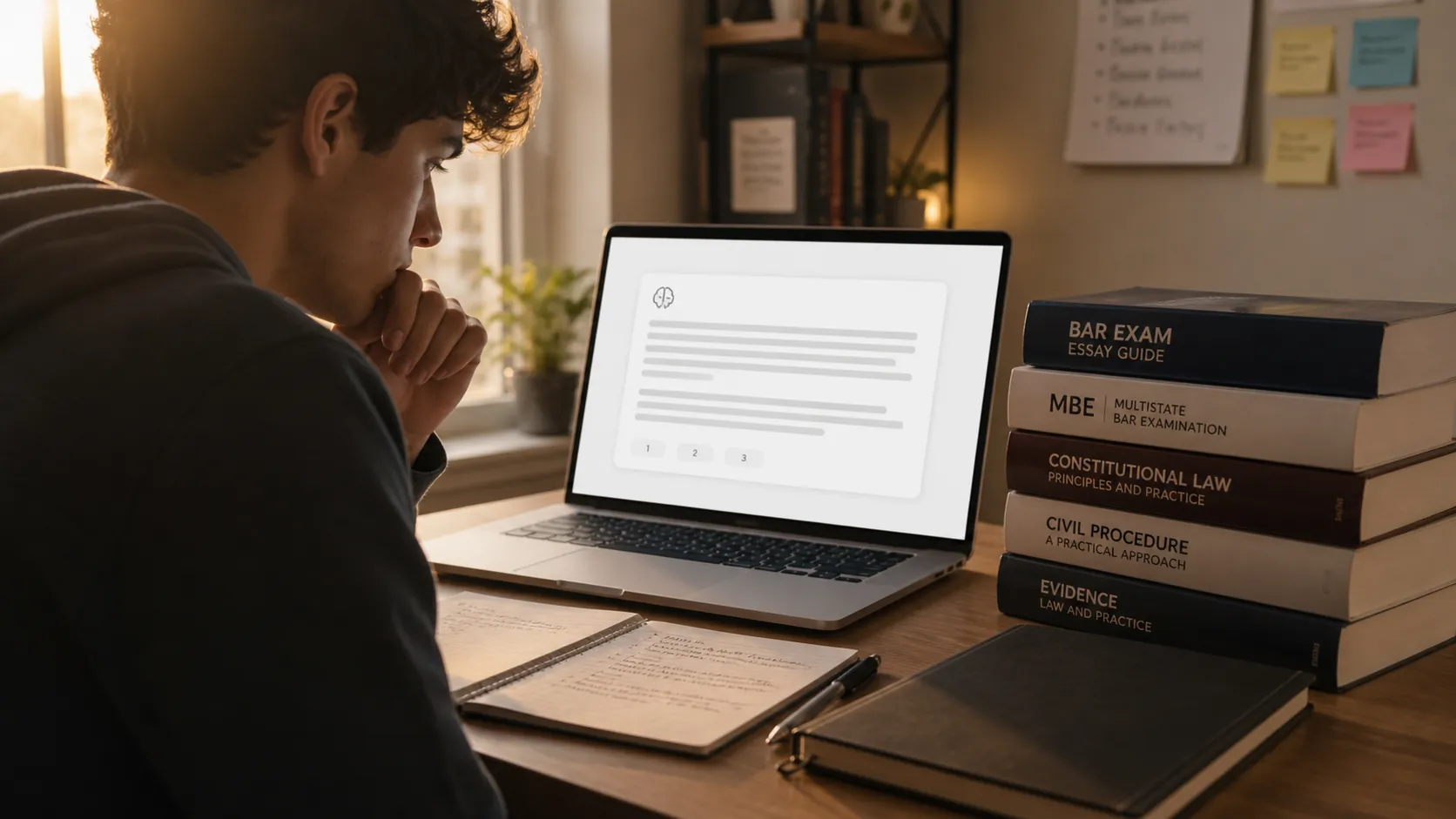
“Google AI search for student research test” can mean two different things. It can mean a student using Google’s AI answers to research an actual test, or it can mean testing Google’s AI search itself. This article takes the second route for the sake of the first: if you are four weeks from the SAT, ACT, GRE, MCAT, ASVAB, or another fixed-date exam, the question is not whether AI search feels useful. It is whether its answers are supported well enough to shape your study plan.
Last reviewed in Q3 2026: Google AI search is useful for orientation, vocabulary, and first-pass source discovery. It should not be treated as a score-critical citation for exam format, tested content, timing, scoring, official accommodations, or practice-test availability. AI Mode remains the kind of tool students should treat as experimental and verification-required, not as a replacement for official exam hubs.
The best short version of the evidence is uncomfortable but not hysterical: Google’s AI answers can be mostly right while still failing the source-support test. Oumi’s study, run for The New York Times and explained in Oumi’s methodology post, reported that AI Overviews were accurate about 91% of the time, but only about 39% were both correct and fully supported by the sources Google cited. Oumi also found that roughly half of correct-sounding AI Overviews contained at least one fact that the cited sources did not support. [1]
The problem is not only wrong answers
A student does not use an AI Overview the way a fact-checking researcher does. In real exam prep, the answer often becomes an action: add a topic to the weekly schedule, skip a chapter, choose one practice source over another, or assume a timing rule is settled. A citation badge makes that action feel safer. That is why “mostly accurate” and “fully supported by cited sources” are not interchangeable.
Imagine a student asks whether a certain algebra topic appears on an entrance exam. A Google AI answer might correctly say the exam tests algebra in general. It might then add a narrower claim about exactly how often a subtopic appears or which official practice set best represents it. If the cited page only supports the broad algebra claim, the answer may still sound right while quietly smuggling in an unsupported planning detail. That planning detail is where time gets wasted.
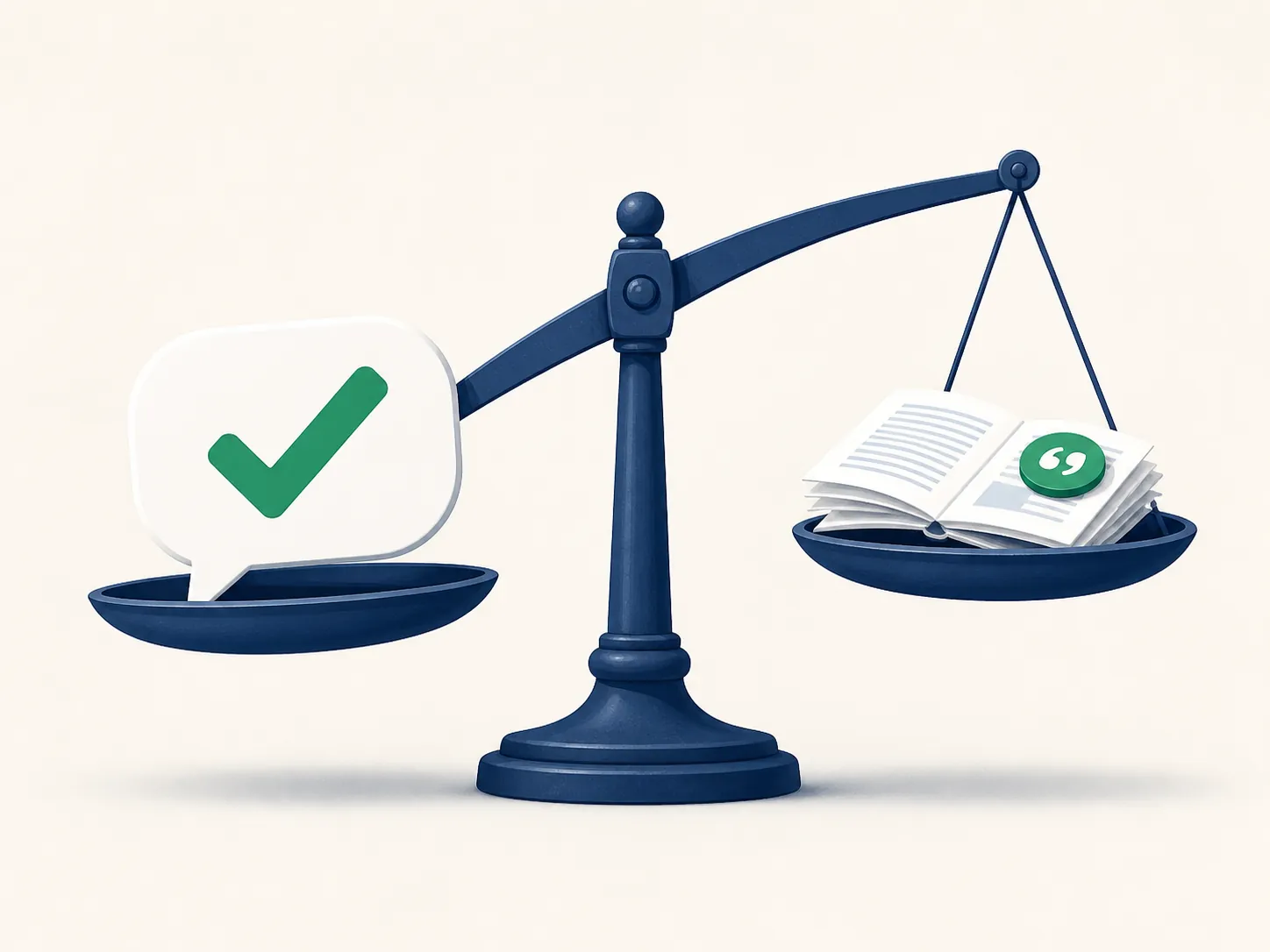
The source-support gap matters most when the student is under deadline pressure. If you have months, a weak AI answer is an annoyance. If you have one month before an MCAT date or two weekends before an ASVAB retest, a falsely confident answer about scope, timing, or practice quality can redirect scarce study hours.
| What the AI answer may do | Why it matters for test prep |
|---|---|
| Give a broadly correct answer with citations that support only part of it | The student may stop checking before verifying the exact exam rule or content boundary |
| Cite an official-looking page that omits the specific claim | The citation badge can make an unsupported detail feel official |
| Blend official information with general prep advice | The student may mistake strategy suggestions for exam-maker policy |
| Summarize several sources without showing which sentence came from which page | A wrong or unsupported subclaim becomes hard to isolate |
Google pushed back on the Oumi findings. In TechRepublic’s coverage, Google said the Oumi study had “serious holes,” and the same coverage reported Google’s own figure that Gemini 3, when used alone, provided incorrect information in 28% of queries. [2] Both points belong in the evaluation. Oumi’s measurement is not the final word on every AI Overview, and a Gemini-alone figure is not the same thing as measuring Google Search’s live AI Overviews. The practical conclusion for students, however, does not depend on declaring one side the winner: even the friendlier reading still leaves too much unsupported or incorrect material for score-critical decisions.
A larger 2026 measurement study shows how unsupported claims get in
The larger mechanism appears in an arXiv measurement study of 55,393 Google queries collected in March and April 2026. The researchers broke AI Overview responses into 98,020 atomic claims and found that 11.0% were unsupported by the cited pages. Omission was the dominant failure mode: the cited page simply did not contain the information needed to support the claim. [3]
That is exactly the kind of failure a busy student is least likely to notice. A contradiction is easier to catch: the source says one thing, the AI says another. An omission is quieter. The page may be relevant to the topic, may come from a respectable site, and may even support neighboring claims. It just does not support the sentence the student is about to rely on.
The same arXiv study also found that question-form searches triggered AI Overviews 64.7% of the time. [3] That matters for exam prep because students naturally search in questions: “What is on GRE Quant?”, “How long is MCAT CARS?”, “Does the ASVAB count toward enlistment?”, “Are official SAT practice tests enough?” The query format students use when they are trying to make a decision is also the format most likely to put an AI answer above the traditional results.
The study does not prove that every exam-prep AI Overview is unreliable. It does show that citation-backed AI answers can include unsupported atomic claims at meaningful scale. For a student, the unit that matters is not the whole answer’s general vibe. It is the single claim that changes tonight’s plan.
Consistency is another warning light
A separate assessment from Common Sense Media’s Youth AI Safety Institute, reported by EdTech Innovation Hub, tested 2,600 searches and found that AI Overviews gave materially different answers to repeated history questions 43% of the time. The same report described an invented unanimous Supreme Court ruling for a fictional case. [4]
Those findings are not an exam-prep benchmark, and they should not be stretched into one. They are still useful warning lights. Students often repeat a search with slightly different phrasing because they are trying to confirm a rule. If repeated searches produce materially different answers, the student has not actually confirmed anything. They have collected multiple fluent drafts.
Why citation chips do less work than students think
The presence of citations would be less dangerous if students routinely opened them, searched within the page, and checked whether each sentence was supported. That is not how most search behavior works. Pew Research Center found that users clicked a link inside an AI summary only about 1% of the time. [5]
That number is not specific to SAT, ACT, GRE, MCAT, or ASVAB students. It still explains the risk pattern. The AI summary answers the question in the same place where the citation appears, so the citation becomes a reassurance symbol rather than a path the user actually follows. A student may feel as though they checked sources because sources were displayed.
One adjacent higher-education study from UPCEA and Search Influence is also worth reading carefully, but not overusing. It concerns prospective higher-ed program researchers, not exam-prep test-takers, so it should not be treated as evidence about GRE, MCAT, SAT, ACT, or ASVAB behavior. Its value here is narrower: AI search is becoming part of how education decisions begin, which means the verification burden is moving earlier in the research process. [6]
What counts as Google AI search here
For student research, the labels matter only enough to identify what you are looking at. AI Overviews are the generated answer panels that can appear above regular Google results. AI Mode is the more conversational search experience that lets a student continue asking follow-up questions. Gemini is Google’s general AI assistant, which may be used separately from Search.
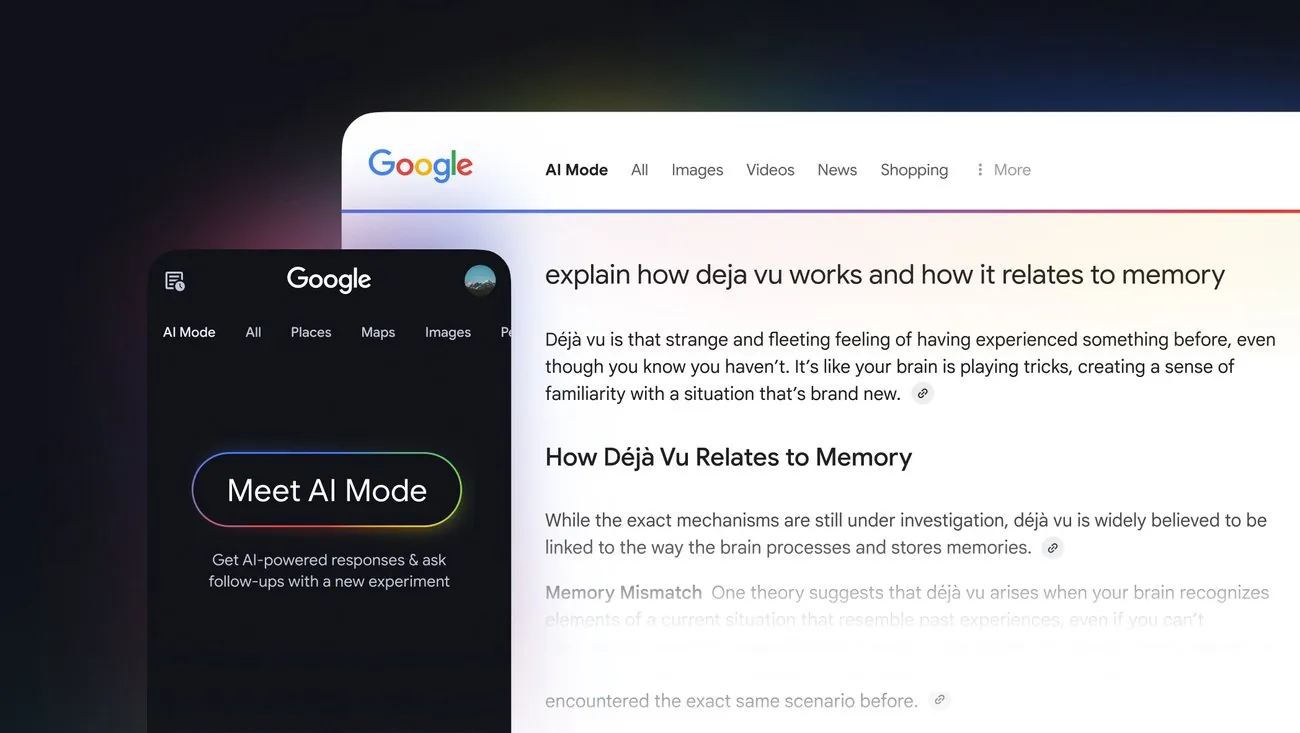
Those surfaces are not identical, and one study of one surface should not be casually applied to all of them. But for a student, they share the same practical risk: they generate a synthesized answer that can feel finished before the student has opened the underlying sources.
Where Google AI search fits in exam research
The safest use is early-stage orientation. If you are beginning an unfamiliar topic, Google AI search can quickly map the vocabulary, show common subtopics, surface likely official sources, and give you alternate explanations to compare. That is useful before you know what to search for precisely.
- Use it to translate a vague topic into search terms: for example, turning “military entrance test math” into arithmetic reasoning, mathematics knowledge, word problems, and formula review.
- Use it to identify likely official sources, then open those sources directly instead of trusting the AI summary.
- Use it to ask for a plain-language explanation of a concept after you have already verified that the concept belongs on your exam.
- Use it to generate low-stakes practice prompts, then check the answers against a trusted prep source or official explanation.
- Use it to compare explanations when you are stuck, especially for concepts where a second phrasing helps.
For example, an ASVAB student can use AI search to get oriented around AFQT vocabulary and then move into a structured source such as the ASVAB Exam Prep Guide. If the question is which app is worth using, a review like ASVAB study apps that boost AFQT score is a better next stop than accepting a generated ranking with unclear source support.
Where it should not be the final authority
Do not let an AI Overview or AI Mode answer settle any fact that changes your study calendar, registration decision, accommodation plan, or practice-test sequence. Those facts need official confirmation.
| Score-critical question | Where to verify |
|---|---|
| What sections are on the exam? | The official exam-maker or official program page |
| How long is each section? | The official test guide or current candidate handbook |
| How is the score calculated? | The official scoring documentation |
| Which accommodations are available? | The official accommodations policy and application instructions |
| Which practice tests are official? | The exam-maker’s official practice page or store |
| What changed this year? | The official update notice, bulletin, or handbook for the current testing year |
This is especially important for exams where small format assumptions shape the whole plan. A student who misunderstands MCAT section timing may build the wrong stamina practice. A GRE student who trusts a weak summary about Quant scope may under-practice a tested skill. An ASVAB student who confuses AFQT-critical areas with the full battery may spend time in the wrong place. The harm is not dramatic; it is operational.
The same caution applies to AI tools beyond Google. If you are comparing assistants for study projects, read tool-specific evaluations such as Claude Opus 5 pricing for student projects with the same question in mind: what work is the tool good for, and where does verification still belong?
A simple verification routine
When an AI search answer affects your study plan, slow down for three checks. First, open the cited source. Second, find the exact sentence or table that supports the claim. Third, ask whether the source is official, current, and specific to your exam version. If any of those fail, the AI answer can remain a lead, but it should not become a rule.
The useful habit is to separate discovery from authority. Google AI search is good at discovery: it can help you see the shape of a topic before you know the map. Authority belongs to official exam pages, current handbooks, official practice materials, and carefully sourced exam guides. The moment an AI-generated sentence starts saving you from checking, it has moved from helpful shortcut to study-plan risk.
So the verdict is narrow and practical: Google AI search passes as a starting point for student research and fails as a citable source for score-critical test facts. Use it at the beginning of the work. Do not let it close the work.
References
- Oumi’s Study Finds 50% of AI Overviews Contain Unsupported Facts, Oumi.
- Google AI Overviews Deliver Inaccurate Answers, Analysis Finds, TechRepublic.
- arXiv:2605.14021, arXiv.
- Google AI Search Rated Unacceptable Risk for Children After 2,600-Query Test, EdTech Innovation Hub.
- Google users are less likely to click on links when an AI summary appears in the results, Pew Research Center, July 22, 2025.
- AI Search & Higher Education Student Search Trends, UPCEA.
Authoritative source
For the authoritative version of this contentHow to Read the '1 in 4 NFL Players CTE' Study
Report an error in this tool's output
Found something this tool got wrong beyond what's documented above? Report it so the accuracy log stays current.
Comments
Join the discussion with an anonymous comment.