Gemini AI Studying Features Independently Reviewed for Exam Prep
Accuracy Warning — Gemini
AI-generated SAT practice content includes off-topic math and missing question types; Guided Learning may produce fake passages and premature answers.
- Accuracy:
- Moderate
- Tested:
- SAT practice test generation and Guided Learning tutoring evaluation
- Last tested:
- 2026-07-25
Last reviewed: July 25, 2026. Version caveat: most independent hands-on testing cited below examined Gemini 2.5 Pro or earlier, so newer Gemini 3 and 3.5 Flash behavior may differ. That matters because this is a Gemini AI studying features review for exam prep, not a permanent ranking of a fast-changing model.
The short verdict for SAT, GRE, MCAT, and ACT students is this: Gemini is safest as a research, organization, summarization, and review layer. It is not safe enough to be your primary tutor, question writer, or full-length practice-test source. That distinction is not cosmetic. A tool that mislabels a topic, gives away an answer too early, or simulates the wrong test environment can make a student feel productive while quietly training the wrong habit.
| Study job | Trust level for high-stakes prep | Reason |
|---|---|---|
| Organizing notes, long documents, class materials, and official explanations | Strong | Gemini’s large context and Google ecosystem make it useful for collecting and reshaping material you already trust. |
| Building source-backed orientation on a topic before deeper study | Useful with verification | Deep Research and summaries can reduce friction, but the student still needs official or instructor-approved sources for final exam claims. |
| Audio review from uploaded materials | Strong as a review supplement | NotebookLM-style audio can turn dense notes into something revisit-ready during a commute or between classes. |
| SAT-style practice tests and score calibration | Risky | Independent SAT reviews found off-test math topics, missing question types, interface gaps, and session-bound progress problems.[1][2] |
| Interactive tutoring through Guided Learning | Mixed | Hands-on tests found real strengths in math visualization, but also fake literature passages, premature answer reveals, and irrelevant remedial prompts.[3][4] |
The SAT practice-test problem is the clearest warning sign
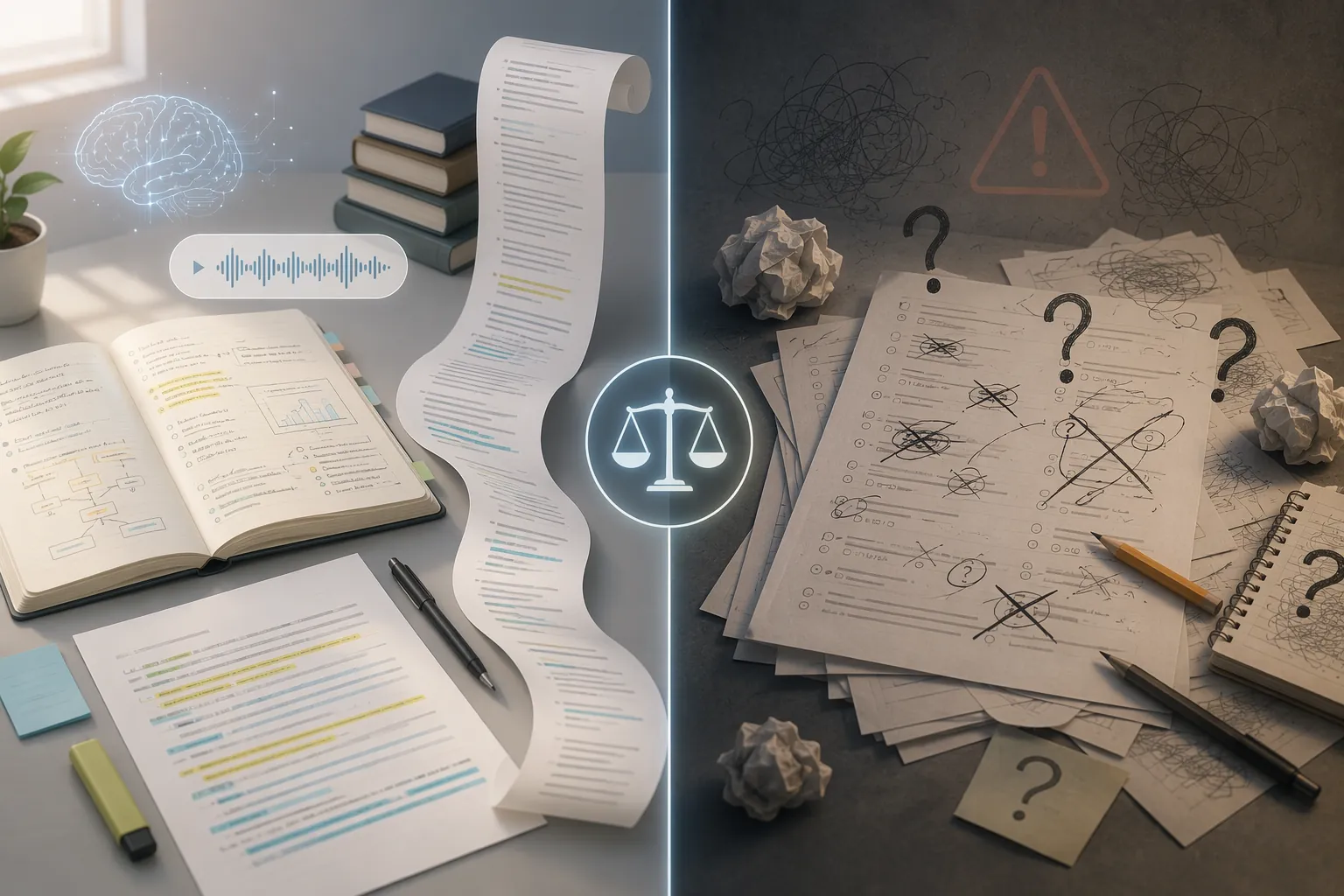
The highest-risk Gemini study use case is not asking it to summarize a chapter. It is asking it to stand in for an exam authority. SAT practice is where that line gets crossed most visibly.
MentoMind’s expert review of Gemini’s SAT prep tool documented generated math content involving imaginary numbers, logarithms, and the law of cosines — topics the review identified as outside the SAT scope.[1] For a relaxed learner exploring math, that might be a minor annoyance. For a student three weeks out from the SAT, it is a tax on the study plan. Every non-SAT topic that appears in a simulated SAT environment can pull attention away from the finite set of skills the student actually needs to sharpen.
That kind of error also damages confidence calibration. A student who misses a logarithm question in a supposedly SAT-aligned set may conclude, incorrectly, that there is a major content gap. Another student who spends an evening reviewing the law of cosines because Gemini surfaced it as practice may feel diligent while spending the wrong hour on the wrong material. The problem is not that enrichment math exists. The problem is that practice labeling tells the student what to worry about.
The reading and writing side raises a different issue: missing question types. MentoMind reported that rhetorical synthesis was absent from Gemini’s SAT practice coverage.[1] A missing type is less dramatic than a wrong answer, but it can be just as costly. Students use practice sets to infer the shape of the exam. If a recurring skill does not appear in the tool’s practice world, the student may under-practice it without realizing anything is missing.
The interface gaps matter for the same reason. MentoMind reported that the Gemini SAT practice environment lacked a Desmos calculator, answer eliminator, and highlighter.[1] North American Tutors also flagged the tool’s practical limitations, including session-bound progress that can reset on sign-out.[2] These sound like small platform complaints until you watch an anxious student practice. Eliminating answer choices, marking text, using the calculator fluently, and returning to unfinished work are not decoration. They are part of the test-taking routine.
A simulated SAT that does not preserve progress reliably also undermines review. Students need to revisit missed questions, separate careless errors from concept errors, and track whether a weak area is improving. If the session boundary becomes part of the risk, then the student has to manage the tool instead of letting the tool manage the practice record.
Google announced SAT practice tests in Gemini as a study feature, and the idea is easy to understand: if students are already asking Gemini for help, practice inside the same interface lowers friction.[5] But lower friction is not the same as valid practice. For the SAT, the safer default remains official College Board Bluebook practice and other exam-aligned resources built around the actual test interface and content boundaries. Gemini can help explain an official question after you have attempted it; it should not be the source that decides what counts as SAT practice.
Guided Learning is useful when it teaches, risky when it improvises
Guided Learning is the more interesting case because it gets closer to the promise students actually want from AI: not just answers, but a responsive tutor that can slow down, show steps, and ask questions. Independent tests suggest Gemini can do part of that well, especially in math. The trouble is that tutoring failures are harder to spot than a broken calculator button.
Mashable tested Guided Learning across five subjects and found that Gemini was strong at math step-by-step visualization.[3] That is exactly the kind of AI study help worth keeping. When a student is stuck on algebra, calculus, physics math, or a GRE quant-style setup, a visual breakdown can make the next attempt less mysterious. If Gemini helps a student see where a transformation came from, rewrite a messy solution, or compare two solution paths, it can improve the next study hour.
The same Mashable test found a more serious failure in reading comprehension: Gemini generated AI-approximated fake literature passages instead of using real texts.[3] That is not a harmless shortcut for exam prep. Reading comprehension is partly about learning how real passages behave — density, ambiguity, tone, evidence, structure, and distractor patterns. A fake passage can still look literary enough to satisfy a chat interface while training the student on the wrong texture of evidence.
MakeUseOf’s test using PharmD curriculum material found another tutoring problem: Guided Learning gave away answers prematurely and asked irrelevant basic questions.[4] For coursework, that can be frustrating. For MCAT, GRE, ACT, or SAT prep, it can be actively distorting. A tutor that reveals the answer before the student commits removes the retrieval moment. A tutor that drops into irrelevant basics consumes time and may convince the student that the system has diagnosed a weakness when it has only drifted.
The pattern is not that Guided Learning is useless. It is that its best behavior and worst behavior sit too close together. A student can get an excellent visual explanation in one exchange and a poor reading-comprehension substitute in the next. That makes it better suited for targeted clarification than for an end-to-end prep plan.
Use it when the source material is already known: an official SAT explanation, an AAMC passage review, an ETS quantitative problem, a teacher’s solution, a textbook section, or your own missed-question log. Ask Gemini to explain the reasoning, generate a simpler analogy, compare two approaches, or turn the explanation into a checklist. Be much more cautious when Gemini invents the passage, invents the practice question, and grades your readiness from its own generated material.
Where Gemini earns its place: infrastructure, not authority
Gemini’s strongest study case is not glamorous tutoring. It is infrastructure. The free 1M-token context window is the feature that changes what a no-cost study setup can hold, especially for students with scattered notes, PDFs, lecture outlines, rubrics, and official explanations.[6] Android Police’s student-focused coverage emphasized the practical value of Gemini AI Pro access and the large context window for student work.[6]
A large context window matters because real studying is messy. A student may have a semester’s worth of biology notes, a stack of MCAT content review summaries, lab handouts, practice explanations, and a personal error log. If the AI can hold more of that context at once, it can compare sources, find recurring weak spots, and turn a pile of material into a usable review map. That is a very different job from asking it to invent the exam.
NotebookLM-style Audio Overviews are also genuinely useful when treated as review, not replacement. Google’s student feature roundup described expanded access to NotebookLM Audio Overviews, including Pro users getting five times more generations, with five generations per source.[7] For a commuter, athlete, part-time worker, or student moving between classes, this is the kind of AI feature that can turn idle minutes into a second pass through material already chosen by the student.
Deep Research belongs in the same category. It can help a student build a source-backed orientation before deeper study, especially for broad subjects such as MCAT psychology terms, GRE issue essay background, or ACT science topic review. The boundary is important: it can help assemble and summarize sources, but it should not become the final authority for what the test requires.
Hackceleration’s review rated Gemini 4.1 out of 5 while still flagging persistent mathematical errors and context loss in long conversations.[8] That combination is a fair picture of the tool. Gemini can be powerful enough to deserve a place in a student’s study setup and still unreliable enough that a score-dependent student should verify calculations, generated questions, and exam-specific claims.
A safer exam-prep stack
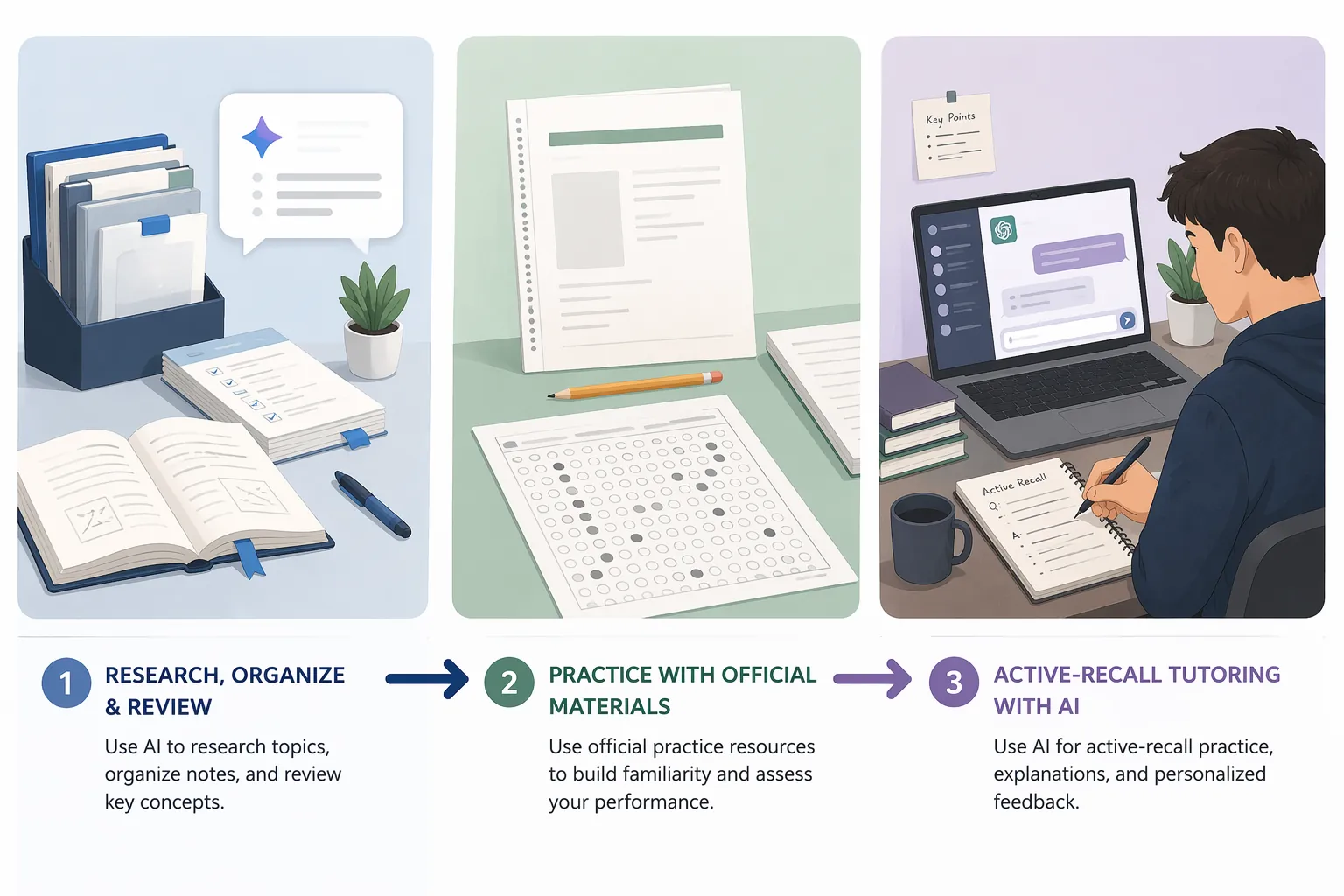
The practical setup is to give each tool a narrower job. Gemini should help collect, summarize, organize, and reformat trusted material. Official exam sources should carry practice, scoring, and timing. A tutoring layer can help with active recall and explanation, but it should be checked against official answers when the stakes are high.
| Prep task | Best source of truth | Gemini’s safer role |
|---|---|---|
| Full-length SAT practice | College Board Bluebook and official SAT materials | Review official explanations, summarize missed-question patterns, organize a retake plan |
| MCAT passage and content review | AAMC materials, instructor-approved content, and trusted prep books | Condense notes, compare explanations, build review sheets from verified sources |
| GRE practice and score calibration | ETS materials and exam-specific practice resources | Explain official quantitative solutions, turn vocabulary or issue-writing notes into review formats |
| ACT timing and section practice | Official ACT practice materials and exam-specific platforms | Create study schedules, summarize mistakes, and convert official review into drills |
| Active-recall tutoring | Verified questions and explanations | Ask for hints, Socratic prompts, analogies, and spaced review from material you supply |
Vertech Academy’s multi-round comparison gave ChatGPT the edge on concept explanations and quiz generation, while Gemini won on Google ecosystem integration and free Pro access.[9] Because prep-site comparisons can carry commercial incentives, that result should not be treated as a final verdict by itself. It does, however, line up with the broader pattern: Gemini is strongest when the task involves documents, Google tools, and study infrastructure; it is less convincing when the task is acting as the sole tutor or quiz authority.
Google’s own Guided Learning announcement frames the feature around helping students learn through step-by-step support rather than simply receiving answers.[10] That is the right goal. The independent tests above show why the implementation still needs boundaries. A student can use Gemini to ask, “What hint would help me take the next step?” or “Can you explain why the official answer is B without revealing the full solution first?” The student should be much more skeptical of “Generate a new SAT reading set and grade me” or “Make me an MCAT-style passage and tell me if I’m ready.”
How to use Gemini without letting it damage your score
The safest Gemini approach starts with material that already has authority. Upload or paste official explanations, class notes, instructor handouts, textbook excerpts, or your own error log. Then ask Gemini to reorganize what is there: group missed questions by skill, turn dense notes into a one-page review, explain a solution in simpler language, or create a commute-friendly audio review from verified material.
For math, use Gemini’s visual and step-by-step strengths, but keep the original problem and official answer in view. If Gemini’s solution disagrees with the source, the source wins until you can independently verify the reasoning. For reading, be stricter: do not let Gemini replace real passages with invented ones when you are practicing comprehension. For science-heavy exams, use it to compare explanations and build concept maps, not to invent final diagnostic passages.
- Safer Gemini request: “Using only the official explanation below, show me the reasoning in three steps and then ask me one follow-up question.”
- Safer Gemini request: “Group these missed SAT math questions by tested skill and list what I should review first.”
- Risky Gemini request: “Make me a full SAT practice test and estimate my score.”
- Risky Gemini request: “Generate MCAT-style passages and tell me whether I am ready for test day.”
Also check current access before building a plan around paid or student-only features. Google’s student offers have shifted over time, and availability can vary by region or account status. A free month of Pro is useful; it is not a study plan. The plan should survive if the subscription changes.
Final trust boundary
Gemini belongs in a serious exam-prep stack, but not at the center of score calibration. Use it to collect, summarize, organize, compare, and review official or instructor-provided materials. Use NotebookLM Audio Overviews and the large context window when they make real studying easier to repeat. Use Guided Learning for targeted clarification, especially when you bring the source material.
Do not let Gemini replace College Board Bluebook, AAMC, ETS, Khan Academy, ACT-aligned official practice, or exam-specific full-length tests. The tool is most impressive where infrastructure matters. It is least trustworthy where exam accuracy matters most.
References
- Gemini SAT Prep Review, MentoMind.
- Google Gemini SAT Practice Tool Review, North American Tutors.
- Google Gemini Guided Learning Review, Mashable.
- ChatGPT vs. Gemini Study Mode, MakeUseOf.
- Practice SAT in Gemini, Google.
- Gemini AI Pro Student, Android Police.
- Gemini Features for Students, Google.
- Gemini Review, Hackceleration.
- ChatGPT vs Gemini for Studying: Which Is Better in 2026, Vertech Academy.
- Guided Learning, Google.
Authoritative source
For the authoritative version of this contentHow to Read the '1 in 4 NFL Players CTE' Study
Report an error in this tool's output
Found something this tool got wrong beyond what's documented above? Report it so the accuracy log stays current.
Comments
Join the discussion with an anonymous comment.