
How Much Does Claude Opus 5 Cost for Student Projects?
Accuracy Warning — Claude Opus 5
AI-generated responses may include errors or hallucinations. Always cross-check with official exam materials.
- Accuracy:
- Limited
- Tested:
- Pricing for conversational tutoring, flashcard generation, and batch problem review
- Last tested:
- 2026-07-25
Checked in Q3 2026, the practical answer is this: if you use Claude Opus 5 like a tutor, the $20/month Pro plan is usually the safer budget choice; if you use it like a machine that repeats the same study job over and over, the API can be cheaper. Opus 5 launched on July 24, 2026 at $5 per million input tokens and $25 per million output tokens for standard API use, with fast mode priced at $10/$50 per million tokens and Pro access listed at $20/month.[1][2]
That split matters more than the model name. A student asking Claude to explain missed GRE questions every night has a different cost problem than a student batch-generating flashcards from the same biology chapter. The first student wants a monthly ceiling. The second wants to avoid paying full input price every time the same context is reused.
| Access route | Best fit for student projects | Budget warning |
|---|---|---|
| Free tier | Trying Claude, light concept checks, occasional short study help | Rate caps make it unreliable for heavy exam-prep weeks |
| Claude Pro at $20/month | Conversational tutoring, essay feedback, back-and-forth explanations | Still has usage limits, but the spending ceiling is clear |
| API at $5/$25 per million tokens | Flashcard generators, batch problem review, repeated chapter-based workflows | Costs can creep if you send long prompts repeatedly without caching |
| API fast mode at $10/$50 per million tokens | Speed-sensitive cramming where response time matters more than price | Twice the standard API price, so it is hard to justify for ordinary prep |

Start With the Week You Are Actually Paying For
A test-prep week usually has a shape. You may spend Monday and Wednesday asking for explanations, Friday revising an essay, and Sunday reviewing every missed question from a practice test. Or you may spend one evening building a spreadsheet-to-flashcard workflow and then run it repeatedly. Claude Opus 5 pricing for student projects only makes sense after that shape is clear.
For normal chat-heavy study, Pro wins because it turns uncertainty into a fixed monthly line item. If you are using Claude as a patient tutor — explain this passage, quiz me again, rewrite my thesis, show another way to solve this algebra problem — API billing makes every long exchange a metered exchange. A $20 subscription is not automatically cheap, but for a month before an exam it is easier to budget than a growing token bill.
The free tier belongs in a smaller role. It is useful for testing whether Claude fits your study habits, or for occasional light help, but it is not a dependable heavy-prep plan. Claude’s public pricing page describes Free as limited access with rate caps, while Pro is the paid consumer plan at $20/month.[2]
One freshness note: as of July 25, 2026, some Claude pricing surfaces may still lag behind the Opus 5 launch and show Opus 4.8 in places. That does not change the launch price cited above; Anthropic’s Opus 5 announcement states that Opus 5 keeps the same pricing as Opus 4.8.[1][2]
Use Case 1: Conversational Tutoring and Essay Feedback
This is the student who opens Claude the way they would text a tutor: “Why is C wrong?” “Can you make me a harder version?” “Grade this ACT essay draft.” “Explain the official solution without skipping the trap.” The work is messy, interactive, and hard to predict in advance.
For that pattern, Pro is usually the cheapest sensible route because the student is buying room to think out loud. The important price feature is not that Pro gives the maximum possible access; it is that the bill does not rise every time a student needs one more explanation before the test date. API access can still work for light conversational use, but the more valuable Claude becomes as a tutor, the more likely a fixed subscription starts to look better.
Essay feedback pushes even harder toward Pro. Drafts are long, rubrics add context, and useful critique often requires follow-up: first structure, then evidence, then timing, then a final rewrite. Those are exactly the sessions where a student does not want to keep wondering whether the next prompt is worth the token cost.
The API is not wrong for tutoring if you are building a custom study app, logging responses, or running a controlled workflow. But if all you want is a browser chat where Claude behaves like an exam coach, start with Free to test fit and move to Pro when the usage becomes regular.
Use Case 2: Flashcard Generation From Reused Material
Flashcards are where the API starts to earn a serious look. The cost problem changes because the student is often reusing the same source material: one textbook section, one set of lecture notes, one anatomy handout, one vocabulary list. If you paste that same context into a chat again and again, you are paying with attention even if you are not looking at a token meter. If you send it through the API without cost controls, you may also be paying repeatedly for the same input.
Claude’s platform pricing gives API users a tool that fits this exact study behavior: prompt caching. Cached reads are priced at 0.1x the standard input price, meaning repeated reads of cached input cost 90% less than normal input reads.[3] In student terms, the first pass through a chapter can be the expensive pass; later runs that ask for cloze cards, misconception checks, or a shorter review set can reuse the cached context at a much lower input cost.
That does not make the API automatically cheaper for every flashcard habit. If you only need twenty cards once, a free flashcard tool or one Pro chat may be enough. If you are building a repeatable generator for a full course or a long MCAT content review schedule, API billing can become more economical because the workflow stops being a conversation and starts being a repeatable job.
The clean version is simple: use Pro when you are asking Claude to help you decide what should become a card; consider the API when you already know the source material and want to produce, revise, deduplicate, or export cards repeatedly. If flashcards are the main budget question, it is also worth comparing Claude against dedicated tools in Free Flashcard Maker with AI — Do You Even Need to Pay in 2026? before paying for another subscription slot.
Use Case 3: Batch Problem Review
Batch problem review is the most overlooked student use case because it does not feel like tutoring. The student exports a list of missed questions, tags the topic, includes their wrong answer and the official answer, and asks Claude to classify the error pattern. The output might be a table: careless arithmetic, content gap, misread question stem, weak elimination, timing issue.
This is where API economics can beat a subscription. The work is structured, repeated, and easy to run in batches. Claude platform pricing includes batch processing discounts, and those discounts matter when a student is less concerned with instant replies than with getting a full practice set analyzed before the next study block.[3]
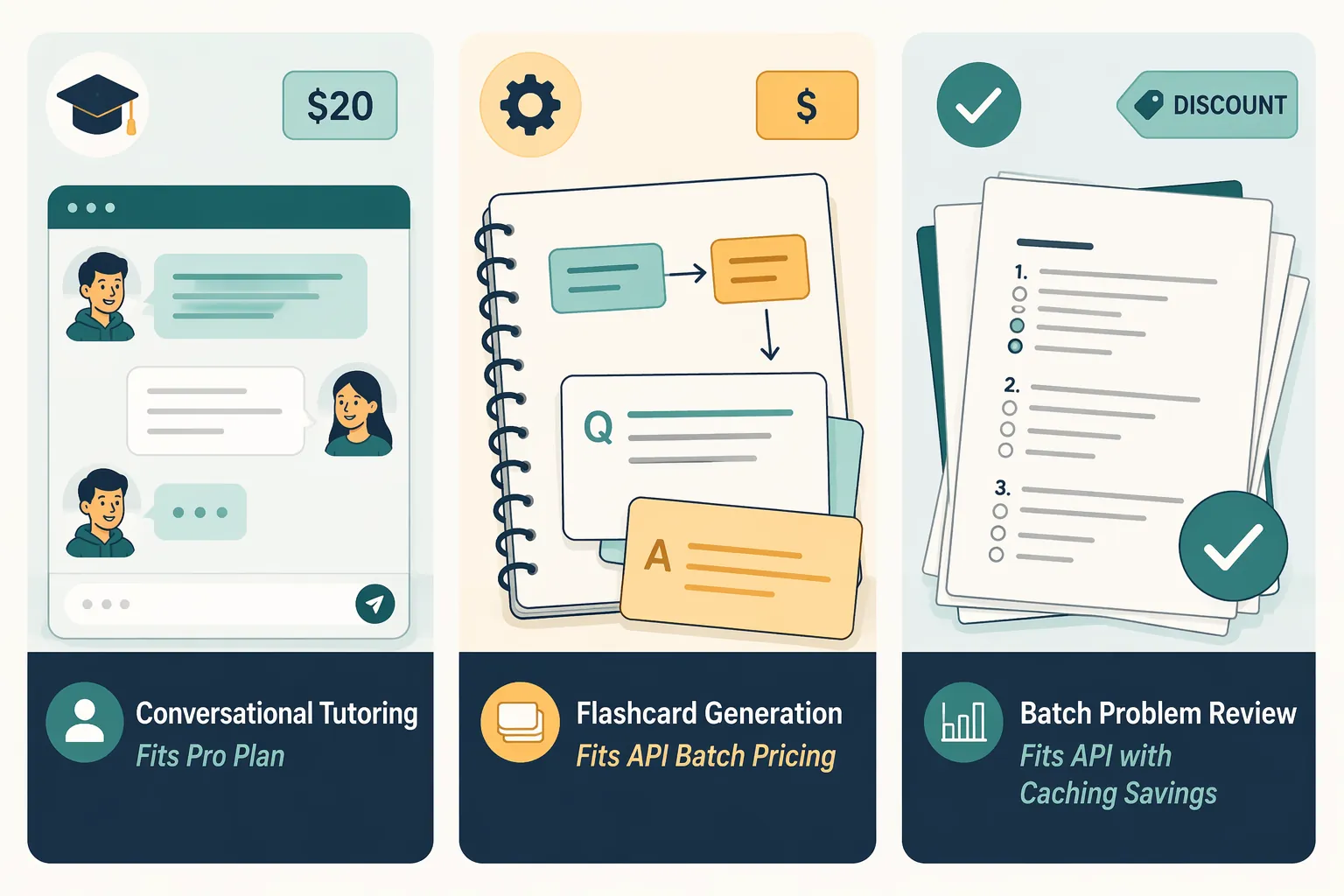
A hypothetical example makes the distinction clearer. Suppose a student has a reusable review template: exam section, missed-question text, answer choices, chosen answer, correct answer, official explanation, and the student’s brief note. In Pro, the student can paste a batch into chat and ask for patterns. That may be perfectly adequate. In the API, the same student can run the template across multiple practice sets, store the results, and reuse stable instructions with caching. The second route takes more setup, but it is closer to building a study system than buying a tutoring session.
The API becomes less attractive if the student will never reuse the workflow. A one-time SAT practice test review the night before the exam does not need engineering. A weekly MCAT missed-question pipeline might.
The Cost Controls That Matter in the API
The mistake is treating API pricing as one flat meter. For student projects, three controls change the bill: caching, batching, and effort level.
- Prompt caching: best when the same chapter, passage set, rubric, or instruction block appears across multiple runs; cached reads cost 0.1x standard input price.[3]
- Batch processing: best when a student can wait for a set of flashcards, classifications, or practice-question reviews instead of needing instant chat replies.[3]
- Effort toggle: best when routine tasks do not need the model’s deepest reasoning, while hard multi-step problems can be escalated.
The effort toggle is the Opus 5 feature I would actually want careful students to notice. Anthropic says Opus 5 ships with low, medium, and high settings that control reasoning token spend per query.[1] In study terms, that means a student can use low effort for routine vocabulary checks or basic summaries, then reserve high effort for dense CARS passages, difficult GRE quant explanations, or a final review of a high-stakes essay.
That is better than pretending every task deserves the same spend. A spelling cleanup, a deck-format conversion, and a multi-step probability problem should not be priced mentally as if they require the same depth. For a broader warning on overusing tokens as a study strategy, see Why Tokenmaxxing Backfires When You're Studying for an Exam.
Fast mode is a different decision. Anthropic prices Opus 5 fast mode at $10 per million input tokens and $50 per million output tokens, and describes it as 2.5x faster than standard mode.[1] That can be worth it during a last-minute cram window when a student needs many responses quickly. For ordinary weekly prep, paying twice the standard token rate is usually the wrong place to spend scarce study money.
Where Sonnet 5 Fits
Opus 5 is the stronger model in Anthropic’s launch framing, and Anthropic reports Opus 5 at 43.3% on Frontier-Bench.[1] That kind of capability can matter when a student needs the model to verify its own work and self-correct instead of producing a confident but brittle explanation.
But not every student project needs the most capable model on every call. Sonnet 5 may be the better API choice for routine, high-volume tasks such as formatting notes, making first-pass flashcards, or tagging easy missed-question categories. Claude platform docs list Sonnet 5 introductory pricing at $2 per million input tokens and $10 per million output tokens through August 31, 2026, rising afterward to $3/$15 per million tokens.[3]
That expiration date matters. A student studying for an August test can make one calculation; a student planning through the fall needs to use the post-intro price. If you are also weighing model quality rather than only price, the companion comparison Is Claude Opus 5 or Fable 5 Better for Studying? is the better next read.
Student Discounts, University Access, and Credits
There is no public, universal “student discount code” that should be treated as part of Claude Opus 5 pricing. The real student-friendly route is institutional access. Anthropic’s Claude for Education program is university-managed, and announced partners include Northeastern, the London School of Economics and Political Science, and Champlain College.[4]
If your school participates and gives students Pro-level access through single sign-on, that can erase the personal subscription cost entirely. That is not the same as a coupon you can apply with a student email. It depends on whether your institution has the program and whether your account is eligible.
It is worth checking because heavy Claude use is already concentrated in campus settings. Anthropic’s April 2025 education report found that computer science students accounted for 36.8% of Claude education conversations, though that report covers university use broadly rather than exam-prep students specifically.[5]
API credits are more uncertain. One commercial discount guide reports a For Student Builders credit range of $500 to $5,000, but that figure should be treated as reported, not official pricing, unless verified against Anthropic’s own application materials.[6] If a student can actually obtain credits, the API route becomes much easier to justify for tool-building projects. Without credits, the same caching and batching discipline still matters.
A Practical Route Recommendation
| Your main study behavior | Start here | Switch when... |
|---|---|---|
| You ask for explanations, tutoring, essay feedback, or practice-question coaching | Free for testing, then Pro at $20/month | You need a custom app, logs, automation, or repeatable batch workflow |
| You generate flashcards from the same materials repeatedly | API if you can use caching; Pro if it is occasional | The setup time costs more than the cards are worth |
| You review many missed questions in structured batches | API with batching and reusable instructions | You only need one conversational review session |
| You need immediate responses during final cramming | Pro first; API fast mode only if speed is the bottleneck | The extra fast-mode cost would replace more useful prep resources |
| Your university offers Claude for Education | Use institutional access first | You need API features the campus plan does not cover |
| You are doing high-volume routine automation | Compare Sonnet 5 API pricing before defaulting to Opus 5 | The task requires stronger reasoning or self-correction |
The student with one paid subscription slot left should not buy the most powerful-sounding route. Buy the route that matches the work. For chat tutoring before a fixed test date, Pro’s $20/month ceiling is the cleanest choice. For repeatable student projects — flashcards, batch review, study dashboards, practice-question pipelines — API pricing can be cheaper if you actually use caching, batching, and the effort toggle instead of sending every task through the most expensive path.
References
- Introducing Claude Opus 5 — Anthropic, July 24, 2026.
- Plans & Pricing — Claude by Anthropic.
- Pricing — Claude Platform Docs.
- Introducing Claude for Education — Anthropic.
- Anthropic Education Report — Anthropic, April 2025.
- Claude Student Discount 2026 — Get AI Perks.
Authoritative source
For the authoritative version of this contentHow to Read the '1 in 4 NFL Players CTE' Study
Report an error in this tool's output
Found something this tool got wrong beyond what's documented above? Report it so the accuracy log stays current.
Comments
Join the discussion with an anonymous comment.