ChatGPT Is Down: 3 Study Tools That Work Better Anyway
Accuracy Warning — NotebookLM
AI can misinterpret source material; always verify explanations against official exam content.
- Accuracy:
- Moderate
- Tested:
- Source-grounded explanation and question generation from uploaded notes and official prep documents
- Last tested:
- 2026-07-25
If ChatGPT is down in the middle of exam prep, do not spend the study block waiting for the green checkmark to come back. Open a flashcard or quiz tool, a source-grounded notes tool, and a spaced-repetition tool. That three-part switch covers the study jobs most students were trying to make ChatGPT do anyway: recall, explanation tied to materials, and durable review.
The whole stack can be assembled in under 10 minutes if you already have your notes, syllabus, PDF, or missed-question list nearby. The point is not to find a chatbot with a different logo. The point is to stop the 9:40 p.m. refresh loop before it eats the hour you set aside for GRE vocab, MCAT biochem, SAT grammar, ACT math, or ASVAB practice.
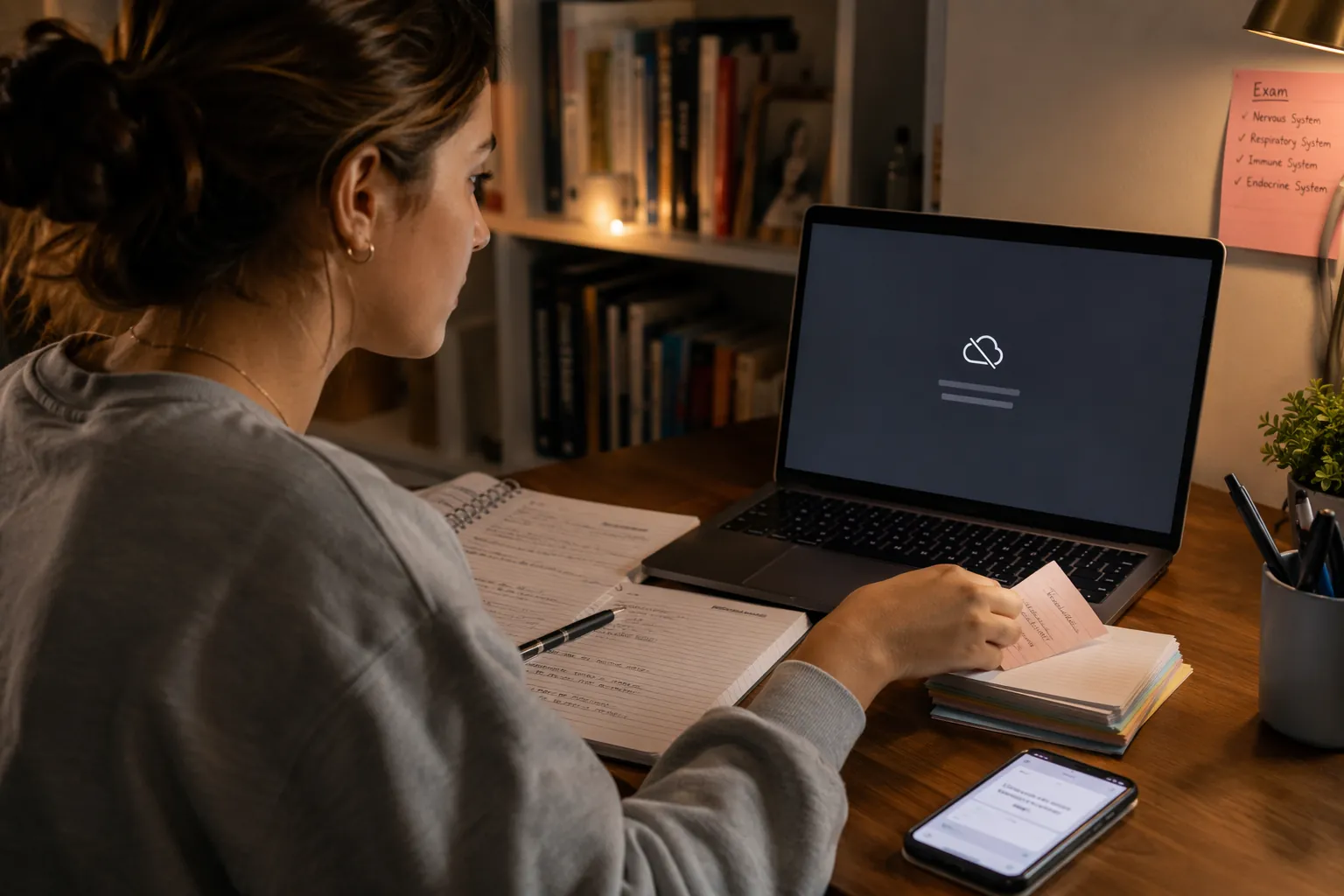
Downtime is real enough to plan around, even if it is not constant. OpenAI’s public status page showed 99.67% uptime for ChatGPT across the April–July 2026 window, which roughly implies several hours of potential downtime per month rather than a daily crisis.[1] Recent outage coverage gives the student-level consequence more shape: Reuters reported more than 13,000 user reports during a February 3, 2026 disruption, and Moneycontrol reported more than 1,720 reports across 12 affected components during an April 20, 2026 incident.[2][3]
That is enough to wreck a fixed study block. It is not enough to justify building your whole prep life around outage anxiety. Build the backup once, use it immediately when needed, and keep the work moving.
The 10-Minute Stack
A useful ChatGPT-down study setup has three jobs, not three nearly identical chat windows. One tool should make you answer before you see the answer. One should keep explanations attached to your actual notes or source material. One should bring old material back on a schedule after the evening’s panic has passed.
| Study job | Fast tool choice | What to do first |
|---|---|---|
| Active recall | Thea, or another flashcard/adaptive quiz app | Paste or upload the topic list, then start a quiz before reading explanations. |
| Source-grounded notes | NotebookLM | Add your class notes, textbook excerpt, lecture PDF, or official prep document, then ask for explanations tied to those sources. |
| Durable review | Knowt or Anki | Turn missed questions and weak terms into cards scheduled for later review. |
Last reviewed July 25, 2026: Thea lists free access across web, iOS, and Android; NotebookLM is available with a Google account; Knowt and Anki both support free spaced-repetition study, with Anki’s offline-first workflow still useful when Wi-Fi is part of the problem.[4][5][6][7] Pricing and platform details change, so treat those as a current snapshot rather than a permanent promise.
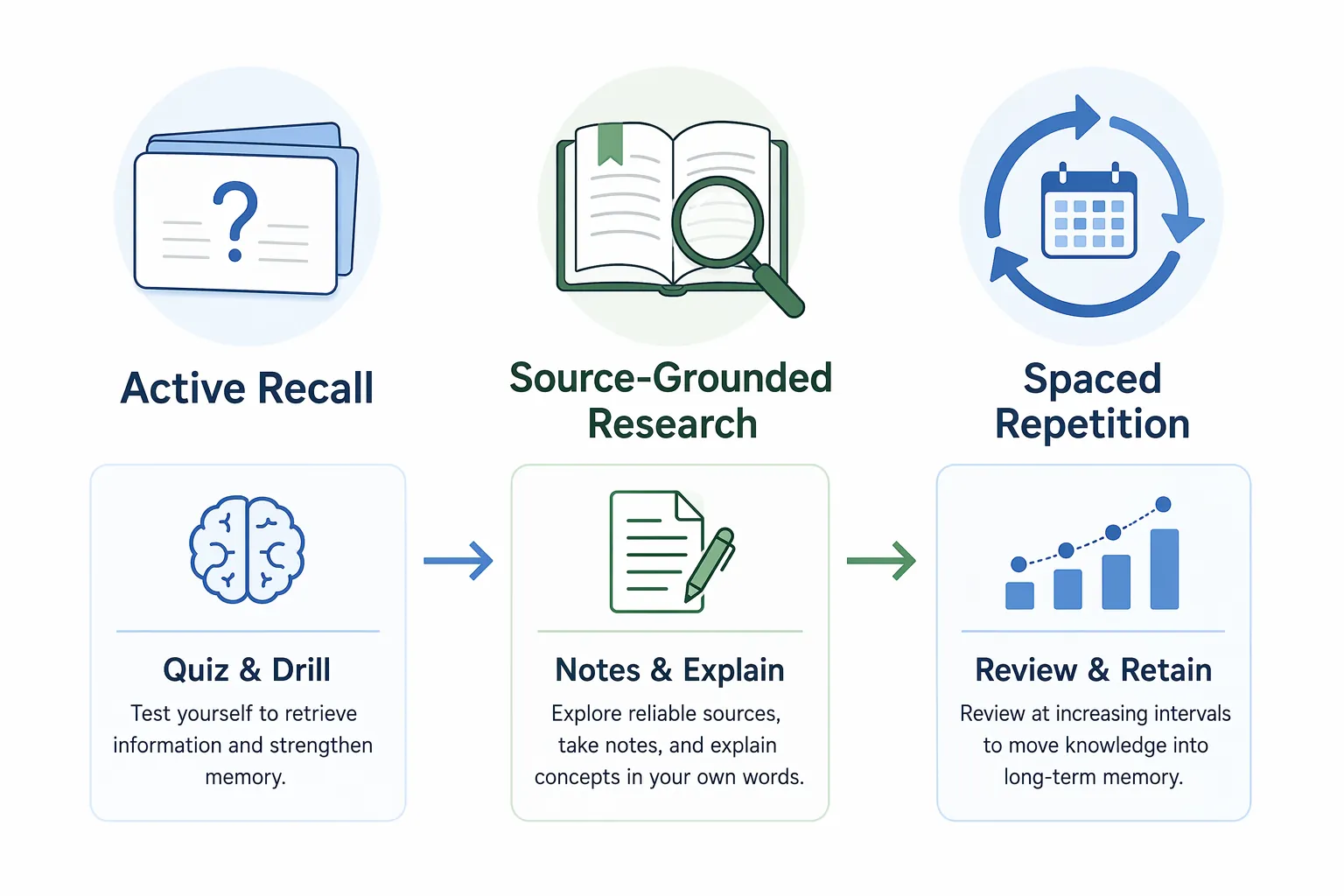
First, Force an Answer
Start with the flashcard or quiz tool, not the explainer. If you begin by asking for a clean summary, you can feel productive while doing the easiest part of the job. For most test prep, the first rescue move is uglier and better: make yourself answer.
For vocab-heavy work, load the terms and definitions, then run a short drill. For science or history, use headings from your notes as prompts and force yourself to write the mechanism, date relationship, or cause before checking. For math, grammar, or admissions-test strategy, use missed questions as the card source: front side is the problem type or trap; back side is the rule, setup, or reason your first answer failed.
Thea fits this first slot because its AI flashcards and adaptive quizzes are built around being tested rather than being talked at.[4] It is not the only possible choice. The selection rule matters more than the brand: if the app lets you keep requesting hints until the answer is basically visible, it is behaving too much like the study pattern you are trying to interrupt.
Then Ground the Explanation in Your Materials
After the first quiz attempt, move to NotebookLM or a comparable source-grounded tool. This is where many students misuse ChatGPT during normal nights: they ask for a broad explanation, get something fluent, and never check whether it matches the class handout, official guide, or instructor’s wording. For test prep, the source boundary matters.
Upload the relevant materials first. Then ask narrow questions: “Explain this missed question using only my notes,” “Which line in the passage supports the correct answer?” or “Turn this chapter section into five likely exam prompts.” NotebookLM is useful here because its central promise is source-grounded work with uploaded materials, not open-ended conversation detached from the packet you will actually be tested on.[5]
This is also the place to be strict about official materials. AAMC, ETS, College Board, ACT, ASVAB practice sources, course rubrics, and instructor-provided documents should remain the authority. AI can reorganize and explain them. It should not quietly replace them.
Finally, Schedule the Stuff You Missed
The last step is the one students skip when the outage ends. Put the misses somewhere they will return tomorrow, next week, and later in the month. Knowt and Anki are the cleanest fits for this job because spaced repetition is their point, not an add-on.[6][7]
- Make one card for the rule you forgot, not five cards copied from a paragraph.
- Use missed official or high-quality practice questions as the source whenever possible.
- Write the back of the card in the shortest wording that would help you solve the next version.
- Do the scheduled review without a chatbot open beside it.
Anki’s offline use is especially valuable during a messy night: if the platform you wanted is down and the network is unreliable, an offline deck still lets you recover the session.[7] Knowt may feel friendlier for students who want a more modern flashcard and notes interface.[6] Either way, the win is not a prettier card. The win is that the card comes back after you would otherwise have forgotten it.
Where Claude, StudyFetch, and NotesXP Fit
Claude can be a good temporary explainer when you need a longer conceptual walkthrough, especially if the problem is confusion rather than recall.[8] Use it for the kind of explanation a patient tutor might give: “Walk me through why this answer is wrong,” “Give me a simpler analogy,” or “Show the steps without solving the next practice problem for me.”
That last clause matters. A concept explanation is helpful when it prepares you to attempt the next item. It is less helpful when it becomes a soft landing after every hard question. If Claude is open, keep a separate quiz or official practice tab in front of it so the explanation leads back to an attempt.
StudyFetch and NotesXP belong in a narrower slot: generating quizzes or study activities from your own materials. StudyFetch listed paid plans in the $7.99–$11.99 per month range as of July 2026, while NotesXP is positioned as a paid study-notes and quiz tool.[9][10] They can be useful if your immediate problem is “I have notes but no questions.” They are not automatically better than a free flashcard app plus official practice.
Why This Beats Waiting
The strongest reason not to wait is not outage frequency. It is that the backup stack pushes you toward the parts of studying that general chatbots often let you avoid.
A July 2024 SSRN pre-print associated with University of Pennsylvania researchers and covered by The Hechinger Report studied roughly 1,000 Turkish high school students. In the reported results, students using ChatGPT solved 48% more practice problems but scored 17% worse on the post-test than students who did not use it.[11] Because the paper is a pre-print, it should not be treated as the final word on AI and learning. It also does not prove that every use of ChatGPT harms every student. The narrower warning is more useful: a tool can increase visible activity while reducing the productive struggle that makes the work stick.
That pattern is easy to recognize in exam prep. A student asks for a summary, then asks for a simpler version, then asks for hints on practice items, then finishes the night with a lot of generated text and very few unaided answers. The session looked busy. The test will not ask whether the explanation sounded clear at 10:18 p.m.
Retrieval practice attacks the problem directly. A 2021 meta-analysis covering 117 studies found that retrieval practice improved long-term retention by 72% compared with passive review.[12] That number does not mean flashcards magically fix weak content knowledge. It means that trying to bring an answer back from memory, then checking it, tends to build more durable learning than rereading or reviewing the same material passively.
Spaced repetition adds the second half of the mechanism. A 2026 meta-analysis in The Clinical Teacher covering more than 21,000 learners reported a spaced-repetition effect size of d=0.78.[13] In plain study-night terms, spacing stops Tuesday’s correct answer from pretending it will still be available on Saturday. The review comes back after some forgetting has happened, which is exactly when recall effort becomes useful.
This is why the three-tool stack is not merely an emergency substitute. The outage forces a better division of labor: quiz first, explain from sources second, schedule review third. ChatGPT can still help when it returns, but it should re-enter as a helper around those actions, not as the place where all studying happens.
A Fast Switch for Different Exams
The same stack looks different depending on the exam. Do not waste time making every tool perform every job.
| If you are studying for | Start here | Do not skip |
|---|---|---|
| GRE or SAT vocabulary | Flashcards or adaptive quiz mode | Spaced review of missed words and confusing second meanings |
| MCAT science | Source-grounded notes, then targeted recall cards | Official-style practice and a missed-question log |
| ACT or SAT grammar | Quiz from rules and missed question types | A card for the tested rule, not just the corrected sentence |
| ASVAB arithmetic or mechanical topics | Short drills followed by source-grounded explanation | Reattempting the problem type without hints |
| College course exams | NotebookLM with lecture notes, slides, and study guide | Instructor wording and assigned readings as the source of truth |
For a two-hour block, a practical split is simple: 35–45 minutes of unaided quiz or flashcard work, 30–40 minutes repairing confusion with source-grounded explanation, then 20–30 minutes turning misses into scheduled review. Keep the remaining time for official practice or a second pass through the weakest items. The exact minutes matter less than the order: answer before explanation, and schedule before you close the laptop.
When ChatGPT Comes Back
Bring it back carefully. ChatGPT is still useful for planning a study block, generating a plain-language explanation, comparing two concepts, or helping turn a messy missed-question log into cleaner review prompts. It is a poor replacement for official exam materials, timed practice, active recall, spaced repetition, and source checking.
The boundary is easy to test. If the tool is making you retrieve, revisit, or verify, it probably belongs in the workflow. If it is mainly making the hard part feel finished before you have attempted it yourself, move it out of the center.
References
- OpenAI Status, OpenAI, https://status.openai.com/
- OpenAI's ChatGPT down for thousands of users, Reuters, February 3, 2026, https://www.reuters.com/
- ChatGPT down for thousands of users, Moneycontrol, April 20, 2026, https://www.moneycontrol.com/
- Thea, Thea, https://www.thea.study/
- NotebookLM, Google, https://notebooklm.google/
- Knowt, Knowt, https://knowt.com/
- Anki, Anki, https://apps.ankiweb.net/
- Claude, Anthropic, https://claude.ai/
- StudyFetch, StudyFetch, https://www.studyfetch.com/
- NotesXP, NotesXP, https://www.notesxp.com/
- Generative AI Can Harm Learning, SSRN, July 2024, https://papers.ssrn.com/
- Retrieval Practice Produces Memory Benefits That Persist Over Time, 117-study meta-analysis, 2021, https://psycnet.apa.org/
- Spaced repetition meta-analysis, The Clinical Teacher, 2026, https://asmepublications.onlinelibrary.wiley.com/journal/1743498x
Authoritative source
For the authoritative version of this contentHow to Read the '1 in 4 NFL Players CTE' Study
Report an error in this tool's output
Found something this tool got wrong beyond what's documented above? Report it so the accuracy log stays current.
Comments
Join the discussion with an anonymous comment.