Plagiarism Checker vs AI Detector: What's the Real Difference for Students?
Many students think a clean plagiarism score means their paper is safe from AI suspicion. This article explains why plagiarism checkers and AI detectors work differently, what each can and cannot do, and when you need both to protect your academic work.
Updated:
A clean plagiarism score can feel like permission to breathe. The paper went through the checker, the similarity number stayed low, and nothing lit up in red. For a student trying to submit before a deadline, that looks like safety.
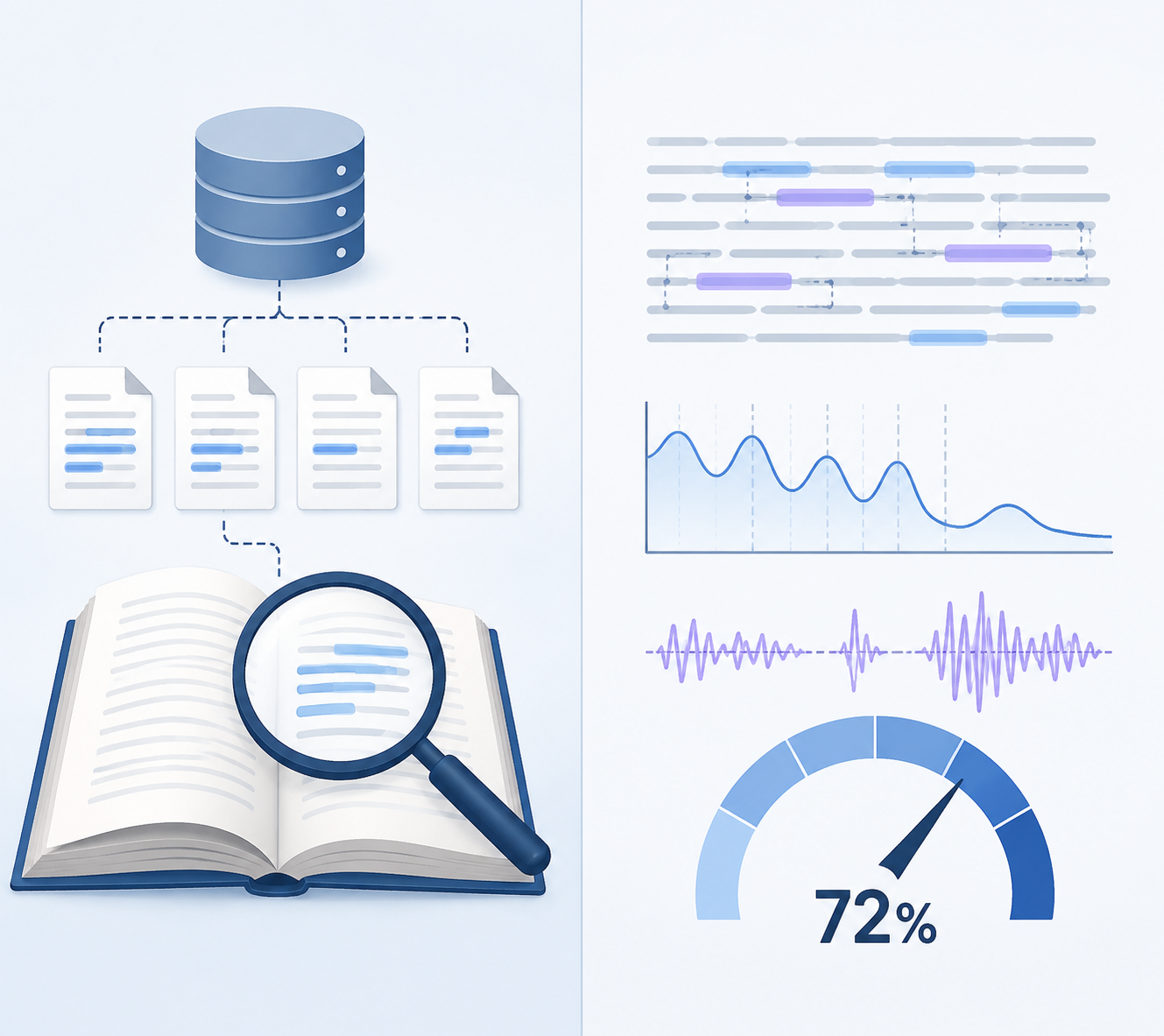
It is not quite safety. The real difference in a plagiarism checker vs AI detector for students is not that one is stricter or more modern. They are looking for different evidence. A plagiarism checker asks, “Does this wording match something in a database?” An AI detector asks, “Does this writing statistically resemble text produced by an AI system?” Those are separate questions, and a good answer to one does not answer the other.
The Short Version: They Measure Different Risks
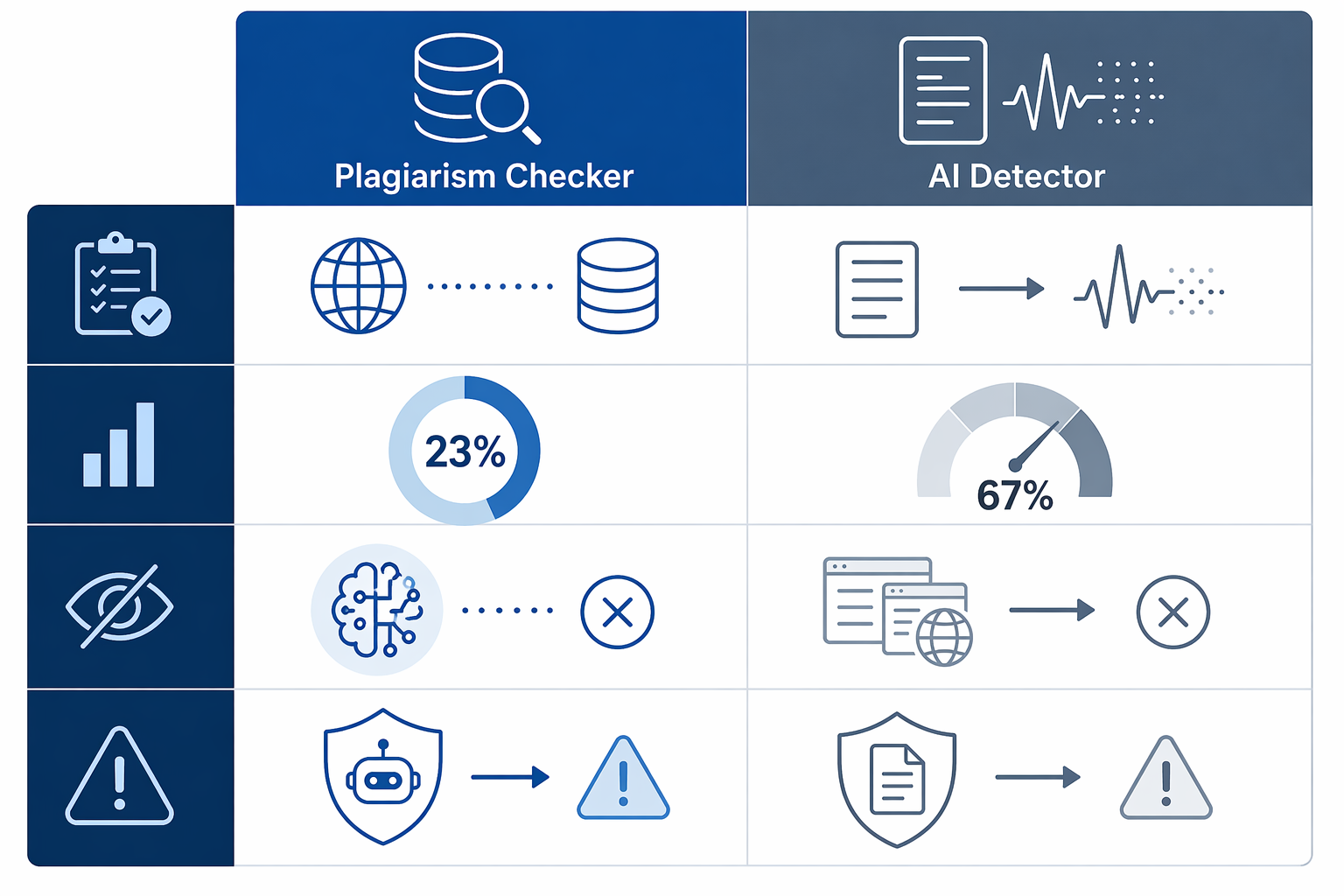
| Question | Plagiarism checker | AI detector |
|---|---|---|
| What it checks | Text overlap with indexed sources, student papers, web pages, journals, or other available databases | Statistical language patterns associated with AI-generated writing |
| What it gives you | A similarity report, matched passages, and source links when available | A probability or classification, often expressed as likely human, likely AI, or a percentage |
| What it can miss | Paraphrased sources, sources outside the database, some textbooks or paywalled material, and AI-written text with original wording | Copied source material, citation problems, and any case where the writing pattern does not fit the detector’s model |
| What a clean result means | The tool did not find substantial matching text in its accessible sources | The tool did not classify the writing as AI-like under its model |
| What risk remains | AI-use concerns, uncited ideas, poor paraphrasing, and unindexed copying | Plagiarism, bad citations, false positives, false negatives, and policy interpretation |
That table is the practical answer, but it is worth slowing down over the mechanics. Most bad decisions around these tools come from treating a score as if it were a verdict. A similarity score is not a writing-quality score. An AI probability is not proof that a student cheated.
What a Plagiarism Checker Is Actually Checking
A plagiarism checker compares your paper against collections of text it can access. Depending on the tool, that may include public web pages, academic publications, institutional repositories, student-submitted papers, or licensed databases. When the checker finds overlapping wording, it flags the passage and usually points to a possible source. SciSpace and Paperpal both describe plagiarism detection in this database-matching way: the tool is looking for similarity between submitted text and indexed material, not for the student’s intent or writing process.[1][2]
That is why a similarity report can be useful. It can show that a paragraph is too close to a source, that quotation marks are missing, or that a citation does not cover enough borrowed language. It can also catch ordinary accidents: pasted notes that never got rewritten, a definition copied from a website, or a source summary that keeps too much of the original sentence structure.
But the checker only sees what it is built and allowed to compare against. If the source is not in the index, the match may not appear. If a student closely paraphrases an argument without credit but changes enough wording, the similarity number may stay low. If a large language model generates new sentences that do not duplicate a source, a plagiarism checker may see very little to match even when the assignment policy does not allow that kind of AI use. Paperpal notes this boundary directly: plagiarism tools compare against existing sources, while AI content detection addresses a different academic-integrity problem.[2]
This is the trap behind “0% similarity.” It may mean the tool did not find copied wording. It does not mean the paper is well argued, properly researched, policy-compliant, or definitely written without AI assistance. A spellcheck can miss a weak thesis; a plagiarism checker can miss an authorship concern.
What an AI Detector Is Actually Checking
An AI detector usually does not search for a source. It analyzes the writing itself. Trinka describes AI detection as a process that examines linguistic and statistical features rather than matching text to a database; detector-checker.ai similarly distinguishes AI detection from plagiarism checking by emphasizing probability-based pattern analysis rather than source overlap.[3][4]
Two terms often appear in explanations of AI detection: perplexity and burstiness. Perplexity is about how predictable the next word or phrase appears to be. Burstiness is about variation in sentence length, rhythm, and structure. Human writing often moves unevenly: a long sentence, then a short one; a precise claim, then a clumsy transition; a paragraph that carries the marks of revision. AI-generated text can be smoother and more statistically regular, although that is not always true.
The important point is that the detector is not saying, “Here is the source this student copied.” It is saying something closer to, “This text resembles patterns I associate with AI-generated writing.” That output may be a percentage, a label, or a highlighted passage, but it remains a probability. It is not a source match, and it is not a transcript of how the paper was written.
This matters especially when a student revises heavily, writes in a formulaic academic style, uses grammar support, or is writing in English as an additional language. A detector may react to polished or predictable phrasing even when the writing process was legitimate. It may also miss AI-assisted writing that has been edited, mixed with human drafting, or generated by a model whose patterns are not well captured by that detector.
Why Accuracy Claims Need Careful Reading
AI detector accuracy is not a single stable number. It depends on the model that generated the text, the length of the sample, the subject area, the detector version, the threshold used, and whether the test includes human writing that looks formal or formulaic. That is why vendor claims and independent tests can point in different directions.
Scribbr’s 2026 test of 12 AI detectors found an average accuracy of 60%. In the same testing, premium tools reached 84% accuracy, while the best free tools reached 78%.[5] Those figures are useful, but they do not mean every detector is right most of the time on every student paper. A class essay is not a lab benchmark; a mixed draft with outlines, quotations, paraphrases, and revisions is often harder to classify than a clean test sample.
A 2025 University of Chicago Academic Technology Solutions test makes the unevenness more concrete. In that test, GPTZero was the most consistent detector on text from three of four tested large language models, but it was only 63% confident on Copilot-generated text. Originality.ai scored 100% on all tested LLM-generated text, yet it also produced a 97% false positive rate on human-written text in that test.[6] That combination is exactly why “very sensitive” is not the same thing as “safe to use for discipline.”
The most worrying evidence involves non-native English writers. Stanford researchers reported in 2023 that AI detectors flagged 61% of TOEFL essays as AI-generated, and 97% of those essays were flagged by at least one detector.[7] Some detector companies have since claimed improvements or debiasing updates, including after 2023, but independent re-verification remains limited in the materials available here. The cautious conclusion is narrower than “all detectors are biased forever” and stronger than “the problem is solved”: false positives have been documented, and students whose writing follows learned academic templates may face particular risk.
How to Read the Scores Without Over-Trusting Them
A plagiarism score and an AI score invite different reactions. If a similarity report flags a paragraph and shows a source, you can inspect the overlap. Is it a properly quoted passage? A common phrase? A bibliography entry? A copied sentence? The evidence is visible enough that you can usually revise, cite, quote, or explain.
An AI score is harder to act on because it does not show an original source. If a detector says a passage is likely AI-generated, the next step should not be panic-editing until the score drops. That can push students into awkward writing, unnecessary paraphrasing, or accidental citation damage. The better response is to gather context: assignment policy, draft history, notes, outlines, version history, source records, and any allowed use of AI tools.
- If the issue is copied wording or missing citations, use the similarity report to find the exact passages and sources.
- If the issue is possible AI authorship, treat the detector result as a prompt for review, not as proof.
- If your school allows limited AI support, keep records of what you used it for, such as brainstorming, grammar review, or outline feedback.
- If your school prohibits AI-generated prose, do not assume a low detector score makes prohibited use safe.
- If you are an English-language learner or write in a highly structured style, keep extra process evidence because some detector errors have affected non-native English writing in documented tests.
There is also a basic fairness issue for instructors. A dashboard can make uncertainty look administratively tidy. A percentage appears, a color changes, and someone is expected to decide what happened. But the tool has not interviewed the student, inspected the draft history, checked whether the assignment allowed AI brainstorming, or separated a formulaic literature review sentence from generated prose.
Where Named Tools Fit
Turnitin, Scribbr, Grammarly, GPTZero, and Originality.ai often appear in the same conversations, but they do not all play the same role. Turnitin’s Similarity Report is a plagiarism-checking context many students already know. Scribbr and Grammarly offer writing and checking tools that may include plagiarism-related features. GPTZero and Originality.ai are commonly discussed as AI detection tools. Some platforms now bundle multiple checks, which can blur the difference for students.
The brand name matters less than the evidence type. If the tool shows matched sources, you are looking at similarity evidence. If it shows an AI probability without a source, you are looking at classification evidence. A platform can contain both, but the two outputs still need to be interpreted separately.
Free-tier limits, word caps, and interface details change often, so they are a weak basis for academic-risk decisions. A student choosing a tool should first ask what risk they are trying to reduce. Do you need to find uncited overlap? Do you need to understand why a draft might attract AI suspicion? Do you need documentation that shows your process? Those are different jobs.
How Universities May Use AI Detection
Institutional use is uneven. Some instructors use AI indicators as one piece of context. Some departments discourage relying on them. Some institutions reportedly disabled Turnitin AI detection in early 2026, though public reporting on exactly how widespread that was remains limited. That uncertainty is part of the point: students should check their own course and university policy rather than assume every school treats these scores the same way.
Turnitin’s AI indicator is often discussed because many schools already use Turnitin for similarity checking. Trinka’s 2026 discussion of university AI detection says Turnitin frames a 38% AI indicator as something meant to start a conversation, not to serve as automatic punishment. The same source reports that Temple University found Turnitin AI detection at 77% accuracy, compared with Turnitin’s claimed 98%.[8] That gap is not a minor footnote if the result might affect a student’s academic record.
For students, the practical lesson is not to ignore AI policies because detectors are imperfect. It is to avoid building your defense around a detector score. If a question comes up, process evidence is usually more meaningful than “the website said 3%.” Drafts, notes, outlines, source annotations, document history, and a clear explanation of any allowed tool use can show how the work developed.
When You Need a Plagiarism Checker, an AI Detector, or Both
Use a plagiarism checker when your main risk is source handling. That includes research papers, literature reviews, lab reports with background sections, policy memos, annotated bibliographies, and any assignment where you have quoted, paraphrased, summarized, or worked closely from outside material. The goal is not to chase the lowest possible percentage. The goal is to inspect matches and make sure borrowed words and ideas are handled honestly.
Use an AI detector cautiously when the concern is AI-generated prose, especially if your course has a specific rule about AI authorship. The detector may help identify passages that look unusually smooth, generic, or statistically AI-like, but it cannot tell the whole story. A high score should lead to review, not instant confession or accusation. A low score should not be treated as permission to submit prohibited AI-written text.
Use both when both risks exist. A student who used sources heavily and also used an AI tool for brainstorming or drafting support has two separate responsibilities: cite source material correctly and follow the course AI policy. One tool cannot certify both. A plagiarism checker may miss AI-generated original prose. An AI detector may miss copied or poorly cited source material.
For a broader look at where AI tools can help or hurt student workflows, this site’s guide to AI study tools in 2026 is a useful companion. The related comparison of AI study tools vs. traditional study tools also helps separate convenience from actual learning value.
A Safer Student Workflow
The safest workflow starts before the final upload. Keep your notes in a place where they can be traced. Mark direct quotations as quotations from the beginning, even in rough notes. Save source links or database records. Draft in a document that preserves version history. If you use AI in a way your course allows, write down what you used, when you used it, and what you changed afterward.
Before submission, run the paper through whatever checking process your institution permits. Read the similarity report passage by passage instead of staring at the percentage. Fix missing quotation marks, weak paraphrases, and citation gaps. If you also choose to use an AI detector, read the result as a risk signal, not as a clearance certificate. A detector score is least useful when it becomes the only thing you trust.
If your paper is questioned, the calmest answer is usually specific evidence: here is my outline, here are my source notes, here are my drafts, here is the feedback I received, here is the allowed tool use I disclosed. That kind of record does not guarantee an outcome, because policies differ, but it gives an instructor more to evaluate than a single percentage.
A clean plagiarism score does not clear AI suspicion. A low AI score does not clear plagiarism. Neither score replaces citations, draft history, assignment rules, or the judgment of the people responsible for the course.
References
- AI Detectors vs Plagiarism Checkers, SciSpace
- Plagiarism Checkers vs AI Content Detection: Navigating the Academic Landscape, Paperpal
- AI Content Detectors vs. Plagiarism Checkers: What’s the Difference?, Trinka.ai
- AI Detection vs Plagiarism Checkers, detector-checker.ai
- Best AI Detector, Scribbr, 2026
- Detection Software, University of Chicago Academic Technology Solutions, 2025
- AI Detectors Biased Against Non-Native English Writers, Stanford HAI, 2023
- How Universities Use AI Content Detectors in 2026, Trinka.ai, 2026
Individual Tool Profiles
Related Comparisons
- Quizlet vs Knowt: Which Free Plan Is Better for Students?
Budget-conscious students comparing Quizlet and Knowt need to know which platform offers the most free features. This head-to-head comparison reveals how Knowt's generous free tier outpaces Quizlet's restricted free plan, with unlimited flashcards, free study modes, and a seamless import tool.
- Quizlet vs Knowt: Which Free Flashcard App Is Better for Students?
A head-to-head comparison of Quizlet and Knowt for budget-conscious students, covering what each platform actually offers for free in 2026, how their paid plans compare, and which tool fits different student profiles — from AP exam preppers to language learners.
- Quizlet Like Apps That Auto-Generate Flashcards: The Best AI-Powered Alternatives for 2026
Drowning in manual deck creation? We compare the top AI-powered apps like Quizlet that auto-generate flashcards from your notes, PDFs, and lecture recordings — so you can spend less time building and more time learning.
Comments
Join the discussion with an anonymous comment.