
Wildfire Smoke Safety Tips to Protect Your Study Focus
Wildfire smoke can reduce attention, memory, and processing speed within hours of exposure. This guide explains how smoke sabotages your study sessions and provides a practical safety protocol to protect your focus and academic performance during wildfire events.
Updated:
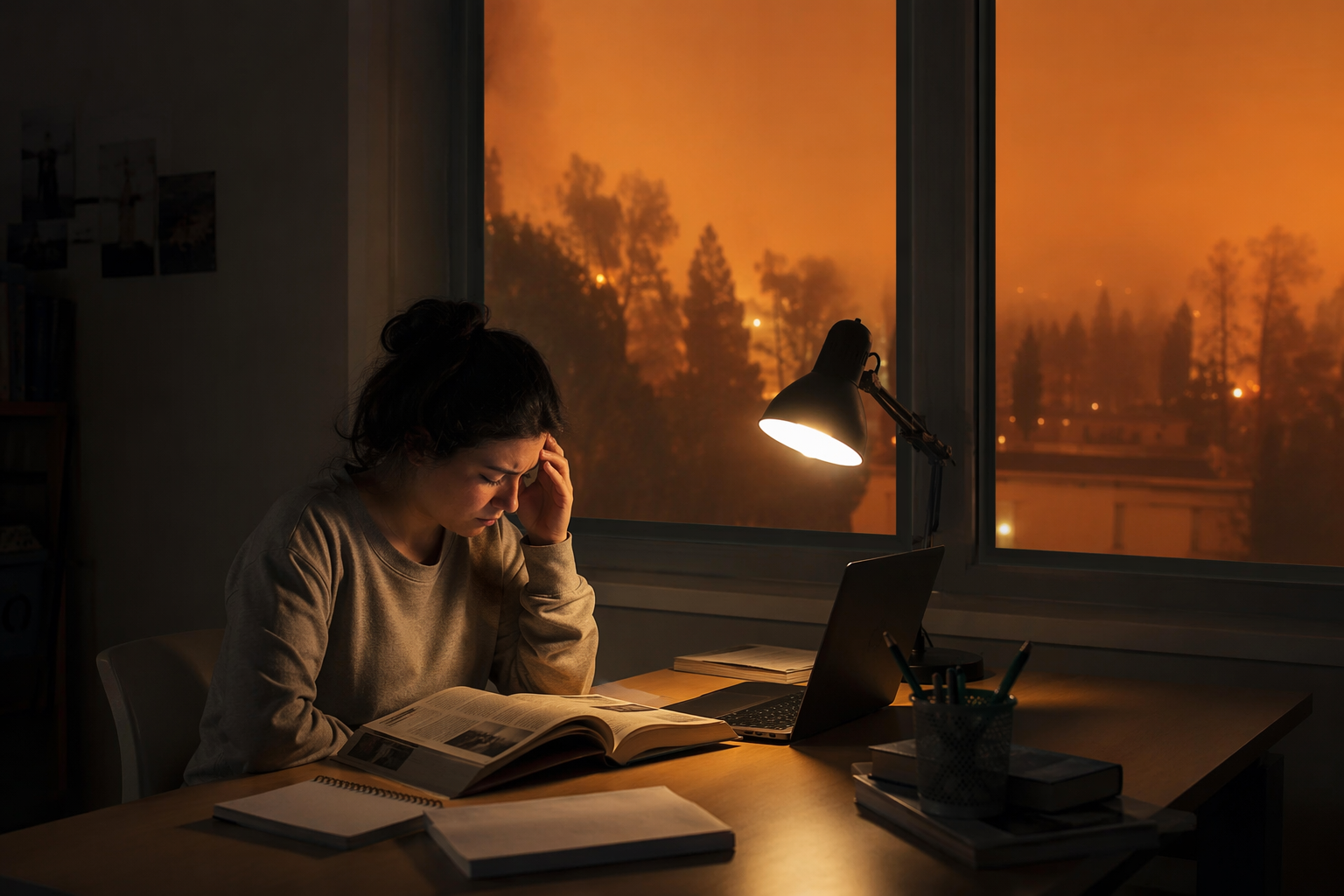
The frustrating part of studying during wildfire smoke is that it can look like a motivation problem from the inside. You sit down for three hours, reread the same page, make a few flashcards, and still feel like nothing stuck. If the sky outside is orange and the room smells faintly like a campfire, the problem may not be your discipline.
Wildfire smoke is usually discussed as a lung and heart risk, which matters. But for students, there is another immediate problem: fine particulate matter from smoke can interfere with attention, memory, processing speed, and decision-making fast enough to affect tonight’s study session.
Smoke Can Hit Attention Within Hours
The most useful student-facing evidence comes from a 2022 study that linked short-term PM2.5 exposure, including wildfire smoke exposure, with performance on Lumosity cognitive games. The study found that short-term PM2.5 exposure reduced adult attention span by an average of 3.7% within hours, with effects that could linger up to two days. In western U.S. states, players lost an average of 887 points across 20 cognitive test rounds during wildfire smoke exposure periods.[1]
That does not prove a student will fail a quiz after a smoky afternoon. The study used adult app users, not a classroom exam room, and Lumosity games are not the same as writing a chemistry test or reading a history chapter. Still, the signal is practical: measurable cognitive changes showed up quickly, and the affected skills are exactly the ones students rely on when they are trying to hold a concept in mind, compare answer choices, or notice that a solution step went wrong.[1]
This is why “just stay indoors” is too thin as study advice. Indoors can still be smoky. A dorm room can have a leaky window, a hallway that smells like ash, a roommate frying food, or a box fan pulling outdoor air through the wrong side of the building. The goal is not to create a perfect lab-grade room. The goal is to protect one clean enough corner long enough to read, recall, and sleep.
Why Your Brain Feels Foggy
Wildfire smoke contains PM2.5, fine particles small enough to travel deep into the body. Brain-focused wildfire smoke explanations describe two relevant routes: particles can cross the blood-brain barrier, and they can also enter through the olfactory nerve. Once there, smoke-related inflammation is one plausible pathway for effects on memory, learning, and decision-making.[2]
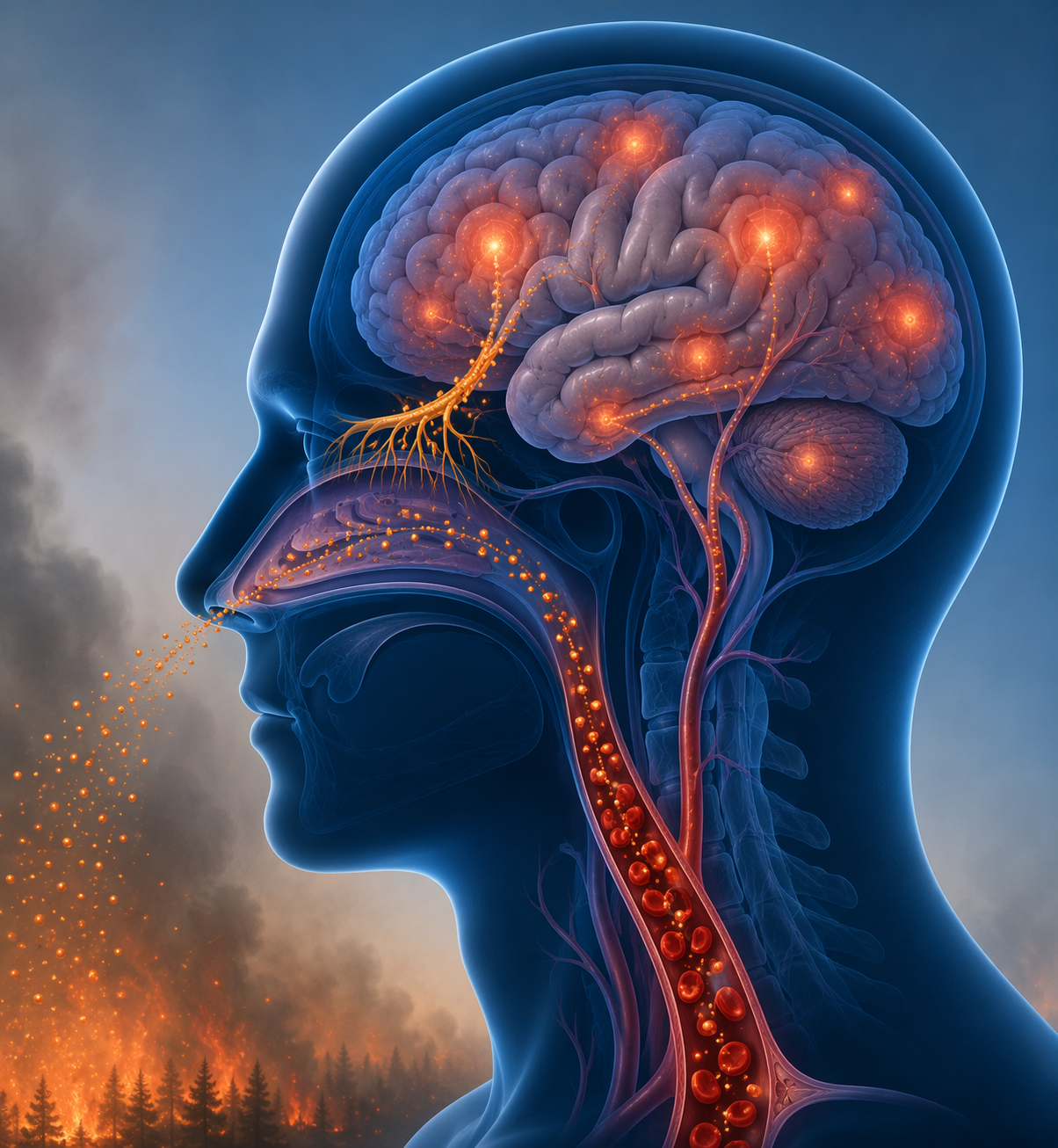
For studying, the mechanism matters less than the consequence. If smoke exposure is making your attention weaker, the wrong response is to shame yourself into a normal workload. A heavy study plan built for clean-air conditions may become a low-yield plan during a smoke event.
A Smoke-Day Study Protocol
Before you decide whether to push through a problem set or move an essay deadline, check the air. In the U.S. AQI system, values above 100 are in the orange “unhealthy for sensitive groups” range, and values above 150 are in the red “unhealthy” range for everyone.[3] For a student, those bands should change the study plan, not just the exercise plan.
| Air condition | Study move | What changes |
|---|---|---|
| AQI above 100 | Move the session indoors and close windows | Choose review, flashcards, outlining, or lower-stakes work if you feel foggy |
| AQI above 150 | Use a clean study room setup and avoid unnecessary time in smoky air | Shorten sessions, use retrieval practice, and postpone high-load work when possible |
| Purple or worse, heavy visible smoke, symptoms, or official warnings | Follow campus, local, and medical guidance before academic plans | Ask about extensions, remote options, or filtered campus spaces if available |
This is not a medical rule for every person. Some students have asthma, heart conditions, pregnancy, disability-related concerns, or family responsibilities that make “just go to the library” unrealistic. When symptoms, official emergency guidance, evacuation orders, or campus closures enter the picture, the study plan stops being the priority.
1. Check AQI before you plan the session
Do this before opening the textbook, not after an hour of wondering why you are reading like your brain is buffering. If the AQI is climbing, split the evening into what must be done and what can move. A quiz review may stay on the schedule. A dense first pass through a new chapter may not.
This is where a weekly planner helps: move cognitively expensive tasks into cleaner windows when you can, and reserve smoky periods for review, organizing notes, emailing instructors, or making a realistic exam checklist.
2. Pick the cleanest indoor space, not just the nearest one
A good smoke-day study spot has closed windows and doors, no obvious smoke smell, and as few indoor particle sources as possible. EPA guidance for wildfire indoor air quality emphasizes keeping windows and doors closed, using filtration when available, and reducing activities that add particles indoors.[4]
In student housing, that may mean choosing a bedroom over a kitchen table, a filtered library floor over a smoky apartment, or a campus building over a car. If you share a room, be direct about the window: “I need this closed while the AQI is bad because I have an exam tomorrow” is not overreacting. It is the baseline condition for making the room studyable.
3. Run a real HEPA purifier in the study room
A portable HEPA air cleaner is most useful when it is matched to the room. The American Lung Association’s dorm air quality guidance points students toward HEPA filtration and notes that an average 225-square-foot dorm room needs a clean air delivery rate, or CADR, of at least 133 cubic feet per minute.[5]
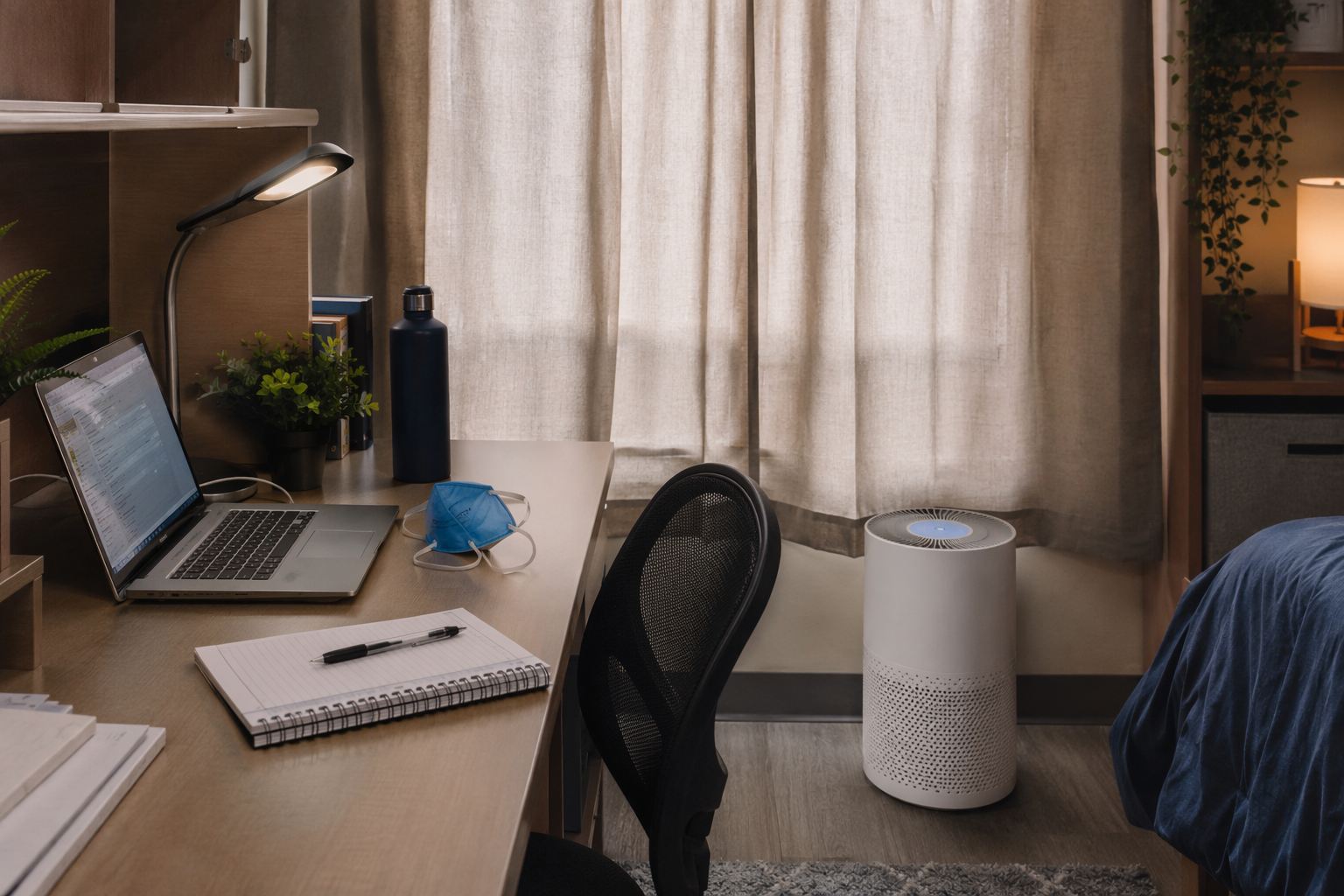
Do not hide the purifier across the apartment and hope it covers everything. Put it in the room where you will actually study or sleep. Close the door if you can. Let it run before and during the session. If money is tight, one properly used unit in one protected room is usually more realistic than pretending the whole apartment can be fixed tonight.
4. Stop adding particles indoors
During smoke events, indoor sources matter more than people think. EPA wildfire indoor air guidance recommends avoiding activities that add particles, including burning candles or incense, frying or broiling food, smoking, and vacuuming unless the vacuum has a HEPA filter.[4]
- Skip candles, incense, and anything meant to “cover” smoke smell.
- Avoid frying or broiling food right before a study block.
- Do not vacuum during the study window unless the vacuum uses HEPA filtration.
- Keep doors and windows closed when outdoor smoke is the problem.
- If a gas stove must be used, ventilate according to local safety guidance without pulling in smoky outdoor air.
This is not about making a dorm room pristine. It is about not making a bad-air study session worse by adding avoidable particles five feet from your notes.
5. Use an N95 when you have to move through smoky air
CDC wildfire safety guidance includes wearing a NIOSH-approved N95 respirator when outdoors in smoky conditions if one is available and fits properly.[3] For students, the overlooked moments are often between places: the walk from dorm to dining hall, the bus stop, the stairwell that smells smoky, or the trip across campus to a filtered library.
A loose mask is not the same as a fitted respirator. Facial hair, gaps at the nose, and stretched straps can make protection worse. If you are moving through smoke to reach a better study space, the N95 is part of the study setup, not a separate health accessory.
Change the Workload When the Air Is Bad
Once the room is as protected as you can make it, adjust the task. This is the step students often skip because it feels like admitting defeat. It is not. If smoke can reduce attention within hours, then a normal clean-air workload may waste the best part of your evening.[1]
High-load work is the first thing to reconsider. That includes learning a brand-new proof, reading a dense chapter for the first time, writing the hardest paragraph of an essay, or doing a long timed practice test. If the AQI is red, the room still smells smoky, or your head feels heavy, move that work to a cleaner window when possible.
Better smoke-day tasks are usually shorter and more structured:
- Review flashcards you have already made.
- Do retrieval practice from memory instead of passive rereading.
- Mark confusing topics for office hours or tutoring instead of forcing them alone.
- Outline an essay without trying to polish every sentence.
- Organize notes, formulas, deadlines, and practice questions for the next cleaner-air session.
Retrieval practice is especially useful because it tells you what is actually available in memory. On a smoky day, that feedback is more valuable than spending ninety minutes staring at highlighted pages and mistaking recognition for learning.
Use shorter sessions and cleaner breaks
A smoke-day study block does not need to be heroic. Try a shorter session with a clear endpoint: one set of practice problems, one flashcard deck, one page of outline, one lecture recap. Then take a break without opening the window, lighting a candle, or walking outside into worse air just because you are restless.
Hydration and sleep are not magic antidotes to PM2.5, but they are part of not stacking extra cognitive stress on top of bad air. If you are choosing between another foggy hour and sleeping before a morning quiz, sleep is often the more protective academic move.
When Campus Buildings Are the Better Study Tool
Schools and universities can reduce smoke exposure by operating HVAC systems properly, using appropriate filters, limiting outdoor air intake when needed, and designating cleaner indoor spaces during smoke events, according to EPA guidance for schools and commercial buildings.[6] Students do not control those systems, but they can use them strategically.
If your apartment is leaky and the library has good filtration, the library may be the real study tool that day. If the library is crowded, a science building, student center, tutoring office, or residence hall lounge may still beat a smoky bedroom. Look for campus messages about clean-air rooms, HVAC changes, class relocations, and building closures before assuming all indoor spaces are equal.
Commuters need a slightly different plan. Keep an N95 available before the commute starts, not buried in a backpack. If your route requires waiting outside, check whether you can shift timing, use a more protected stop, or study after reaching a cleaner building rather than trying to read while exposed.
What Not to Overclaim
Wildfire smoke does not turn every bad study session into a scientifically proven smoke effect. Stress, poor sleep, heat, evacuation worry, missed meals, and ordinary procrastination can all make studying worse. The Lumosity findings are relevant because they show short-term cognitive changes associated with PM2.5 exposure, not because they diagnose any one student’s exam result.[1]
There is also a difference between long-term brain-health research and tonight’s academic problem. Evidence about smoke, inflammation, and neurological risk helps explain why the brain belongs in the wildfire smoke conversation, but student guidance should stay focused on immediate exposure reduction and realistic study adjustments.[2]
A Compact Smoke-Day Study Checklist
- Check AQI before choosing the task.
- Move indoors when AQI is elevated, and treat AQI above 150 as a serious study-environment problem.
- Choose the cleanest room you can access; close windows and doors.
- Run a HEPA purifier matched to the room size, especially where you study or sleep.
- Avoid candles, incense, frying, broiling, unnecessary vacuuming, and other indoor particle sources.
- Wear a well-fitting N95 when moving through smoky outdoor or semi-indoor air.
- Switch heavy new learning to shorter review, retrieval practice, planning, or rest when cognition feels dulled.
- Let medical symptoms, severe AQI, official emergency guidance, evacuation orders, and campus closures override academic plans.
If smoke can affect thinking within hours, “study harder” is the wrong first move. Protect the air around the study session, lower the cognitive load when needed, and save the hardest work for the cleanest conditions you can realistically get.
References
- Short-Term Exposure to Wildfire Smoke and PM2.5 and Cognitive Performance in Adults — Environmental Health Perspectives — https://pmc.ncbi.nlm.nih.gov/articles/PMC9196888/
- How Does Wildfire Smoke Affect the Brain? — International Association of Wildland Fire — https://www.iawfonline.org/article/how-does-wildfire-smoke-affect-the-brain/
- How to Safely Stay Safe During a Wildfire — CDC — https://www.cdc.gov/wildfires/safety/how-to-safely-stay-safe-during-a-wildfire.html
- Wildfires and Indoor Air Quality (IAQ) — EPA — https://www.epa.gov/emergencies-iaq/wildfires-and-indoor-air-quality-iaq
- How to Improve Dorm Air Quality — American Lung Association — https://www.lung.org/blog/dorm-air-quality
- Wildfires and Indoor Air Quality in Schools and Commercial Buildings — EPA — https://www.epa.gov/emergencies-iaq/wildfires-and-indoor-air-quality-schools-and-commercial-buildings
Comments
Join the discussion with an anonymous comment.