
Comparison
How Trump Endorsements Secure Primaries Yet Lose Seats
This article synthesizes research on Trump's endorsement impact, explaining why it yields 97% primary win rates but also triggers a general-election penalty that may cost Republicans seats. Political science students will learn the empirical evidence behind the 'Trump endorsement effect' and the strategic factors that shape it.
Verdict panel
- Compared
- not specified
- Target exam
- not specified
- Best for
- not specified
- Pricing last reviewed
- pricing currency unconfirmed
The Trump endorsement puzzle is easy to state and easy to misread. In the 2026 cycle, USA Today reported Ballotpedia data showing Trump-backed Republican primary candidates had won 220 of 227 primaries, a 97% win rate; Ballotpedia’s broader count put the figure at 98% across 312 endorsements.[1] Yet in the 2018 general election, a peer-reviewed study by Andrew Ballard, Hans Hassell, and Matthew Heseltine estimated that a Trump endorsement reduced endorsed candidates’ vote share by about 2.5 percentage points and cost Republicans an estimated 16 House and Senate seats.[2]
Those findings are not contradictory once the question becomes precise. The relevant question is not whether a Trump endorsement “works.” It is whether it works for a candidate inside a Republican nomination contest, for a Republican Party trying to maximize seats in November, or for a campaign trying to persuade voters outside the GOP coalition. Those are different electorates, and the same signal can travel through them in different ways.

A Primary Win Rate Is Not a Causal Estimate
A 97% or 98% win rate is a descriptive statistic. It tells us what happened to candidates who received the endorsement. It does not, by itself, tell us what would have happened to those same candidates without it. That missing counterfactual is where many headline interpretations go wrong.
In a Republican primary, a Trump endorsement can matter in several ways at once. It can reassure voters that a candidate is acceptable to the party’s dominant faction. It can discourage some challengers, redirect activists, influence donors, and help low-information primary voters coordinate around one candidate. In that setting, the endorsement is not merely a persuasion message. It is also a sorting device.
But the win rate also includes candidates who were already favored. If Trump endorses a safe incumbent months before the primary, then the eventual victory partly reflects incumbency, district partisanship, weak opposition, fundraising networks, and the absence of a serious challenge. The endorsement may still be useful. It may even help prevent a race from becoming competitive. But counting the win as proof that the endorsement created the victory is a much stronger claim.
| Question | What the evidence can show | What it cannot show by itself |
|---|---|---|
| Did Trump-endorsed candidates win primaries? | Yes, at very high rates in the 2026 data available by late June. | Whether the endorsement caused each win. |
| Did the endorsement help in Republican primaries? | Often plausibly, because it functions as a strong partisan signal. | The exact size of the causal effect from the win rate alone. |
| Did it help Republicans in general elections? | The 2018 study estimates a vote-share penalty and seat cost. | That the same penalty must appear at the same size in every cycle. |
Why the Same Endorsement Looks Stronger in a Primary
A Republican primary is a filtered electorate. The voters are not a miniature version of the general public. They are more partisan, more likely to evaluate Republican candidates through intra-party cues, and more likely to treat Trump’s approval as useful information about loyalty, ideology, and coalition membership.
That matters because endorsements rarely operate as simple advertisements. A voter does not have to learn much about tax policy, committee assignments, or the candidate’s local biography if the endorsement already answers the immediate primary question: which Republican is aligned with the party’s most powerful national figure? In low-salience races, that cue can be especially valuable.
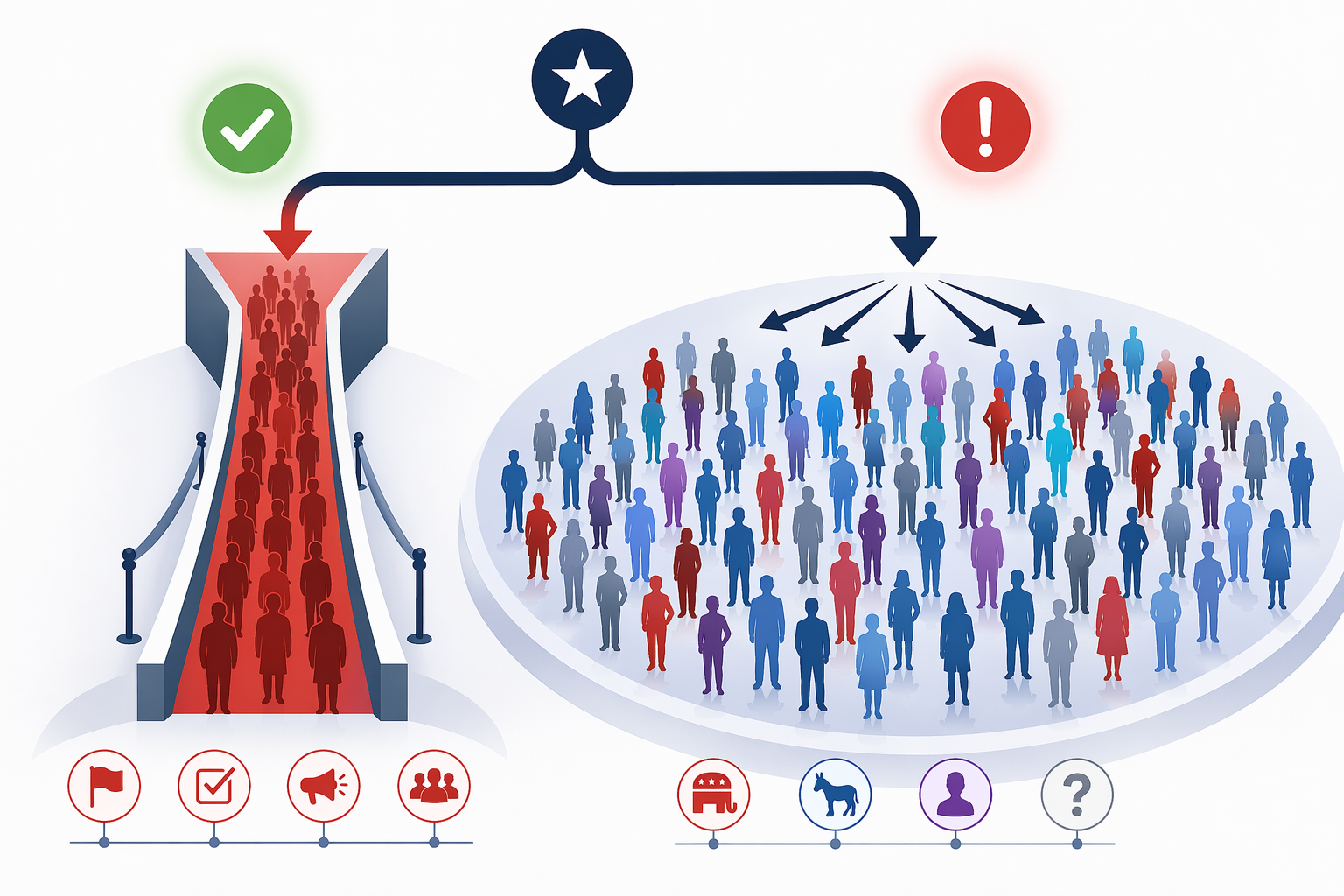
A general election asks a different question. The electorate now includes Democrats, independents, and Republicans who may already have decided how they feel about Trump. A cue that coordinates one side can repel the other. If the Republican base was already likely to support the nominee, the endorsement has limited room to add votes among Republicans but plenty of room to mobilize or harden opposition among Democrats.
That is the central asymmetry. The endorsement can be powerful inside the nomination electorate without being helpful in the November electorate. A candidate-level asset in May can become a party-level liability in November.
The 2018 Penalty: Small in Points, Large in Seats
Ballard, Hassell, and Heseltine’s 2018 analysis gives the paradox its sharpest empirical edge. They estimate that Trump-endorsed candidates lost roughly 2.5 percentage points in general-election vote share and that this penalty cost Republicans about 16 House and Senate seats.[2] A 2.5-point penalty may sound modest until it is applied to a map full of competitive races. In close elections, a small average movement can decide control-relevant seats.
The seat estimate should be treated as an estimate, not a law of politics. It comes from one election cycle, a midterm held during Trump’s presidency, and the effect could differ in a presidential year, in a safer district, or when Trump himself is on the ballot. Still, it is strong evidence against the lazy inference that primary dominance automatically helps the party in the general election.
The distinction between candidate and party is important here. A candidate may rationally seek the endorsement to win a primary that would otherwise be uncertain. The party may then inherit a nominee whose brand carries a broader general-election cost. Both can be true at the same time. Strategic behavior at the candidate level does not guarantee optimal outcomes at the party level.
What the Survey Experiment Adds
The most useful mechanism evidence comes from a 2024 survey experiment by Blatte, Piccoli, and Zachem. In a sample of 1,346 American adults, they tested a general-election scenario and found that a Trump endorsement reduced overall voting likelihood for the endorsed candidate by 4 points, with the result reported at p<0.10.[3]
The subgroup pattern is more revealing than the topline alone. The decline was driven by an 11-point drop among Democrats, while the study found no statistically significant increase among Republicans.[3] That is exactly the pattern one would expect if the endorsement has more room to activate opposition than to add support in a general-election setting.
There are reasons to be careful. A p<0.10 result is weaker than conventional p<0.05 evidence, and a survey experiment is not the same as observing actual turnout and vote choice in a real campaign. The study also tests a general-election scenario, not a Republican primary. It should not be used to argue that Trump endorsements fail among Republican primary voters.
Its value is narrower and still important: it helps explain why the general-election penalty might appear. If Republican voters are not significantly more likely to support the candidate because of the endorsement, while Democratic voters become less likely to do so, then the net general-election effect can be negative even when the endorsement remains valuable in the primary.
Backlash Is Not Only About Votes
The 2022 spending and fundraising evidence helps fill in the campaign mechanism between voter reaction and election outcome. AdImpact reported $109 million in primary ad spending by Trump-endorsed candidates in the 2022 cycle.[4] That spending figure does not prove the endorsement caused those campaigns to spend more, but it shows that Trump-backed primary contests were embedded in expensive, high-attention nomination fights.
Ballard and coauthors also found a donor-side asymmetry: endorsements boosted fundraising for the endorsed Republican candidate but triggered even larger donor surges for Democratic opponents.[2] This is a useful bridge between the primary and general-election findings. The same endorsement that energizes one coalition can give the other coalition a target.
Campaigns often talk about energy as if it belongs to only one side. The evidence here points to a more awkward possibility. Trump’s endorsement can activate Republican donors and activists while also making the Democratic opponent easier to fundraise for, easier to nationalize, and easier to present as part of a larger anti-Trump contest. A nomination advantage can therefore carry an opposition-mobilization cost.
The Self-Selection Problem in the 2026 Scoreboard
The 2026 endorsement scoreboard is impressive, but the timing and target selection matter. NPR’s June 2026 analysis of more than 1,000 endorsements found that Trump’s endorsement timing shifted from about seven weeks before primaries in 2018 to about seven months before primaries in 2026, and that the incumbent share rose to roughly 75%.[5]
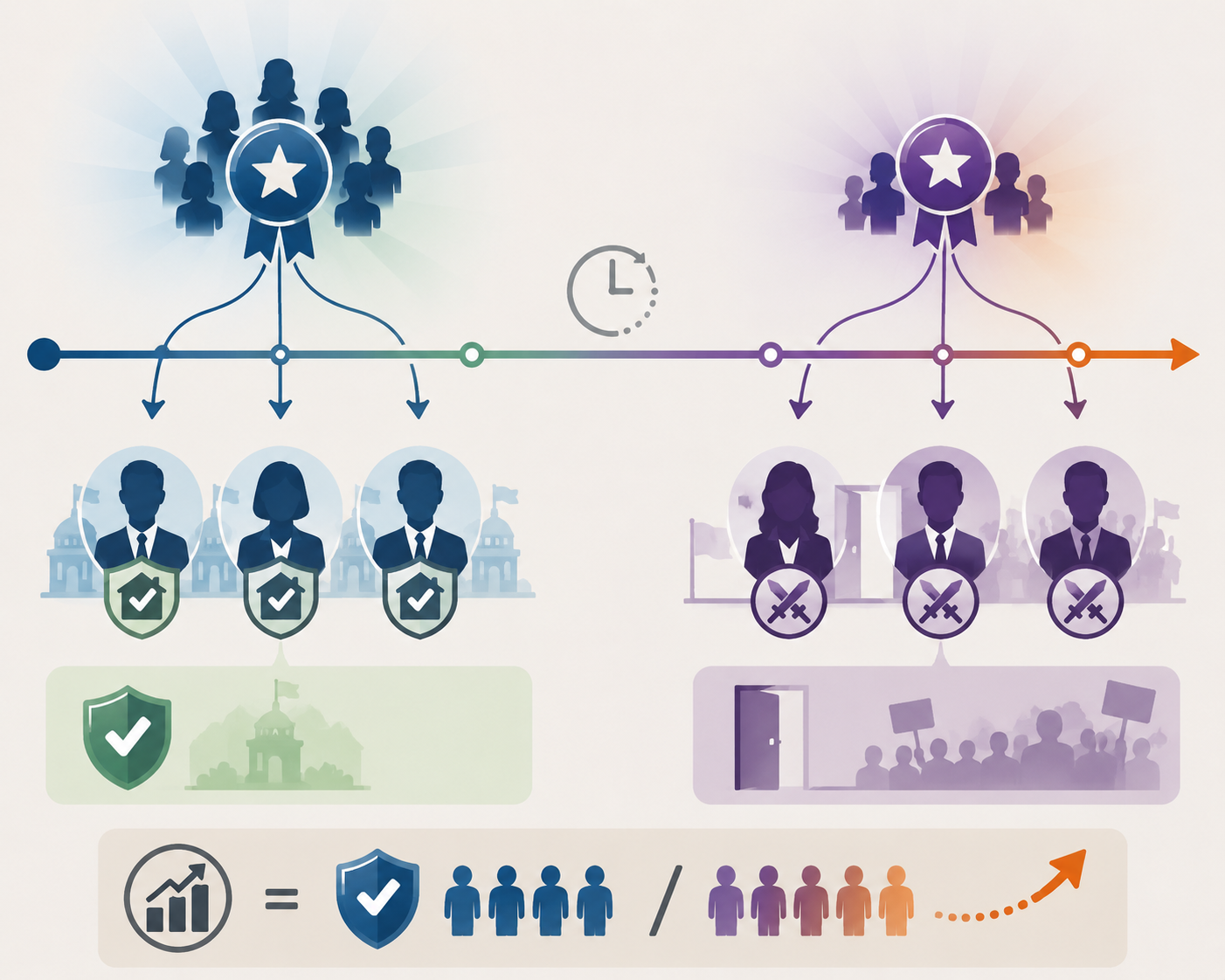
That changes how the win rate should be read. Early endorsements of incumbents do not support the same inference as late endorsements in competitive open-seat primaries. Incumbents usually begin with name recognition, donor networks, party relationships, and district-specific advantages. If many endorsed candidates are incumbents in safe or low-competition races, then a high win rate partly measures the safety of the chosen endorsees.
This is the classic self-selection problem. Trump is not randomly assigning endorsements across all Republican candidates. He and his political operation can choose whom to endorse, when to endorse, and which races to avoid. A high success rate can reflect influence, strategic caution, or both.
The timing shift also changes candidate behavior. An endorsement seven months before a primary can shape the field before many voters are paying attention. It may discourage challengers from entering, encourage donors to consolidate, and reduce the amount of visible conflict. If the race never becomes competitive, the endorsement’s effect is partly hidden inside the absence of a serious contest.
That does not make the endorsement meaningless. Preventing a challenge can be a real form of power. But it is a different claim from saying the endorsement persuaded a large share of voters who otherwise preferred someone else. The first claim is about agenda-setting and coordination. The second is about voter conversion. The 2026 win-rate data alone cannot separate them.
How to Read the Evidence Across 2018, 2022, and 2026
The evidence on Trump endorsements is best understood as a sequence of different selection processes rather than a single up-or-down effect. The same political signal enters different electorates, at different times, with different consequences.
- In 2018, the strongest peer-reviewed evidence points to a general-election penalty: about 2.5 points in vote share and an estimated 16-seat Republican cost.[2]
- In 2022, spending and fundraising evidence suggests that endorsement energy did not stay on one side; Democratic opponents also benefited from donor backlash.[2][4]
- In 2026, the primary win rate was overwhelming, but endorsement timing and the heavy concentration among incumbents make causal interpretation more complicated.[1][5]
A clean interpretation has to preserve all three pieces. The endorsement can help Republican candidates secure nominations. It can also make those nominees more costly in November. And the visible primary success rate can be inflated by endorsing candidates who were already likely to win.
The mistake is to treat a primary scoreboard as if it settles a general-election question. A primary win rate measures survival inside a nomination process. A vote-share penalty measures performance against the opposing party’s candidate. A seat estimate measures the party-level consequence of those individual races. These are related outcomes, but they are not interchangeable.
The Conditional Answer
Trump endorsements are powerful nomination signals. They help organize Republican primary politics by marking favored candidates, coordinating voters, and deterring conflict. In 2026, that power appears in the overwhelming primary win rates reported by Ballotpedia and USA Today.[1]
They are much weaker, and often negative, as general-election assets. The best evidence in the research set points to a backlash pattern: a 2018 vote-share penalty, an estimated seat cost, experimental evidence of reduced support in a general-election scenario driven by Democrats, and fundraising evidence that Democratic opponents can benefit from the endorsement’s mobilizing effect.[2][3]
The safest conclusion as of Q3 2026 is conditional rather than absolute. A Trump endorsement can help a Republican win the primary, especially in a filtered electorate and especially when directed toward an incumbent or already advantaged candidate. The party-level cost becomes clearest when those safe primary victories nominate or brand candidates in ways that mobilize the opposition in November. The same intervention can look overwhelming in one selection process and costly in the next.
References
- Trump boasts of near-perfect record in GOP primaries. Does his endorsement matter? USA Today. June 27, 2026.
- The Effects of Donald Trump’s Endorsements in the 2018 Congressional Elections. Legislative Studies Quarterly. 2021.
- The Causal Effects of a Trump Endorsement on Voter Preferences in a General Election Scenario. PS: Political Science & Politics. 2024.
- Primary Spending Insights on Trump-Endorsed Candidates. AdImpact.
- Trump’s endorsements are coming earlier and going to more incumbents. NPR. June 23, 2026.
Back to the exam this applies to
Target exam not specified — see all exam hubs.
Comments
Join the discussion with an anonymous comment.