
Comparison
You Can Solve NYT Connections With a Systematic Process
NYT Connections is a pattern-recognition game, not a vocabulary test. This guide lays out a repeatable five-step process that helps any player dramatically reduce mistakes and solve more puzzles consistently.
Verdict panel
- Compared
- not specified
- Target exam
- not specified
- Best for
- not specified
- Pricing last reviewed
- pricing currency unconfirmed
The dangerous moment in NYT Connections usually comes before the first submission. You open the grid, see two words that obviously belong together, then feel the little rush of recognition: there it is. The problem is that Connections is built to reward recognition only after it has been checked. If you want to know how to solve NYT Connections puzzles more consistently, the useful answer is not “be smarter with words.” It is to slow the first move long enough for a system to take over.
The difference between a clean solve and a blown puzzle is large enough that process matters. WordsRated reports that 57% of Connections players solve without any mistakes, while 9.1% fail entirely.[1] That does not mean more than half of players have encyclopedic vocabularies. It means many players are doing something before they tap: scanning, testing, counting, and refusing to submit the first pattern that feels familiar.
A workable process has five moves: scan the whole board without touching it, count every candidate before believing a category, submit only the strongest group, re-read the remaining board as a new puzzle, and move to paper when the screen starts making you stare in circles. That sequence is simple enough to use on a phone before class, but strict enough to prevent the most expensive kind of mistake: being right about the general idea and wrong about the four words.
| Stage | What to do | What it prevents |
|---|---|---|
| 1. Silent scan | Read all 16 words before selecting anything. | Locking onto the first obvious pair. |
| 2. Candidate count | For each suspected category, ask whether exactly four words fit. | The 5-word trap. |
| 3. Strongest group first | Submit the group with the cleanest four-word boundary. | Spending guesses on partial hunches. |
| 4. Re-evaluate | After a solved set disappears, scan the remaining grid again. | Using old assumptions on a changed board. |
| 5. Paper method | Write and rearrange possible groups outside the app. | Layout bias and mental clutter. |
Start With A Silent Scan
The first rule is almost insultingly plain: do not touch the tiles yet. NYT’s Regina Bediako recommends taking time to scan all 16 words before making a move.[4] That advice is easy to underrate because it does not sound clever. It is, however, the one habit that gives every later tactic room to work.
During the scan, do not hunt for a completed group immediately. Let your eyes do three passes. First, notice obvious meanings: foods, colors, jobs, sports, school subjects. Second, notice word shapes and grammar: plurals, verbs, abbreviations, things that can come before or after another word. Third, notice suspicious words that seem too flexible. A word that can sit in several phrases is not a solution yet; it is a warning label.
This is where Connections starts to look less like a vocabulary quiz and more like studying from a messy page of notes. If you underline the first familiar phrase and ignore the rest of the page, you may understand one part and still answer the wrong question. The silent scan protects the board from your own fluency.
Count Candidates Before You Believe A Category
Most bad guesses in Connections do not feel random. They feel justified. You see a pair, then a third word, then a fourth that sort of fits, and the brain rounds the uncertainty up to confidence. Lifehacker warns that obvious pairings can be traps, noting examples such as WONDER next to BREAD or MATCH next to BOX as the kind of tempting connection that should make a player cautious rather than quick.[2] CNET gives the same practical warning in its advice on looking for hints and avoiding premature answers.[3]
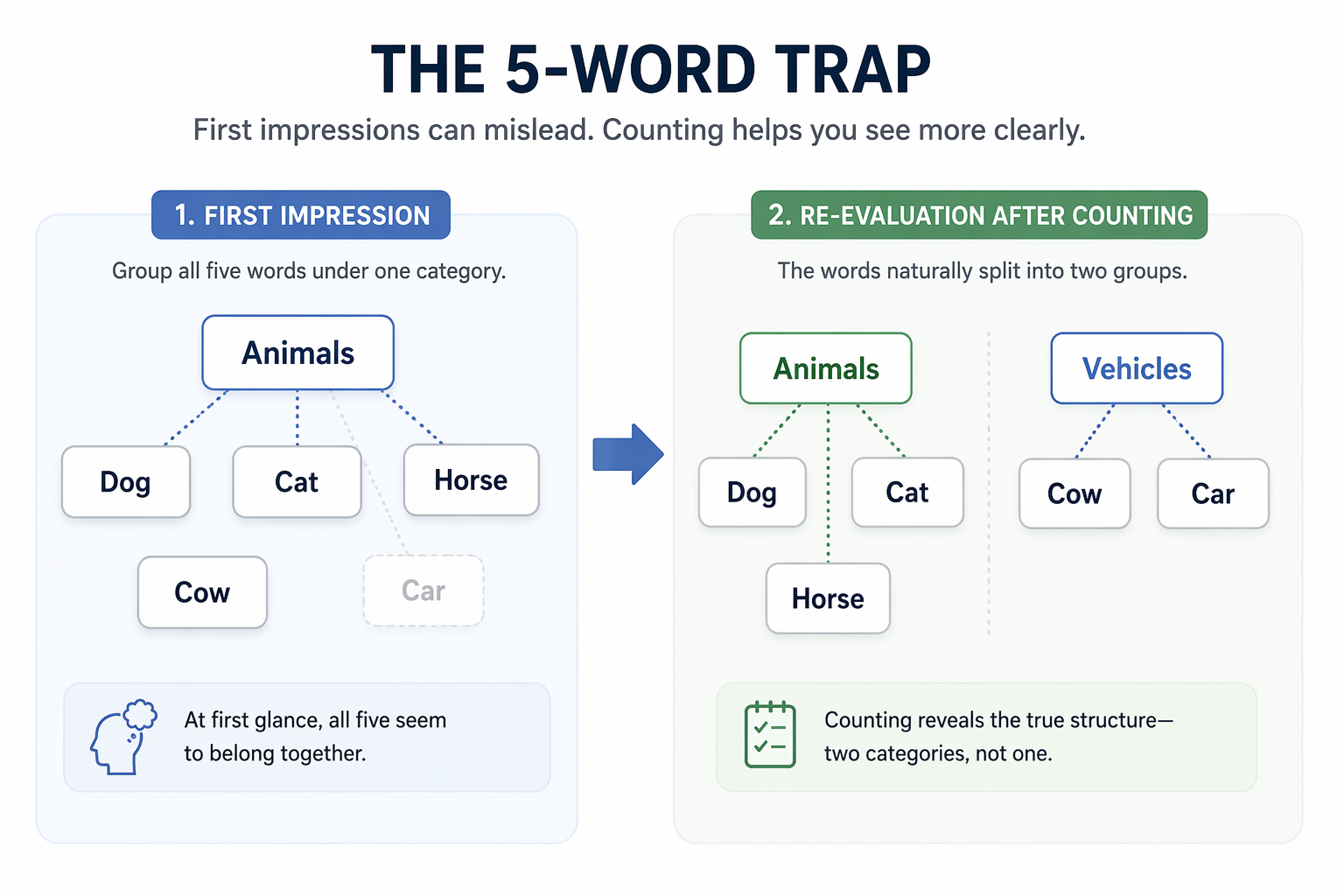
The fix is candidate counting. When you think you have a category, do not ask, “Do these four work?” Ask, “How many words on the board could plausibly belong here?” If the answer is five, the category is not solved. It is a trap waiting for one word to be reassigned.
This one change explains a lot of the emotional frustration of the game. The player was not foolish for seeing the category. They may have seen a real category-shaped pattern. The mistake was submitting before finding the boundary. Connections does not ask for “some words that go together.” It asks for exactly four.
A useful way to count is to make a quick mental ledger:
- If exactly four words fit cleanly, keep the group as a candidate.
- If five words fit, mark the category as unresolved and look for the word that has a second life elsewhere.
- If only three words fit, do not invent a weak fourth just to complete the set.
- If one word fits only because you are stretching the definition, leave the group alone.
The five-word version is the important one. Suppose, hypothetically, you see five words that can all be types of containers. Four may truly form a container category, or one may belong to a phrase category, a brand phrase, a sound-alike set, or a hidden meaning somewhere else on the board. Until you know which word has been borrowed by another group, you do not have a solved group. You have a crowd.
Submit The Cleanest Group, Not The Flashiest One
After the scan and count, choose the group with the least leakage. That may be an easy yellow category, but it is not always the most obvious one. The best first submission is the set where all four words share the same relationship and the remaining twelve words do not contain a serious challenger.
There is a small discipline here that pays off. Do not submit a group because you are tired of looking at it. Do not submit because three words are perfect and the fourth is “probably fine.” Use your first move to remove certainty from the board. Once four correct words disappear, the puzzle changes; every remaining word has fewer places to hide.
Experienced players often feel a group before they can fully explain it. That feeling is not useless. It is pattern recognition doing its early work. But in Connections, intuition should nominate a group, not authorize the tap. The count still has to confirm it.
After Every Solve, Treat The Board As New
A correct submission is not only a reward; it is new information. Four words leave, and with them go several false possibilities. This is why re-evaluation matters. The group you almost submitted earlier may become stronger, weaker, or obviously wrong after the first answer clears.
Run the silent scan again on the remaining twelve, then eight, then four words. The board is smaller each time, but the danger does not disappear. Sometimes the first solved category removes the word that was hiding the real pattern. Sometimes it removes the decoy that made a weak group look plausible. Either way, old confidence needs to be rechecked against the current grid.
This habit also keeps you from spending later guesses to defend an earlier idea. In puzzles and in studying, the first interpretation can become strangely sticky. Once you have decided that a word “must” belong somewhere, you may keep bending new evidence around that decision. Re-scanning forces the opposite movement: the board tells you what is still possible.
Use Paper When The Screen Starts Winning
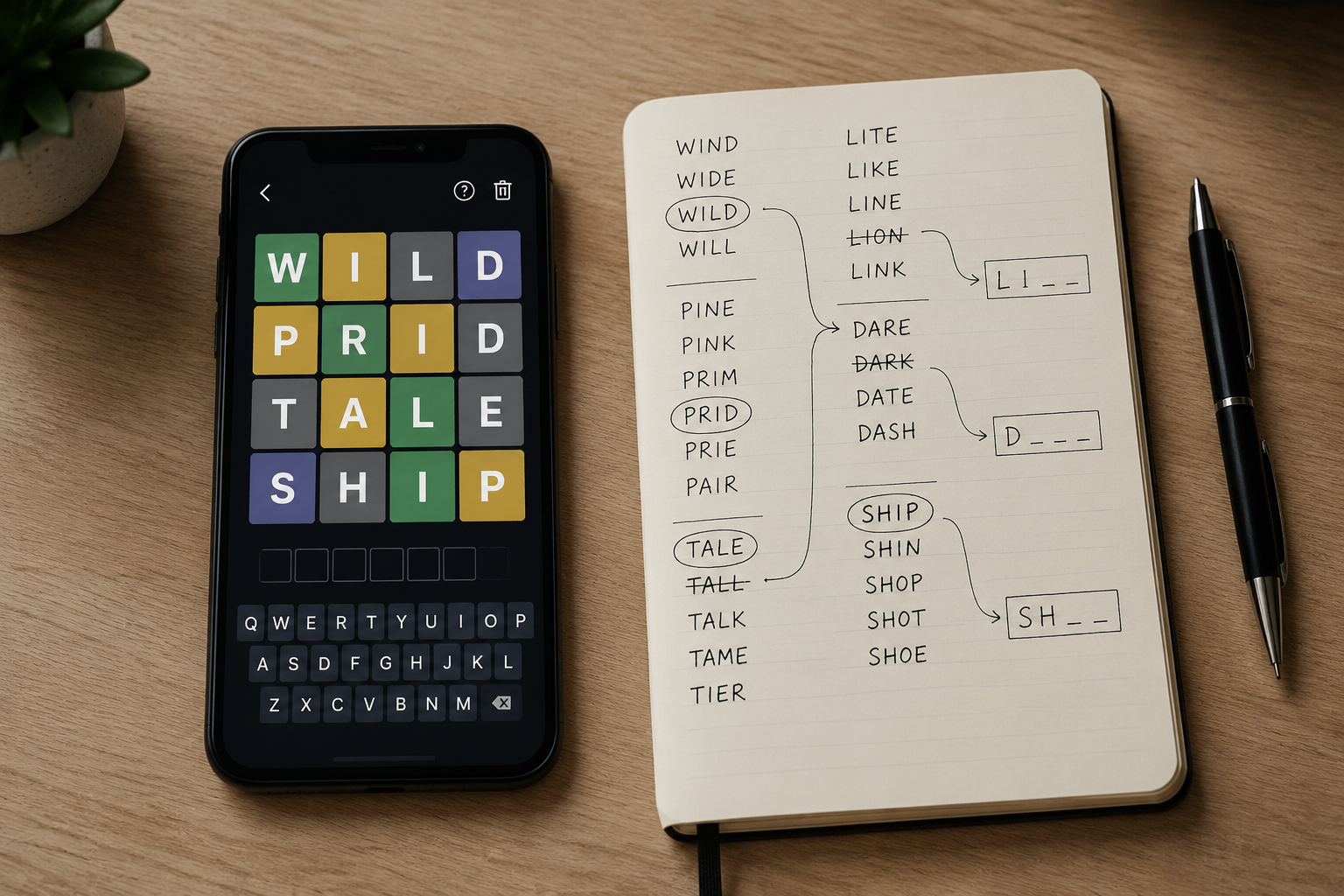
Some boards do not yield to careful looking. That is the moment to stop looking harder. The Puzzle a Day blog recommends writing candidate groups down on paper, which lets you rearrange words without being pushed around by the app’s visual layout.[5] This deserves more attention than it usually gets, because the paper is not a quaint add-on. It changes the task.
On the screen, the same word keeps appearing in the same physical neighborhood. Your eye may keep pairing it with the tile beside it, especially if that pair was your first hunch. On paper, you can copy a word into one possible group, then copy it again into a competing group. That makes overlap visible. Instead of holding five half-groups in working memory, you can inspect them.
The paper method works best when it is messy and quick:
- Write the 16 words in a loose grid or list.
- Circle any pair or trio that seems real, but do not treat it as solved.
- Put a question mark beside words that appear in more than one possible group.
- Cross out a candidate only when another group gives that word a better explanation.
- Submit only after one written group has four words and no unresolved fifth candidate.
That is the bridge from puzzle habit to study habit. Paper lets you externalize the competing hypotheses. A student doing a practice question can make the same move: write the tempting answer, write the reason it seems tempting, then look for the condition that would make it false. Connections is a neat little laboratory for that skill because the feedback arrives quickly and the cost of a bad first choice is visible.
When Meaning Fails, Change The Input
Not every category announces itself through plain meaning. Some depend on pronunciation, phrase fragments, alternate definitions, or words that become something else when paired with the same missing term. CNET recommends reading words aloud as one way to catch sound-based links such as homophones.[3] This is not a mystical creativity trick. It is a different input channel.
Use it selectively. If the remaining words look unrelated by definition, say them aloud once. Listen for shared sounds, hidden phrases, or words that could be mistaken for something else. Then return to the same rule: count candidates. A homophone hunch is still only a candidate until exactly four words share the same mechanism.
The same goes for purple-category overlap. NYT puzzle editor Wyna Liu has described overlap between categories as a main difficulty driver in Connections, especially in harder groups.[6] That matters because the hard group is often not hard in isolation. It is hard because several words keep trying to belong to more than one story.
A Full Solve Sequence
Put the method together and a daily solve looks like this. Open the puzzle and read all 16 words silently. Touch nothing. Notice the obvious pair, but do not reward it yet. Make a quick pass for categories based on meaning, then another for grammar, sound, phrases, and flexible words.
When a possible category appears, count outward. Does it have exactly four members, or does a fifth word hover nearby? If five words fit, pause. Look for the word that can escape into another category. If only three fit, leave the group unfinished rather than recruiting a weak fourth.
Submit the cleanest four-word group first. After it disappears, do not continue from your old mental map. Scan the remaining words again. Some earlier hunches will improve because the decoy is gone. Others will collapse because the word they needed has been used.
If the board stalls, move to paper. Write the remaining words, sketch possible groups, mark overlap, and test which four-word set has the firmest boundary. If the words look meaningless together, say them aloud once before returning to the count. The point is not to make the puzzle dramatic. The point is to keep your next guess from being merely a mood.
This process will not remove every brutal purple group, and it will not turn a puzzle into a guaranteed win. It does something more useful: it replaces impulsive guessing with repeatable pattern recognition. On the next grid, the order is enough to remember: scan before touching, count before believing, submit only the strongest group, then re-check the board as if it is a new puzzle.
References
- NYT Connections Statistics, WordsRated.
- The Best Strategies for Winning NYT Connections, Lifehacker.
- NYT Connections Puzzle: Here's a Great Hint to Help You Win, CNET.
- Connections Tips and Tricks, The New York Times, November 6, 2023.
- Tips and Tricks for the NYT Connections Puzzle, Puzzle a Day, June 28, 2023.
- How Our New Game, Connections, Is Put Together, The New York Times, June 26, 2023.
Back to the exam this applies to
Target exam not specified — see all exam hubs.
Comments
Join the discussion with an anonymous comment.