
The Best SAT Practice Problems for Your Score Level
This guide shows you how to select SAT practice problems tailored to your current score level, so you can study efficiently and avoid wasting time on problems that are too easy or too hard.
Updated:
If your SAT practice feels random, your difficulty level is probably wrong. A long set of SAT practice problems can look productive while giving you almost no useful signal: too easy, and you are rehearsing what you already know; too hard, and you are copying explanations for skills you have not built yet.
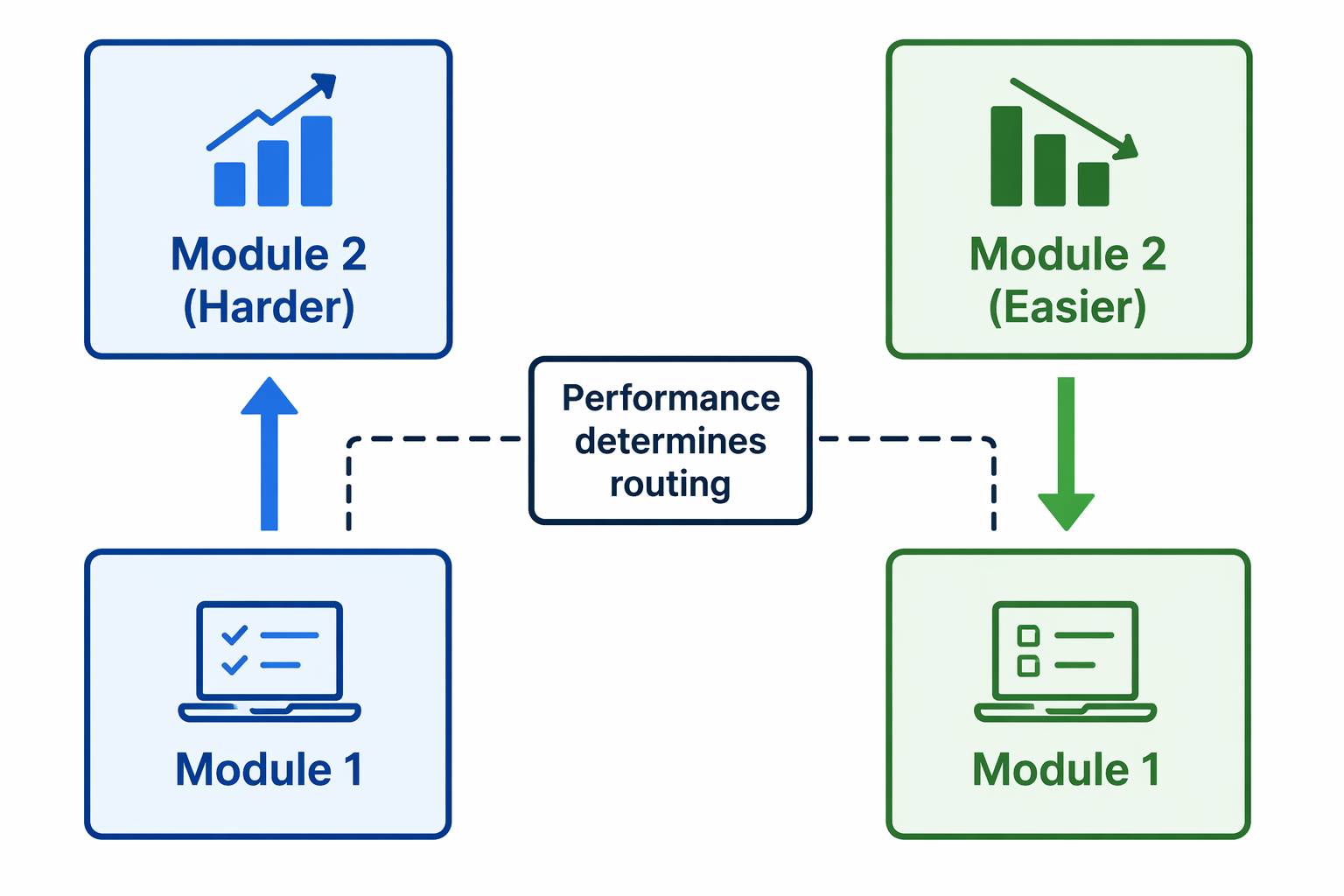
That matters more on the digital SAT than it did on an old one-size-fits-all paper test. Each section has two modules, and your performance on Module 1 helps determine whether you see an easier or harder Module 2.[1] The goal of practice is not to collect the hardest questions on the internet. It is to get better at the level of question that moves you into the next scoring band.
The best starting point is the College Board Student Question Bank because it lets you filter questions by domain, skill, and difficulty: easy, medium, or hard.[2] Those labels are not the same thing as the test’s adaptive routing algorithm, but they are practical enough to build a smarter study session than “do 30 random questions and hope.”
First, Place Yourself in the Right Practice Band
Use your most recent full-length digital practice test, not your best section drill, to choose a band. These are practical study ranges, not official College Board categories. They are meant to answer one question before your next practice session: which difficulty level should get most of your time today?
| Current score range | Main problem type to use | What you are trying to prove |
|---|---|---|
| 300–500 | Easy and medium official questions | You can recognize the tested skill and finish standard versions accurately |
| 500–650 | Medium official questions, then selected hard questions | You can handle common test patterns without needing a perfect setup |
| 650+ | Hard official questions and later Bluebook tests | You can solve dense, unfamiliar, or multi-step questions under test pressure |
The table is not a rule that locks you in. If you are at 590 overall but 700 in Reading and Writing and 480 in Math, your Math practice should follow the lower band while your Reading and Writing work can be more aggressive. Difficulty matching works best when you apply it by section, domain, and skill, not just by total score.
300–500: Easy and Medium Questions Are Not Remedial
If you are scoring in the 300–500 range, your first job is not to “challenge yourself” with the hardest advanced math or grammar questions you can find. Your first job is to stop losing points on questions where the test is asking for one recognizable skill in a standard form.
In the Student Question Bank, start by filtering for easy questions in one domain and one skill. Do not mix everything yet. For Math, that might mean working on a single algebra skill before moving into a mixed algebra set. For Reading and Writing, that might mean isolating information and ideas questions before combining them with craft and structure.

Once you can answer easy questions correctly and explain why the wrong answers are wrong, move to medium questions in that same skill. This is where a lot of students want to jump ahead because medium does not sound impressive. Ignore the label. Medium questions are often where you learn whether you actually understand the test’s wording, not just the classroom concept behind it.
For below-600 Math students especially, starting with the hardest math examples is usually a bad trade. Third-party collections of the hardest SAT math questions tend to emphasize demanding advanced algebra, functions, and multi-step setups.[5][6] Those questions can be useful later, but if you cannot yet solve standard linear equations, percentages, systems, or function notation questions reliably, the hard version mostly teaches you that the SAT feels impossible.
A useful 300–500 study set looks boring from the outside: ten to fifteen questions from one skill, careful review, then a second short set at the next difficulty only if the first one held up. The progress marker is not “I survived a hard set.” It is “I can see what the question is testing before I start guessing.”
500–650: The Messy Middle Needs Medium Questions Plus Targeted Repair
The 500–650 range is where random practice becomes most tempting. You know enough to get many questions right, so mixed sets feel productive. But if you keep doing easy and medium questions across every topic, your score may stall because the same weak skills keep hiding inside your overall percentage correct.
Use medium questions as your main diagnostic tool. Pick one domain, filter by medium difficulty, and do a short set. Then sort the misses into two groups: skill gaps and execution errors. A skill gap means you did not know what to do. An execution error means you knew the path but made a reading, setup, calculation, or timing mistake. Those two errors should not lead to the same next assignment.
| What happened in review | Next practice choice |
|---|---|
| You missed several medium questions from the same skill | Stay at medium difficulty and repair the skill before adding hard questions |
| You got most medium questions right but needed too much time | Do another medium set with timing pressure before increasing difficulty |
| You got medium questions right and can explain the traps | Add a small number of hard questions in the same skill |
| You missed hard questions because of one missing concept | Use targeted skill practice, then return to official hard questions |
This is where Khan Academy can help, especially if you use it as a repair tool rather than a place to log hours. College Board reported that 20 hours of personalized Official SAT Practice on Khan Academy was associated with an average 115-point score gain.[3] That number should not be read as a guarantee for any one student. The useful part is the word “personalized”: practice tied to individual skill gaps is more valuable than another random batch of questions.
A good 500–650 week might look like this: take one missed skill from a Bluebook or Question Bank review, repair it with Khan Academy practice, then return to medium and selected hard official questions on that skill. If the hard questions are now understandable but still slow, that is the right kind of discomfort. If the explanation still reads like a different language, you moved too fast.
Do not make every set mixed. Mixed practice has a place, especially near a full test, but it is poor at teaching you what to fix. At this score level, the fastest gains often come from finding the two or three skills that repeatedly cost points, then drilling them at the highest difficulty you can still learn from.
650+: Stop Proving You Can Do Easy Questions
If you are already scoring above 650 in a section, easy questions should mostly appear in warmups, error checks, or rare skill resets. They should not take up the center of your SAT practice. The problem is no longer basic exposure; it is whether you can handle the questions that compress several decisions into a small space.
In the Question Bank, filter for hard questions by domain and skill. For Math, give special attention to advanced math, functions, nonlinear equations, and problems where the setup is less obvious than the computation. For Reading and Writing, look closely at craft and structure, transitions, rhetorical synthesis, and evidence questions that punish a slightly-too-fast reading of the passage.
This is also the band where the later official Bluebook practice tests matter most. College Board’s Bluebook practice tests are official digital SAT practice, and the current official practice page lists eight full-length practice tests numbered 4–11.[4] Because they are full adaptive tests, they give better calibration than a homemade hard-question packet.
Review at this level should be stricter. A missed hard question is not automatically a disaster, but a missed pattern is. If three hard questions in different sets all involve function notation, paired evidence, or a transition between two claims, that is no longer bad luck. It is your next study block.
Use Full Tests to Calibrate, Not to Avoid Repair
Full-length Bluebook tests are the best way to check whether your difficulty choices are working, but taking them too often can turn into avoidance. A practice test tells you what happened. The score goes up when you do the repair work afterward.
A practical cadence is to leave enough time between full tests for review, targeted skill practice, and a return to official questions. If you test, skim the score report, and immediately schedule another full test, you have converted a diagnostic into a ritual. The test found the leak; now you have to patch it.
- After a full test, identify the section and domain where missed points cluster.
- Use the Student Question Bank to pull easy, medium, or hard questions that match your current score band.
- Use Khan Academy or another lesson source only when review shows a real skill gap.
- Return to official questions before deciding the skill is fixed.
- Take the next full test only after you have changed something about your performance, not just your mood.
How to Know When to Move Up in Difficulty
Move harder when your review becomes too clean. That does not mean every answer is correct. It means the mistakes are occasional, explainable, and not coming from the same missing skill again and again.
| Signal | What to do next |
|---|---|
| You are getting almost every easy question right and can explain the wrong choices | Move to medium questions in the same skill |
| You are getting medium questions right but only after long pauses | Stay at medium briefly and add timing pressure |
| You are getting medium questions right under reasonable timing | Add selected hard questions |
| You are missing hard questions for different reasons each time | Keep using hard questions, but review slowly |
| You are missing hard questions because the same underlying skill is weak | Drop back to targeted medium practice or a lesson, then return |
The move up should be narrow. Do not go from medium algebra to a full mixed set of the hardest Math questions. Go from medium linear equations to a few hard linear equation questions, or from medium transition questions to hard transition questions. That is how you raise difficulty without losing the thread of what you are training.
What Your Next Practice Session Should Look Like
Before you open a problem set, decide three things: your current score band for that section, the skill you are training, and the difficulty level that gives you useful friction. If you cannot name those three, you are probably about to do random practice again.
- Choose one section: Math or Reading and Writing.
- Choose one domain and one skill from your latest review.
- Filter official questions by difficulty in the Student Question Bank.
- Start at the level that matches your current score band.
- Review every miss before adding more questions.
If your errors cluster in Math, the next useful read is “How to Make SAT Math Practice Questions Actually Work.” If you are unsure how often to test, use “The Right Way to Take SAT Practice Tests” or “How to Use SAT Practice Tests to Raise Your Score.” If you need a weekly system, go to “How to Structure Your SAT Prep with Khan Academy and Bluebook.” For broader planning, start with “SAT Exam Prep Guide: Best Tools, Study Plans, and Section Strategies for the Digital SAT.”
Your best SAT practice problems are not the hardest available problems. They are the hardest problems you can learn from right now.
References
- How the SAT Is Structured, College Board,
- How to Use the Student Question Bank, College Board,
- New Data Links 20 Hours of Personalized Official SAT Practice on Khan Academy to 115-Point Average Score Gain, College Board Newsroom,
- Practice and Preparation, College Board,
- The 15 Hardest SAT Math Questions Ever, PrepScholar,
- 25 of the Hardest SAT Math Problems in 2026-27, PrepMaven,
Comments
Join the discussion with an anonymous comment.