
Is Ridley Scott an Auteur? A Film Studies Study Guide
Explore whether Ridley Scott qualifies as an auteur through his painterly visual style, recurring themes, and genre versatility. This study guide provides analytical frameworks and evidence for film studies essays and exams.
Updated:
To call Ridley Scott an auteur, a film studies essay has to do more than admire the look of the films. It has to prove that the look is doing repeatable authorial work. The useful question is not “Does Scott have a style?” but “Can we track a pattern of visual control and thematic anxiety across Alien, Blade Runner, Thelma & Louise, Gladiator, Black Hawk Down, The Martian, and Kingdom of Heaven without pretending they are all the same kind of film?”
The best answer is yes, with a necessary qualification. Scott is not a tidy auteur in the sense of making one kind of film over and over. He is better understood as a painterly, controlling, genre-fluid auteur: a director whose authorship appears in composition, atmosphere, world-building, and recurring concerns about survival, otherness, technology, and power. That case is persuasive only if it survives the counterargument that he is also a highly adaptable professional filmmaker with an uneven, commercially varied career.
Start With What Is On Screen
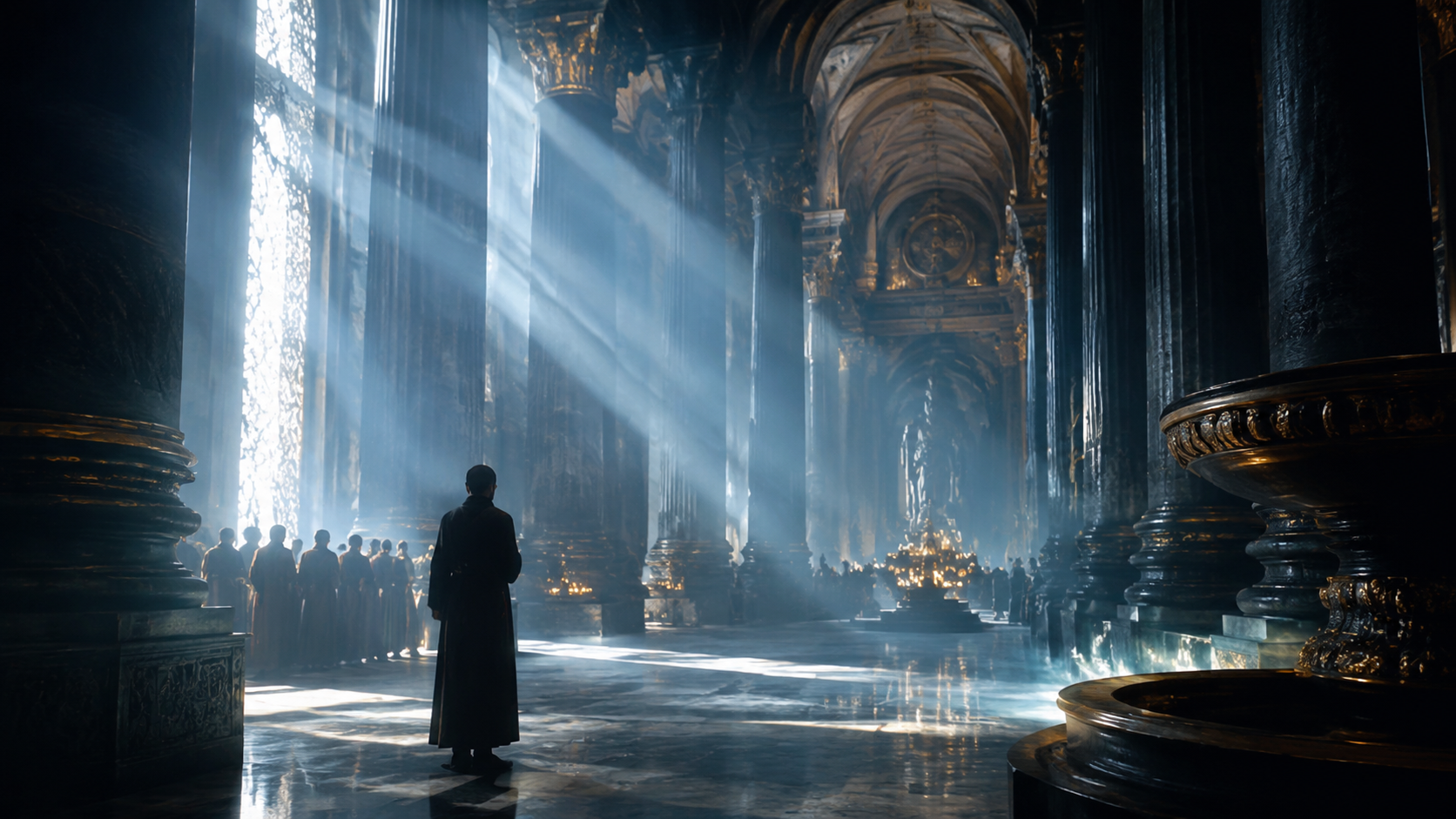
Auteur claims are weakest when they start with reputation. They become stronger when they start with evidence: smoke that turns space into depth, bodies reduced to silhouettes, corridors and chambers arranged as traps, light entering the frame in visible shafts, and environments built so densely that the world seems to exist before the plot arrives.
Scott’s background helps explain why those images feel designed rather than merely photographed. Before his feature career, he trained at the Royal College of Art and worked extensively in advertising; Indie Film Hustle describes his pre-feature experience as including more than 2,000 commercials, a useful detail when discussing his precision with image, texture, and visual impact.[1] That does not “prove” auteur status by itself. Training is context, not evidence. The evidence is what happens when the same visual habits migrate across genres.
In Alien, the Nostromo is not just a location for a monster plot. It is a working industrial maze: grates, condensation, chains, vents, tunnels, screens, and cramped thresholds. The creature is frightening partly because the ship already feels hostile. Scott’s authorship appears in the way space is made legible and oppressive at the same time. The viewer can sense the design, yet the characters seem trapped inside it.
Blade Runner makes the same argument through a different genre grammar. Instead of a spaceship, Scott gives us a future city layered with rain, neon, advertising, smoke, crowds, and architectural overload. No Film School’s discussion of the Blade Runner films emphasizes the lessons filmmakers take from its world-building and visual density, which matters because the film’s authorship is not limited to isolated beautiful shots.[2] The world is the argument. It tells us that identity, memory, labor, and technology have already been contaminated before any character explains them.
The common mistake is to say “Scott uses dark lighting” and stop there. Darkness is not the point. Control is the point. In Alien, darkness hides the creature and makes the ship feel bodily. In Blade Runner, darkness is pierced by artificial light, making the city feel manufactured, commercialized, and morally exhausted. In Gladiator and Kingdom of Heaven, shafts of light, dust, banners, armor, and architecture turn history into a visible system of power. These are not identical images, but they are related habits of mise-en-scène.
Ridleygrams and the Case for Authorial Control
If a student wants a cleaner piece of evidence than “the films look similar,” Ridleygrams are useful. Scott is known for hand-drawn storyboards, often referred to as Ridleygrams, which pre-visualize shots, movement, and spatial organization before production. Lightworks treats these detailed drawings as central to his filmmaking method and to the way he communicates visual intention on set.[3]
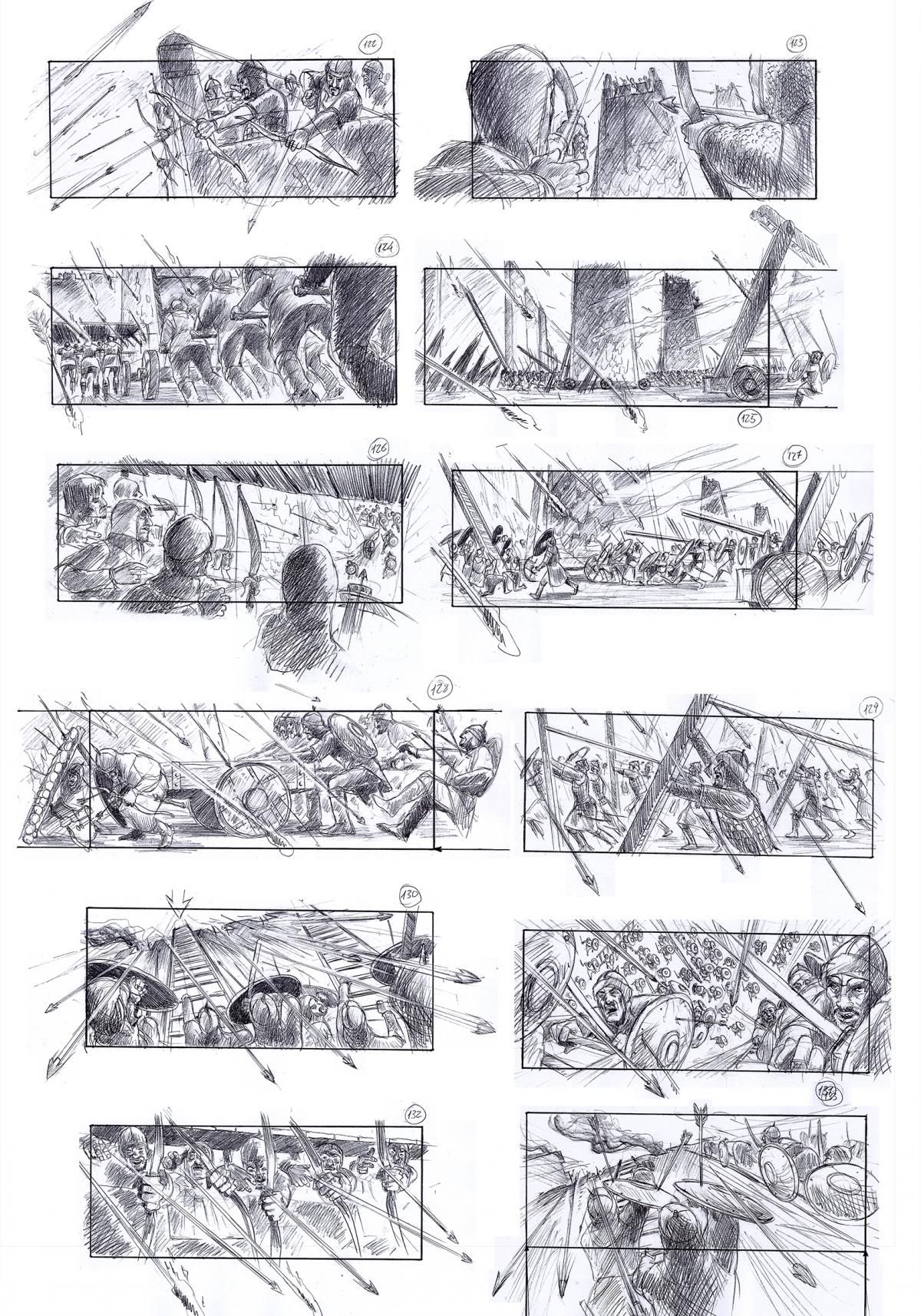
This matters because auteur theory often gets blurred into personality worship. Ridleygrams give the argument something harder: not just that Scott has taste, but that he exerts pressure on the image before the image exists. The storyboard becomes a bridge between intention and mise-en-scène. It helps explain why a battlefield in Kingdom of Heaven, a corporate chamber in Blade Runner, and a ship corridor in Alien can feel organized by the same visual intelligence even when the screen content differs.
Use this carefully in an essay. A storyboard does not mean the director controls every meaning in the film, and it does not erase the contributions of cinematographers, production designers, editors, actors, and producers. It does, however, strengthen the claim that Scott’s films are unusually preoccupied with designed space. When discussing authorship, that is more precise than saying he has “a strong visual style.”
| Film | Visual evidence to compare | Essay use |
|---|---|---|
| Alien | Industrial corridors, smoke, grates, darkness, claustrophobic movement | Argue that Scott turns setting into threat before the alien fully dominates the plot |
| Blade Runner | Rain, neon, smoke, vertical city space, crowded frames, artificial light | Argue that world-building carries the film’s anxieties about humanity and technology |
| Gladiator | Dust, arena geometry, imperial architecture, bodies arranged in spectacle | Argue that power is visualized through scale, ritual, and composition |
| Kingdom of Heaven | Fortifications, battle formations, religious architecture, controlled shafts of light | Argue that history is staged as a conflict between belief, territory, and systems of authority |
| The Martian | Hostile landscape, practical workspaces, survival routines, contrast between isolation and institutional spaces | Argue that Scott adapts his world-building to problem-solving rather than dread |
World-Building Before Plot
Scott’s films often feel authored because the world seems to have rules before the protagonist acts. That is different from simple production value. In weaker essays, “detailed world” becomes a compliment. In stronger essays, detail becomes a method: the world pressures behavior, limits choices, and turns genre into an environment.
Alien is a horror film because of the creature, but it is also a workplace film. The crew wake, eat, argue, negotiate, search, and obey company procedure inside a ship that looks functional rather than heroic. The horror depends on that ordinary labor environment being invaded. Scott’s industrial design makes the Nostromo feel used, dirty, and indifferent; when the alien appears, it belongs too well to the machinery around it.
Blade Runner pushes world-building toward overload. The city does not simply decorate Deckard’s investigation. It makes the investigation feel morally unstable. Artificial humans, artificial animals, artificial memories, and artificial light all belong to the same visual system. That is why the film is so useful for auteur study: theme and mise-en-scène are not separate boxes. The film’s questions about personhood are built into its surfaces.
The historical epics show the same habit in material less obviously associated with Scott. Gladiator organizes Rome through spectacle: arenas, processions, armor, banners, crowds, and imperial interiors. Kingdom of Heaven organizes the medieval world through walls, deserts, siege machinery, religious architecture, and light. If Alien and Blade Runner prove Scott can build speculative worlds, these films prove that his authorship is not dependent on science fiction.
The Martian is the useful pressure test because its tone is less gothic. Scott still builds a hostile environment, but the emphasis shifts from entrapment to procedure. Mars is dangerous because it is empty, exposed, and materially unforgiving. Mark Watney survives by converting environment into a series of practical problems. The film’s optimism does not cancel Scott’s authorship; it shows that his designed worlds can produce competence as well as dread.
Recurring Themes: Otherness, Creation, Survival
A visual argument alone is not enough. For auteur theory, the stronger case comes when repeated images connect to repeated concerns. Scott’s major films return to several anxieties: fear of the outsider, unstable creation, institutional betrayal, survival under pressure, and women who refuse the roles assigned to them. These patterns do not operate identically in every film, which is exactly why they are worth analyzing rather than merely listing.
Xenophobia and the Fear of the Outsider
Alien is the obvious starting point: the alien body is frightening because it violates boundaries. It enters the ship, the body, the crew hierarchy, and the viewer’s sense of what life should look like. The film’s terror depends on contamination. The outsider cannot be safely classified, and the institution responsible for the crew treats that unknown life as more valuable than the workers exposed to it.
That anxiety changes shape in Black Hawk Down and Kingdom of Heaven. A student should be careful here: these films do not make the same argument as Alien, and they involve historical and political material that cannot be reduced to monster imagery. What can be compared is Scott’s recurring interest in groups encountering spaces they do not fully understand, then relying on systems of command, belief, or military order that prove insufficient. The fear is not just of the other; it is also of the institution’s failure to interpret the other.
AI, Creation, and the Problem of the Made Human
Blade Runner gives students one of the cleanest thematic lines in Scott’s work: what happens when human beings create life and then deny responsibility for it? The replicants are manufactured, exploited, hunted, and feared. The film’s melancholy comes from the possibility that the artificial beings may understand mortality more intensely than the humans who dismiss them.
Alien also belongs in this discussion through Ash, the android whose loyalty to corporate instruction exposes the crew’s vulnerability. The artificial human is not merely a twist; he reveals the company’s value system. Prometheus and Alien: Covenant extend Scott’s interest in creation, biological design, and artificial intelligence, though students should distinguish continuity of theme from equality of achievement. A recurring obsession does not mean every film handles that obsession with the same dramatic force.
Survival Under Systems That Do Not Care
Scott’s protagonists are often placed inside systems that are larger, colder, and better resourced than they are. Ripley faces a corporation willing to sacrifice a crew. Maximus faces imperial power and the machinery of spectacle. Mark Watney faces a planet that cannot be persuaded, only worked around. Thelma and Louise face legal and social structures that narrow their options after male violence and institutional disbelief reshape their lives.
This is where comparison becomes more valuable than plot summary. Ripley and Watney are both survival figures, but their films generate survival differently. Alien is about suspicion, bodily threat, and institutional betrayal. The Martian is about scientific procedure, collaboration, and endurance. If an essay flattens both into “strong characters survive,” it loses the texture of Scott’s genre work. If it compares how each environment dictates behavior, it becomes a film studies argument.
Strong Female Protagonists Without the Poster Slogan
Ripley, Thelma, and Louise are often invoked as proof that Scott is interested in strong women. That claim is usable, but only if it is made specific. Ripley’s strength emerges through competence, suspicion, and refusal to accept corporate priorities. Thelma and Louise’s strength emerges through transformation: they do not begin as mythic heroines but are pushed into self-definition by violence, friendship, pursuit, and the closing down of lawful escape.
The BFI’s guide to where to begin with Scott places films such as Alien, Blade Runner, Thelma & Louise, Gladiator, and The Martian at the center of his accessible canon, which is useful because it shows how often classroom-friendly Scott discussions cross genre boundaries rather than staying inside science fiction.[4] For students, Thelma & Louise is especially important because it prevents an overly narrow version of Scott as merely a designer of futuristic or historical worlds. Here, landscape, car movement, motel rooms, police pursuit, and the open road become a different kind of authored space.
| Theme | Useful comparison | Stronger essay move |
|---|---|---|
| Otherness | Alien with Black Hawk Down or Kingdom of Heaven | Compare how unfamiliar bodies, cultures, or territories expose institutional limits |
| Creation and AI | Blade Runner with Alien, Prometheus, or Alien: Covenant | Ask who creates life, who controls it, and who is treated as disposable |
| Survival | Alien with The Martian | Compare survival as paranoia and bodily threat against survival as procedure and collaboration |
| Female agency | Alien with Thelma & Louise | Compare competence and refusal in different genre systems |
| Power and spectacle | Gladiator with Kingdom of Heaven | Compare how architecture, crowds, ritual, and battle formations make authority visible |
The Counterargument Is Not a Footnote
A good Ridley Scott essay should not pretend the auteur case is effortless. The most serious objection is that his career looks too wide, too commercially adaptive, and too uneven to fit a neat auteur model. Britannica’s overview of Scott’s career presents a filmography moving across science fiction, historical epic, crime, war, thriller, and drama, which supports the point that he is not easily contained by one genre identity.[5]
That range can be used in two opposed ways. Against auteurism, it suggests a director skilled at entering pre-existing genres and industrial projects rather than imprinting a single personal worldview on every film. For auteurism, it becomes evidence that the same habits of visual organization and thematic pressure reappear even when the assignment changes. The argument depends on the comparison, not the label.
James Porcher’s film studies discussion of Scott frames the “auteur or not” question directly, including the difficulty of classifying a director whose work ranges so widely and whose reputation includes both distinctive authorship and a hired-gun dimension.[6] This is the tension students should keep. It is more useful than a one-sided tribute because it lets the essay test what auteur theory can and cannot explain.
Unevenness also matters. An auteur claim does not require every film to be equally successful, but it does require an essay to avoid cherry-picking only the masterpieces. If the argument works only for Alien and Blade Runner, it is a science-fiction style argument, not a Scott argument. If it can also make sense of Thelma & Louise, Gladiator, Kingdom of Heaven, Black Hawk Down, and The Martian, it becomes more robust.
Director’s Cuts and Continued Authorial Pressure
Director’s cuts are tempting evidence, but they need discipline. Blade Runner, Kingdom of Heaven, and Legend are often discussed through their alternate versions, and that matters because revised cuts can show a director continuing to exert authorial pressure after initial release. They suggest that Scott’s authorship is not only a matter of what happens during production, but also of how the film is shaped, restored, or reframed afterward.
Still, do not turn a study guide paragraph into a trivia contest about versions. The essay question is not “How many cuts exist?” The better question is what changes in emphasis when a film is re-edited: whether character motivation becomes clearer, whether world-building breathes differently, whether ambiguity is protected or explained, and whether the director’s preferred structure strengthens the patterns visible elsewhere in the filmography.
How to Frame an Essay Answer
A workable Ridley Scott essay should move from evidence to claim, not from claim to admiration. Start with two or three films, name the exact visual or thematic pattern, and then test whether the pattern survives a genre shift. That is the difference between an essay that says “Scott is an auteur” and an essay that proves why the term is useful.
- Weak claim: Scott is an auteur because his films are visually stunning.
- Stronger claim: Scott’s authorship appears in controlled mise-en-scène, especially smoke, silhouettes, shafts of light, dense production design, and spatial systems that make environments feel oppressive or rule-bound.
- Weak claim: Scott likes strong characters.
- Stronger claim: Scott repeatedly places survivors inside institutions or environments that treat them as expendable, then uses genre to determine what survival looks like.
- Weak claim: Scott makes many different genres, so he cannot be an auteur.
- Stronger claim: Scott’s genre range complicates auteur theory, but it also makes recurring visual discipline and thematic anxieties more persuasive when they appear across unrelated forms.
For an exam or class presentation, the safest structure is comparative. Alien and Blade Runner establish the visual and thematic baseline. Thelma & Louise tests whether that authorship survives outside science fiction. Gladiator and Kingdom of Heaven test it against historical spectacle. The Martian tests it against a more optimistic survival narrative. Black Hawk Down can complicate the discussion by forcing attention to military space, group action, and the politics of representing unfamiliar territory.
The final position should be precise: Ridley Scott qualifies as an auteur if auteurism is understood as recurring visual control and thematic preoccupation rather than total consistency of genre, tone, or quality. His authorship is visible in painterly mise-en-scène, pre-visualized composition, and worlds that shape human behavior before plot takes over. The counterclaim remains serious because his career is broad, industrial, and uneven. That tension does not weaken the essay. It gives the essay something worth arguing.
References
- Ultimate Guide To Ridley Scott And His Directing Techniques, Indie Film Hustle
- 8 Great Filmmaking Lessons from the 'Blade Runner' Films, No Film School
- Learn From The Best: A Ridley Scott Masterclass, Lightworks
- Where to begin with Ridley Scott, BFI
- Ridley Scott | Biography, Movies, Alien, The Last Duel, & Facts, Britannica
- Auteur or Not, James Porcher's Film Studies Blog
Comments
Join the discussion with an anonymous comment.