
Comparison
Ortega's Election Cancellation: A Timeline Study Guide
Trace the two-decade process of democratic backsliding in Nicaragua that culminated in Daniel Ortega's July 2026 announcement canceling all future elections. This study guide provides a structured timeline, key statistics, and analytical frameworks for AP Comparative Government or political science exam preparation.
Verdict panel
- Compared
- not specified
- Target exam
- not specified
- Best for
- not specified
- Pricing last reviewed
- pricing currency unconfirmed
On July 19, 2026, Daniel Ortega returned to public view at the 47th anniversary celebration of the Sandinista Revolution after a 61-day absence and announced that Nicaragua would hold no more elections. In remarks reported the next day, he said new laws would be introduced to “build a wall” against the opposition, but the implementing laws had not yet been published as of July 21, 2026.[1]
For exam purposes, the most important point is not simply that Ortega canceled elections. It is that elections had already been drained of their competitive function before the announcement. The July 2026 statement is the endpoint currently visible in the record, not a complete legal package. The usable argument is narrower and stronger: Nicaragua moved from competitive democracy to consolidated authoritarian rule through a sequence of institutional removals, beginning well before 2026.
The short version students should be able to defend
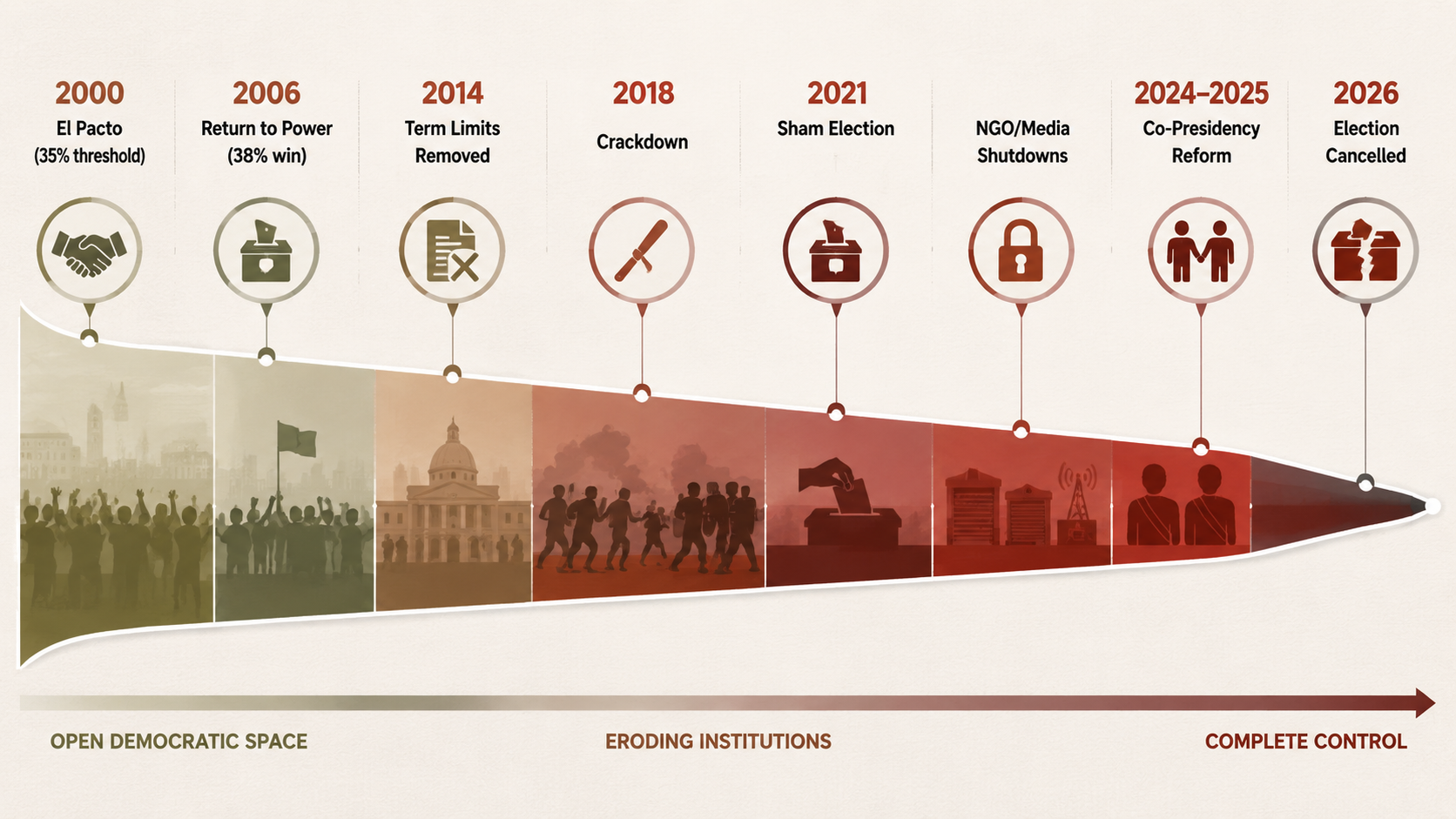
Nicaragua’s democratic backsliding can be explained as a timeline of constraint removal. In 2000, Ortega helped change the electoral rules. In 2006, he returned to power under those rules. In 2014, term limits were removed. In 2018, mass protest was met with lethal repression. In 2021, the main opposition candidates were jailed before the election. From 2018 onward, civic organizations, universities, media outlets, and religious groups were closed in large numbers. In 2024–2025, the executive itself was redesigned around Ortega and Rosario Murillo as co-presidents. In 2026, Ortega said future elections would end.
That sequence matters because “authoritarianism” is not just a label. It is a set of mechanisms: weakened electoral competition, captured courts, abolished term limits, crushed opposition leadership, restricted civil society, insecure citizenship, and concentrated executive authority.
Before the consolidation timeline: Ortega’s origin and the post-1990 opening
Ortega first became internationally known as a leader of the Sandinista revolutionary movement that overthrew the Somoza dictatorship in 1979. That background explains why the July 2026 announcement took place at a Sandinista Revolution anniversary event, but it is not where the exam answer should spend most of its time.
The more useful starting point is 1990, when Ortega lost power in an election and Nicaragua entered a period of competitive politics. The question is how a system that still had meaningful electoral competition after 1990 became one in which the sitting ruler could announce the end of elections altogether by 2026.
Timeline: from altered rules to no elections
| Date | Event | What changed institutionally |
|---|---|---|
| 2000 | El Pacto between Ortega and President Arnoldo Alemán | The presidential victory threshold was lowered from 45% to 35%, reducing the vote share needed to win. |
| 2006 | Ortega returned to the presidency with 38% of the vote | A candidate could regain power without majority support because the earlier electoral rule change had lowered the barrier. |
| 2014 | Term limits were eliminated | The constitutional limit on indefinite presidential rule was removed. |
| 2018 | Protest crackdown and the Mother’s Day Massacre | Mass opposition moved from electoral contestation into a repression environment. |
| 2021 | Election held after viable opposition candidates were jailed | The election remained formally scheduled, but competition had been disabled. |
| 2018 onward | NGOs, universities, media outlets, and religious organizations were shut | Independent civic infrastructure was narrowed or dismantled. |
| 2024–2025 | Co-presidency reform with Rosario Murillo | The presidency and vice presidency were replaced with a co-presidency arrangement. |
| July 2026 | Ortega announced that Nicaragua would hold no more elections | The regime moved from controlled elections to openly dispensing with elections, pending unpublished implementing laws. |
2000: El Pacto changed the electoral doorway
The first major step in the consolidation pathway was not a mass arrest or a canceled election. It was a rule change. In 2000, Ortega and President Arnoldo Alemán reached the arrangement known as El Pacto. One of its most important electoral effects was lowering the threshold for winning the presidency from 45% to 35%.[2]
That detail is easy to underestimate. A lowered threshold does not itself create a dictatorship. It does, however, change the strategic environment. It allows a disciplined candidate with a strong minority base to win without persuading a majority of voters. In an essay, this belongs under electoral-system manipulation, not yet under full authoritarian closure.
2006: Ortega returned with 38%
In 2006, Ortega returned to the presidency with 38% of the vote. That result was possible because the earlier threshold change meant he did not need to win an outright majority.[2]
This is the difference between a cause and a milestone. The 2006 result did not by itself abolish democracy. It was a milestone made possible by an earlier institutional cause: the altered threshold. Students should avoid writing as if Ortega simply “became dictator” in 2006. A cleaner claim is that the 2006 election restored Ortega to executive office under rules that had already made minority victory easier.
2014: term limits were removed
The next major constraint was the time limit on executive power. In 2014, Ortega’s legislative supermajority passed a constitutional amendment removing presidential term limits.[3]
Term limits are not the only safeguard in a democracy, but they matter because they force leadership turnover even when opposition parties are weak. Once removed, the presidency could become an indefinite office. That changed the question facing courts, parties, bureaucrats, business elites, and voters: instead of preparing for alternation, they had to operate under a ruler who could remain indefinitely.
2018: repression moved the system into a harsher phase
The 2018 protests marked a sharp acceleration. More than 300 protesters were killed during the crackdown, and the Mother’s Day Massacre alone killed 19 people.[4]
For a comparative politics answer, 2018 is where the regime’s problem changes. Before then, the central mechanism was rule manipulation and institutional capture. After 2018, coercion and fear become much more visible. Protest, media activity, university life, civil society organizing, and religious work all become higher-risk forms of political action.
The numbers should not be rushed past. More than 300 deaths is not just evidence of “instability.” It shows the state’s willingness to use lethal force against mass dissent. The 19 deaths on Mother’s Day identify a concrete episode inside the broader crackdown, which helps distinguish general repression from a specific event.
2021: an election without viable opposition
In 2021, Nicaragua still held a presidential election, but all viable opposition candidates had been jailed before the vote. Ortega was reported as winning with 75.87%.[5]
That distinction is exam gold: adoption of an electoral ritual is not the same as meaningful electoral competition. A government may print ballots, open polling stations, and announce totals while removing the conditions that make elections democratic. If the opposition cannot campaign, organize, appear on the ballot, or speak freely without fear of imprisonment, the election functions as ratification rather than contestation.
2018 onward: civic space was narrowed across sectors
After the 2018 crackdown, repression did not remain limited to party leaders or street protesters. Freedom House’s 2026 reporting gives Nicaragua a score of 14 out of 100 and reports more than 5,670 NGOs shut down, along with 29 universities, 58 media outlets, and 1,294 religious organizations closed since 2018.[6]
Those categories matter because they show that the state was not only defeating parties. It was removing the institutions that normally help citizens gather information, organize collectively, train professionals, document abuses, and maintain alternative public authority. A closed newspaper and a closed university do different kinds of damage, but both reduce the social capacity to challenge power.
The pressure also reached citizenship itself. In 2023, 222 political prisoners were stripped of their nationality and expelled to the United States, according to reporting cited by The Guardian.[7] By 2026, estimates of remaining political prisoners varied: AP reported 46, while Human Rights Watch figures cited by The Guardian put the number at more than 50.[1][7]
The range is worth keeping rather than smoothing away. On an exam, saying “roughly 46 to more than 50 political prisoners were reported, depending on the source” is more accurate than pretending all monitors used the same count. The larger analytical point is that imprisonment, exile, and denaturalization made opposition not only politically costly but personally insecure.
Fear also shows up in public opinion data. The 2024 Americas Barometer found that 74% of Nicaraguans feared speaking about politics.[2] That is an attitude measure, not a direct count of arrests or protests. Still, it helps explain why formal institutions can appear quiet after repression: silence may reflect fear rather than consent.
2024–2025: the executive was redesigned around Ortega and Murillo
The 2024–2025 constitutional redesign went beyond normal reelection politics. The reform abolished the presidency and vice presidency and replaced them with a co-presidency shared by Ortega and his wife, Rosario Murillo.[8]
This belongs in an essay under executive concentration and dynastic institutionalization. By this stage, the issue was no longer only whether Ortega could run again. The constitutional structure itself was being rewritten to place the Ortega-Murillo family at the center of executive authority.
2026: the announced end of elections
The July 2026 announcement therefore did not come out of an open competitive system. It came after the electoral threshold had been altered, term limits removed, protest repressed, opposition candidates jailed, civic organizations shut, citizenship weaponized, and the executive redesigned. Ortega’s statement that Nicaragua would hold no more elections made explicit what the prior sequence had already prepared: elections were no longer needed even as a controlled ritual.[1]
The caveat remains important. As of July 21, 2026, the promised laws to “build a wall” against the opposition had not been published. Students should not claim legal details that are not yet documented. The defensible claim is that Ortega announced the end of future elections and promised implementing legislation whose precise mechanisms were still unavailable.
What each step removed
A strong political science paragraph should connect events to mechanisms. The timeline is not a list of bad things happening one after another. It is a sequence in which different checks on power were removed or weakened.
| Constraint | How it was weakened | Why it matters analytically |
|---|---|---|
| Electoral competition | The threshold was lowered in 2000; opposition candidates were jailed before the 2021 election; elections were announced as canceled in 2026. | Citizens lost meaningful ability to replace rulers through competitive voting. |
| Judicial and institutional independence | El Pacto and later institutional capture weakened the institutions that were supposed to referee competition. | Institutions that should referee competition became part of the consolidation pathway. |
| Term limits | The 2014 constitutional amendment removed presidential term limits. | The presidency became an indefinite office rather than a time-limited mandate. |
| Civil society | Thousands of NGOs and many universities, media outlets, and religious organizations were closed after 2018. | Citizens lost organizational channels outside the ruling party and state. |
| Opposition leadership | Viable opposition candidates were jailed before the 2021 election. | Electoral choice was reduced before voters reached the ballot box. |
| Citizenship security | Political prisoners were denaturalized and expelled. | The state signaled that dissent could cost not only office or liberty but membership in the nation. |
| Executive separation | The 2024–2025 reform replaced the presidency and vice presidency with an Ortega-Murillo co-presidency. | Executive authority was personalized and family-centered inside the constitutional design. |
This is also how to avoid a weak essay. A weak version says, “Ortega became authoritarian because he canceled elections.” A stronger version says, “The cancellation of elections was possible because earlier reforms and repression had already removed electoral competition, term limits, civic organization, opposition leadership, and institutional separation.”
International response belongs after the domestic sequence
External reactions help confirm how outside institutions viewed Nicaragua’s trajectory, but they should not replace the domestic causal timeline. Reporting and analysis cited U.S. sanctions on more than 2,350 officials, United Nations accusations of crimes against humanity, and Nicaragua’s withdrawal from the Organization of American States as evidence of the regime’s international isolation and outside recognition of its authoritarian consolidation.[1][9]
In an exam answer, these facts are supporting evidence, not the spine. Sanctions did not cause the original 2000 threshold change. The OAS withdrawal did not jail the 2021 opposition candidates. The domestic sequence still does the explanatory work.
How to turn this into an exam paragraph
If the prompt asks about democratic backsliding, use Nicaragua to show gradual institutional erosion rather than sudden regime change. Begin with the 2000 pact because it changed the rules of competition. Move to the 2006 return to power and the 2014 removal of term limits. Use 2018 as the acceleration point, when repression against mass protest raised the cost of dissent. Then use 2021, the post-2018 closures, denaturalizations, the co-presidency reform, and the 2026 announcement to show consolidation.
A defensible claim might read: Nicaragua’s move from competitive democracy to no elections was a process of authoritarian consolidation in which Ortega first changed electoral incentives, then removed tenure limits, then repressed protest and opposition leadership, then dismantled civil society, and finally redesigned the executive around the Ortega-Murillo family before announcing the end of elections in 2026.
The evidence should be specific: the threshold fell from 45% to 35%; Ortega returned with 38%; term limits were removed in 2014; more than 300 protesters were killed in the 2018 crackdown; viable opposition candidates were jailed before the 2021 election; Freedom House reported more than 5,670 NGOs shut; and the co-presidency reform placed Ortega and Murillo together at the top of the executive.[2][3][4][5][6][8]
Common mistakes to avoid
- Do not call the July 2026 announcement a fully documented legal package. The laws Ortega promised had not yet been published as of July 21, 2026.
- Do not treat the 2006 election as the single moment democracy ended. It was a milestone made possible by the 2000 rule change.
- Do not confuse holding an election with holding a competitive election. The 2021 vote occurred after viable opposition candidates were jailed.
- Do not present fear of political speech as the same kind of evidence as an arrest count. The 74% figure measures reported fear, not direct behavior.
- Do not flatten all estimates of political prisoners into one exact number. Available sources reported roughly 46 to more than 50 remaining political prisoners.
- Do not make a long Somoza comparison if the prompt is about post-1990 democratic erosion. The clearer exam answer is the 2000–2026 institutional timeline.
Study takeaway
Ortega’s July 2026 election cancellation should be studied as the last visible step in a long consolidation sequence. The key pattern is not one sudden coup. It is the removal of one constraint after another: electoral thresholds, term limits, opposition candidates, civic organizations, independent information channels, citizenship security, and finally the need to hold elections at all.
References
- Ortega says Nicaragua will hold no more elections, CNN, July 20, 2026
- Nicaragua’s Slow-Motion Democratic Collapse, Democratic Erosion Consortium, May 5, 2026
- BTI 2026 Nicaragua Country Report, Bertelsmann Stiftung
- Nicaragua’s crisis, explained, Chatham House, April 2023
- Nicaragua’s Ortega wins fourth term in election criticized as undemocratic, AP News
- Freedom in the World 2026: Nicaragua, Freedom House, 2026
- Nicaragua strips 222 political prisoners of citizenship and sends them to US, The Guardian
- Nicaragua’s Electoral Counter-Reform, Verfassungsblog
- Nicaragua: Repression and Authoritarian Consolidation, ACLED Analysis
Back to the exam this applies to
Target exam not specified — see all exam hubs.
Comments
Join the discussion with an anonymous comment.