
Comparison
How Meteorite Amino Acids Explain the Origins of Life
This guide for biology students examines the evidence from meteorite and asteroid samples showing that amino acids formed in space and were delivered to early Earth. It also explains the unresolved homochirality puzzle — why life uses only left-handed amino acids despite space rocks containing equal mixtures.
Verdict panel
- Compared
- not specified
- Target exam
- not specified
- Best for
- not specified
- Pricing last reviewed
- pricing currency unconfirmed
In origin-of-life research, a common shortcut is to say that space rocks brought life to Earth. That is not what the evidence shows. The better sentence is more careful and more useful for biology students: carbon-rich meteorites and asteroid samples show that several of life’s chemical building blocks can form without biology, survive inside small solar-system bodies, and reach planets.
That distinction matters. Amino acids are ingredients, not organisms. Finding glycine, alanine, nucleobases, ammonia, or other prebiotic molecules in extraterrestrial material does not explain the origin of cells, metabolism, heredity, or natural selection. It does, however, make one part of the origin-of-life problem less mysterious: early Earth did not have to make every useful organic molecule from scratch.
| Evidence type | What it supports | What it does not prove |
|---|---|---|
| Amino acids in meteorites and asteroid samples | Abiotic chemistry can make biologically relevant organic molecules | Life itself formed in space |
| Returned samples from Bennu and Ryugu | Contamination concerns can be reduced with controlled collection and curation | Every early-Earth pathway used those exact molecules |
| Laboratory formation experiments | Plausible reactions can produce amino acid precursors or amino acids under asteroid-like conditions | A complete route from chemistry to living systems |
| Equal L- and D-amino acid mixtures | Extraterrestrial amino acids can be racemic | Why modern life uses almost exclusively L-amino acids |
Start With the Cleanest Evidence, Not the Most Famous Story
The classic teaching example is the Murchison meteorite, a carbonaceous chondrite that fell in Australia in 1969. It became famous because analyses found a rich inventory of organic compounds, including many amino acids that are not used in modern proteins. That last detail is not trivia. Non-protein amino acids are one reason the Murchison findings are hard to explain as simple biological contamination: a laboratory sample smeared with modern biology should not neatly resemble a strange prebiotic chemistry set.

Murchison still deserves its place early in many lectures, but it should not carry the whole modern argument. It fell into the open environment before current sample-return standards existed. That does not make its organic chemistry worthless; it means students should ask what later evidence does to the contamination objection.
Winchcombe, which fell in the United Kingdom in 2021 and was collected within about 12 hours, helps with that question. A 2024 study reported extraterrestrial amino acids and nucleobases detected in situ by advanced electron microscopy, without relying on chemical extraction from the meteorite powder.[1] That detail is easy to miss, but it is exactly the kind of detail that changes how strongly we trust the result. If a molecule is observed in place, associated with the meteorite material itself, the argument is cleaner than if the entire case depends on dissolving material, separating compounds, and ruling out every laboratory or environmental input afterward.
The strongest modern evidence comes from asteroid sample-return missions. NASA’s OSIRIS-REx mission returned material from asteroid Bennu in 2023. Analyses reported 14 of the 20 amino acids used by life to build proteins, all five nucleobases used in DNA and RNA, ammonia, and salts formed from ancient brines.[2] That is a broad inventory: amino acids matter for proteins, nucleobases matter for genetic polymers, and ammonia matters because nitrogen chemistry is central to both.
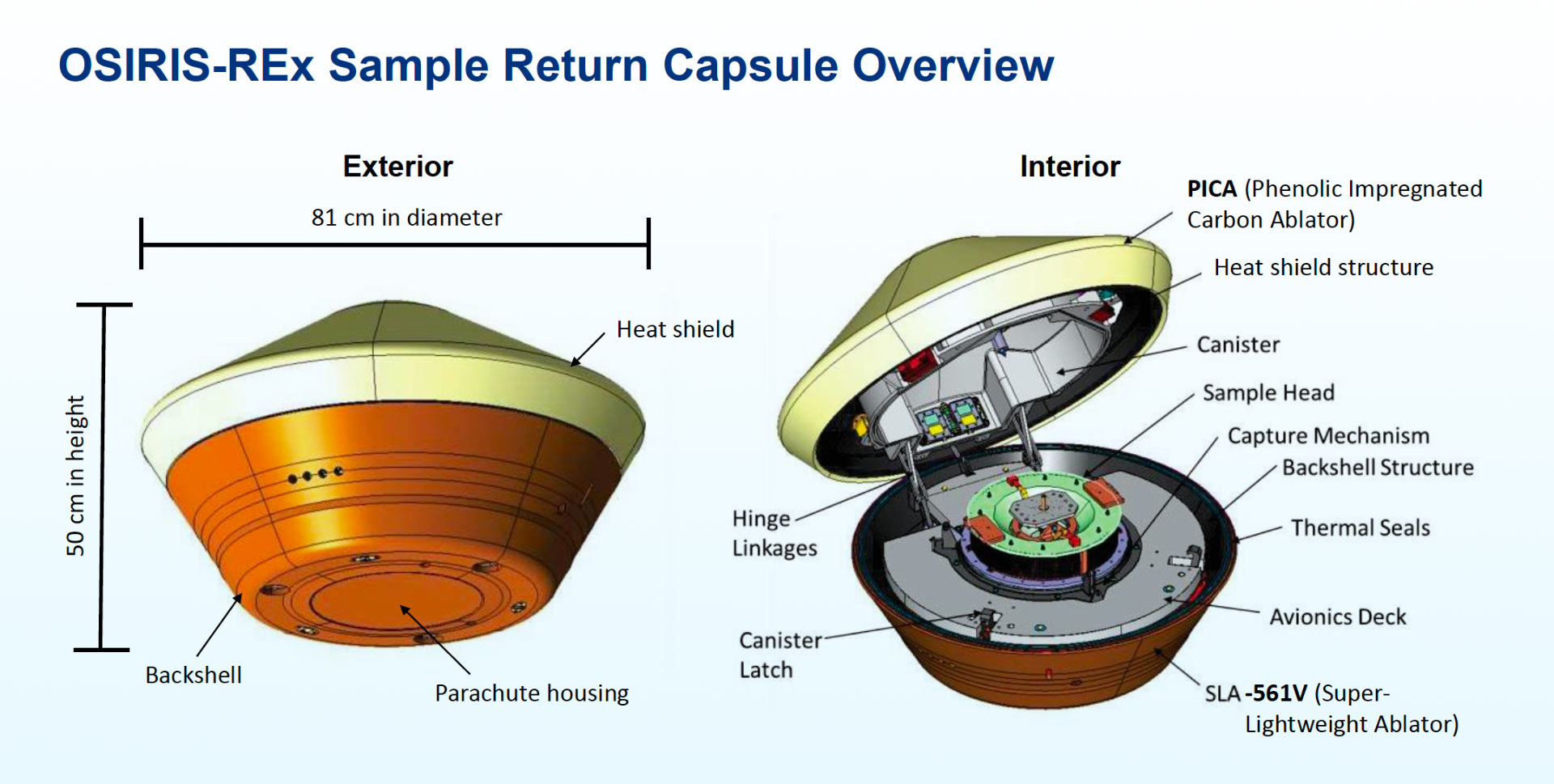
Bennu also contained 11 evaporite minerals, including trona, which points to briny liquid water in the asteroid’s parent body before Bennu became the rubble-pile asteroid sampled by OSIRIS-REx.[2] This is where the evidence becomes more interesting than a list of molecules. Amino acids are not floating in from nowhere. They sit inside a history of water, minerals, salts, heat, and radiation in small bodies left over from the early solar system.
A later Bennu report described tryptophan, which would make the detected inventory 15 of the 20 protein-building amino acids, but that result was described as confident rather than fully conclusive.[3] For an exam answer or essay, this is the correct way to write it: Bennu has strong evidence for 14 protein-building amino acids, with tryptophan reported as tentative in later analysis. The careful wording is not a weakness. It is how science prevents an exciting sentence from becoming an inflated one.
Ryugu, sampled by Japan’s Hayabusa2 mission and returned to Earth in 2020, adds a different lesson. In a 2023 analysis of Ryugu particles, N,N-dimethylglycine was the most abundant amino acid in one particle but was undetectable in another; β-alanine and glycine ratios also varied between particles.[4] That means asteroid organic chemistry can be heterogeneous at very small scales. One pebble-sized sample is not always a miniature version of the whole parent body.
For students, the clean mental model is not “Murchison proved it, and everything since then repeated it.” It is this: Murchison showed that carbonaceous meteorites can be chemically rich; Winchcombe showed why rapid recovery and in-place detection matter; Bennu supplied a carefully returned inventory of amino acids, nucleobases, ammonia, and evaporite minerals; Ryugu showed that the chemistry can vary from particle to particle because alteration inside asteroid material was uneven.
Protein Amino Acids Are Only Part of the Story
Amino acids are often introduced as the monomers of proteins. That is true for the 20 standard protein-building amino acids used by modern life, but meteorites contain broader chemistry. They can include amino acids that biology does not normally use in proteins. In origin-of-life research, those “extra” amino acids are not clutter. They are evidence of reaction networks that were not being directed by enzymes, ribosomes, genomes, or living cells.
So when a source says a meteorite contains many amino acids, the next question is: many of which kind? A count that mixes proteinogenic and non-proteinogenic amino acids is not the same as a count of amino acids used in modern proteins. Bennu’s 14-of-20 result is powerful because it refers specifically to the standard protein-building set.[2] Murchison’s importance is different: it shows a wide abiotic organic inventory, including amino acids outside modern protein chemistry.
Nucleobases require the same care. Finding all five nucleobases in Bennu material matters because adenine, guanine, cytosine, thymine, and uracil are familiar from DNA and RNA.[2] But a nucleobase is not a nucleotide, a nucleotide is not an RNA strand, and an RNA strand is not automatically a living system. The evidence supports delivery of ingredients and compatible reaction chemistry, not a completed recipe.
How Amino Acids Could Form Inside Asteroid Parent Bodies
The most useful pathway to draw on paper begins before a meteorite reaches Earth. A carbon-rich asteroid parent body contains simple molecules, minerals, ice or water-bearing phases, and radioactive isotopes. Heat and radiation alter that material. Liquid water, when present, lets molecules move and react. Mineral surfaces concentrate reactants and can catalyze reactions. Later impacts break pieces loose, and some fragments eventually fall to planets as meteorites.
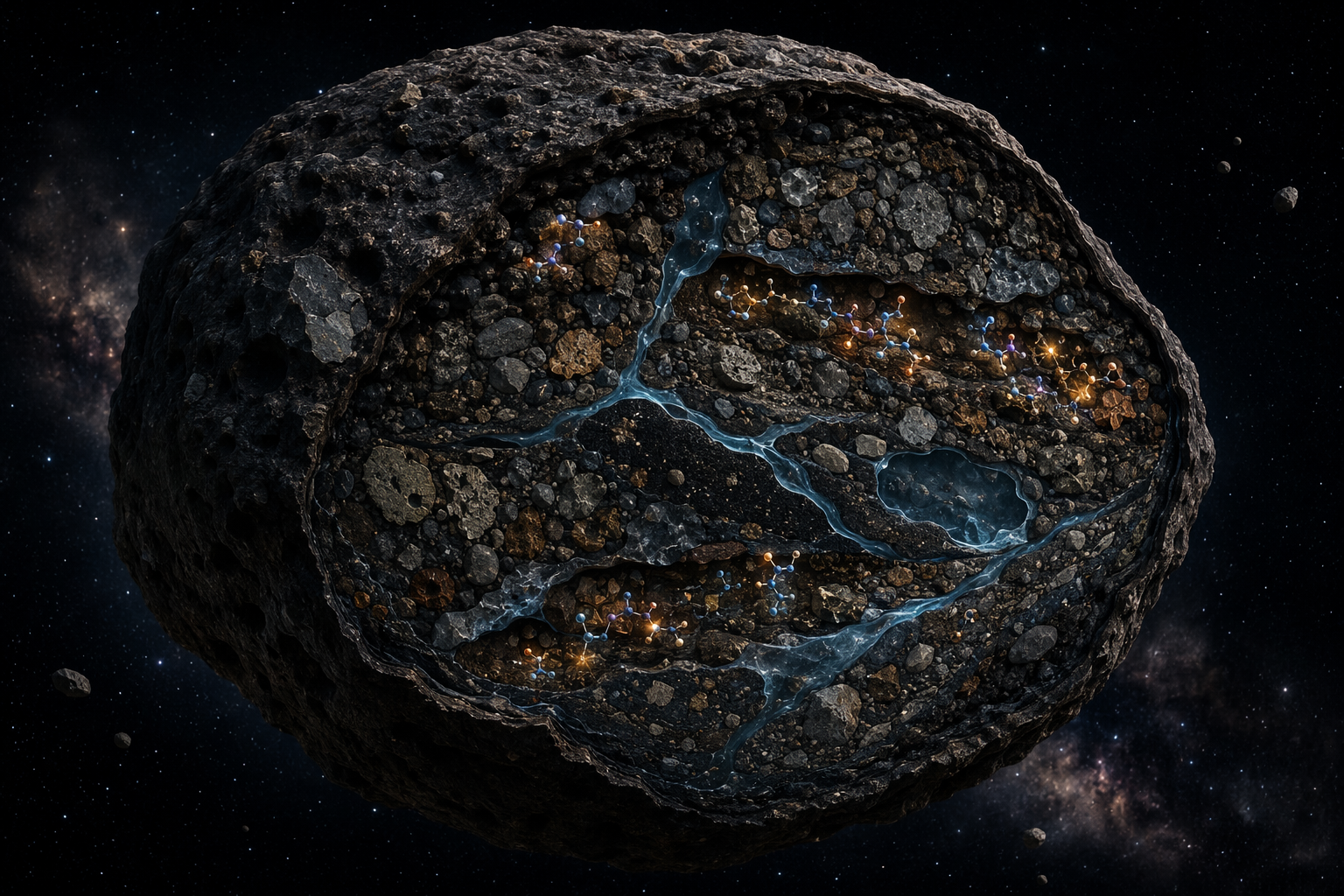
Gamma-ray chemistry gives one experimentally tested route from simple molecules to amino acids. In a 2022 study, researchers irradiated aqueous formaldehyde-ammonia solutions with gamma rays and produced α- and β-amino acids; amino acid yields rose linearly with total gamma-ray dose, with a reported correlation of R = 0.94.[5] The same study calculated that 1,000 to 100,000 years of irradiation from aluminum-26 decay could produce Murchison-level amino acid concentrations under modeled parent-body conditions.[5]
That experiment does not prove that every meteorite amino acid formed by gamma-ray radiolysis. It does something narrower and still important: it shows that water, formaldehyde, ammonia, and radiation can make amino acids on timescales relevant to early solar-system bodies. In a student diagram, this belongs in the “formation inside parent body” box, not in the “life begins” box.
Hexamethylenetetramine, or HMT, supplies another bridge between simple starting materials and later organic complexity. HMT has been confirmed in the Murchison, Murray, and Tagish Lake meteorites, and NASA described it as a stable molecule that can act as a reservoir of formaldehyde and ammonia, releasing them when heated with water inside asteroids.[6] That is chemically useful because formaldehyde and ammonia are the same kinds of small molecules needed in amino acid-forming reactions.
A simple way to connect the pieces is:
- Small molecules such as formaldehyde and ammonia are present or stored in precursor molecules such as HMT.
- Water inside an asteroid parent body allows those compounds to react instead of remaining locked in dry grains.
- Radiation and heat drive chemical transformations over long timescales.
- Minerals and metals provide surfaces and catalytic environments.
- Fragments of the altered parent body later deliver the resulting organic inventory to planets.
Iron-catalyzed chemistry is a supporting route in the same larger picture. In 2023, Max Planck Society researchers reported that iron particles from the Campo del Cielo meteorite and volcanic ash could convert carbon dioxide and hydrogen into methanol, ethanol, acetaldehyde, and formaldehyde.[7] Those products are not amino acids themselves, but they are direct precursors in prebiotic chemistry. The important point is not that there is one magic reaction. It is that several plausible reactions point toward the same kind of organic starting material.
Delivery to Early Earth Is Plausible; the Next Step Is Not Solved
Carbonaceous chondrites are primitive, carbon-rich meteorites that preserve material from early solar-system history. If such bodies carried amino acids, nucleobases, ammonia, and related compounds, then impacts on early Earth could have contributed prebiotic ingredients to surface environments. That is the delivery part of the argument.
The next part is harder. Molecules delivered to Earth would have faced dilution, destruction, concentration, mineral adsorption, wet-dry cycling, ultraviolet radiation, and competition among many reaction pathways. Some of those conditions may have helped prebiotic chemistry; others would have broken molecules apart. A delivered amino acid does not automatically join a peptide. A delivered nucleobase does not automatically become RNA.
This is why “meteorites delivered building blocks” is a stronger statement than “meteorites explain life.” The first statement follows from converging sample evidence and laboratory chemistry. The second quietly jumps over polymer formation, compartmentalization, replication, metabolism, and evolution. Those are not small details. They are the rest of the origin-of-life problem.
The Homochirality Problem Should Be the Last Complication, Not a Footnote
Amino acids can exist in mirror-image forms called L and D enantiomers. Modern life on Earth builds proteins almost exclusively from L-amino acids. Many abiotic reactions, however, tend to produce racemic mixtures: roughly equal amounts of left- and right-handed forms. That mismatch is one of the cleanest places to see the boundary between ingredient supply and biological organization.
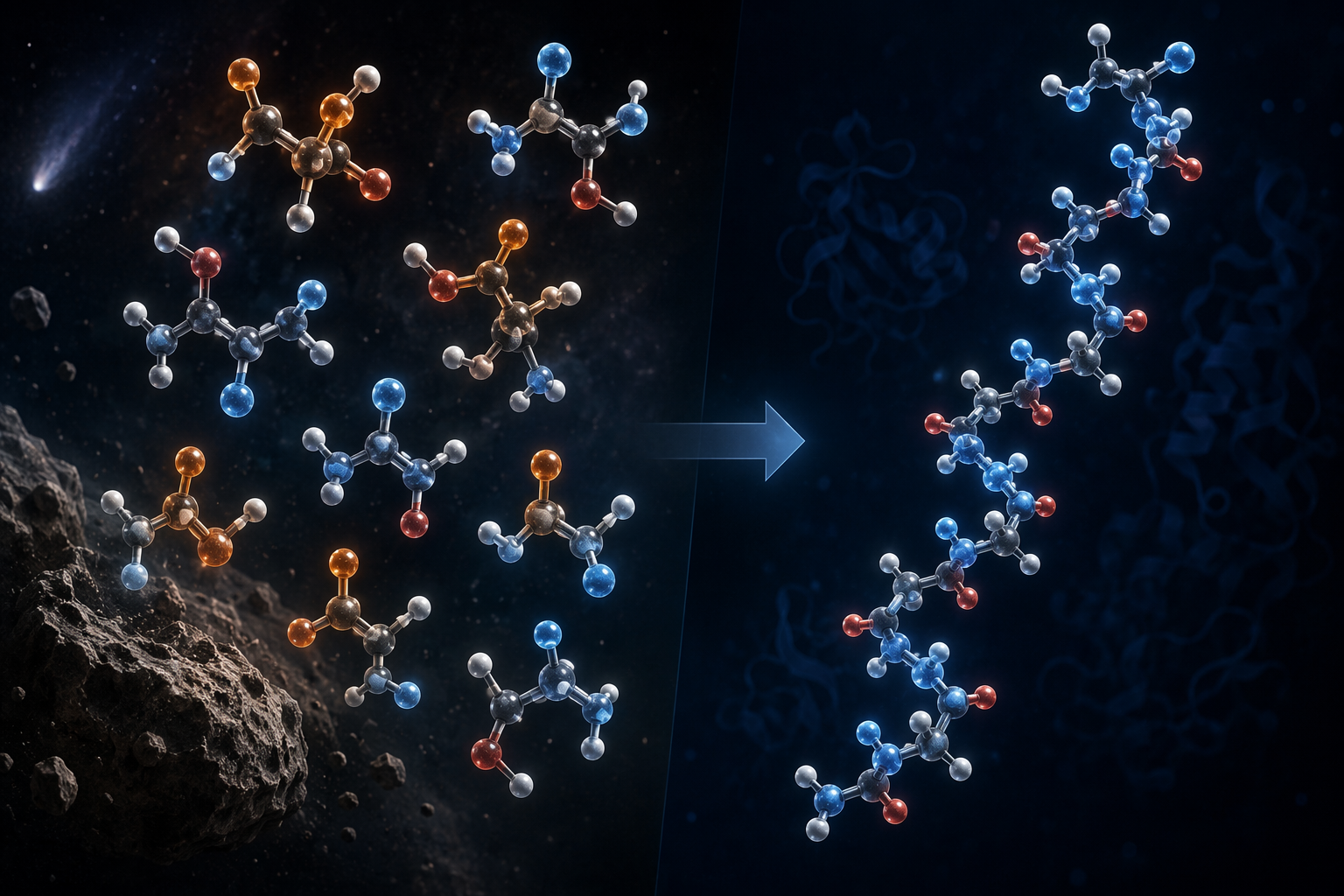
Bennu makes the problem sharper. NASA reported that amino acids in the Bennu sample occurred in equal L and D mixtures, rather than showing the L excess familiar from biology.[2] That supports an abiotic origin for the molecules, because a strong biological contamination signal would be expected to favor L-amino acids. At the same time, it does not explain how Earth life ended up using one handedness so consistently.
A 2024 UCLA ribozyme study complicates one possible answer. Researchers tested 15 different ribozymes and found no inherent preference for attaching L-amino acids rather than D-amino acids.[8] That result does not rule out all routes to homochirality, but it weakens the easy story that early RNA-like catalysts naturally selected the same handedness modern proteins use.
So the best current answer is balanced. Meteorites and asteroid samples strongly support the idea that amino acids and other prebiotic molecules formed abiotically in early solar-system materials and were delivered to Earth. They help explain the supply of chemical building blocks. They do not yet explain why biology selected left-handed amino acids, or how a mixed inventory of space-made molecules crossed into self-maintaining, evolving living systems.
References
- Scientists Uncover New Clues Regarding the Origin of Life on Earth Inside the Recently Recovered Winchcombe Meteorite, SciTechDaily, 2024
- NASA’s Asteroid Bennu Sample Reveals Mix of Life’s Ingredients, NASA
- Tryptophan detected in asteroid Bennu sample, NASA says, CNN, 2025
- Sub-millimetre scale distribution of organics in Ryugu particles, Nature Communications, 2023
- Gamma-Ray-Induced Amino Acid Formation in Aqueous Small Bodies in the Early Solar System, ACS Central Science, 2022
- Key Building Block for Organic Molecules Discovered in Meteorites, NASA, 2020
- Origin of life on Earth through iron particles from meteorites as catalyst, Max Planck Society, 2023
- UCLA scientists shed new light on why life favors one hand of chemical building blocks, UCLA Newsroom, 2024
Back to the exam this applies to
Target exam not specified — see all exam hubs.
Comments
Join the discussion with an anonymous comment.