
Comparison
What Is the Jacobian Conjecture? A Simple Explanation
The Jacobian conjecture is surprisingly simple to state: if a polynomial map has a nonzero constant Jacobian determinant, does it have a polynomial inverse? This guide explains the conjecture from scratch and covers the July 2026 AI-discovered counterexample that shows the answer is 'no' in dimensions above 2, while the 2D case remains open.
Verdict panel
- Compared
- not specified
- Target exam
- not specified
- Best for
- not specified
- Pricing last reviewed
- pricing currency unconfirmed
A good simple explanation of the Jacobian conjecture starts one variable earlier than the conjecture itself.
Take the ordinary function f(x)=x+x³. Its derivative is f′(x)=1+3x², which is always positive. So the graph never turns backward. It passes the usual calculus smell test for having an inverse: every horizontal line hits it once, and you can solve backward in principle.
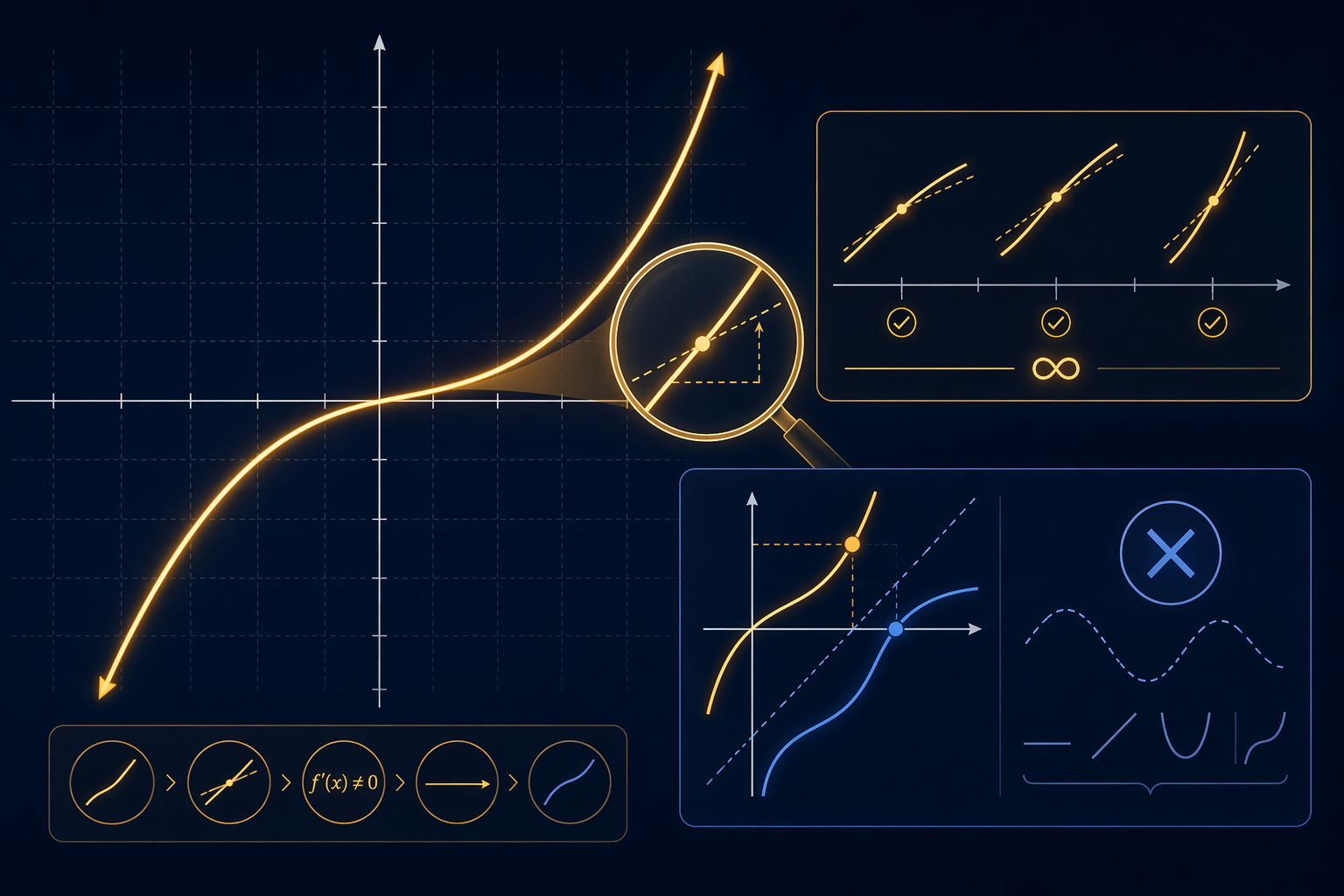
But here is the small trap that prepares you for the bigger one: the inverse of f exists as a function, but it is not a polynomial function. The condition “the derivative behaves nicely” and the conclusion “the inverse is polynomial” are different kinds of promises. The Jacobian conjecture asks whether a stronger multivariable version of that derivative condition is enough to force a polynomial inverse.
From a derivative to a Jacobian determinant
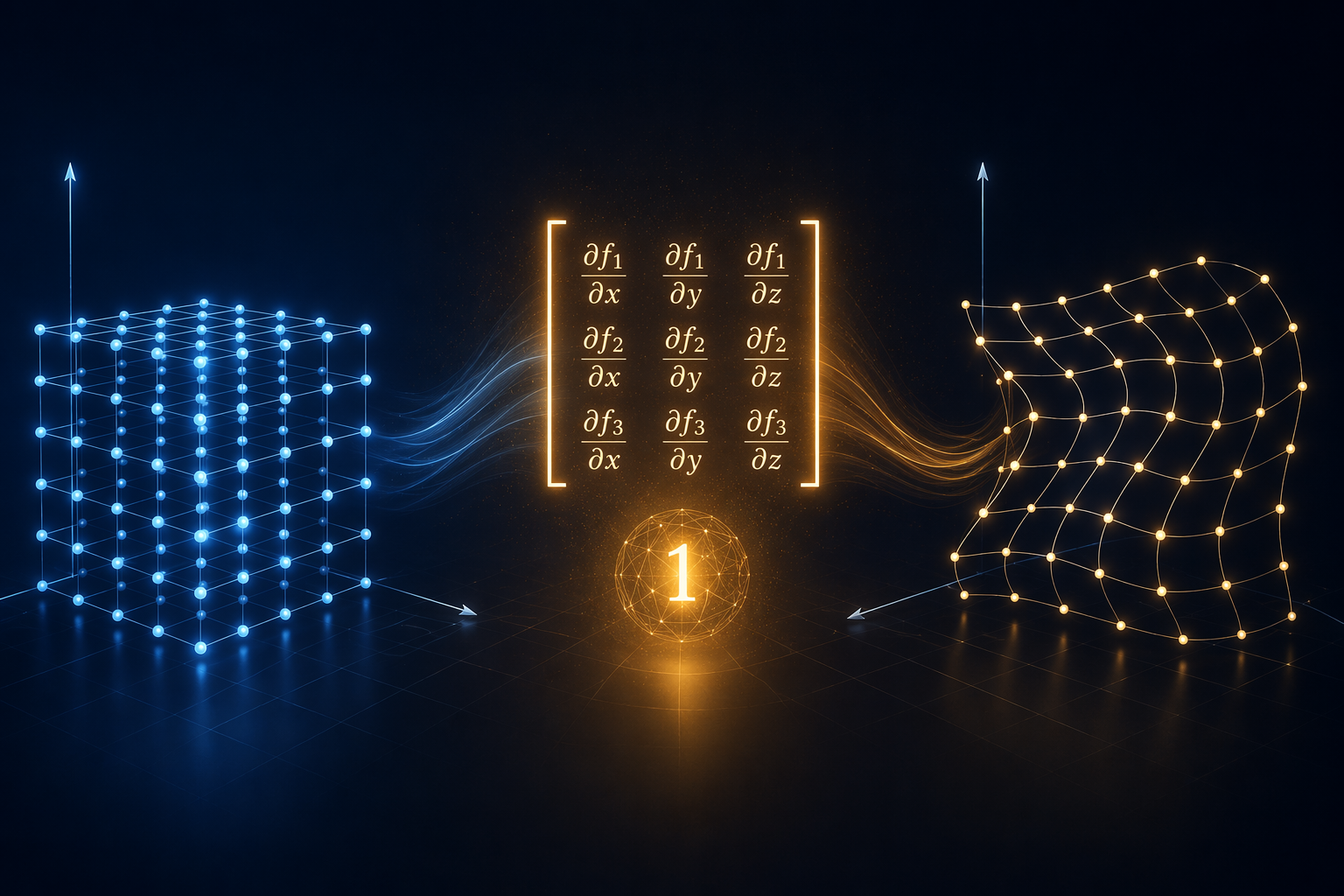
In one-variable calculus, the derivative tells you how a function stretches or flips tiny intervals near a point. In several variables, a polynomial map might take an input such as (x,y) or (x,y,z) and output several new coordinates. The derivative information becomes a matrix: the Jacobian matrix.
For a two-variable map F(x,y)=(u(x,y),v(x,y)), the Jacobian matrix is
[ ∂u/∂x   ∂u/∂y ]
[ ∂v/∂x   ∂v/∂y ]
Its determinant is the number that says, locally, how the map scales tiny areas. If the determinant is zero at a point, the map is flattening area there; information is being crushed in a way that makes a local inverse suspicious. If the determinant is nonzero, the map is locally well behaved around that point.
The Jacobian conjecture asks for more than “nonzero somewhere.” It asks about polynomial maps whose Jacobian determinant is a nonzero constant everywhere. In plain form:
If a polynomial map has a nonzero constant Jacobian determinant, must its inverse also be a polynomial map?
That is the whole reason the conjecture is famous and slightly dangerous to explain. It sounds like a tidy calculus question, but for decades it resisted the tools people brought to it. The standard statement is usually credited to Ott-Heinrich Keller’s 1939 formulation, and it is classically posed over fields of characteristic zero, such as the complex numbers.[1][2]
A small example where the condition works
Before looking at the 2026 counterexample, it helps to see the condition doing what your intuition wants it to do. A common worked example uses the polynomial change of variables
u = x² + y + x
v = x² + y
The Jacobian matrix is
[ ∂u/∂x   ∂u/∂y ]   [ 2x + 1   1 ]
[ ∂v/∂x   ∂v/∂y ] = [ 2x       1 ]
The determinant is
(2x + 1)(1) - (1)(2x) = 1So this map has Jacobian determinant 1 everywhere. It never locally squashes area to zero, and its local area-scaling behavior does not even vary from point to point.[1]
Even better, the inverse is easy to find. Subtract the two equations:
u - v = xThen plug that into v=x²+y:
x = u - v
y = v - (u - v)²
Both inverse coordinates are polynomial expressions in u and v. This is the picture the conjecture encouraged: a polynomial map with constant nonzero Jacobian determinant ought to be globally reversible by polynomials, not just locally respectable.
The same source often contrasts this with a nearby-looking map whose Jacobian determinant is 2x, not a nonzero constant. That version can behave differently because the determinant vanishes when x=0.[1] The word “constant” is not decoration; it is the part that tries to rule out local collapse everywhere at once.
What the conjecture was really betting on
The conjecture was not merely saying, “the map probably has some inverse.” It was saying something more algebraic: if the map is built from polynomials and the Jacobian determinant is a nonzero constant, then the reverse map should also be built from polynomials.
That is why the problem sits in an unusual place for students. The statement uses objects from multivariable calculus, but the desired conclusion is algebraic. You are not just checking whether tiny neighborhoods are reversible. You are asking whether a local derivative condition controls the whole global polynomial machine.
There is an important line here: local invertibility does not automatically give global invertibility. A map can look perfectly reversible under a microscope and still fold distant parts of space onto the same output. The Jacobian conjecture was famous because, for polynomial maps with constant nonzero Jacobian determinant, many mathematicians expected that kind of global collision could not happen.
The 2026 counterexample makes the failure visible
On July 19, 2026, a reported AI-assisted discovery produced an explicit three-variable polynomial map of degree 7:
F(x,y,z) = (x² + y, xy + yz², xy² + xz + y³)Its Jacobian determinant is the constant -2.[3] That means it passes the central derivative test in the conjecture: the local volume-scaling signal is nonzero everywhere and does not vary from point to point.
But the same map sends three distinct input points to the same output point, (-1/4,0,0):
- (-1/2, 0, 0)
- (1/2, -1/2, 1)
- (1/2, -1/2, -1)
Each of those inputs lands at (-1/4,0,0).[3] That one fact breaks invertibility in the plainest possible way. An inverse function would have to answer the question, “Which input produced this output?” Here there are three correct answers.
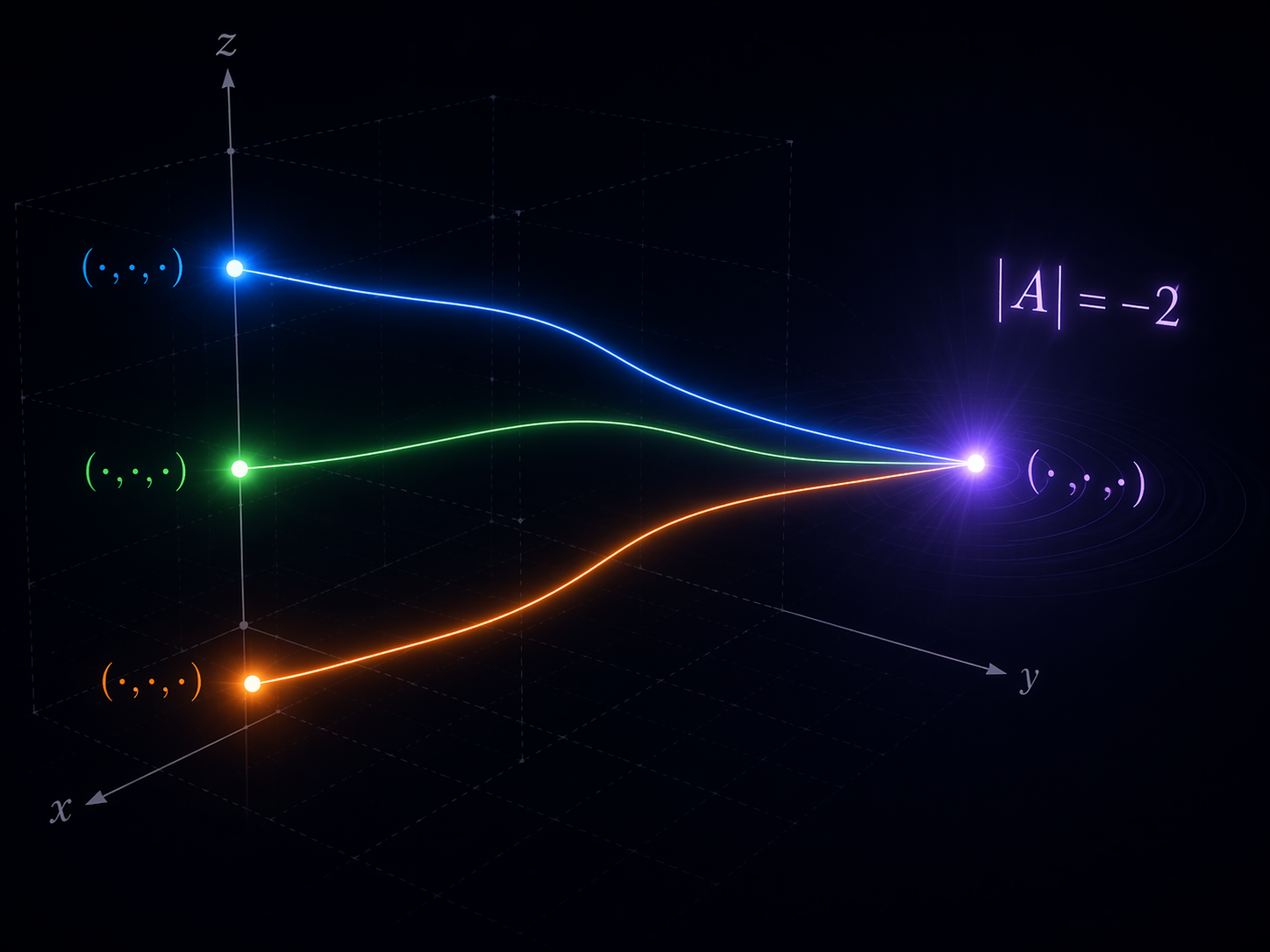
The essential mechanism does not require drama. A constant nonzero Jacobian determinant says the map is locally nonsingular. The collision says it is not globally one-to-one. Once two or more different inputs give the same output, there cannot be an inverse function on the whole space, and therefore there cannot be a polynomial inverse.
What has, and has not, been settled
The counterexample matters because the Jacobian conjecture had survived since Keller’s 1939 formulation.[2] A single valid counterexample in three variables is enough to show that the conjecture is false as a general statement in all dimensions.
It does not settle the two-variable case. That distinction is easy to blur, and it should not be blurred. The familiar map (u,v) example above lives in two variables, but the 2026 counterexample lives in three. The original two-variable problem remains open under the current materials.
There has been serious partial progress in two variables. Tzuong-Tsieng Moh verified the two-variable Jacobian conjecture up to degree 100, according to Purdue’s historical page on the problem.[4] That is not the same as a proof for every degree, but it explains why the two-dimensional case has felt stubborn rather than neglected.
The July 2026 result is also being discussed for consequences beyond the Jacobian conjecture itself. Community discussion has pointed to implications for corresponding Dixmier and Poisson conjectures in related dimensions.[5] For a first pass, though, those consequences are not the main thing to learn. The main thing is simpler: a polynomial map can have a constant nonzero Jacobian determinant and still identify distinct points.
Why the 2026 result should be described carefully
Because the announcement is only two days old as of July 21, 2026, it should not be written up as though it has already passed through the ordinary slow machinery of peer review. The available report says the counterexample has been verified with multiple computer algebra systems and checked by independent mathematicians.[3] That is meaningful evidence, especially for a claim built from an explicit formula and explicit collision points.
Still, “computationally verified and independently checked” is not the same status as “absorbed into the peer-reviewed literature and stabilized through time.” For students, that caution should make the result more understandable, not less. The counterexample is not a vague claim that an AI solved a problem somewhere offstage. It is a concrete polynomial map with a stated constant Jacobian determinant and stated colliding inputs. Those are the pieces to inspect.
So the clean answer to “What is the Jacobian conjecture?” is this: it predicted that a polynomial map with nonzero constant Jacobian determinant must have a polynomial inverse. The clean answer to “What changed in 2026?” is that an explicit three-variable degree-7 map was reported with constant Jacobian determinant -2 but with multiple inputs mapping to the same output.[3] That makes the general conjecture false in dimensions above 2, while the two-variable case remains open.
References
- Jacobian conjecture, Wikipedia.
- Jacobian Conjecture, MathWorld.
- Claude and the Jacobian Conjecture, bit-partners.
- The Jacobian Conjecture, Purdue University Department of Mathematics.
- Claude disproves the Jacobian conjecture, Hacker News.
Back to the exam this applies to
Target exam not specified — see all exam hubs.
Comments
Join the discussion with an anonymous comment.