
Comparison
How the Psyche Gamma-Ray Sensor Works
A clear explanation of NASA's Psyche gamma-ray and neutron spectrometer — how its cryogenically cooled germanium detector achieves the highest resolution ever flown in space to reveal the elemental makeup of asteroid 16 Psyche and test whether it is an exposed planetary core.
Verdict panel
- Compared
- not specified
- Target exam
- not specified
- Best for
- not specified
- Pricing last reviewed
- pricing currency unconfirmed
The Psyche gamma-ray sensor is worth explaining because of a small number: 2.1 keV. That is the energy resolution reported for its high-purity germanium detector in flight, about 2.5 times sharper than the roughly 5 keV resolution of the gamma-ray spectrometer flown on MESSENGER. Before launch, the same detector reached 1.93 keV full width at half maximum at 1332.5 keV, nearly twice as good as its 3.5 keV requirement; after checkout in space, it measured 2.09 ± 0.03 keV, reported as the best resolution of any space-based HPGe detector so far.[1][2]
That number is not decorative. A gamma-ray spectrometer does not take a photograph of an asteroid and then label the interesting parts. It waits for atoms to announce themselves by energy. If two elemental signatures are close together, a blunt detector smears them into the same hill. A sharper detector can keep them apart, and that difference determines whether a composition measurement is useful or merely hopeful.
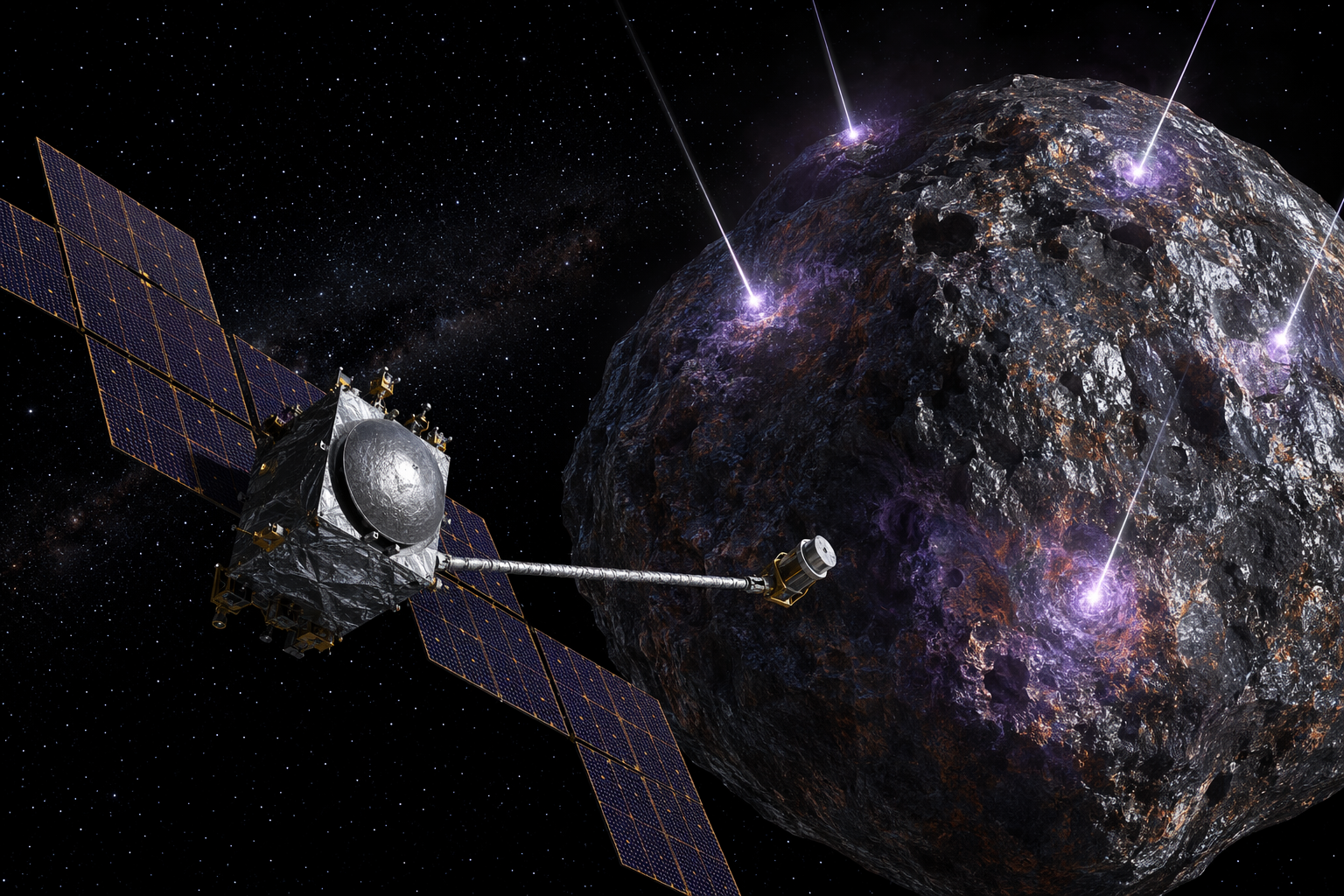
What the Psyche Gamma-Ray Sensor Measures
The measurement begins before the instrument does anything. Galactic cosmic rays strike the surface of asteroid 16 Psyche. Those impacts excite atoms in the upper surface material, and the atoms release gamma rays at energies tied to their nuclei. Iron, nickel, silicon, potassium, sulfur, aluminum, and calcium are among the elements the mission wants to measure because their abundances can test whether 16 Psyche is an exposed protoplanetary core or something less tidy.[2][3]
Two example lines show why resolution matters. Iron has a useful gamma-ray line at 846 keV. Nickel has one at 1454 keV. Potassium sits nearby at 1461 keV. Those numbers are close enough that careless hardware choices can become scientific problems: if the spacecraft itself produces nickel background near 1454 keV, it can interfere with the potassium signal next door.[2]
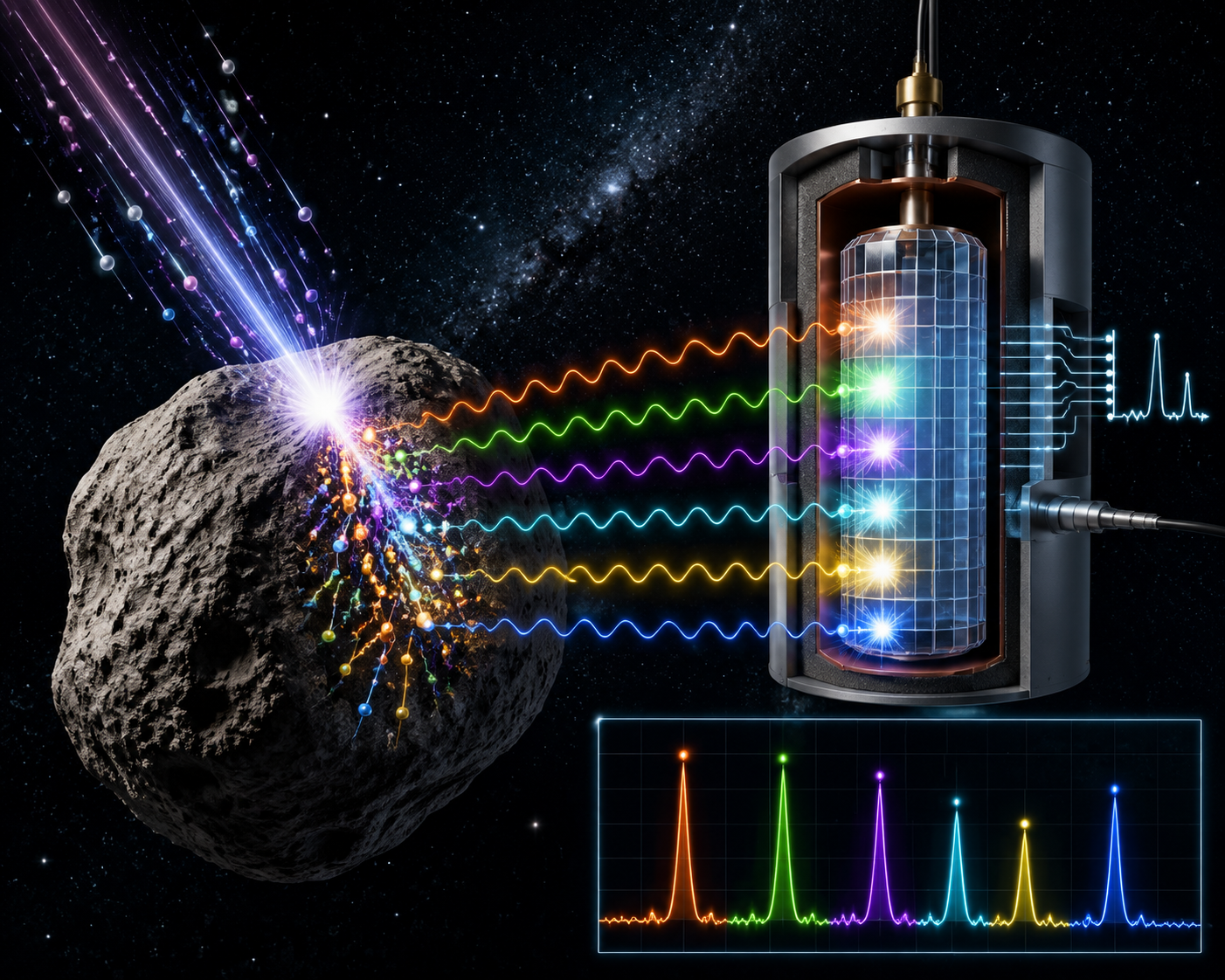
A useful way to picture the instrument is as a sorter. Each incoming gamma ray deposits energy in the detector. The detector turns that deposited energy into an electrical pulse. The electronics measure the pulse and place the event into an energy spectrum. Over time, the spectrum fills with peaks. A peak at the right energy, after background and geometry are handled, becomes evidence for an element in the asteroid’s surface material.
The important phrase there is “over time.” Gamma-ray spectroscopy in orbit is patient work. The planned low-altitude Orbit D campaign is expected to run for roughly 100 days at about 75 km altitude, building up enough counts for composition measurements after Psyche arrives at the asteroid, currently projected for August 2029.[2][3]
Why Germanium Has to Be Kept Cold
The heart of the gamma-ray side of Psyche’s GRNS is a high-purity germanium crystal. HPGe detectors are valued because they can measure gamma-ray energies very precisely. They are also inconvenient in the way good instruments often are: they have to be kept cold, quiet, and stable, or their beautiful resolution degrades.
Psyche’s detector is cooled to about 90 K by a pulse-tube cryocooler. That choice matters. The mission moved away from older rotary cryocooler designs because the pulse-tube approach supports longer life and lower vibration, both useful when the job is to preserve narrow spectral peaks over a long cruise and a later orbital campaign.[2]
Cooling is not just a temperature target; it is a heat-budget argument. The cryostat heat load was measured at 380 ± 20 mW at 23°C, inside the cryocooler’s 500 mW capacity. That margin is the kind of unglamorous fact that earns trust because it ties the performance claim to a test condition rather than a brochure adjective.[2]
The cryostat also vents to space. That sounds like plumbing, but it is part of the measurement. A detector surrounded by trapped gas or extra conductive heat paths has to fight its own thermal environment. For this instrument, keeping the germanium cold enough is part of keeping the energy peaks narrow enough to separate composition signals later.
From Energy Peaks to Asteroid Composition
Suppose the detector records many events around 846 keV while Psyche is orbiting low over the asteroid. The instrument team does not simply declare “iron” and leave the room. They compare the measured spectrum with expected gamma-ray lines, subtract or model background, account for spacecraft and detector effects, and fold the result into abundance estimates. The line is the clue; the composition number is the product of calibration, counting statistics, and background control.
Nickel is even more instructive. A nickel-rich asteroid would be scientifically important for the exposed-core hypothesis, but nickel is also a contaminant risk in the spacecraft. The Ni line at 1454 keV sits close to potassium at 1461 keV, so spacecraft materials containing nickel could create a false or confusing background exactly where the science team needs clarity. The mission ran a nickel-accounting campaign to remove Ni-bearing materials, and early flight data showed nickel background consistent with zero.[2]
That is not a discovery about 16 Psyche. It is better than that, in the instrument-builder’s sense: it is evidence that the spacecraft is not loudly talking over one of the measurements it was built to make.
| Element or issue | Energy or role | Why it matters |
|---|---|---|
| Iron | 846 keV gamma-ray line | A key element for testing whether the asteroid’s surface is metal-rich |
| Nickel | 1454 keV gamma-ray line | Scientifically important, but also a possible spacecraft background problem |
| Potassium | 1461 keV gamma-ray line | Close enough to nickel that poor resolution or contamination can blur the interpretation |
| Detector resolution | About 2.1 keV in flight | Allows nearby gamma-ray features to be separated more cleanly than lower-resolution instruments |
The GRNS Is More Than One Sensor
The full Psyche Gamma-Ray and Neutron Spectrometer is not just the germanium detector. It has five sensors across two subsystems: the HPGe gamma-ray detector, three helium-3 neutron sensors, and a NEUTRON detector. Together they produce 10 distinct measurement types, giving the team several ways to constrain surface composition and neutron behavior rather than relying on one spectrum alone.[2][4]
For a learner, the map is simple enough: gamma rays identify element-specific energy lines, while neutron measurements help interpret how cosmic-ray interactions and surface composition shape the particle environment. The unusual engineering still sits in the gamma detector because its resolution is the record-setting part, but the science result will come from the instrument system, not from one elegant crystal acting alone.
The MESSENGER Lessons Built Into Psyche
Psyche’s gamma-ray detector did not appear from nowhere. The team inherited hard lessons from MESSENGER, which also flew an HPGe gamma-ray spectrometer. Galactic cosmic rays and other radiation can damage a germanium detector over time, degrading the charge collection that sharp peaks depend on. The cure is annealing: warming the detector to repair radiation damage.
Here the exact temperature matters. A multi-year annealing study for Psyche found that 105°C, not the 85°C used on MESSENGER, was needed for full radiation damage recovery. Psyche also added an improved passivation layer and the vent-to-space cryostat, both tied to making the detector more durable and stable over the mission.[2][1]
This is the part of instrument design that rarely fits into a mission poster. The detector has to survive launch, cruise, radiation exposure, thermal cycling, and then still be able to produce narrow peaks years later. A 2.1 keV resolution figure is impressive only because the engineering around it tries to keep that number from becoming a one-time laboratory memory.
Why the Detector Rides on a Boom
The GRNS is mounted on a 2-meter boom. That is not a styling choice; it is an admission that the spacecraft is part of the measurement problem. Spacecraft materials can emit or scatter radiation. Electronics, structure, and shielding can all contribute background. Moving the detector away from the spacecraft helps the instrument listen more to the asteroid and less to its own ride.[2]
The boom, nickel cleanup, cryostat, cryocooler, passivation layer, and annealing plan all point in the same direction. The mission is not merely carrying a sensitive detector; it is carrying a detector whose surroundings have been negotiated so the useful signal has a chance to remain visible.
What the Mars Flyby Proved—and What It Did Not
Psyche launched in 2023 and used a Mars gravity assist in May 2026 on its way to the asteroid. During the May 15, 2026 flyby, the LLNL-built gamma-ray sensor performed as expected while the spacecraft passed Mars at 2,864 miles and traveled about 12,000 mph.[5]
That flyby was a useful rehearsal and health check. It showed that the instrument was alive, cold, and behaving well during an important mission event. It did not determine the composition of asteroid 16 Psyche, and it did not prove the asteroid is an exposed planetary core. The decisive measurement still waits for orbital operations at the target.
What Makes the Instrument Record-Breaking
The record is not that Psyche can detect gamma rays at all. Space missions have done gamma-ray spectroscopy before. The record is that this space-flown HPGe detector can separate gamma-ray energies with unusually fine resolution, and that the rest of the instrument was designed to defend that resolution against heat, radiation damage, vibration, contamination, and spacecraft background.
- The HPGe crystal provides the sharp gamma-ray energy measurement.
- The pulse-tube cryocooler keeps the crystal near 90 K with low vibration.
- The vent-to-space cryostat helps manage heat and detector stability.
- The annealing strategy repairs radiation damage that would otherwise broaden peaks.
- The boom placement and nickel-control effort reduce backgrounds that could masquerade as asteroid signals.
That chain is why explaining the Psyche gamma-ray sensor cannot stop at “it detects elemental fingerprints.” The fingerprints are faint, the detector is vulnerable, and the spacecraft can accidentally become a source. The engineering is the science pathway.
The Composition Question Is Still Open
Asteroid 16 Psyche is often discussed as a possible exposed protoplanetary core, and the GRNS is one of the instruments built to test that idea. The fair wording is “test,” not “confirm.” The spacecraft has passed checkout milestones, the gamma-ray detector has demonstrated record resolution in flight, and the Mars flyby showed the sensor performing as expected. None of that is the same as an asteroid composition result.
If the instrument performs during the low-altitude campaign as designed, it should be unusually well prepared to distinguish the elemental fingerprints that matter: iron and nickel for metal-rich material, silicon and sulfur for the broader geochemical story, potassium, aluminum, and calcium for additional compositional constraints. The exciting part is not that the answer has already been packaged. It is that the detector has been made quiet, cold, clean, and stable enough for the asteroid to answer.
References
- LLNL gamma-ray sensor has the best resolution — LLNL
- The Psyche Gamma-Ray and Neutron Spectrometer — Space Science Reviews
- Instruments & Science Investigations — UC Berkeley Psyche Mission
- Psyche GRNS — JHU APL
- NASA's Psyche mission tests LLNL-built gamma-ray sensor on Mars flyby — LLNL
Back to the exam this applies to
Target exam not specified — see all exam hubs.
Comments
Join the discussion with an anonymous comment.