
Comparison
What the 2025 Study on Artificial Sweeteners and Brain Aging Means for Students
The largest study to date links six common artificial sweeteners to faster cognitive decline, especially in adults under 60. This article explains what the 2025 Neurology study actually found, what it doesn't prove, and how students can make informed choices without panic.
Verdict panel
- Compared
- not specified
- Target exam
- not specified
- Best for
- not specified
- Pricing last reviewed
- pricing currency unconfirmed
If you saw the headline about artificial sweeteners and brain aging and immediately thought about the diet soda in your backpack, the short answer is: no, this study does not prove your study drink is damaging your brain. It does, however, give a better reason than usual to stop treating zero-calorie sweetness as automatically irrelevant.
The 2025 study in Neurology followed 12,772 Brazilian civil servants for 8 years, starting at an average age of 52, and tested their cognition in three waves. At the beginning, participants reported their intake of seven low- or no-calorie sweeteners through a food-frequency questionnaire. The researchers then compared cognitive decline across lower, moderate, and higher intake groups.[1]
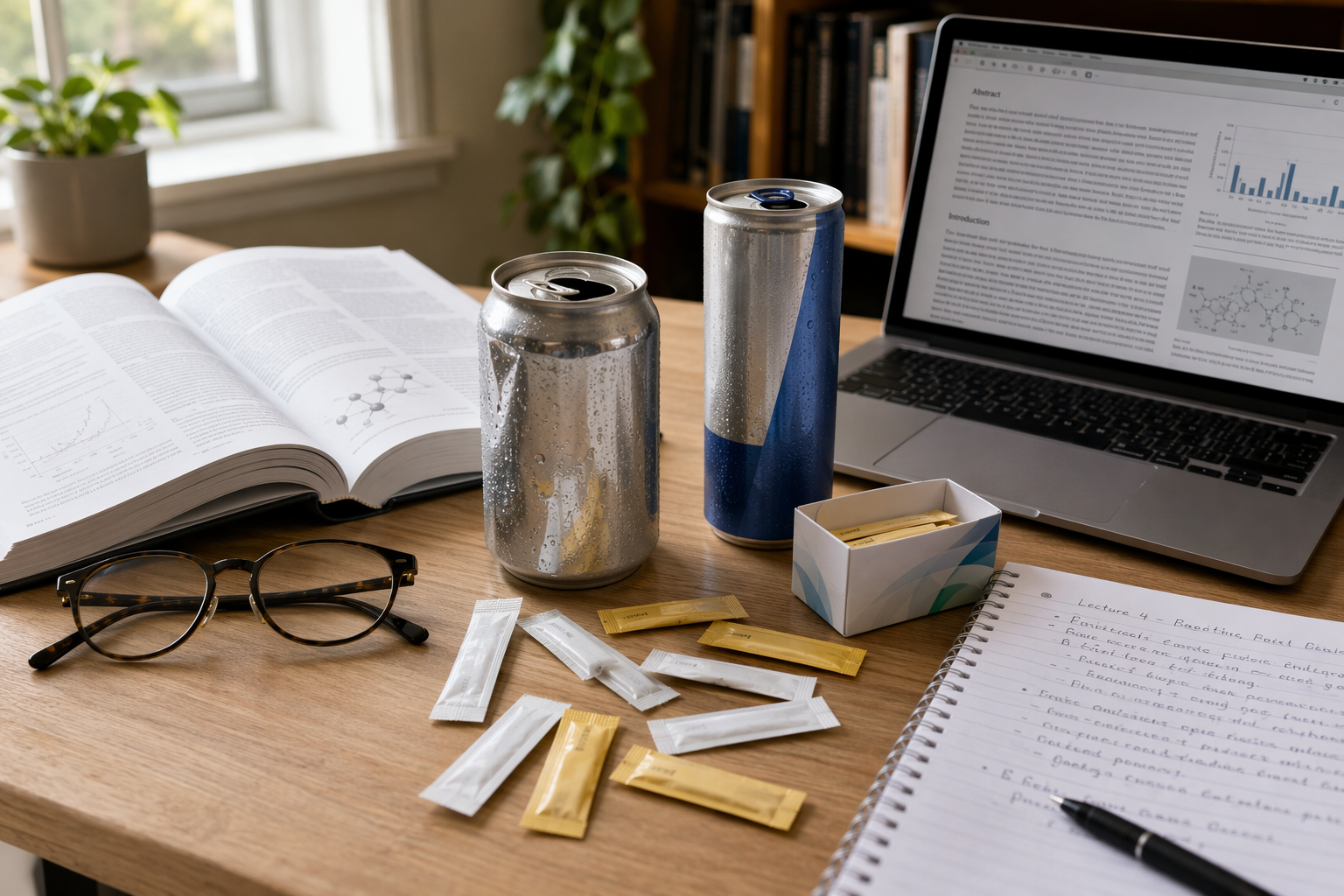
That design matters. It is stronger than a one-time internet survey and weaker than a randomized trial. Nobody was assigned to drink diet soda for years. Nobody had brain scans showing sweetener-related damage. The study found an association between higher sweetener intake and faster decline on cognitive tests; it did not prove that sweeteners caused the decline.
What “62% Faster Decline” Actually Means
The headline number came from the highest intake group. Participants in that group consumed about 191 mg per day of the sweeteners studied, roughly described as the amount in one diet soda, and showed 62% faster global cognitive decline than the lowest intake group, whose average intake was about 20 mg per day. The moderate group showed 35% faster decline.[1]
That sounds huge because it is a relative rate. It does not mean people suddenly lost 62% of their thinking ability. The absolute differences were modest, and they accumulated across years of testing. Still, the pattern is not nothing: the higher the reported intake, the faster the decline. That dose-response pattern is one of the reasons this paper is worth reading instead of filing under another recycled wellness scare.[1]
| Study Detail | What It Means for Reading the Result |
|---|---|
| 12,772 participants | Large enough to take seriously, though still one cohort |
| 8 years of follow-up | Long enough to observe change rather than just a snapshot |
| Three cognitive testing waves | Better than relying on self-reported memory complaints |
| Diet measured once at baseline | A major limitation if people changed habits later |
| Observational design | Association, not proof of cause |
The Student-Relevant Part Is Verbal Fluency
The steepest decline appeared in verbal fluency. In the high-consumption group, verbal fluency declined 173% faster than in the lowest group; in the moderate group, it declined 110% faster.[1][2]
Verbal fluency is not the same as “being smart,” and one test domain should not be inflated into a full diagnosis of intelligence. But it is also not some abstract lab measure students can ignore. It overlaps with the kind of fast retrieval that shows up when you are writing under time pressure, answering in a seminar, explaining a lab result, or trying to make your brain produce the word you definitely know but cannot grab.
The study also measured broader cognition, including memory and executive function. The verbal fluency signal was the most dramatic, which makes it interesting. It also makes replication important, because one striking domain result is not the same thing as a settled account of how sweeteners affect the brain.
Why the Under-60 Finding Lands Differently
The association appeared in participants under 60 and disappeared in participants 60 and older. That is the part that makes this feel less like a distant aging story and more like a midlife-and-before habit story.[3]
Students are not 52-year-old civil servants, so the study cannot be pasted directly onto campus life. But the under-60 signal matters because it pushes the question earlier than the usual “dementia later” framing. Dr. Thomas Holland of Rush University, in editorial commentary reported by Practical Neurology, interpreted the result as consistent with the idea that midlife dietary exposures may shape the trajectory of later brain aging.[3]
There is also an unresolved wrinkle: the null result in adults over 60 does not prove sweeteners become harmless after 60. One explanation raised by editorialists is that older adults may have more baseline cognitive variability, making associations harder to detect.[3]
Which Sweeteners Were Actually Studied
Six of the seven tested sweeteners were linked to faster cognitive decline: aspartame, saccharin, acesulfame-K, erythritol, sorbitol, and xylitol. Tagatose was the exception. Sucralose and stevia were not included, so this study cannot be used as evidence that they have the same association.[1][4]
For a student, the relevant exposure is not usually a tiny pink packet in isolation. It is the pattern: diet sodas with aspartame, sugar-free energy drinks that may use acesulfame-K, sugar-free gum with xylitol or sorbitol, protein bars or keto snacks with sugar alcohols, and a general habit of stacking “zero sugar” products across the day.[4]
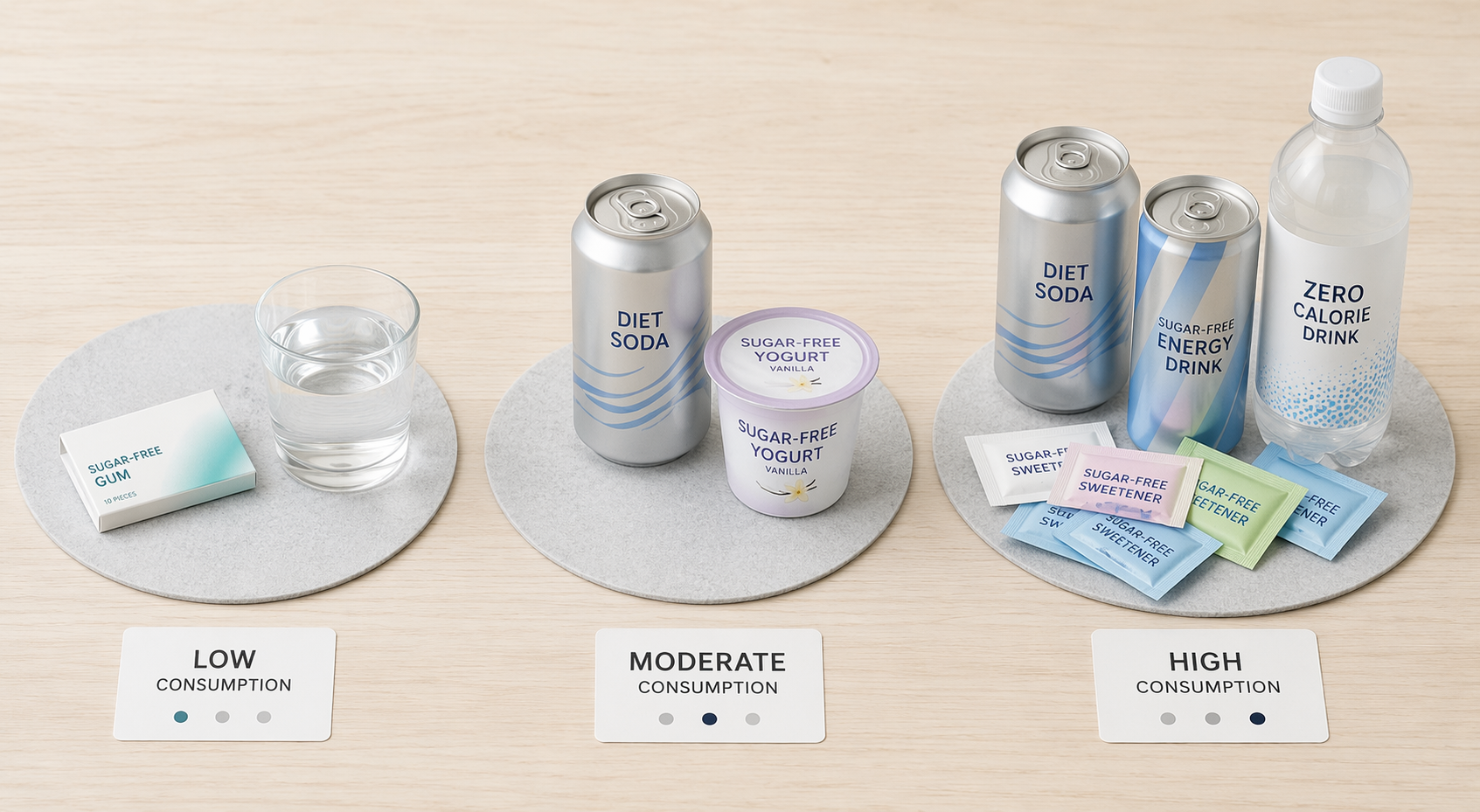
The study also cannot cleanly separate one sweetener from another. People who consume one low-calorie sweetener often consume others too. So it would be too neat to say, for example, that one specific can ingredient is the villain while every other sweetener gets cleared.
What the Study Does Not Prove
The biggest caveat is causation. This was an observational study with no randomization. Higher sweetener intake may travel with other health, diet, metabolic, or lifestyle factors that also affect cognition. The researchers adjusted for many factors, but adjustment is not magic.
Diet was measured at baseline using 2008 food-frequency data from Brazil.[1] That creates two limits at once: people may have changed what they consumed during follow-up, and current U.S. student intake may not match the intake patterns in this cohort. A student who drinks one sugar-free energy drink during finals week is not the same exposure story as someone with a daily multi-product sweetener routine.
The study did not include brain imaging, so it cannot say whether structural brain changes explain the test differences. It also did not test mechanisms directly. Ideas such as neuroinflammation, gut microbiome disruption, and vascular dysfunction come from animal, cell, and related biomedical research, not from direct evidence inside this cohort.[5]
The diabetes subgroup deserves care too. The associations were stronger among participants with diabetes, and people with diabetes may consume more artificial sweeteners.[1][2] That does not mean the study proves sweeteners are uniquely dangerous for every person with diabetes; it means the signal was stronger in a group with different baseline health risks and likely different consumption patterns.
The Industry Response Is Predictable, but Not Irrelevant
Industry groups, including the International Sweeteners Association, the Calorie Control Council, and the British Soft Drinks Association, pushed back by emphasizing the observational design and noting that approved sweeteners have been reviewed by authorities such as the FDA and EFSA.[6][7]
That response is partly fair and partly incomplete. Yes, an observational study should not be treated as a causation machine. Also yes, regulatory approval for safety within accepted intake limits does not answer every long-term question about cognition, combinations of sweeteners, or real-world daily patterns. Approval is not the same as proof of cognitive benefit, and one cohort study is not a ban notice.
So What Should Students Do Now?
The practical move is moderation, not a dramatic purge. If your intake is occasional, this study is not a reason to panic. If your default study setup is a diet soda at lunch, a sugar-free energy drink before lab, gum all afternoon, and a protein bar because it says “zero sugar,” then the study gives you a decent reason to reduce the daily stack.
- Swap one daily diet soda or sugar-free energy drink for water, sparkling water, coffee, or unsweetened tea.
- Keep the caffeine if that is what you actually need; reduce the sweetener exposure if sweetness is just along for the ride.
- Check whether “zero sugar” snacks are adding sugar alcohols across the day, especially gum, bars, and keto-style products.
- Avoid replacing every artificially sweetened drink with a high-sugar drink; that creates a different nutrition problem.
- If you have diabetes or another metabolic condition, treat this as a conversation starter with a clinician rather than a reason to improvise.
A realistic student version of caution is boring in the best way: fewer daily sweetened drinks when it is easy, less automatic gum-and-can stacking, and no need to make studying feel like punishment. The 2025 Neurology paper is a real signal worth watching. It is not a verdict on every sweetener, every person, or every exam-week drink.
References
- Low- and No-Calorie Sweeteners and Cognitive Decline: The ELSA-Brasil Study, Neurology, 2025
- Artificial Sweeteners Tied to Faster Cognitive Decline in Adults Under 60, MedPage Today
- Artificial Sweeteners Linked to Faster Cognitive Decline in Midlife Adults, Practical Neurology
- Six Artificial Sweeteners Linked to Faster Decline in Thinking and Memory Skills, American Academy of Neurology
- Are Artificial Sweeteners Bad for the Brain?, Cognitive Vitality / Alzheimer's Drug Discovery Foundation
- Artificial Sweeteners May Speed Cognitive Decline, Study Finds, CNN
- Sweeteners Can Harm Cognitive Health Equivalent to 1.6 Years of Ageing, Study Finds, The Guardian
Back to the exam this applies to
Target exam not specified — see all exam hubs.
Comments
Join the discussion with an anonymous comment.